The Hive Is Its People
Architecture, Bondage, and Harvest in Dan Abnett’s HIVE
[WARNING: SPOILERS APLENTY]
On first reading, HIVE feels like sprawl. This is by design. On second reading, the sprawl becomes visible as architecture.
That may be the most useful way to approach Dan Abnett's latest Warhammer 40,000 behemoth. It is not quite a review, though a positive judgment is embedded in the argument. A review would ask whether the novel is good, whether it rewards the reader's time, whether the ending satisfies, whether the many viewpoint characters cohere. Those questions matter, but HIVE is more interesting when treated as a built thing: structural, political, linguistic, administrative, and — to coin an ugly but useful word — populational. A hive city is not merely a city containing people. It is a city made out of population as a material. People are the load, the column, the circulating fluid, the fuel, the record, the residue, the pressure, and eventually the meal.
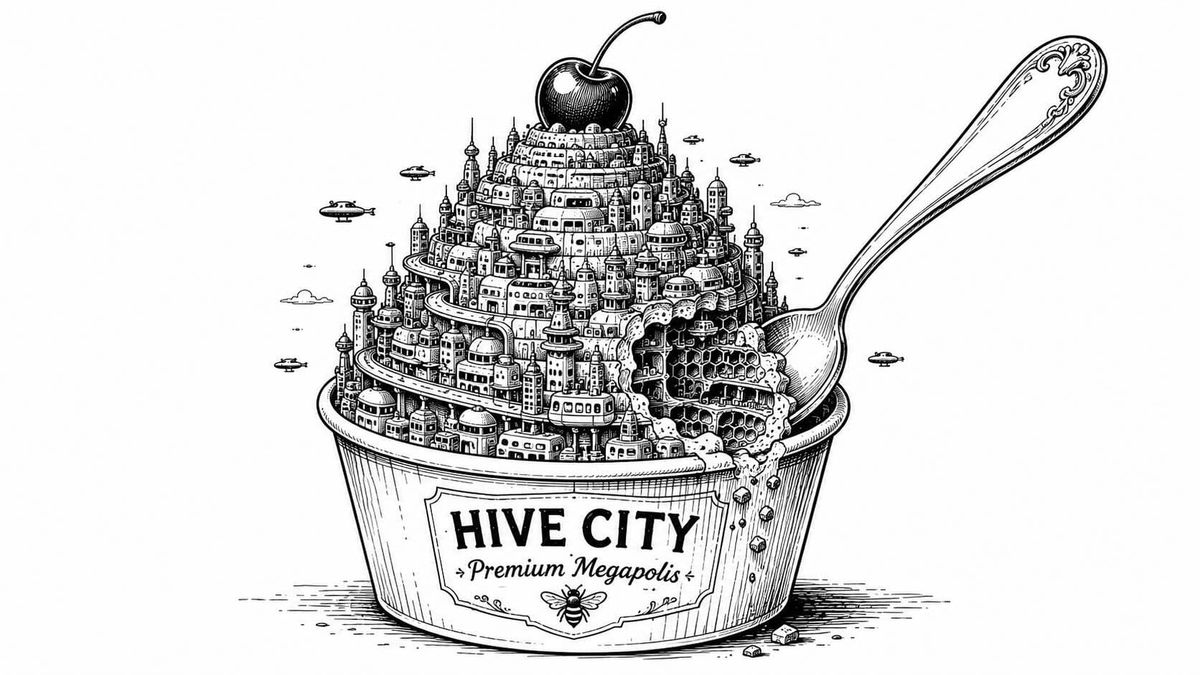
The title is almost rude in retrospect. HIVE. There it is, on the label of the tin. The first meaning is obvious: Sacramentus, the great hive city, "the whole of the world" to those who live inside it. The second meaning waits in plain sight, not hidden so much as deferred. This is a Warhammer 40,000 novel. We know, or think we know, what hives are. We also know, or think we know, what the Hive Mind is. The novel's trick is not concealment in the cheap sense. It is reclassification. On first reading, Sacramentus is a city under pressure. On second reading, Sacramentus is food learning, too late, that it's been the main course for years.
Abnett's other large-scale works often begin with a dramatis personae. He knows how useful a cast list can be when the machinery gets large enough. Such lists are almost a user interface: names, factions, ranks, affiliations, sufficient handles for the reader to operate the epic. HIVE refuses that interface. At first, this can feel overwhelming. The opening movement inundates the reader in a torrent of names: Cherish Palgrave, Burri Bornalon, Szen Kaidemueller, Martan Dolomae, Uthan Fenn, Lotar Sahid, Annjanu Naysay, Carcy Hynze, Moler, Scuti, and others in a sequence that sets the threads and fuses. The reader hops from one viewpoint to another like navigating lily pads in a fogged-over pond.
This has a cost. The first reading can feel overpopulated because it is overpopulated. The method asks the reader to move through the crowd before the crowd has become legible. It is a gamble, and not every reader will want to pay that toll. Design does not cancel friction. A staircase may be the only way to get upstairs, and still be exhausting. But the difference between the first and second reading is not that confusion becomes magically pleasant. It is that the crowd is revealed not as surplus cast but as civic mass, which is precisely what the novel has been asking us to understand.
On rereading, the apparent sprawl sharpens. The characters are not simply "a large cast." They are load points. Cherish is labor moving upward from the Neg – the Hive's buried underworld – into the visible civic body. Bornalon is the highskin and the false outside beneath glass. Szen is informal violence, gang succession, and the memory of Astra Militarum technique brought home. Dolomae is record, inscription, and the official production of history. Uthan is labor discipline made physiological, the body as early warning system. Sahid and Naysay are military memory, the war outside, and the unbearable fact of having gone Without and returned. Carcy is class pressure, guild politics, and the burn waiting to happen. Moler is local knowledge in a coat. Scuti is Imperial authority, not omniscient but privileged by access.
The absence of a dramatis personae is therefore not an omission. It is a method. Sacramentus does not know itself in clean lists. Its inhabitants know their work, route, zontal, vertic, shift, bond, superior, grievance, district prejudice, and inherited phrases. Their society is compartmentalized not only by ignorance but by design. The reader is made to enter the Hive the way its citizens live inside it: locally, occupationally, by partial vocabulary and local maps. The first reading presents Sacramentus's epistemology. The second reading becomes the thing the Hive itself does not possess: a cross-section.
Abnett states the conceit plainly in his afterword. The novel is "almost exclusively not talking about what it's really about." It takes a high-profile 40K phenomenon and writes it from the point of view of characters who do not know what it is and have "never read the relevant codex." That phrase is funny because it describes the great privilege of the 40K reader. We know more than the citizens or even their rulers do. We know the setting's monsters by silhouette. We hear a few wrong sounds and start checking the vents. But HIVE complicates that advantage. Lore knowledge gives the reader suspicion, not mastery. There is no single character inside the story authorized to explain the whole thing. Everything must be inferred from symptoms, small visible details, social tremors, and the pressure changes of a sealed world.
The result is a novel about ignorance, but not stupidity. The people of Sacramentus are not fools. They are skilled, observant, brave, venal, loyal, exhausted, prejudiced, competent, petty, and often quite funny. They know many things, but they do not know the scale on which their knowledge is inadequate. This is one of the most Imperial things about the book. The Imperium's genius, if such a word can be used for a civilization this monstrous, is that it can function through compartmentalized ignorance. Most people do not need to know the galaxy. They need to know where to stand, when to toil, who to obey, what to fear, and what words to say when the light is still good.
That last point matters because Abnett's local language is not ornament. "Plenty be your light" sounds, on first encounter, like a neighborly blessing filtered through a workhouse religion. Its usual response, "May your light last," seems merely quaint until light has become class privilege, environmental infrastructure, civic luck, metaphysical hope, and finally catastrophe. "Walk you now," said at the Skirt Lock, is not just a sentence of exile. It is a ritual reduction of personhood to motion: leave the world, because you are no longer of it. The Hive's language is small enough to pass between carters, clerks, reeves, and toilbonds, but it carries law, theology, class, and fear in the same mouthful.
Sacramentus has an entire taxonomy for outside. There is the Without: the exterior beyond the Hive skin, imagined as death, exile, and unpersoning. There is Without Away: the realm from which Imperial agents, Arbites, governors, decrees, and wars arrive. And then there is the Throne Without: Terra, the Emperor, the source of authority not merely elsewhere but beyond the Hive's world-picture. The phrasing is beautiful because it is provincial and metaphysical at once. To a citizen of Sacramentus, outside cannot be merely geography. The Hive is the world. Therefore what lies beyond it must be another order of reality.
This is why the novel's opening punishment is so effective. Galter Stike is not simply expelled from the city. His ear-peg is cut away; his bond is severed. He is made Without. The horror is not "you must go outdoors." It is "you are no longer a person within the only structure that defines personhood." Stike fears the barren light, the lack of food, water, hood, shelter, or heat, but more than that he fears the conceptual void. Without the Hive, he is not merely unsafe. He is nothing.
That word — bond — is one of the book's all-purpose joints. Abnett uses it as legal status, labor category, social adhesive, military memory, and shackle. Citizens are bonded to the Hive. Workers are toilbonds. Soldiers are warbonds. Representatives are Guildbonds. The phrase "bonded citizen" sounds almost honorable until the servitude under it begins to show. A bond is belonging, obligation, identity, employment, love, memory, and bondage. It holds society together because it holds people in place.
Sahid and Naysay's old platoon reunion shows the sentimental side of this. Garnet Platoon still gathers years after the war because the warbond persists. They have aged into different classes and institutions; they disagree, resent, remember, drink, joke, and fail one another. Yet the bond remains. Sahid's insistence that they have a bond is not merely nostalgia. It is one of the few truthful forms of continuity in a society otherwise built from coercive continuity. Naysay, however, understands the bond differently. Their deepest bond is not simply that they fought together. It is that they went Without and lived to tell the tale. They crossed the category boundary that everyone else fears.
Naysay may be the novel's quiet hinge. She is scarred, partially withdrawn, difficult to read, and easy to treat as one more member of the large ensemble. But she carries a knowledge almost no one else has: the Hive is not the whole of reality. This does not make her liberated, exactly. It makes her less protected by the lie. She has already survived the fact that Sacramentus treats as impossible. She has seen that Without is not nonexistence, even if it is horror, distance, exposure, and war. She is therefore not outside fear because she is brave in some simple heroic sense. She is outside the specific fear that organizes the Hive's interior life.
Her final movement into the outside reframes the opening punishment. The parallel is almost formal: the Skirt Lock, the hurting light, the step across the lip, the same movement into the last hour of mortal life. But what was terror for Stike becomes, for Naysay, something closer to release. Not victory, not salvation, but clear sight. She can say "Plenty be your light" into a world where the phrase has become unbearable. She can walk out because the Hive's deepest superstition has collapsed behind her. Inside was never safety. It was only deferred consumption with paperwork.
If "bond" is the adhesive, class is the framework. Sacramentus is vertical class made literal. Neg, Low, Waistland, Overmost, highskin, Skirt, Cauldron, Scriptorum, Rampart: these are not just locations on a map. They are social positions, bodily conditions, air qualities, light allotments, administrative jurisdictions, and epistemic limits. Where one lives determines what one breathes, what one sees, what words one uses, what authorities one recognizes, how one imagines danger, and how far one can conceive the world extending.
Politics in HIVE is therefore not an added theme. It is the central column. The Hive is a managed pressure vessel. The Guild, ORPO, reeves, gangs, Administratum, Arbites, HiveDef, ruling houses, and incoming Domne are all pressure systems. Some record pressure. Some vent it. Some punish it. Some steal from it. Some misread it as criminality, sedition, heresy, or mere unrest. Everyone can feel that a burn is coming, but not everyone means the same thing by "burn."
The Scriptorum gives this dynamic its most elegant self-image. Rubrus Sacramentalis, the Hive's prized ink, is made from waste products, mineral spoil, alchemical leftovers, agricultural compounds, animal collagen, and other remnants. Refuse becomes the substance in which official history is written. The master's civic analogy is explicit: the bonded citizens of all walks and ways, individually nothing, mixed together into "a mighty thing," a world complete. Dolomae answers with the phrase the whole novel keeps testing: "The Hive is its people." The full poetic correction — "the Hive entire is only its people" — is called a subtle distinction, but the distinction is not subtle at all. It is the book's foundation and its indictment.
The Imperium, meanwhile, is curiously surface-level. This may sound strange in a Warhammer 40,000 novel, but Sacramentus experiences the Imperium less as daily governance than as weather from beyond the world. The Arbites arrive and conduct what amounts to a root canal on the ruling houses. Orbiton is removed. Heads roll, literally and politically. Statues are revised. A new Domne is sent from Without Away. Yet the Arbites do not remake the Hive from first principles. They cannot. You do not decapitate a hive and expect it not to topple. The ruling families are punished but not wholly eradicated, because the Imperium is brutal but also conservative. Stability matters more than justice. Continuity matters more than cleansing.
And as the Scriptorum scene makes plain, "the Hive is its people" can sound humane, almost redemptive. It is also a trap. If the Hive is its people, then infection of the people is infection of the Hive. If the Hive survives through bonds, then the corruption of bonds is more dangerous than the corruption of institutions. This is where the Genestealer cult's horror becomes especially precise. It does not invent loyalty from nothing. It parasitizes the Hive's existing grammar of belonging. Family, work, grievance, secrecy, class resentment, old symbols, local prejudices, pressure, and hope: all become conduits.
The novel's misdirection around the Circle is one of its sharper structural pleasures. The apparent Slaaneshi or diabol cult looks like the "real" corruption because 40K has trained us to recognize such things. Purple, masks, decadence, old elites, ritual chamber, occult language, and the stink of cabalistic self-importance all point toward a familiar answer. The Circle is not fake. It is dangerous, corrupt, and real enough to kill for. But it is not the primary infection. It is a human-sized conspiracy with human-sized vanity, and the colder biological conspiracy outcompetes it.
That competition is not only martial. It is systemic. The Circle traffics in secrecy, initiation, elite transgression, and symbolic possession. It wants the glamour of being hidden and chosen. The Genestealer cult works through reproduction, kinship, grievance, misdirection, and mass infiltration. One conspiracy wants to stand above the Hive and manipulate it. The other gets inside the Hive's family structure, labor structure, and pressure structure until the distinction between civic unrest and invasion preparation has become difficult to draw. The Circle plays with forbidden meaning. The cult converts meaning into logistics.
This is important because HIVE is not a puzzle box with one false clue and one true solution. It is an ecosystem of decay. The Guild's unrest is real. The ruling class's corruption is real. The Circle's heresy is real. Gang violence is real. Administrative blindness is real. Imperial high-handedness is real. The Genestealer cult does not erase those problems; it uses them. It thrives because Sacramentus is already overpressurized, already compartmentalized, already trained to mistake local symptoms for the whole disease.
This is the "lily pad effect" in narrative form. Each viewpoint is a local surface. Each thread burns at its own rate. Labor revolt, statue revision, gang succession, bodily sickness, political transition, investigation, military memory, cult practice, and class grievance all seem to be moving under their own power. Gradually they intersect. Pressure builds. Then, when the Tyranid reality becomes undeniable, it feels as if the pond were overwhelmed overnight.
But that feeling belongs to the characters, and perhaps to the reader's first pass.
The Genestealer cult has been at work for years. The Hive has not been suddenly attacked from outside; it has been prepared for harvest from within. The cult functions less like an invading army than a long digestive process. It softens institutions, redirects grievances, confuses symbols, rewires kinship, manufactures false explanations, and turns the Hive's own bonds into invasion infrastructure. It is, in the end, an interface layer: translating human bonds into Tyranid utility. By the time the cosmic predator is visible, the local society has already been pre-chewed.
This is why HIVE feels like a mature expression of Abnett's Warhammer method. His great contribution to 40K has never been only plot. It is vernacular. Vox, slab, recaff, earbead, operational chatter, pseudo-Latin bureaucracy, military competence under absurd conditions — whether he invented every term is beside the point. He made the Imperium speak habitable language. He turned lore into usage. In HIVE, that gift becomes the engine of the novel. Local words are not decoration. They are structural beams. Without, bond, light, burn, circle, zontal, vertic, Skirt, Neg, plenty be: the glossary is the detonator.
Abnett's strength is abundance. He does not merely sketch the city and gesture toward unseen depth. He builds the temple, the annex, the service corridor, the archive, the clerk's desk, the supply forms, and the exhausted person responsible for repairing the lightwell. He solves scale by accumulation. If the target has been sighted in the southeast quadrant, eliminate the entire quadrant. The danger is mass; the reward is texture. At his best, he makes the setting feel large not by invoking primarchs or god-engines, but by showing how many ordinary systems must continue functioning for the nightmare to remain possible.
That is what HIVE does. It makes 40K feel large again by refusing the obvious icons. Space Marines are not the point. The Adepta are mostly offstage. Even the Arbites, terrifying as they are, do not possess the full truth. The novel's grandeur is not transhuman. It is civic. It asks what a hive city is when treated not as backdrop or statistic, but as a civilization with language, class, memory, pressure, and self-deception.
The answer is architecture. A hive city is built from stone, metal, glass, vents, shafts, locks, lightwells, habicules, transit routes, manufactoria, and administrative chambers. But it is also built from people: bonded people, classified people, recorded people, expendable people, people who have never seen the outside and people who have seen too much of it. The Hive is its people. That is its human dignity and its fatal vulnerability.
By the end, the double meaning of the title has closed. Sacramentus was a hive because it contained multitudes. It was a hive because it was stratified, industrious, compartmentalized, and self-sustaining. It was a hive because each citizen was a tiny life moving through a greater organism. And it was a hive because, in the scale of the Tyranid appetite, all of that structure amounted to biomass arranged in interesting patterns.
Man proposes. The Hive Mind deposes.