Reading the Surfaces
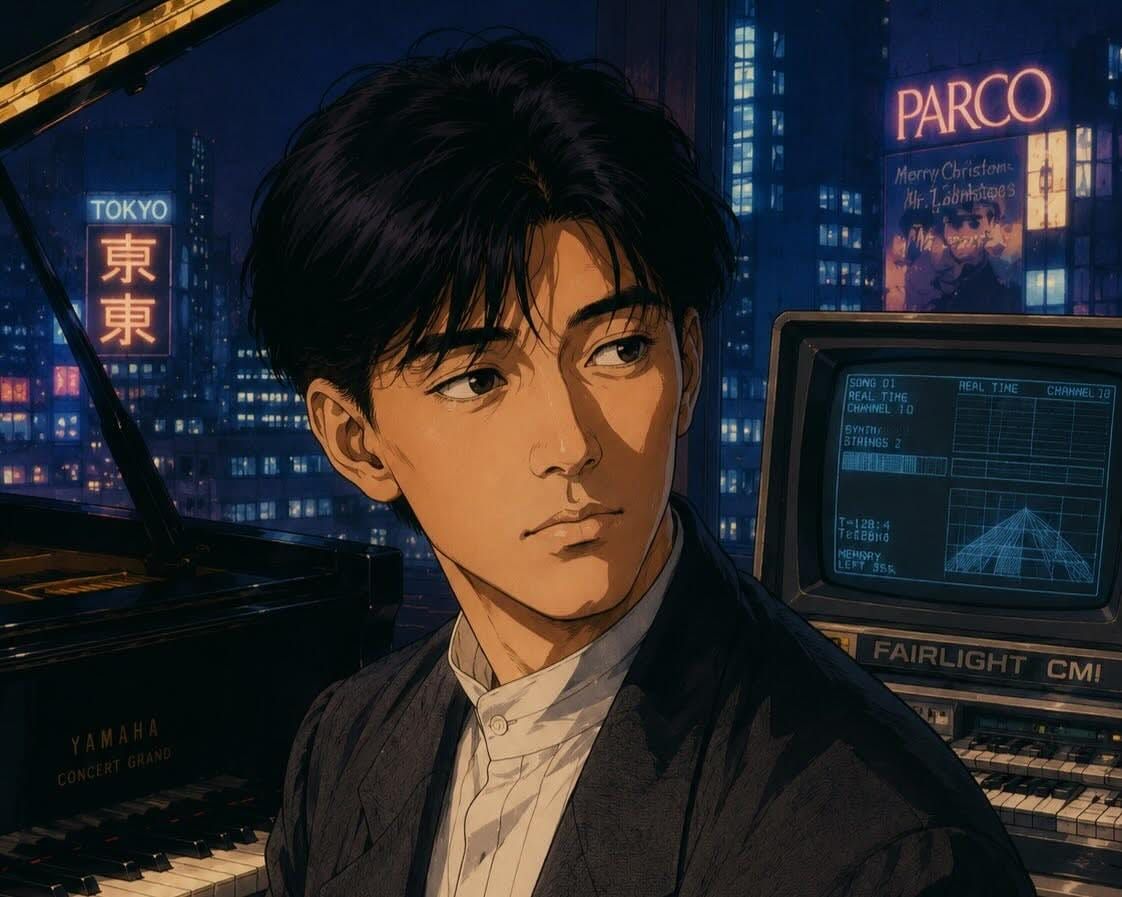
Tokyo Melody and the Politics of Legibility
Tokyo Melody: A Film about Ryuichi Sakamoto (1985) is both a portrait of a musician and a document of 1980s Tokyo, but its deeper subject is legibility itself — the conditions under which a person, a city, a nation, and finally a film become readable, partially readable, or permanently opaque depending on who is looking, through what apparatus, and from which historical position.
By 1985, Ryuichi Sakamoto was already legible inside Japan. Yellow Magic Orchestra had already happened. Merry Christmas, Mr. Lawrence had already happened. His face appeared on the giant commercial screens he would walk past during filming. He was, within the Japanese media ecology, a finished surface: recognizable, packaged, reflected back at himself.
What director Elizabeth Lennard's film produces is a different kind of legibility — outward-facing, export-formatted, calibrated for Western art-documentary and international festival circuits. The apparatus through which this focus is constructed is worth naming precisely: a French public broadcasting institution (INA), a seven-day shooting window, a director who does not speak Japanese, an interpreter whose voice leaks audibly into the Fairlight synthesizer sequence, a 16mm format whose grain and partiality become part of the film's texture. None of this is incidental. Each element bends what could be seen, how long it could be held, and which of Sakamoto's self-presentations would survive the translation.
The film's Sakamoto is articulate, self-aware, philosophically fluent about technology and time, genuinely curious, and positioned at the intersection of tradition, pop commerce, and electronic futurity. That is a coherent and exportable figure. It is also a figure produced by a specific encounter under specific constraints — not a discovered truth about Sakamoto, but a legibility constructed between him and a French filmmaker working through the limit of her own comprehension.
That Sakamoto seems entirely comfortable within this construction, that he appears to collaborate in his own rendering, is part of what makes him so readable. He already understands that being legible to outside eyes requires a particular kind of performance. He has been doing it for years.
The film makes Tokyo legible through surfaces: electronics superstores, danchi apartment towers with safety nets across their interior cavities, pachinko arcades, a proto-Jumbotron playing YMO concert footage downtown, trains, street festivals, rockabilly dancers in Yoyogi Park, Casio keyboards in shop windows, the Fairlight CMI in a recording studio. These surfaces are arranged, not decoded. Lennard does not explain them; she sequences them against Sakamoto's music and studio work until they start to feel like a single system.
The legibility this produces is of a specific kind: Tokyo as technocapitalist laboratory, Japan as if it had solved something the West was still fumbling with. In 1985, this was a broadly held Western projection, and Sakamoto himself voices a version of it — Japan as "leading capitalist nation," a place of cultural hunger operating at industrial velocity. The film does not interrogate that projection; it inherits it, and in doing so, makes it visible as the organizing fantasy of its own gaze.
What the film cannot read, and does not pretend to read, is the social firmware beneath those surfaces. The pachinko patrons are visible; their inner lives — the loneliness, the routine, the small gambling economy, the after-work decompression — remain inaccessible. The rockabilly dancers are visible as a striking image, but the film does not decode whether they represent youth rebellion, cultural appropriation, tradition-making under mass media, or simply recreation. The copywriters at the top of the hill, whom Sakamoto mentions in passing, are fascinating precisely because their craft — compressing language into stickiness, making phrases portable and repeatable — anticipates what algorithmic engagement culture would industrialize four decades later. But in 1985, one couldn’t begin to extrapolate that trajectory. It remains a data point rather than a thesis.
This is not a failure. The surfaces do not conceal a single hidden truth; they mark the point at which the film's readability reaches its edge. An outsider with a seven-day shooting window and an interpreter between herself and the city is not in a position to decode Japan. What she can do — what Lennard does — is arrange the surfaces into a field of partial readability and let the gaps remain gaps. Tokyo in Tokyo Melody is legible enough to suggest a world, and opaque enough to resist becoming a theory about one.
Lennard is credited, and her name appears on the film. But in most reception — including a recent extended conversation of the documentary that ranged across Japan's economic history, the Fairlight CMI's price history, YMO's cultural ambiguity, and the archaeology of Tokyo's attention economy — she was treated as neutral infrastructure. Sakamoto was the subject. Tokyo was the subject. The legibility of 1985 Japan as capitalist futurity was the subject. Lennard was the transparent medium through which those subjects became visible.
This is what successful infrastructure does. It disappears. The sociologist Susan Leigh Star observed that infrastructure becomes visible primarily at the moment of breakdown. Lennard's filmmaking did not break down. It worked: the film coheres, it has screened for four decades, it has been incorporated into later Sakamoto documentaries as authoritative archival footage, and it is receiving a 4K restoration in 2026. Because it worked, it receded. What remained visible was the subject.
But the filmmaker's choices are not neutral. The decision to use a nonlinear, associative structure is not only a philosophical position about music and time — it is also a pragmatic response to the constraint of limited footage, in a language the director cannot follow, in a city she cannot fully read. The constraint became method; the method became aesthetic; the aesthetic was credited to the film rather than to the conditions that produced it. That is the disappearing act that successful craft performs.
Lennard's filmmaking becomes legible only when that act is reversed — when the apparatus is treated as authored rather than transparent. The interpreter's audible voice in the Fairlight scene is a small crack in the surface. The "hands-off" structure is a large one, if examined as a response to constraint rather than a pure expression of artistic preference. The exterior gaze, the French institution behind the camera, the physical print traveling to São Paulo and returning with frames stolen as souvenirs — these are all the texture of a specific production under specific pressures. They are not incidental to what the film is. They are part of what the film is.
Tokyo Melody is not a stable object. It is a signal that has passed through multiple transmission systems, each of which introduced noise and removed information while enough structure survived each transfer to remain recognizable.
The 1985 print and the 2026 4K restoration are related but not identical objects. Between them: VHS and DVD releases in Japan, digitized excerpts in the 2017 documentary Coda, broadcast on France 3 and NHK, decades of sporadic screenings, a 16mm print with frames missing since São Paulo, a 4K scan of the original negative that adds resolution the original format did not possess. The "restoration" is a particular kind of paradox: it recovers what survives while changing the material state of the object being recovered. The film gains archival stability and loses whatever the stolen frames contained. It is more present and differently absent than before.
This material afterlife is not merely an interesting footnote. It rhymes with the film's own subject matter. Sakamoto in Tokyo Melody is preoccupied with exactly these questions: what it means to sample and loop recorded material, whether the copy has the same standing as the source, what nonlinear time means for musical composition. The Fairlight CMI — a machine that can load the sound of any instrument from a floppy disk, render it visually, loop and recontextualize it — is the film's central technological image precisely because it literalizes those questions. A document about the partial readability of copies has itself become a copy in multiple states, readable differently depending on which version, which screening, and which historical position you bring to it.
The 1985 Rotterdam viewer encounters a present-tense document: Japan is this, Sakamoto is doing this, the Fairlight is new. The 1996 Tokyo viewer, seeing the film alongside Chris Marker's 1965 documentary in a double bill explicitly titled "Tokyo Timeslip," encounters it as recent history. The 2026 viewer encounters it across the unbridgeable context of Sakamoto's subsequent career, his 2023 death, the long aftermath of Japan's asset bubble, and a technological landscape in which the Fairlight's conceptual model lives as a laptop plugin. The photographed frame is fixed. The interpretive apparatus around it is not. What any given viewer can read depends less on what the film shows than on where and when they are sitting.
A film about legibility cannot claim to have made everything legible. What Tokyo Melody shows — Sakamoto moving through a city generating culture and infrastructure at industrial velocity, half-inside and half-outside the machinery he is simultaneously composing for and critiquing — is organized into coherence by a filmmaker whose own organizing presence was successfully rendered transparent. The surfaces of Tokyo expose and withhold simultaneously. The social firmware beneath them remains partially inaccessible, as it would to any exterior gaze working under any constraint.
That remainder is not the film's failure. A document that acknowledged its own limits in 1985 has those limits confirmed and extended by everything that has happened to it since: the missing frames, the format migrations, the restored version, the forty years of reception that kept treating the apparatus as invisible. The film begins by making Sakamoto readable through Tokyo. It ends — if it ends anywhere — by becoming a partially readable object itself, legible differently across time, stable enough to persist and unstable enough to keep changing.
What remains permanently unreadable is not a failure of the film but its most honest feature.