Les Arrondissements: Internal Memorandum
BUREAU DE LA QUIÉTUDE MUNICIPALE
Internal Memorandum
Classification: Routine (Annotated)
Distribution: Clerical / Field / Unassigned Review
Reference: QO-17.3 — “Pattern Persistence and Resident Drift”
To: All personnel assigned to nonstandard civic phenomena
From: Office of Procedural Continuity (Window 4)
Re: Clarifications regarding recurring anomalies, resident interpretation, and appropriate administrative posture
1. On the Status of the City
Paris remains in good working order.
All major systems are operational:
- postal delivery (within acceptable variance)
- address recognition (subject to periodic reassignment)
- resident identification (stable under routine conditions)
Reports describing the city as “unstable,” “incorrect,” or “in flux” are to be understood as interpretive rather than structural.
The city is not malfunctioning.
It is recording.
2. On the Substrate (Terminology Advisory)
Personnel are reminded that the terms:
- les courants
- les échos
- la mémoire vive
are informal descriptors and should not appear in official documentation except when quoting resident language.
For filing purposes, all such phenomena are to be categorized under:
“Accumulated Pattern Retention (APR),”
defined as:
The persistence of repeated civic behaviors within infrastructural media, producing observable continuity independent of originating residents.
Further explanation is not required for processing.
3. On Persistants
Persistants are not to be classified as:
- entities
- intrusions
- hazards
They are to be understood as:
“Continuity Artifacts”
that perform previously established routines at a level sufficient to maintain local stability.
Examples include, but are not limited to:
- courtyard maintenance
- beverage ordering
- document processing
Removal is not recommended unless the routine interferes with current municipal function.
In most cases, reassignment or accommodation is sufficient.
(See Form 8-C: Temporary Role Regularization.)
4. On Geographic Variance
Reports of:
- arrondissement renumbering
- stairwell extension or contraction
- spontaneous business presence
are to be categorized as:
“Topological Adjustment Events (TAE)”
These events are not errors.
They represent alignment between recorded patterns and present conditions.
Personnel are advised to:
- confirm current signage before issuing directions
- avoid referencing prior configurations unless requested
- update forms only when discrepancies affect service delivery
Historical accuracy is not a requirement for operational clarity.
5. On Resident Coherence
Residents may experience variation in what is informally described as “Coherence.”
For administrative purposes, this corresponds to:
“Recognition Alignment (RA)”
High RA:
- resident is consistently identified across systems
- interactions proceed without hesitation
Low RA:
- identification requires verification
- delays or inconsistencies in service may occur
This is not a disciplinary matter.
It is an expected outcome of:
- prolonged anomaly exposure
- excessive pattern interrogation
- successful high-resolution observation
Personnel are advised to remain courteous.
Additional documentation may be requested as needed.
6. On Investigation Practices
Personnel are reminded:
The objective is not explanation.
The objective is continuity.
When encountering a nonstandard phenomenon:
- Observe
- Classify
- File
- Adjust locally
Resolution is not required.
Full system understanding is not expected and not necessary for effective service.
7. On Re-Entry (Post-Incident Reporting)
Following a disturbance, the city will incorporate events into its own record.
Personnel may note discrepancies between:
- observed events
- official accounts
These discrepancies are to be treated as:
“Acceptable Narrative Compression (ANC)”
Do not attempt to correct them unless they interfere with function.
Residents may express confusion.
Recommended response:
“Yes, it appears to have resolved.”
Further elaboration is discouraged.
8. On Insight (Controlled Use Advisory)
Certain personnel may report brief periods of heightened system legibility.
These are classified as:
“Acute Interpretive Events (AIE)”
Indicators include:
- unusually precise understanding of spatial or temporal conditions
- ability to anticipate system behavior beyond standard parameters
- reluctance to accept post-incident reporting
These events are:
- temporary
- non-transferable under normal conditions
- destabilizing if experienced simultaneously by multiple individuals
In rare cases, personnel may facilitate shared interpretation.
This should be done:
- sparingly
- deliberately
- with awareness of local conditions
No formal documentation exists for this process.
It is nevertheless recognized.
9. On Refusers
Individuals minimizing interaction with APR systems are to be classified as:
“Voluntary Low-Engagement Residents (VLER)”
They may:
- decline services
- avoid standard environments
- express concerns regarding long-term pattern influence
They are not to be corrected.
Their practices fall within acceptable variance.
Personnel should note:
VLERs often articulate system behaviors more directly than other residents.
This does not imply accuracy.
It does not imply inaccuracy.
10. On Professional Conduct
Personnel are expected to maintain:
- procedural consistency
- tonal neutrality
- operational focus
Avoid:
- speculation regarding system origin
- personal interpretation of large-scale behavior
- attempts to establish definitive explanations
Such efforts have not improved service outcomes.
11. Final Note
If you find that:
- doors hesitate
- names take longer to resolve
- conversations feel slightly misaligned
this is not cause for concern.
It indicates that you are observing at a higher resolution than required for your duties.
You may:
- continue
- or reduce engagement
Both are acceptable.
The city will accommodate either choice.
Filed by:
M. Gauthier-Prevost
Senior Clerk, Window 4
Stamp: VALID UNTIL RECLASSIFIED
Les Arrondissments, a setting for TiGGR (Tiny Game for Generalized Roleplaying) is available as a free download on hotelkilo.itch.io.
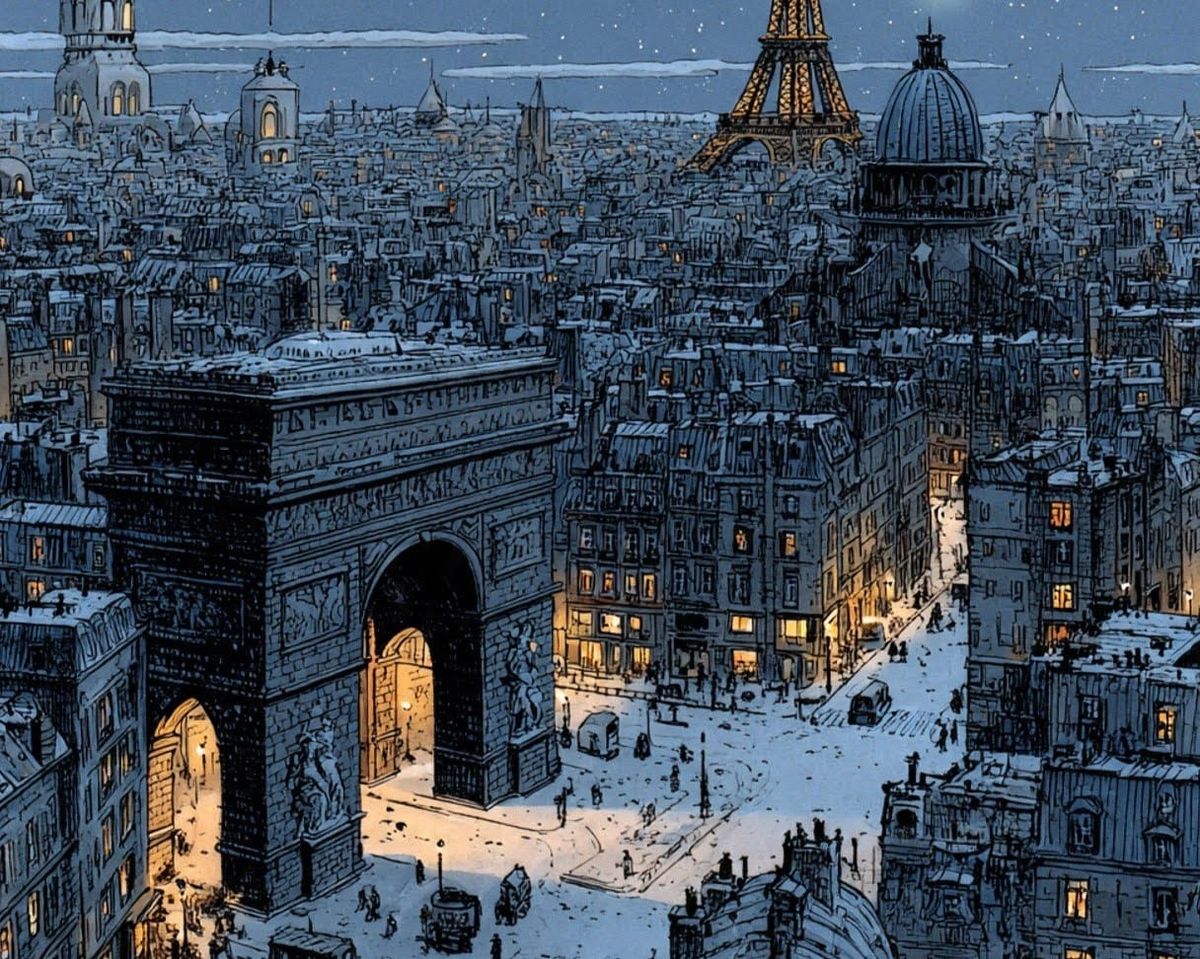
Image generated by intelliaigence.