Casino Royale, But Which Version?
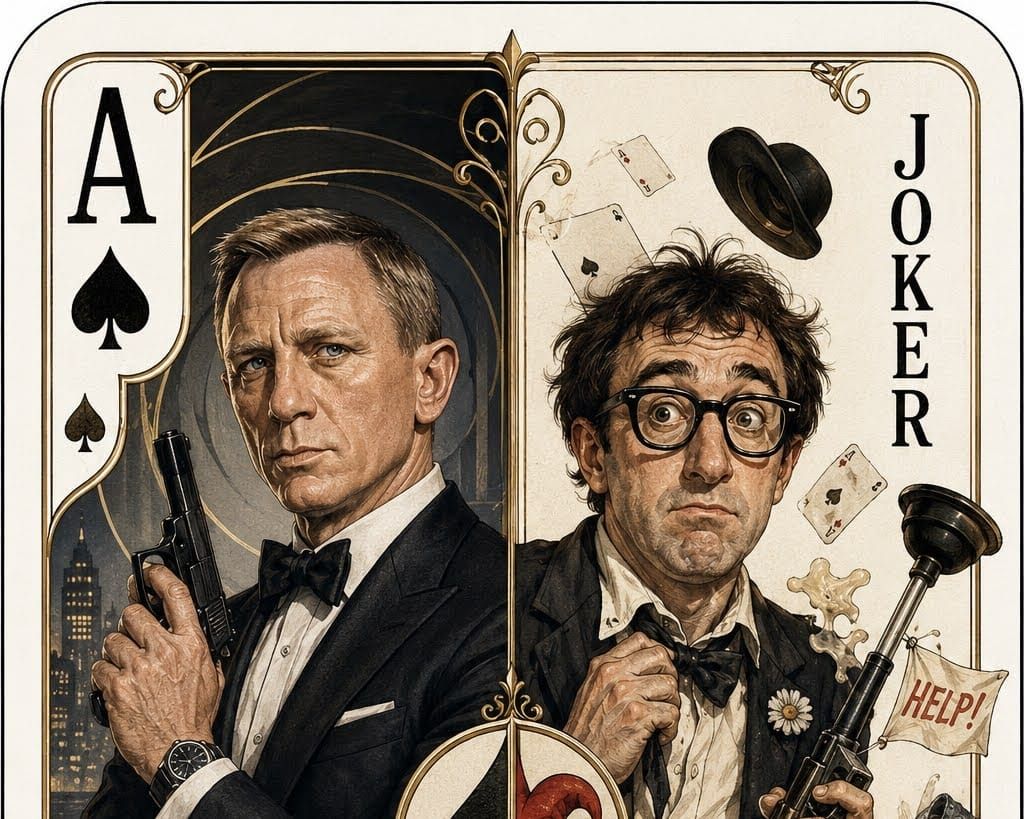
Will the Real James Bond Please Stand Up?
When companies talk about AI agents, they usually sound like they are pitching the Daniel Craig version of Casino Royale: disciplined, lethal, elegantly scoped, dangerous only to the right people. One agent, one mission, clear authority, decisive execution. The vendor demo is all tuxedo, suppressed pistol, and clean extraction.
The implementation, too often, looks more like the 1967 Casino Royale: multiple Bonds, unclear command structure, competing agendas, lavish set pieces, tonal confusion, and a final explosion that resolves nothing.
It's a distinction worth making. The problem is not that AI agents cannot do useful work. A good agent, applied to a bounded task with clear inputs, constraints, success criteria, and supervision, can be genuinely helpful. It can inspect a codebase, summarize a dependency chain, draft Terraform, chase a familiar class of build failure, generate monitor specifications from existing infrastructure, or turn operational fog into something closer to a plan. In that frame, the agent is not magic and not management. It is a junior analyst with perfect patience, alarming speed, uneven judgment, and a meter running.
Used that way, real work can happen. Tokens are not always burned in vain. Sometimes the smoke means the machine is doing something useful.
But the fantasy being sold is rarely “a useful bounded assistant operating inside a mature process.” The fantasy is Bond.
Because Bond "gets things done."
Organizations love that idea because organizations are full of things that are not getting done. Releases stall in ambiguous ownership. Incidents reveal undocumented dependencies. Monitoring exists without response models. Documentation lags reality. Everyone wants better runbooks, cleaner handoffs, clearer accountability, and fewer meetings where the real decision is deferred to a later meeting involving different people. Into this world arrives the AI agent, polished and plausible, promising motion.
But Bond only works because he is the sharp end of a bureaucracy. Behind the car, the watch, the passport, and the license to kill? We have M, Q Branch, the Foreign Office, legal cover, intelligence sharing, diplomatic cleanup, and decades of institutional scar tissue. The solo operative is not solo. He is an interface for a system.
An enterprise AI agent without that system is not Bond. It's some dude in a tuxedo causing international incidents.
This is the part the demos tend to skip. They show the agent identifying the problem, proposing the fix, opening the pull request, updating the ticket, maybe even writing the release note. They do not show the RACI. They do not show the argument over who owns the service after 5 p.m. They do not show the escalation path when the agent is wrong in a way that looks right. They do not show the meeting where someone has to put their name next to an obligation they will be expected to defend later.
And that, more than token burn or leaderboard games, may be the real boundary. AI can generate the document. It cannot create the commitment.
And that boundary matters because operationalization is not a text problem. A monitor is not an operational model. A runbook is not accountability. A dashboard is not a response plan. A RACI is not a table; it is a set of social commitments that have to be negotiated, signed up for, and defended when the alert fires at the wrong hour.
An agent can draft the RACI. It can format the RACI. It can infer the RACI from org charts, tickets, Slack messages, and the fossil record of previous incidents. It can generate a Confluence page called “RACI Alignment Proposal” in seconds. But until the people named in it agree to be named, the document is only fan fiction with columns.
This is where the 1967 version starts to appear. Not because the tools are useless, and not because everyone involved is naïve. The uncomfortable part is that the 1967 version does not keep getting greenlit because everyone mistakes Peter Sellers for Daniel Craig. Often enough, people in the room know exactly what they are looking at. The mission is vague. The authority model is unresolved. The use case is still being “discovered.” The cost controls are aspirational. The agent has no meaningful definition of done.
But naming that too plainly has a price.
The person who says the tuxedo does not fit becomes the obstacle to transformation, while the benefit of being right is delayed, diffuse, and likely attributed to someone else later. So the meeting proceeds. The pilot is extended. The leaderboard ships. The dashboard turns green. Belief is performed not because everyone is naïve, but because performing belief is locally rational.
This is how organizations end up protecting the wrong thing. The 1967 version gets the cold shoulder not simply because it is chaotic, but because it is anathema to the franchise itself. Vendors, consultants, executives, internal champions, and teams asked to demonstrate “AI transformation” all become stakeholders in Bond remaining Bond. To admit that the deployment more closely resembles a spoof than a thriller is to threaten the value of the underlying story.
The problem is not just overselling or naïveté. It is franchise maintenance. People may privately hold Joker cards while publicly discussing Ace-of-Spades strategy, because too much of the surrounding machinery depends on the tuxedo still fitting.
At that point, the organization is no longer evaluating the tool. It is protecting the genre.
The metric layer only makes this worse. A metric, a leaderboard, an incentive. What could possibly go wrong?
If the metric is AI usage, then “use AI” becomes the work. Not better code, clearer decisions, faster incident response, less toil, fewer defects, or more customer value. Just usage. Threads. Turns. Tokens. Streaks. A session-stat screen after a dungeon run, except the mana burn is real money and the boss may not even be in the instance.
This is not hypothetical. Anyone who played World of Warcraft learned this decades ago. The moment you publish a chart, people optimize for the chart. The priest spams group heals to top the healing meters. The DPS tunnels the boss and ignores the adds. The tank pulls extra mobs to look busy. Someone stands in avoidable damage because more incoming damage makes the healer numbers look heroic.
Meanwhile, the raid wipes.
The enterprise version is not much different.
“AI adoption is up.”
“Are we shipping better?”
“Adoption is up.”
“Are we reducing toil?”
“Adoption is up.”
“Are we sure people are not just overhealing the raid?”
“Please take that concern to the AI Center of Excellence.”
Usage metrics are not inherently useless. Healing meters were not useless either. They could tell you something, in context. But the number has to be subordinated to the encounter. Did the boss monster die? Did people survive? Did the gimmicky mechanics get handled? Did the team conserve resources? Did the strategy improve?
Without that context, you get one priest glowing on the chart while the floor is covered in dead rogues.
This is why agentic AI is especially dangerous when bolted onto incompatible processes. Older automation was usually deterministic. If your script punched you in the face, it punched you in the face the same way every time, which at least made the punch diagnosable. Agents introduce stochastic behavior into the loop. They may approach the same situation differently on different runs. When they fail, they may fail through a series of plausible-looking intermediate steps that require domain knowledge to unwind.
A failed shell command is honest in its brutality. An agent can misunderstand the mission, proceed anyway, generate artifacts, update tickets, consume budget, and look productive until someone with enough context notices that the plunger gun is waving a HELP flag.
Agents accelerate existing organizational reflexes. If your process occasionally punches itself in the face, the agent’s contribution may be increasing the punch rate.
This is simply an argument against pretending that agents remove the need for the boring machinery that makes work durable. In fact, the organizations best positioned to benefit from agents may be the ones least dazzled by them: the ones with documented processes, clean failure modes, understood dependencies, review checkpoints, budget limits, and a culture willing to stop a pilot when the use case is still foggy.
The others get Casino Royale, 1967.
Not malice. Not even necessarily stupidity. Just chaos wearing tuxedos and evening gowns.
The scene still opens in the casino. The music still swells. Someone still says “agent” and everyone nods at the word as if the genre has done the work. But the difference between the Ace and the Joker is not printed on the card. It emerges from the game being played, the rules being enforced, the players at the table, and whether anyone is willing to admit what they are actually holding.
The vendor deals you the Ace.
You find out later which card is actually in your hand.
Footnote: The author has yet to personally observe a high-functioning multi-agent deployment in an enterprise context. The existence of same is not disputed. Its distribution appears limited. Like Jessica 6 from Logan’s Run, he remains open to the possibility that Sanctuary exists. He merely notes that many current directions appear to lead instead toward a maniacal robot flash-freezing people alongside the plankton.