Transcendence Through Failure
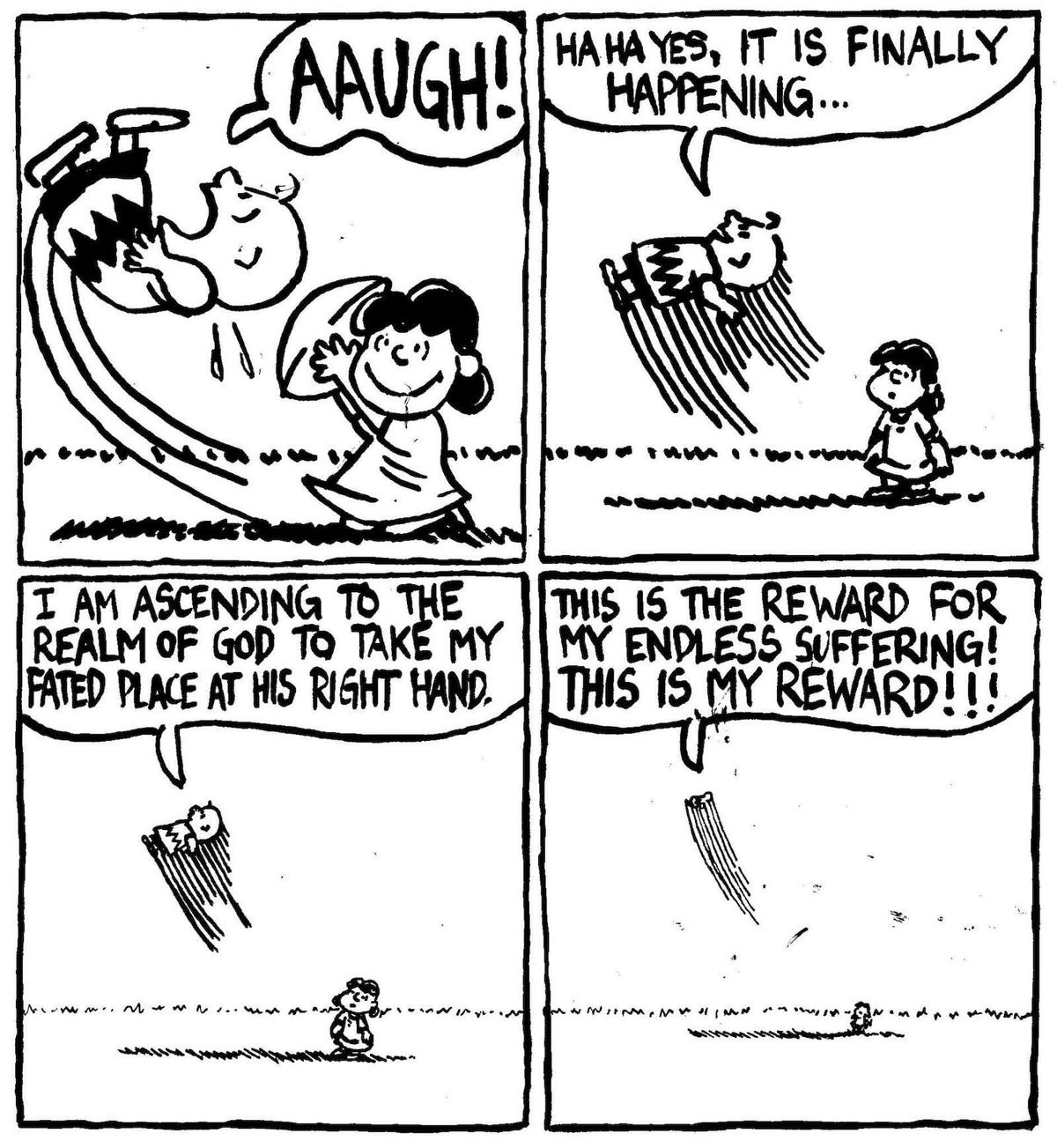
The Day Charlie Brown Kept Falling Up
It is hard not to over-read the Peanuts football gag, in which Lucy yanks the ball away just as Charlie Brown tries to kick it, and he keeps literally falling for it. That “round-headed kid,” as Snoopy calls his human, is Charles M. Schulz’s Sisyphus: the everyman who knows the game is rigged, yet keeps returning to it, again and again and again. And yet it is also just a cartoon — and a darned endearing one.
Douglas Adams, in Life, the Universe, and Everything, introduced the idea of flying by throwing yourself at the ground and missing. Arthur Dent, Adams’s interstellar Candide, does manage to miss the ground and remain aloft. At some point I wondered: what if Charlie Brown, bamboozled by Lucy one final time, did not hit the ground either? What if he just kept going?
The following comic answered that question, and then some.
The convergence works because it treats the football gag not as a one-off joke, but as a ritual. In Schulz’s original grammar, the sequence is almost liturgical. Lucy offers the football. Charlie Brown hesitates. Lucy reassures him. Charlie Brown persuades himself that this time might be different. Lucy pulls the ball away. Charlie Brown flies through the air, lands flat on his back, and the world quietly resets.
The premise did not require much invention. An internet commenter once noted that if you do not see the final panel of the football gag — the crash, the impact, the reset — Charlie Brown is not necessarily falling. He is simply continuing along the arc. Schulz had already drawn the beginning of Adams’s flight mechanic. The missing panel does the rest.
That is where Douglas Adams enters. In Life, the Universe, and Everything, Adams describes flight as the art of throwing yourself at the ground and missing. It is one of his perfect comic mechanisms: bodily failure, distraction, and accident converted into technique. Flying is not mastery. It is failed falling.
But when applied to Charlie Brown, the joke changes key. Arthur Dent misses the ground by accident. Charlie Brown misses it after seventy years of rehearsal.
That is the whole miracle. Charlie Brown does not merely fly. He ascends. Lucy’s pull, the gesture meant to complete his humiliation, becomes the mechanism of his release. The football is not kicked; the kick is not completed; the fall does not resolve. The system produces an unexpected output.
And the visual grammar matters. Charlie Brown keeps shrinking upward, panel by panel, while Lucy remains grounded, full-sized, and suddenly irrelevant to the motion she initiated. Heaven is not elsewhere. Heaven is simply what happens when the old trajectory continues past its expected endpoint. The direction was always there. Only the crash made it seem otherwise.
Lucy’s reaction is one of the best parts of the comic. At first she is delighted. She believes she is watching the familiar pattern unfold. She has pulled the ball away one more time, and Charlie Brown is about to become Charlie Brown again. But then he does not land. He recedes. He rises. Her certainty drains away into silence.
She expected repetition. She got consequence.
That makes Lucy, oddly, the more troubling figure. In this reading, she is not simply cruelty punished or prankster confounded. She is the unwilling instrument of grace. She performs the same act she has always performed, with the same intention, and this time it produces transcendence. Her small betrayal becomes sacramental without her consent.
And then she is left behind.
That may be the comic’s darker joke. Charlie Brown has been released from the cycle, but Lucy remains inside it. She is still on the ground, still holding the football, still occupying the role the universe has now used up. But if she pulls the ball away tomorrow, what happens? The ritual cannot simply resume, because the ritual required Charlie Brown’s willingness to return. Without him, there is no tragicomic hope to betray, no round-headed body arcing toward the inevitable impact, no reset. There is only Lucy, standing in a field, holding a football for someone who has finally escaped her jurisdiction.
Charlie Brown, for once, does not respond with bewilderment. He does not say, “Good grief!” He does not ask what is happening. He does not marvel at the clouds or the miracle of flight. Instead, he understands the event immediately in moral terms: “This is the reward for my endless suffering! This is my reward!!!”
That line is the whole theology.
Charlie Brown’s dignity has always come from persistence without triumph. He is not a conventional hero. He does not win through excellence, cunning, force, or transformation. He does not learn the correct lesson and finally outsmart Lucy. He simply keeps showing up, even though the pattern is obvious. His courage is repetitive. It is the courage of the person who knows the game is rigged and still cannot quite surrender the possibility that decency will be met by decency.
In this version, his failure, for one glorious moment, accumulates interest. Every missed kick had been load-bearing. Every pratfall was a deposit in the cosmic ledger. The universe, having reviewed the file, seems to find in favor of Charles Brown.
But that may not be quite right.
The joke is stranger than justice. Charlie Brown does not ascend because he has earned compensation. That would make flight a wage, and Adams’s whole comic mechanism depends on flight being the opposite of earned mastery. Arthur Dent does not fly because he has trained properly. He flies because, at the critical instant, he forgets to finish falling.
Charlie Brown’s ascension works the same way. His long history of failure makes the miracle feel deserved, but deserving is not what causes it. He does not kick the ball. He does not defeat Lucy. He does not even complete the ordinary failure the gag requires. Gravity simply abstains.
That is grace. Or something embarrassingly close to it — unearned, gratuitous, ridiculous, and devastating to anyone who thought the rules were still in force.
The fall remains unresolved, as he keeps falling up.
That is why the comic feels so satisfying, and why the satisfaction is slightly unstable. Charlie Brown is not granted victory in the ordinary sense. He does not get to kick the ball. He gets something stranger and less accountable: release from the mechanism altogether.
He did not learn to fly.
He was released from falling.
“The theological implications are earth shattering.”
— Bongo, Life in Hell