Zephyr-class Fast Packet
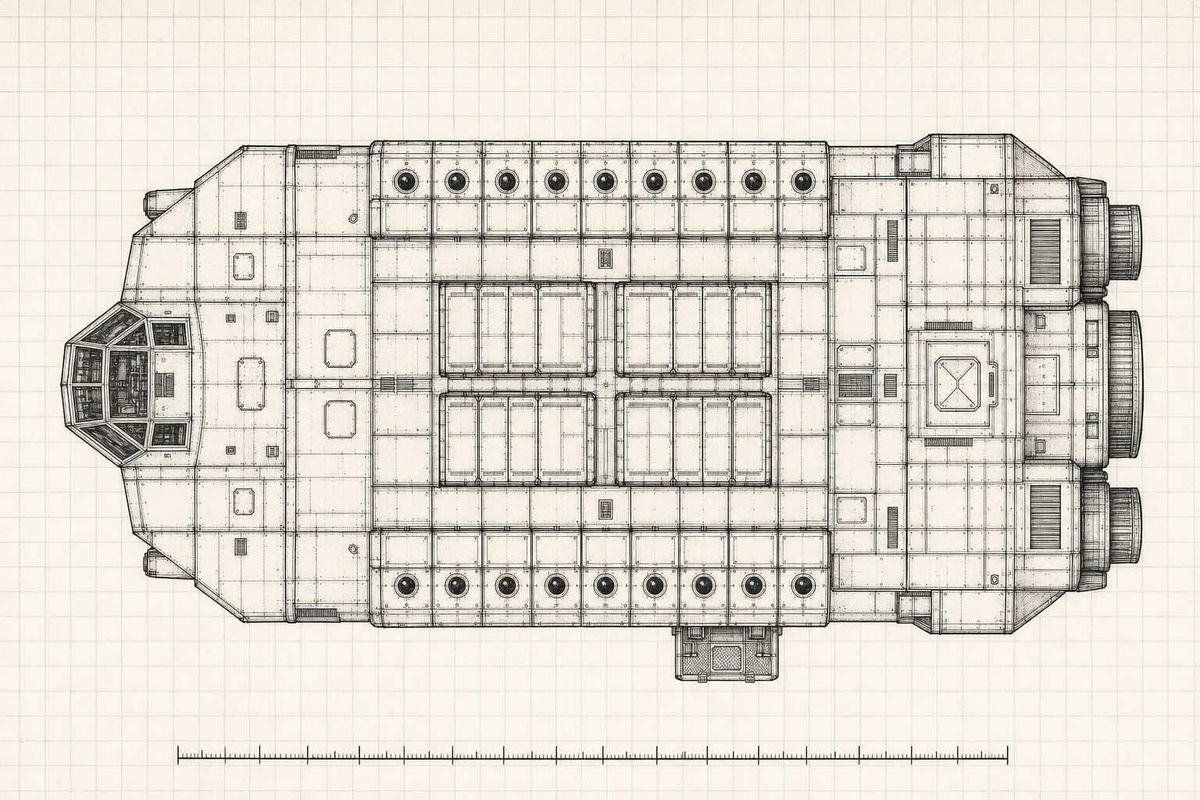
Designed under Classic Traveller Book 2 (1981) rules. Class name is a placeholder — rename at will. Built in small numbers (a handful of hulls in the class), jointly funded by consortiums on both terminus worlds.
Paragraph Description
Using a custom 1,000-ton hull, the Zephyr-class fast packet is built for exactly one job: carrying priority passengers and high-value freight between two specific TL-15 worlds, six parsecs apart, in a fortnight door-to-door instead of a months-long slog through jump-1 and jump-2 trade routes. It mounts jump drive-X, maneuver drive-V, and power plant-X, giving performance of jump-6 and 4-G acceleration. Fuel tankage of 660 tons supports the power plant for four weeks and allows exactly one jump-6, with no reserve for a second jump without refueling. Adjacent to the bridge is a computer Model/6.
The ship is unarmed. It carries no hardpoints, no turrets, and no gunners — security on both ends of its route is the responsibility of the two terminus worlds' navies, not the ship itself. The 4-G maneuver drive is not a combat or evasion feature; it exists because the passengers paying a premium for speed expect a brisk, short transit in normal space as well as in jump, not because the ship is built to outrun anything. (Book 2 has no G-force/strain rules of its own — the "nobody feels it" comfort of a hard 4-G burn is a setting assumption about shipboard gravity compensation, not a mechanical fact.)
Eighteen staterooms split the accommodation: six double-occupancy cabins house the crew and stewards, and twelve single-occupancy cabins carry high passage-only passengers — no middle or low passage offered, consistent with a premium, single-purpose service. Two stewards support the passenger complement. Twenty tons remain for baggage and small consignments of priority freight; this is not a bulk trader by any measure. The hull is unstreamlined — by design, since every voyage begins and ends at one of exactly two TL-15, Class-A-capable ports, and the ship was never meant to refuel anywhere else.
The minimum crew is ten: pilot, navigator, seven engineers (221 tons of drives and power plant, one engineer per 35 tons), and a medic. Two stewards (one per eight high passengers) bring the working complement to twelve. The ship costs MCr651.450 (including the naval architect's 1% fee) and takes 30 months to build.
Statistics
| Hull | 1,000 tons, custom (engineering section sized to drives) |
| Performance | Jump-6, 4-G, Power plant-6 |
| Fuel | 660 tons (600 jump + 60 power plant; one jump, no reserve) |
| Computer | Model/6 (CPU 15 / Storage 35) |
| Crew | 10 — pilot, navigator, 7 engineers, medic |
| Stewards | 2 (1 per 8 high passengers) |
| Staterooms | 18 total — 6 double-occupancy (crew/stewards), 12 single-occupancy (passengers) |
| Passenger capacity | 12, high passage only |
| Armament | None — unarmed, relies on naval escort at both termini |
| Baggage / priority freight | 20 tons |
| Streamlined | No — fixed two-port route, never refuels outside a developed starport |
| Cost | MCr651.450 incl. 1% architect's fee |
| Build time | 30 months |
Design Rationale
- Unarmed by doctrine, not by oversight. The prior armed variant of this hull spent 30 tons and several million credits on ten turrets and their gunners. Dropping that in favor of naval escort trades a self-defense capability this ship was never going to use well (it's a packet, not a combatant) for passenger and cargo space it can actually sell.
- 4-G as a comfort feature. The maneuver drive letter is unchanged from the armed variant, but the justification inverts: it's there so paying passengers get a fast normal-space transit to match the fast jump, not so the ship can dodge anything. A raider that catches this hull in the open has caught an unarmed target regardless of its thrust rating — the 4-G doesn't change that calculus, only the boarding math for escorts trying to reach it in time.
- No streamlining, deliberately. This isn't a gap in the design, it's a consequence of the route being fixed. A ship that only ever operates between two Class-A, TL-15 ports has no operational need to skim gas giants, and the tonnage is better spent on cabins.
- Small fleet, not a single hull. Splitting the route across several sister ships trades the single-point-of-failure fragility of one irreplaceable vessel for scheduled, redundant service — closer to a fleet of Zephyr streamliners or a Concorde fleet than a lone prototype.
Design History
- Frame: 1,000-ton custom hull, jump-6 (drive X), 4-G (drive V), power plant-X — established as the minimum viable jump-6/4-G combination on this tonnage.
- Military variant: 10 hardpoints, 10 single turrets, 19 crew (9 base + 10 gunners) — built to test survivability against raiders. MCr650.440, 62 tons remaining before crew, 42 tons after.
- Civilian conveyor (this version): turrets and gunners removed; security reassigned to naval escort. Twelve high-passage staterooms and two stewards added for a paying passenger complement. Crew recalculated for the unarmed, escorted role. MCr651.450, 20 tons remaining for baggage/freight.