Cloud Empress: Welcome to the Hereafter
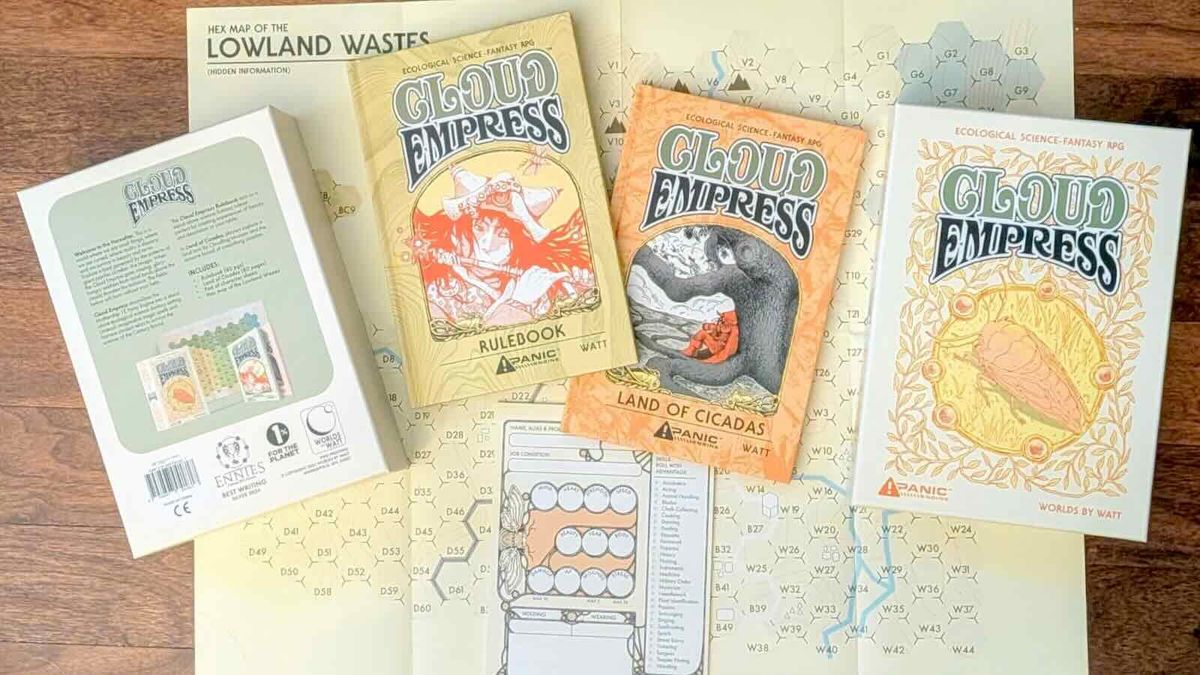
A player handout for the Cloud Empress RPG
Read this before the first session. It contains no rules to memorize — only the world you are about to walk into.
TALK. RUN. HIDE. FIGHT. ASK QUESTIONS BEFORE YOU ROLL. SURVIVAL IS A GROUP PROJECT.
The Five-Minute Read-Aloud
Thousands of years from now, the sky is still covered. A hundred generations ago, an ancient people—remembered only as the Torturers—strip-mined Earth to feed their ambitions, fogged the sky with a permanent yellow shroud called the Spread, and left for the stars. What they abandoned is the Hereafter, where technology, magic, time, and space mix in strange and unequal combinations.
Humanity survived, barely. A village might hold five people; a sizable military force might number less than a dozen. Below the Spread lie the Lowland Wastes: green woods, blue water, rosy sunsets, and soil, air, and water laced with invisible poison. The Farmerlings who work the land accept chronic illness and early death as parts of the ordinary human condition. Above the Spread hang eighteen remaining Cloud Cities, chandelier settlements suspended from ancient anchors in space. Most Cloudlings live in freezing squalor while self-appointed nobles called Lordlings invent titles, hoard clean water, and dream of empire.
Much of what remains runs on chalk, a white magical soot brought from cousin realities by the Torturers. Chalk is also a pollutant. It settles into soil, crops, animals, and human bones before climbing the food chain into the Imago: intelligent, thirty-foot cicadas that rise from the earth each summer to feed on bone and chalk. When Imago molt, people carve chalk from their shells to power villages, wake ancient machines, heal wounds, and cast spells. Magic is chalk, spoken poetry, and a piece of the caster. It lives in the teeth. There are no old Magicians.
Reality itself is worn thin. The Slip is a blurring of worlds: roads refuse to stay mapped, dead relatives appear at supper, unknown machines fall through cracks in the sky, and hollow ghosts called Wanderlings drift on the horizon. The Slip always buzzes. Sometimes it sounds like one bee; sometimes like a hive inside your skull. If you hear it, run.
This summer, three things are true at once. First, the Century Brood has arrived seven years early. Imago rise not by hundreds but by the tens of thousands, plowing a furrow through settlements and leaving no trace of the dead. Second, the Cloud Empress—a girl taken from Sewer Alley, fed pure chalk, imprisoned, and expected to grant the wishes of an empire—has vanished. Third, the Lordlings have blamed "Farmerling betrayal" and launched the Twenty-Ninth Expedition, flooding the Lowlands with barges, house soldiers, and ambitions. The war is already becoming more important to them than the Empress.
You are travelers in that summer. Summer is migration season in the Lowlands: strangers join together for a season, share sugarberries and swims in the Snek River, and walk the roads as an unlikely company. There are mountains of chalk to collect, fortunes to turn, people to help, and dangers worth avoiding. Every traveler carries the foolish private wish that they might be the one to find the missing Empress.
If the world ever needed saving, that time has passed. But there is still work to be done, and more trails than we have legs to walk them.
What Kind of Game Is This?
Cloud Empress is an ecological science-fantasy sandbox. There is no single prescribed story and no correct route across the map. The world has people, pressures, and consequences; the traveling party decides what matters and where to go.
Your characters are not chosen heroes. They are real-ish people moving through a dangerous world. They survive through judgment, curiosity, preparation, cooperation, luck, and knowing when to retreat. New characters are quick to create when someone is lost.
The game is concerned with travel, fragile communities, ecological aftermath, exploitation, wonder, care, and survival. It is not built around treating the environment as an object to plunder, violence as an uncomplicated power fantasy, or other beings as caricatures to degrade.
The Hereafter has no dependable currency. People barter with goods, labor, favors, reputation, and their names. A useful object is valuable, but a relationship may be worth more.
The basic order of preference is printed on the rulebook's reference page: Talk. Run. Hide. Fight. Fighting is available, not privileged.
Your Summer Traveling Party
The game gives you a simple reason to cooperate: people who might never share a home can still share a road for one summer. Differences are set aside because food, shelter, information, companionship, and another pair of eyes are all easier to find together.
The Four Jobs
Each job carries a Job Condition — a way your character's bad moments ripple outward to the people beside you. The exact mechanics live in Handout 2; what matters here is who these people are.
Sellsword — Capable in violence but treated as disposable labor, you are looking for a home, a fortune, a test of skill, or perhaps merely a full stomach. When you break, the people who trust you feel the ground shift under their own feet.
Lordling — Raised amid status, cramped privilege, court danger, and inherited obligation, you may be climbing toward power, fleeing assassination, or trying to escape the vanity of your class. Something about your presence makes it harder for your companions to hold their nerve.
Magician — A Lowlands miracle-worker who turns chalk and poetry into dangerous changes in reality. Your work can heal, transform, or ruin, and it consumes you. When your grasp on what is real slips, the people near you carry a share of the strain.
Courier — You carry the threads that still connect the world: potatoes, cider, medicine, rumors, letters, and news that may arrive too late. You have seen it all, and once in a while, that experience is exactly what the moment requires.
Character creation is quick and partly random. Treat unexpected age, history, gear, weaknesses, and complications as material to play with rather than defects to optimize away.
Stranger Possibilities
A character who rolls a Bodyhopper carries an ancient mind-transfer spell and wears an unusually strong borrowed body — but the miracle that interrupts most travelers' first death will never come for them.
A Wanderling is a ghost caught between realities. Ordinary harm passes through them, but chalk, Imago, magic, relics, and Slipstuff can hurt them — and they can only mend at sunrise, never through ordinary rest. Sometimes a wall is merely a suggestion.
Questions for the Group
Answer these together before the first scene. One sentence each is enough.
- Why are you traveling this summer rather than staying somewhere safe?
- What do you hope to find, deliver, repair, escape, or understand?
- What have you heard about the missing Empress, and which part do you believe?
- What is your attitude toward the Imago: fear, respect, resentment, fascination, or something else?
- What do you carry that matters more to you than its trade value?
- What did one other traveler do that made you trust them enough to share the road?
- What ordinary pleasure are you hoping to enjoy this summer?
The Table Agreement
Before play, agree on boundaries and a simple way to pause, rewind, fade out, or skip material. Check in again when the tone changes or the game reaches unfamiliar territory. A character may be frightened, compromised, transformed, or lost; the real people at the table remain more important than the fiction.
Possible content includes large insects, body horror, blood, amputation, chronic illness, mental distress, military occupation, gun violence, medical experimentation, dead animals, religious cults, sexual content, familial abuse in the introductory adventure, and violence toward insects. (The publisher's printed warnings cover a core of these; the rest reflect material that appears across the setting books.)
Discuss these questions:
- What material should not appear at all?
- What may appear only off-screen or without detail?
- Are there themes someone wants advance warning about?
- How will anyone pause or redirect play without having to justify themselves?
- How much interpersonal conflict within the traveling party is enjoyable?
- Is sexual or romantic content part of the game, faded out, or absent?
Before the First Scene
- [ ] Agree on boundaries and the table's pause/rewind tool.
- [ ] Create characters and note each Job Condition (Handout 2).
- [ ] Name the traveling party and decide who tracks shared provisions.
- [ ] Answer the seven group questions above.
- [ ] Establish where the journey begins and what the group intends to do first.
- [ ] Put Handout 2 and the Panic/Wounds tables within reach.
Once everyone knows what summer they have walked into, this handout can go back in the folder. Handout 2 stays on the table.
Unofficial player aid. Cloud Empress is by worlds by watt and uses the Panic Engine.