The Zombies: Never Fully Offline
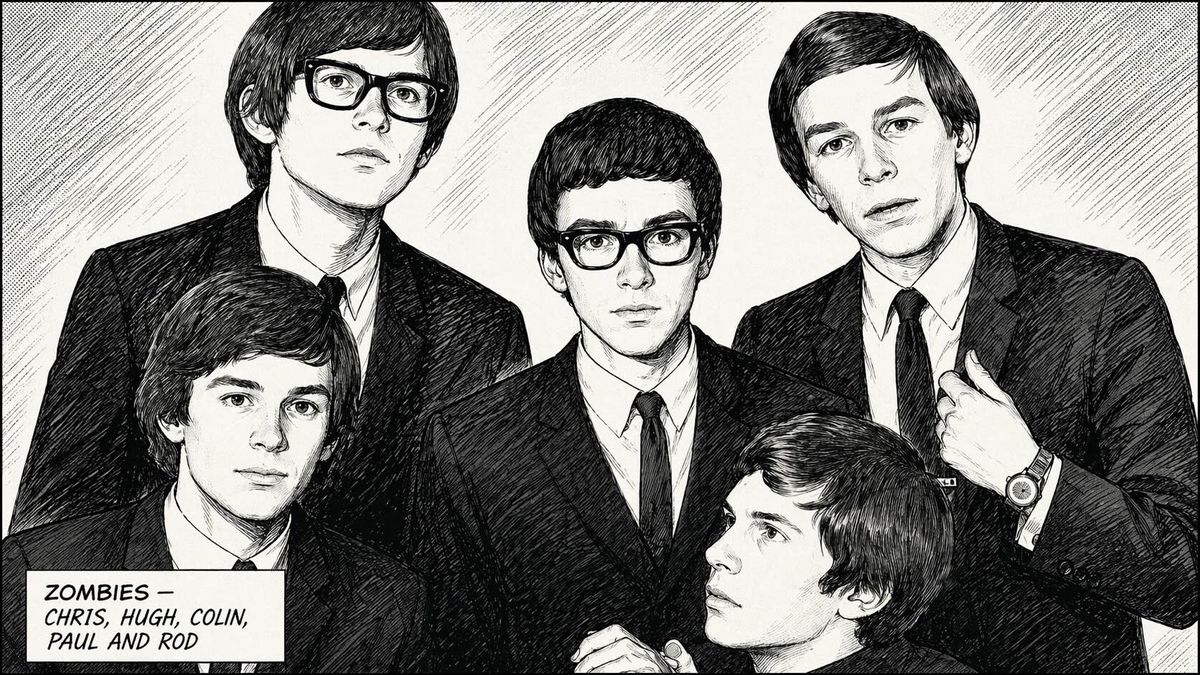
The best way to tell your story is to tell it yourself. The four surviving members of the Zombies clearly understand this, which is why they're listed as executive producers on Hung Up on a Dream, the documentary about their improbable arc from forgotten 60s also-rans to Rock and Roll Hall of Famers. A more cynical part of your brain might call that legacy management. But so would the less cynical parts. The difference is that legacy management only works when the legacy can withstand scrutiny — and Odessey and Oracle, the album at the center of everything, absolutely can.
Start with the accident of geography. In the summer of 1967, three albums were recorded at Abbey Road Studios in close succession: the Beatles' Sgt. Pepper's Lonely Hearts Club Band, Pink Floyd's The Piper at the Gates of Dawn, and the Zombies' Odessey and Oracle. Three very different bands, three very different records, all breathing the same studio air and arriving at overlapping conclusions about what British pop could become. Sgt. Pepper's rewrote the rules in real time. Piper launched psychedelia down a weirder trajectory. Odessey and Oracle — holding more than a few echoes of the Beach Boys' Pet Sounds — quietly slipped through the cracks and waited for the world to catch up.
That waiting became the whole story.
The Zombies broke up before their biggest song became a hit. "Time of the Season," which would eventually define the band for most casual listeners, was sequenced as the very last track on side two of the vinyl — the spot where the needle rides the innermost grooves, where the physics of the format literally compress the sound. The prime real estate on an LP is at the beginning of each side, where the grooves are widest and the fidelity is fullest. So the song that finally caught the public ear was sitting in the worst seat in the house, on an album by a band that no longer existed. Stranger fiction is harder to write, methinks.
And "Time of the Season" ends on a fadeout, which I've always privately considered a cop-out — the songwriter/producer's way of backing slowly out of the room rather than finding a definitive last note. Though in this case, there's an unintended poetry to it: the band's most famous song doesn't end, it just recedes. The medium gives up on it before the song gives up on itself.
The documentary, to its credit, tells this story well. But documentaries are containers, and containers have... well, walls. There's a moment early in the film, treated almost as an aside, where it's mentioned that Rod Argent and Chris White — the band's two songwriters — continued to receive royalties after the breakup, while the other members went on to drive cabs, sell insurance, and work desk jobs. We quickly sail by the economic iceberg beneath the narrative. Songwriting royalties versus performance labor created entirely divergent life trajectories, and no reunion or Hall of Fame induction can retroactively redistribute those years and Pounds Sterling. The documentary touches this lightly and moves on, because its structural function is a resolution, not an audit. It's a redemption arc dictated by genre.
One of those other members, Hugh Grundy, ended up driving people around after being made redundant at Columbia. Another, Paul Atkinson, went on to sign Abba, Elton John, and — somewhat less immortally — Mr. Mister. Colin Blunstone, the band's singer, worked in an office before eventually returning to music. Each trajectory is its own short story, but the documentary can only gesture at them. The four executive producers chose what to emphasize and what to soften, and they chose warmth, recognition, and reunion. It's an intentional framing, even if it lights up the cynical parts of my brain as a spin.
The album itself doesn't need the frame. I had it on this morning, and it does its own advocacy without a single talking head or archival photo. The songs are tightly constructed, harmonically adventurous, and emotionally specific in a way that rewards the hundredth listen as much as the first. Part of this is the constraint of the recording process — four tracks on a reel-to-reel, no room for second-guessing. Every arrangement decision was essentially permanent. When they tried adding a cello to "A Rose for Emily" and didn't like it, pulling it wasn't just a creative choice — it may have meant starting over entirely. The album's clarity isn't just an aesthetic; it's an artifact of forced intentionality.
There's a moment in the documentary where the band revisits Abbey Road and listens to the original multitrack masters through the studio's enormous control board. Four faders in use, sitting in the middle of a console built for orchestral complexity. The modesty of the original recording made physically visible against the grandeur of the room. Someone, incidentally, had to locate those fifty-year-old tapes, bake the reels to prevent oxide shedding, and coax them back into playable condition — an entire saga of archival science that the documentary smooths into a seamless, emotional scene. The labor made invisible so the feeling reads clean.
Colin Blunstone, who had originally lobbied for the band to be called the Sundowners, laughs at one point and says he still doesn't know what a zombie is. It's a good line, made better by the fact that the word now means something in almost every domain — the teeming undead, the neglected server humming away unmonitored on a network, the company that should have folded but keeps stumbling forward. The Zombies embody the concept in the most flattering sense. They weren't resurrected. They were never fully offline — a persistent background process, quietly transmitting, until enough accumulated signal finally tripped an alarm and someone asked, "Wait, what's been running back here this whole time?"
The answer, it turns out, was a masterpiece.