The Wok, the Reel, and the Back Porch
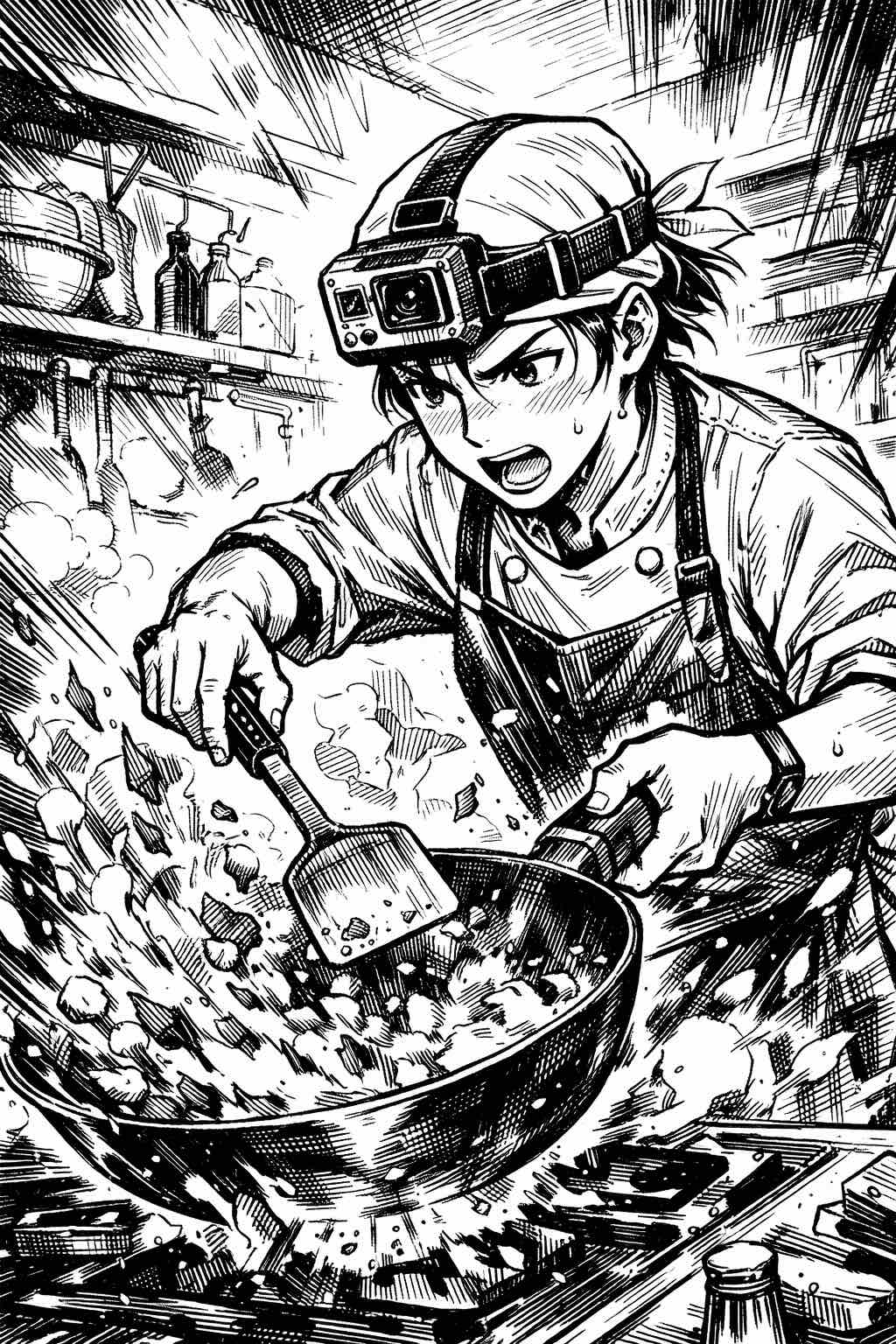
A video from a Chinese takeaway in Motherwell, Scotland popped up on my Instagram feed the other day. Someone — the cook, or someone standing where the cook stands — holds a phone over a wok set on a gas burner. A ladle of oil goes in. Then meat, then vegetables, then salt, MSG, dark soy sauce, cooking wine, sesame oil. Stir and stir. In under two minutes, the dish goes from raw ingredients to a takeout container. No narration, no face to camera, no plating sequence. Just hands and heat and timing.
The takeaway is called the Mayflower. Their Facebook page describes them as "Scotland's most viral Chinese takeaway," and they lean into that identity with frequent reels, ingredient captions, and a pinned note about a "super secret curry recipe passed on to three generations." "Family owned takeaway since 1975 and still going strong!" The self-awareness is right there, in the bio and the edit.
And yet — the videos work. Not because they're unmediated, but because they preserve the feel of labor better than most food content does. A lot of food media is engineered to erase friction: the jump cut past the chopping, the soft focus on the finished plate, the anodyne soundtrack. The Mayflower clips still let you feel heat, grease, repetition, timing, and muscle memory, even after the cuts and captions. Their garlic fried rice reel is basically a compact ledger of process and inputs: butter, minced garlic, egg, boiled rice, salt, MSG, soy sauce, chopped green onions, sesame oil, then out. That doesn't make it raw reality. But it does make the work legible.
This presentation is far from novel. Japanese fried rice videos have become their own genre on social media — the rhythmic tossing, the egg hitting the flat top, the scrape of the spatula. Those are mesmerizing, but they're shot from the audience's perspective. You're watching a performer. The skill is so refined it crosses into spectacle, and you watch it the way you'd watch someone practice a martial arts form. The Mayflower's POV collapses that distance. You're not watching someone cook. You're standing at the station. The difference matters: one makes you think "I could never do that," and the other makes you think "so that's how that gets made." The thing you've been ordering from a counter for years, suddenly visible from the other side.
That feeling of visibility — of the curtain being pulled back — is genuinely compelling. When I watched the garlic fried rice reel, my first thought was that every ingredient on that list is available at any grocery store. There's no mystery component, no inaccessible technique. Butter, garlic, egg, rice, soy, sesame oil. You could do this tonight.
But I know better, because I tried.
A couple of years ago, a similar wave of Instagram reels convinced me to buy a cast iron wok. The videos made it look elemental: hot metal, oil, food, fire. What they didn't show was the infrastructure. Our induction range couldn't generate the kind of heat a wok needs. The oil smoke, once the wok got anywhere close to the right temperature, clobbered the house with the intensity of an artillery barrage. Our home wasn't built for this. Commercial facilities, even unassuming Scottish takeaways, are designed to survive exactly the thing a residential kitchen is desperately trying to prevent: sustained high heat, aerosolized grease, and the kind of smoke that permeates every pore within fifty feet.
The wok wasn't a waste. I learned things about heat management and seasoning and the behavior of oil at different temperatures. We acquired a butane tabletop stove, which has never been used indoors but sits in reserve for power outages. And there was one afternoon in autumn when I set that butane stove on the concrete steps of our back porch to season the wok properly, oil smoking into the open air, knowing that I should probably be doing this indoors or at least on a proper surface, but deciding that the low-stakes defiance of a homeowner answerable only to himself was its own small pleasure. A back-porch culinary insurgent with a dream backed by Amazon Prime.
That experience is, I think, why the Mayflower's videos land on me the way they do. I'm not responding as a pure spectator. When their ladle of oil hits hot metal, I don't imagine the sensation abstractly. I have the smell-memory. I know what that oil spatter feels like on the forearm. I know what your clothes and hair smell like afterward. The POV format hooks into something physical rather than something aspirational, and that makes the connection feel different from ordinary food content consumption.
These videos aren't windows into an unmediated kitchen. They're edited. They're captioned. The cuts remove the dead time — the minutes where meat cooks to safe temperatures, the pauses that would break the rhythm of a sixty-second reel. Someone made decisions about framing, pacing, and text. The POV angle itself is a choice, and it's a choice that produces a specific effect: intimacy, proximity, the impression of access. The Mayflower knows this works. They keep doing it. They call themselves Scotland's most viral takeaway. None of this is accidental.
But acknowledging the craft of the presentation doesn't negate what the presentation reveals. These are still real cooks making real food under real conditions, and the format — even in its edited, optimized form — preserves something that more polished food media typically discards: the choreography of throughput. You can see the economy of motion that comes from doing this hundreds of times a week. Nobody pauses to explain what they're doing or why. Nobody presents the dish. The food goes into the container and presumably out the window to a customer. What you're watching is competence so deeply absorbed into routine that it doesn't register as performance, even though — on a screen, framed and captioned and posted for engagement — that's exactly what it is.
Maybe the right word isn't "authentic" or "unpretentious." Maybe it's "unnarrated." The appeal of the Mayflower's reels is that nobody stops to tell you this is art, craft, heritage, tradition, or content strategy. They just keep moving. That absence of explanation can itself be a strategy, and maybe it is. But it doesn't interrupt the rhythm of doing, and that rhythm is what carries the videos past the viewer's trained skepticism about anything encountered on social media.
I think of the medium's paradox often. Social media has trained us to read certain production choices as truth-adjacent. Low-fi reads as honest. POV reads as intimate. Minimal editing reads as transparent. These are learned associations, not inherent qualities, and they can be deployed as deliberately as any high-production technique. The Mayflower's videos may or may not be calculated in this way — I genuinely don't know, and I'm not sure it matters. What matters is that the format, whether by instinct or design, lets the labor show through. And because I've attempted some amateur version of that labor myself, on a back porch with a butane stove and a smoking wok, the illusion of proximity hooks into lived knowledge rather than fantasy.
That's why "empowering" and "incomplete" can both be true at once. The Mayflower's garlic fried rice reel can genuinely teach you something — the order of operations, the proportion of ingredients, the pace of the work — while still concealing the material conditions that make the performance possible. The burner output, the ventilation, the spatial tolerance for oil smoke, the heat-resistant instincts built over years of repetition. The reel shows you the what. It doesn't show you the infrastructure of the how, because that infrastructure is invisible even to the people working inside it. You don't caption the exhaust hood.
The other day, I watched another Scottish-Chinese takeaway post a similar reel. Then another. The format is becoming a genre now, which is its own kind of development. The Mayflower went viral, and others noticed, and the POV wok video is on its way to being a recognized content template with its own conventions and audience expectations. Whether that leads to a broader recognition of Chinese-Scottish cooking as its own legitimate culinary tradition — fifty-plus years of Hong Kong diaspora families adapting recipes to local ingredients in towns across Scotland — or whether it just becomes another content cycle that peaks and fades, I don't know.
But the Mayflower will still be there. They were cooking before the reels, and they'll be cooking after the algorithm moves on. The format may be new. The wok is not.
In our kitchen, a cast iron wok sits in a cupboard, properly seasoned, waiting for a day when I decide the house can live with the smoke. The back porch is still there. The butane stove is still charged. The ingredients are easy enough to find. A reel from Motherwell showed me the sequence; my own kitchen taught me the limits. That feels worth keeping. Not mastery, and not exactly competence. Just a smoke-scented familiarity with the other side of the counter.