The Sump
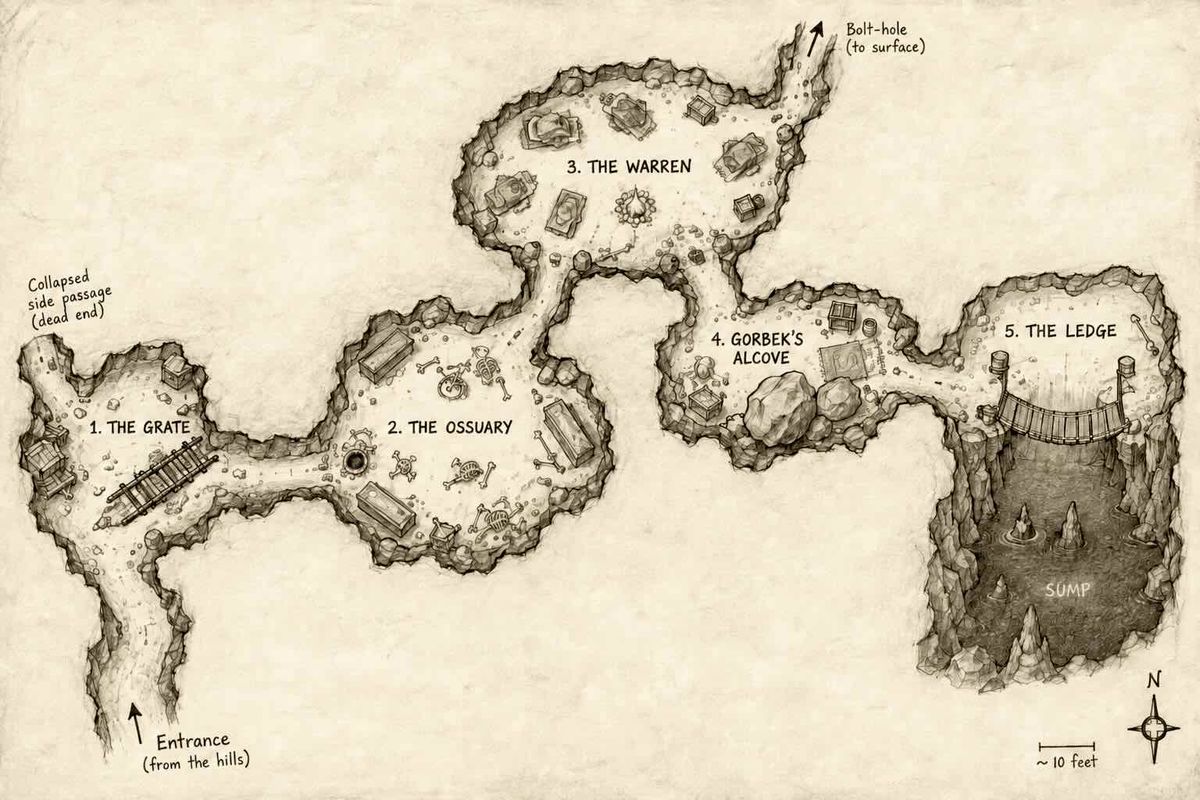
An introductory five-room cavern for The Black Hack
Three rooms present combat, each showcasing one class's signature tool — though another class's ability may bypass it entirely, and that's a feature. Two rooms teach the rest.
Plenty of combat opposition sits on this map; good use of class tools can reduce that to one fight, or none. That gap is the tutorial.
Say this before you start
- "Survive the cavern, everyone hits level 2." Advancement is per-quest, not per-kill.
- "An hour's rest returns every Armor Point. Once per day that same rest also lets you roll your class Hit Die and heal that much." Say it in exactly that shape, and let them rest as often as they like.
- "Rolling under your stat succeeds. Rolling on it fails."
- "You may run, and you may talk."
Two rules that get misread
Spellcasting. The spell always works. The INT/WIS test afterward only decides whether the caster keeps the slot.
Powerful Opponents. +1 per HD above the character's level on every roll resolving a conflict with that creature — attack, defense, parley. The entire difficulty curve.
RULINGS THIS ADVENTURE MAKES
The book leaves these open. Decide them here, not mid-scene.
THE PARTY
Starting gold is 3d6 × 10 — max 180 — so chain (350) and plate (600) are unbuyable at level 1.
KHERA — Warrior
STR 15 · DEX 12 · CON 13 · INT 9 · WIS 10 · CHA 11 HP 11/11 · Hit Die d10 · Attack 1d8 (1d6 unarmed) Armor: Gambeson (2) + Large Shield (4) = 6 AP Carried (17 max — STR 15 +2 pack): broadsword, large shield, gambeson, backpack, torches ×6, 50' rope, flint & steel, fresh rations, wineskin, purse
- Once per hour in combat, as your action, regain d8 HP. The party's only reliable mid-fight healing.
- 1 attack per level — one now, two at level 2.
- Fail a STR or DEX test and take damage? Destroy your shield to ignore it entirely. The 4 AP are gone for good.
SISTER VEHL — Cleric
STR 12 · DEX 10 · CON 12 · INT 11 · WIS 15 · CHA 13 HP 10/10 · Hit Die d8 · Attack 1d6 (1d4 unarmed) Armor: Gambeson (2) + Small Shield (2) = 4 AP Carried (14 max): mace, small shield, gambeson, holy symbol, backpack, torches ×6, preserved rations, flint & steel, purse
- Banish undead. As an action, test WIS adding the creature's HD, once per group. Your holy symbol gives +2 WIS for this — treat WIS as 17. Banished undead spend every action fleeing for 2d4 Moments; not destroyed, and they return when it expires.
- Advantage on CON against poison and paralysis.
- No spell slots until level 2. Book holds Cure Light Wounds (1) and Bless (2 — known, not castable yet).
PIP — Thief
STR 10 · DEX 16 · CON 11 · INT 12 · WIS 13 · CHA 12 HP 8/8 · Hit Die d6 · Attack 1d6 (1d4 unarmed) Armor: Leather = 4 AP Carried (12 max): shortsword, dagger, leather, thieves' tools, backpack, torches ×6, 50' rope, work tools, fresh rations, purse
- Advantage on DEX against traps and magical devices.
- Backstab: Advantage from behind, 2d6 + level damage (avg 8). Anything turning an enemy's back sets this up — a banished skeleton, a fleeing goblin, one engaged with Khera.
- Advantage on delicate work, climbing, listening, moving silently, reading unknown script, opening locks.
ORMEL — Conjurer
STR 8 · DEX 12 · CON 10 · INT 16 · WIS 13 · CHA 11 HP 7/7 · Hit Die d4 · Attack 1d4 (1 unarmed) Armor: none. You may wear it — anything outside your class list adds its full AP value to every attack roll and roll to avoid damage, spent or not. A small shield buys 2 AP for +2 on those rolls. Almost always a bad trade, and yours to make. Carried (8 max — no backpack): staff, one-handed sword, spellbook, lantern, flask of oil, preserved rations, 10' pole, purse
You are full. Pick up anything and you're encumbered: Disadvantage on every test, movement limited to Nearby. Buy a backpack for 5 coins, or hand something to Khera.
Slots: 1 × level 1. Memorised: Sleep — castable without the book in hand.
Casting never fails. After each level-1 cast, test INT+1: success keeps the slot, so about a 70% chance to cast again.
GM NOTE: SLEEP IS THE MASTER KEY
4d6 has a floor of 4. Sleep automatically defeats anything here of 4 HD or fewer — everything but the immune skeletons. Ormel can end the goblins, Gorbek, and the bugbear with one spell.
On the likely route (Sleep in the Warren, parley with Gorbek) that's one casting, so the slot survives into Room 5 about 70% of the time. Sleeping Gorbek and taking the eight-hour rest refreshes his slots, reloading the master key — and eight hours is also how long Warren goblins stay down, so any left breathing wake behind the party.
Don't declare monsters immune; price it in fiction. A slept ogre gives loot and rest but no information and no ally; a slept bugbear gives a helpless one, and whether it dies is the players' call. If you want the Room 5 fight anyway, the only honest lever is presentation: it's already Close when they round the bend, so roll initiative at once.
THE CAVERN
A sinkhole in the drover's road drops into a limestone gut. Something down there took goats, then dogs, then a child — a shoe was found at the lip. The village offers 200 coins and can find nobody willing to go.
[surface]
    |
1. THE GRATE
    |
2. THE OSSUARY
    |
3. THE WARREN ---- goblin bolt-hole (too small for PCs)
    |
4. GORBEK'S ALCOVE
    |
5. THE LEDGE ---- walkway to the crack, and out
    |
[the sump] ---- drainage crawl back to Room 4
ROOM 1 — THE GRATE
A rusted iron grate is bolted across the passage at chest height. Beyond lie a rotted pack and scattered bones. Getting through: STR test to bend the bars, or Pip's tools at Advantage.
The trap is the flagstone two paces past the grate. Give all three tells unprompted: the scout's bones are crushed, not merely old; powdered limestone lies beneath a ceiling seam; the flagstone is clean at its edges where the floor is silted.
Examine the stone or ceiling in response: they find the mechanism automatically, no roll. Only glance around: WIS test, no Advantage — spotting isn't on the Thief's list. Walk on: DEX test or 2d6 falling rock, with Advantage for Pip.
Loot: 40 coins, a flask of oil, a small shield (2 AP), a backpack.
No monsters — let them roll and succeed before anything bites them. If someone offers Ormel the shield, walk through the cost and let him decide. Pip can take it for 6 AP.
OOM 2 — THE OSSUARY
A domed chamber, walls stacked with femurs in tidy courses. Four figures unfold from the alcoves as the light touches them.
RUN COMBAT LIKE THIS
- Initiative. Every character tests DEX separately. Passes act before the monsters, failures after. No party roll; within a group, players choose their order.
- Players attack by testing STR (melee) or DEX (ranged). Success: roll damage.
- Monsters attack and do not roll. Name the target; the target tests STR or DEX. Only on a failure does the GM roll damage.
- Armor Points are a pool. They subtract from incoming damage until used up, then the character takes full damage. An hour's rest refills them.
4 Skeletons — HD 1 · 1d8 HP (avg 4) · 0 AP · d4 damage · one attack attempt each Immune to Sleep, Charm, and all mind-affecting magic. Ormel's best spell does nothing here, so Vehl steps forward.
The banish: one action, one WIS test for the group, adding HD (1). Vehl needs 15 or less — about 75%. All four flee for 2d4 Moments, then turn around and come back.
Point this out. Fleeing skeletons have their backs turned — what Pip's backstab wants: Advantage, 2d6+1, one skeleton destroyed. The only cross-class combo here.
If she fails: four 4 HP enemies, four attack attempts per round, against 14 Armor Points. The party should win, and should feel their armor draining. Let her retry next Moment.
Loot: two vials of Holy Water and a Magic Gambeson — magic armor doubles its rating, so 4 AP.
Holy Water: two single-use vials. A thrown vial deals d4 to one undead or evil creature, ignoring AP, and cannot be avoided by a test. The gambeson is Vehl's upgrade (4 AP to 6); it does nothing for Pip, already at 4 from leather.
ROOM 3 — THE WARREN
A low chamber stinking of woodsmoke and old meat. Six goblins squat around a fire pit arguing over a boot. The bolt-hole in the back wall is too narrow for anyone larger than a goblin.
6 Goblins — HD 1 · 1d6 HP each (avg 3.5) · 0 AP · d4 damage · one attack attempt each
The Sleep solve: 4d6 HD against 6 HD takes all six on all but a freak roll. Then test INT+1; 70% the slot survives.
If they fight: six attack attempts per round, the most incoming dice this dungeon throws. Goblins often drop to one hit, so the party likely wins — but Ormel at 7 HP and 0 AP is two bad rolls from Out of Action. Let it get scary. Once three are down the survivors break for the bolt-hole; a GM call, not a die roll.
Sleeping goblins are eight hours of unconscious prisoners. Say nothing. See what they do.
Track this. Leave them alive and unrestrained, then take an eight-hour rest, and they wake and slip down the bolt-hole — possibly turning up behind the party later. A one-hour rest is too short to matter.
Loot: 60 coins, a Large Shield (4 AP), preserved rations, fresh torches.
Flag the shield to Khera: knowing she has a spare is what makes her willing to sunder hers in Room 5.
ROOM 4 — GORBEK'S ALCOVE
A dry shelf above the water line. A boulder has been dragged across the opening — not sealing it, but narrowing it to a waist-wide gap: wide enough to see and speak through, not to fight through. Two people can shift it with a STR test.
Have him speak before anyone can frame this as a fight — a tired, aggrieved voice asking whether they're the thing that took his food.
Gorbek — HD 4 · 4d8 HP (avg 18) · 3 AP · d10 damage · one attack attempt Gives Advantage on all CHA tests made against him.
Four HD against level 1 is +3 on every roll, and the book grants Advantage on CHA specifically for ogres.
The parley: CHA test with Advantage at +3. Vehl (CHA 13) needs 9 or less on the better of two dice — about 70%.
- Success: he's sulking, not hostile. Something took his larder — the deep ledge — and put a hole in his shoulder. He rolls the boulder aside and trades.
- Failure: he throws the goat carcass through the gap and demands tribute. Food, wine, or 50 coins earns a second attempt, still at Advantage. He won't pursue a party that backs off.
- If they attack: 18 HP behind 3 AP, d10 to one character per round, against four attackers at +3 — and only one or two reach through the gap at a time. Four or five rounds, and it hurts. A bad trade, not a death sentence; if it goes badly he takes their coins and shoves them back down the passage.
- If Ormel sleeps him: automatic; he's visible through the gap. They get the alcove, the potions, and an eight-hour rest — but not the warning about the ledge, or a choice about the goblins behind them.
He gives or trades: 2 × Potion of Healing (one action, 1d8, single use); word that the bugbear is on the ledge, is big, took his food, and that a crack to the surface lies behind it; and the alcove for an hour's rest.
The pressure valve. Chewed up, he's generous; fresh, he wants 80 coins for the potions.
ROOM 5 — THE LEDGE
A ledge above a black sump twenty feet below. A rope-and-plank walkway crosses to a crack of daylight. The bugbear has nested at the near end, on goat bones and one small shoe.
The Bugbear — HD 3 · 3d8 HP (avg 13) · 2 AP · 2d4 damage · one attack attempt All DEX tests in a conflict with it are rolled at Disadvantage.
Ruling: this covers initiative, ranged attacks against it, and dodging. Powerful Opponents is not stacked onto the initiative test — keep that for attack and defense.
Initiative. Each character tests DEX at Disadvantage. Pip (DEX 16) passes about 56%, Khera and Ormel about 30%, Vehl about 20% — roughly an 83% chance at least one acts before the bugbear, though most act after. Split the round properly.
The maths: +2 to every party attack and defense roll. Khera hits on 12 or less (60%) for 1d8. Its 2 Armor Points absorb 2 points of damage in total — not two hits — then they're gone. Expect 3–4 rounds. It deals about 5 per round to whoever is in front, and a natural 20 on the defender's roll doubles that to as much as 16 — enough to drop anyone here in one Moment.
The walkway is one creature wide, rope-anchored at both ends.
Cutting it: anyone beside an anchor rope with a blade severs it with one action, no test. Cut both ropes on one side and anything on the walkway falls into the sump for 2d6. Monsters get no test — the players engineered the consequence.
The sump: waist-deep black water over silt. The 2d6 is the only damage; nobody drowns. A drainage crawl leads back to Gorbek's alcove; climbing to the ledge is a STR test.
Retreating onto the walkway means fighting it one at a time — good for Khera, stranding the others. Letting it follow means a decision about the ropes.
It fights to the death only if cornered. At a third HP it breaks past and flees up the passage, where surviving goblins may or may not be.
Khera's moment: the first time she fails a defense test, remind her — if she still has a shield — that she can destroy it to ignore the damage.
If it rolls hot and drops two characters: it is hungry, not vengeful. It takes the nearest pack and withdraws to eat. Never a body: an unrecovered Out of Action character is gone permanently.
Loot: 120 coins, a jet bead worth 40, and a +1 Mace (+1 to the attribute tested, +1 to each damage die). Blunt, so Vehl can use it — it raises both her attack stat and her d6.
Then they climb into daylight, and everyone is levels up to 2!
AT LEVEL 2
Roll your class Hit Die, add it to maximum HP. Roll a d20 against each stat — anything rolling higher raises it by 1. Then roll twice for your class's favoured stats (two separate attempts, so those can rise by 2):
Flag the payoffs — capability roughly doubles, so say so. Vehl gets her first spell slot and can finally cast Cure Light Wounds. Khera gets a second attack. Pip's backstab rises to 2d6+2. Ormel memorises two spells and adds a slot.
F IT GOES WRONG
None of these requires fudging a roll or changing a creature's abilities.
Do not run the wandering monster check — a d4 every fifteen minutes of real play is a 50% rate, and it will turn this map into a grinder.
WHAT THIS POSTPONES
Usage Dice appear on the sheets but nothing depends on them. Reaction Rolls are absent by design: every creature here has a stated motive, and the book reserves that table for creatures that don't.