The Probable Barrier Operator
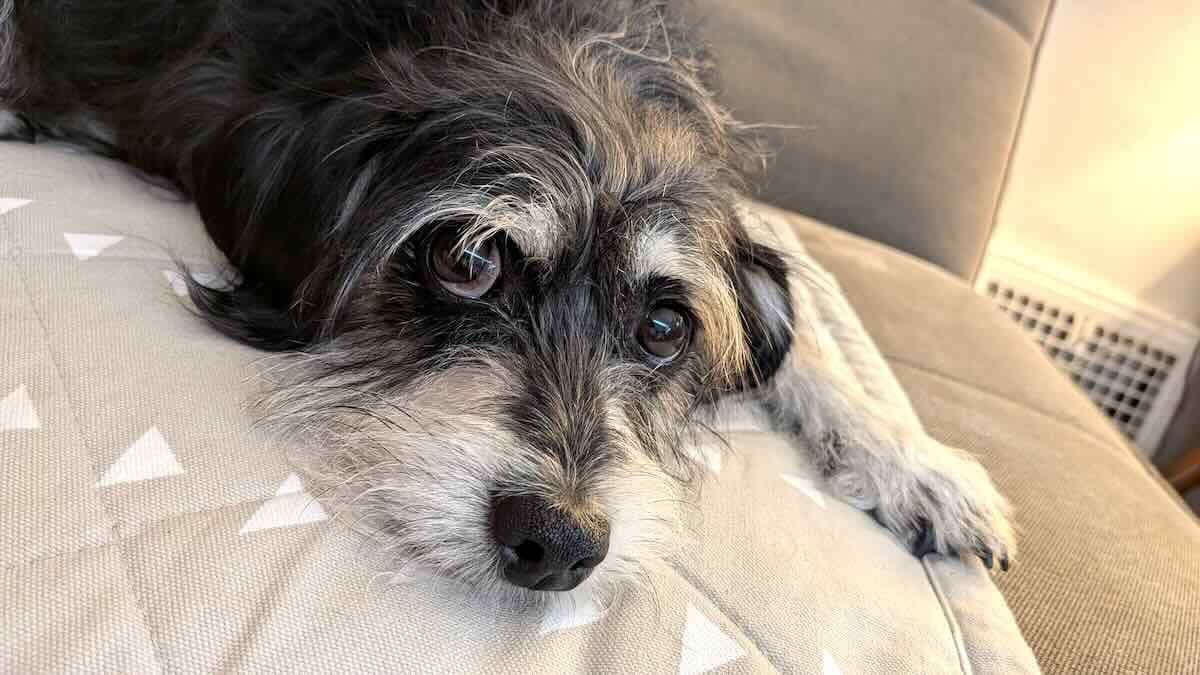
What I Think I Know About What Delia Thinks About Us
After seven in the evening, Delia will sometimes sit and stare at me. Not Nancy. Me. And cry.
There are plenty of things a dog might accomplish by staring at a human, but more often than not this particular stare ends with me getting up, putting on shoes, and taking her for the evening walk. I have therefore become reasonably confident about what it means.
The same thing happens at the foot of the stairs. We keep a barrier there. Delia will sit in front of it, look upstairs, and then look at me. I move the barrier. Delia tears upstairs to do zoomies.
I could put a thought bubble over her head: Move this thing, spare hooman. Or I could be more careful and call myself the probable barrier operator. That distinction turns out to contain a good bit of what interests me about living with a dog.
Dog people are extraordinarily fluent in putting sentences into their dogs' heads. A canine side-eye becomes I can't believe you're doing that. An expectant stare becomes Where is my dinner? A sigh becomes I suffer so. The famous canine “smile” needs almost no translation at all.
I do this constantly. Nancy is Delia's “hooman honey.” I am variously the “mean hooman” or the “spare hooman.” When Delia's water bowl is empty, she bangs it around the kitchen hard enough that one of her many names is F.M.—Furry Mutt—Einheit. At 2:30 in the morning, this has roughly the subjective force of a PagerDuty alert. The runbook, fortunately, is simple.
But those sentences are translations. They are not transcripts. I know this partly because my relationship with Delia did not begin with anything resembling instant mutual understanding. She came to Portland through a rescue group after being flown from a kill shelter in El Paso. It took her about three days to warm up to Nancy.
It took her three weeks to tolerate me.
For those three weeks I spent a lot of time tossing treats in her direction while she barked at me. Somewhere along the way the barking stopped. More than two years later, I am now an approved chin rest. If I nap on the other couch, she will sometimes curl herself over my ankle. That looks like a fairly dramatic shift in whatever model of me Delia carries around.
And I still don't know what that model is.
There are other moments when the easy household translation becomes less comfortable. If Nancy is watching television and I approach her, Delia may growl at me. Then she gives me licks. It is tempting to narrate the whole thing as personality: She's an odd one. That can work perfectly well as domestic shorthand. We know the routine. Nobody needs a TED Talk every time the dog grumbles.
But suppose the growl is doing something more specific—marking a boundary around Nancy, guarding access to her, communicating unease at my approach. "She's an odd one" is a sentence I can live with indefinitely. "She is guarding" is a sentence with something attached to it. I notice that I now approach slowly and let her sniff my hand before I sit down—which suggests I have already half-accepted the second translation while continuing to say the first. That is the moment when "I know what my dog means" becomes a more interesting claim. And this, roughly, is where the science enters.
One 2022 study tested whether dogs could distinguish between humans who appeared competent and incompetent. Dogs watched two experimenters try to open containers. One could do it; the other could not. When a later container contained food, dogs looked longer toward the competent person, and female dogs in particular were more likely to approach her.
You can practically hear the thought bubble writing itself:
I have observed your performance, Susan. I know who opens the Tupperware around here.
But that sentence goes well beyond what the experiment established. The researchers found a behavioral difference under a carefully constructed condition. And the finding that made the title—the sex difference—wasn't part of the study's stated prediction. The title says flatly that female dogs “evaluate levels of competence in humans”; the abstract itself retreats to suggests and might. Somewhere between result and headline, a measured difference has acquired a surprisingly mind-like verb.
The one thing that resists easy dismissal is the empty condition. When the third container had nothing in it, the dogs showed no preference at all. The difference appeared when the demonstrated skill suddenly mattered to the dog. Something is being tracked. What that something is—competence, a history of lids opening, or a person whose actions predict access to something desirable—is not visible from the outside.
And when researchers ask a nearby question—whether dogs form reputations of humans—the picture gets considerably murkier. A 2025 study exposed forty pet dogs to “generous” and “selfish” humans, both by having the dogs observe interactions with another dog and through direct experience. The dogs did not significantly prefer the generous person afterward. The authors' conclusion was not that dogs definitely cannot form reputations, but that their results did not provide evidence for it and that studying the phenomenon is methodologically difficult.
Their review of the broader literature is messy in the useful way. Some studies report that dogs distinguish between generous and selfish people, competent and incompetent people, cooperative and competitive people. Others find nothing. And the cleaner methods do not settle it: the 2025 authors point out that some earlier positive findings may have turned on incidental details like where the experimenters were standing, then note that their own attempt to control for such things still produced a negative result—and that their methodological choices may account for some of what they failed to find.
I think of it as science running headlong into a difficult object. The laboratory can control things I cannot. I cannot randomize Nancy. I cannot blind myself to which one of us usually takes Delia for an evening walk. I cannot erase the first three weeks of barking and treat-tossing, counterbalance who opens the stair barrier, or prevent yesterday's interactions from affecting today's.
My household is a hopelessly confounded experiment. But I have the thing the laboratory has to strip away: history.
I have thousands of observations of one particular dog interacting with two particular humans in one particular house. I know the difference between Delia happening to look at me and Delia staring at me after seven. I know what usually follows the look toward the stairs. I know what the metallic clanging from the kitchen means with enough confidence to stumble out there half asleep.
None of this makes my experience more valid than controlled research. It makes it differently compromised. The laboratory gains control by reducing history. I gain history while surrendering control. And neither of us gets inside Delia's head. Living with her has not given me privileged access to her mind. It has given me a very large training set. And that training set produces some good predictions.
When Delia stares at me after seven, there is a high probability that a walk is involved. When the water bowl begins performing industrial percussion, its level is probably unacceptable. When she settles her chin across me, I am evidently serving some useful function as furniture.
And when she sits at the foot of the stairs, looks upstairs, and then looks at me, I have a fairly good idea what happens next. What I do not have is access to what that sequence represents for her. Does she think of me as the human who understands her requests? As the human associated with upstairs access? As one component in a learned sequence that has repeatedly ended with the barrier disappearing?
Those descriptions feel psychologically different to us. I do not know whether they are different to Delia—or whether anything in her experience corresponds neatly to any of them. The scientists are right to make me cautious about putting sentences in her head. Two years of living with her have made me equally cautious about pretending that nothing is being communicated simply because I cannot translate it cleanly.
Delia looks upstairs.
She looks at me.
More often than not, I move the barrier.
I am the probable barrier operator.