The Rover Takes Over
A TiGGR Scenario About Automation, Indifference, and the System That Doesn't Need You
Players: 2–5 | Playtime: 30–45 minutes | Components: 2d6, pencil, paper | Requires the TiGGR core rules
THE PREMISE
Number 2 is gone.
Helicoptered out this morning, mid-sentence, mid-tea. No announcement. No replacement. The Green Dome is locked. The control room is still lit—screens active, cameras panning, Rover on patrol—but no one is sitting in the chair.
Everything else continues. The café opens on time. The brass band plays at eleven. The PA system delivers its scheduled announcements. The cameras pan their usual arcs. Rover drifts along the beach on its usual route. The Village runs.
No one is running it.
At first this looks like freedom. No Number 2 means no interviews, no manipulations, no personal attention from authority. But you will quickly discover that an automated Village is worse in specific ways. Rover responds to behavioral triggers without judgment. The hospital's screening schedule continues but no one can approve exemptions. Privileges that required sign-off are frozen. The café serves the same meal every day because no one has updated the requisition. The system isn't cruel. It's indifferent. And indifference doesn't negotiate.
This is not a scenario about escape. It is not a scenario about rebellion. It is a scenario about what happens when the system stops needing people to run it—but keeps running anyway.
The system does not require a Number 2 to function. The Number 2 requires the system to appear necessary.
TOUCHSTONE
The Prisoner (ITV, 1967–68), but with the chair empty. Also: automated customer service lines, algorithmic moderation, unattended systems aging into weirdness, and the moment you realize there's no human on the other end.
You do not need to have seen the show to play. The premise is self-sufficient: a beautiful, surveilled village you cannot leave, a system that enforces its rules without anyone directing it, and the question of whether the absence of authority is the same as the presence of freedom. It isn't.
SCENE & GOAL
Setting
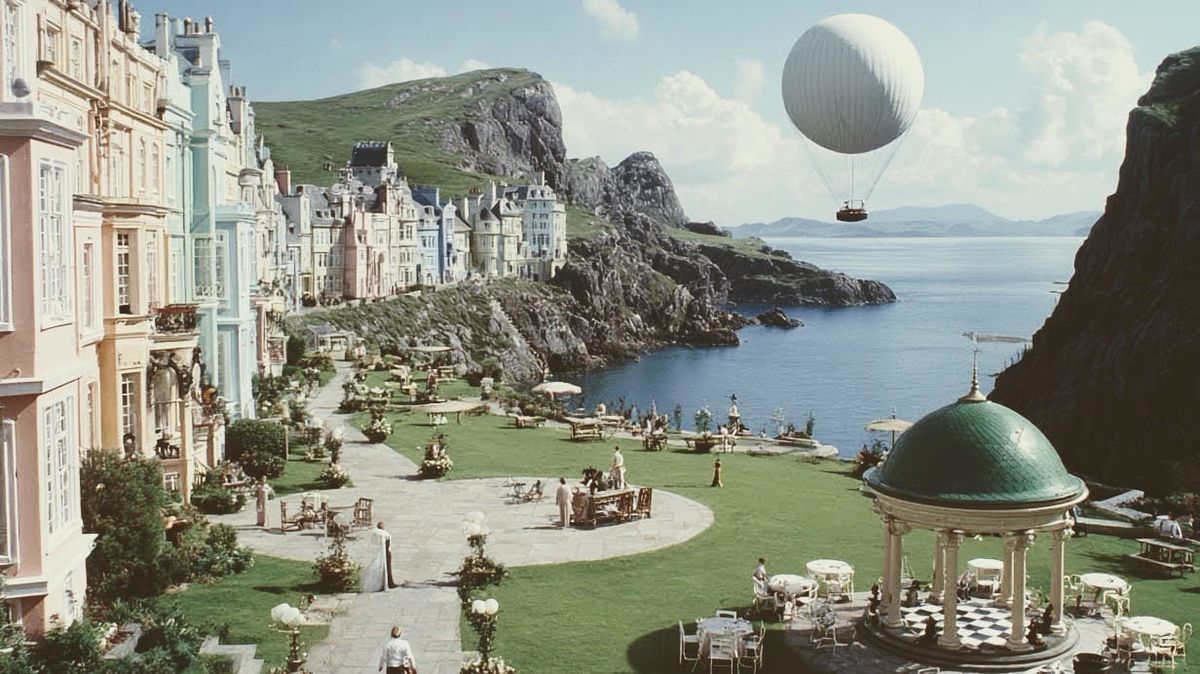
The Village. Same lawns, same buildings, same sea. Same cameras, same PA, same Rover. But the Green Dome is dark. The intercom returns a tone. The suggestion box is full and no one has emptied it. The newspaper reprints yesterday's edition. The weather is beautiful. It is always beautiful.
Key locations: the Town Hall (control room running unattended), the Green Dome (locked, empty), the hospital (operating on automated protocols), the general stores, the band stand, the chess lawn, the café (menu unchanging), the old people's home, the lighthouse, the beach, the graveyard, cliffs and caves.
Goal
Survive the gap. No one knows how long the Village will run without a Number 2. No one knows if a replacement is coming. No one knows if this is a test. Your privileges are frozen, your routines are degrading, and the enforcement apparatus is still active but no longer calibrated by human judgment. Keep your life intact until someone—anyone—sits back down in the chair. Or until you accept that no one will.
Each player begins with a routine privilege, as in the previous scenarios. The difference is that this time, your privileges are not being revoked as leverage or disrupted by chaos. They are expiring—timing out, defaulting to a previous setting, or simply no longer being renewed because the renewal process requires a signature that no one can provide. The system hasn't taken your tea ration. It just doesn't know you still want it.
FACTIONS
The Apparatus
Body 1 | Mind 2 | Charm 0 | HP — No special ability. No HP. Cannot be defeated, negotiated with, or appealed to.
The cameras, the control room, the PA system, the hospital protocols, and Rover. Still running. Not directed. The Apparatus does not have intentions. It has parameters. It does not make decisions. It executes triggers. It cannot be charmed, reasoned with, or intimidated. It can only be predicted—and its predictions are becoming less reliable as the gap widens.
Note: The Apparatus has no HP because it is not an adversary. It is an environment. You do not fight the weather.
The Current Number 6
Body 2 | Mind 1 | Charm 0 | HP 5 "There's No One to Fight": +1 Body when attempting escape, but —1 Charm in any situation where rhetoric is useless
Trained to confront, scheme, speechify, resist. All of which require an audience. There is no audience. Shouting at Rover doesn't work. Hacking the control room reveals no one is logged in. Rallying the Village against Number 2 is meaningless when Number 2's chair is empty. Number 6 is trained to fight a person and they're facing a thermostat. Their frustration is genuine. Their irrelevance is total. They may become genuinely dangerous—not to the system, but to the people around them—as they search for something to push against.
The Watchers (Residual)
Body 1 | Mind 1 | Charm 1 | HP 3 "Force of Habit": +1 Mind when reporting—but to whom?
Some Watchers continue to file reports out of routine. Some have stopped. Some are filing reports and leaving them on desks that no one will check. A few have begun to wonder, for the first time, what the reports were for. The Watchers are the most human element in this scenario—people whose entire function has been removed, still performing it, unsure whether to stop.
SCENARIO-SPECIFIC RULES
Automated Response
Whenever a player crosses a behavioral threshold—leaving a designated area, missing a scheduled activity, approaching a restricted zone, exhibiting "irregular" behavior in a public space—Rover responds. No warning. No negotiation. No appeal. Roll Body 8 to evade. Rover does not interview. Rover does not file reports. Rover enforces a boundary. The absence of judgment is the horror.
Trigger → Response. That is the entire logic.
No One Is Watching (But Everything Is Recorded)
The cameras still run. The files still update. But no one reviews them in real time. Actions that would have triggered an immediate response in Be Seeing You now trigger a delayed response—sometimes one scene later, sometimes never. Players do not know which. The GM rolls 1d6 secretly when a player does something that would normally draw attention: on 1–3, the system catches up later; on 4–6, it never registers. The uncertainty is worse than the surveillance.
Paranoia without feedback. Causality without visibility.
The Empty Chair
Once per scene, a player may attempt to contact the Administration through official channels—the phone in the Green Dome, the intercom, the suggestion box, the hospital reception desk. The system responds with a recorded message, a form, or silence. The player may persist (Mind 8 to navigate the automated system), but the result is always procedural rather than personal. You can file a request. No one will read it. It will be processed.
Explanation is where humans used to live.
Drift
Each scene, the GM introduces one small degradation in a Village routine. These are not crises. They are mutations—the slow weirdness of unattended systems.
- The café menu narrows by one item
- The band plays the same song twice
- A streetlight stays on during the day
- The newspaper reprints yesterday's edition
- The PA announces an event that happened last week
- A flower bed is overwatered and flooding the path
- The chess pieces have been set up wrong and no one has corrected them
These accumulate across scenes. By Scene 3, the Village should feel subtly off—not broken, not collapsed, just drifting into a version of itself that no one designed and no one is correcting.
Not collapse. Mutation.
Phantom Queue
Once per scene, the GM marks one player action that should have triggered a system response but didn't. At any later moment—possibly in a different scene entirely—the system resolves it out of context. Rover appears late. A notice arrives after the fact. A privilege is revoked retroactively for something that happened hours ago. The system is processing. Just not in human time.
The queue is always running. You just don't know where you are in it.
THE THREE SCENES
Scene 1: "The Chair Is Empty" (The Setup)
Number 2 was recalled this morning. No ceremony, no explanation, no successor. The helicopter left and did not return. The Green Dome is locked. The control room hums behind closed doors.
The Village continues. The café serves breakfast. Rover patrols the beach. The PA announces the day's schedule, which is identical to yesterday's. Players go about their routines and find that most things still work. Almost. A privilege renewal has stalled. A scheduled appointment returns a busy tone. The Watchers are still watching, but several look confused about where to deliver their reports.
Number 6 is suspicious. This feels like a trap. They are probing the edges, looking for the trick, trying to provoke a response from an authority that isn't there. A player may be approached for information about what happened. Number 6 doesn't want help. They want confirmation that someone is still in charge—because if no one is, their entire mode of resistance stops making sense.
Hooks:
- A player's routine privilege fails to renew. The automated system shows their request as "pending—awaiting authorization." No one can authorize it. (Mind 6 to understand the problem; Charm 8 to find a workaround through another villager who has access.)
- Rover patrols the chess lawn at a time it has never patrolled before. No one diverted it. Its parameters may have shifted. (Mind 8 to identify the new pattern; Body 6 to simply avoid the area.)
- A Watcher approaches a player and asks, quietly, where they should be leaving their reports. The question is genuine. (Charm 6 to deflect; Mind 8 to realize the implications of a Watcher without a handler.)
- Number 6 tries to enter the Green Dome. It's locked. They try the control room. It's sealed. They turn to the nearest villager—a player—and demand to know who is in charge. The honest answer is: no one. (Charm 8 to deliver this without provoking them; Body 8 to be somewhere else when they ask.)
Scene 2: "The System Continues" (The Escalation)
The absence is no longer ambiguous. No replacement has arrived. The helicopter pad is empty. The control room is running on whatever it was set to run, and whatever it was set to run is starting to show its edges.
The hospital has sent automated screening notices to every resident. No one can approve exemptions or deferrals. The notices are non-negotiable because there is no one to negotiate with. The café has served the same lunch three days running. The band is playing the same set. The newspaper is yesterday's again. Rover's patrol has expanded—not dramatically, but enough that routes that were safe last week are no longer reliable.
Number 6 has broken into the control room. It is running. Lights on, screens active, data flowing. The chair is empty. No one is logged in. The system is executing stored procedures. Number 6 stares at it and, for the first time, has nothing to say. They may become reckless—not out of defiance, but out of the need to provoke any human response from the machine.
Hooks:
- The hospital screening notice arrives for a player. It is automated, mandatory, and cannot be rescheduled because the rescheduling system requires authorization. (Body 8 to find a plausible medical reason to delay; Mind 8 to discover the screening is running a protocol from three administrations ago.)
- A player discovers that their Watcher has stopped filing reports. Not on principle—they simply can't figure out the automated submission system that replaced the desk where they used to leave them. (Charm 6 to leave this alone; Mind 8 to realize this means the player is, for the moment, unmonitored.)
- Number 6, increasingly erratic, does something that triggers Rover in a populated area. Players must navigate the aftermath. (Body 8 to avoid Rover's expanded radius; Charm 8 to calm other villagers.)
- A player's routine privilege is suddenly restored—but to its default setting from months ago, overwriting the version they'd carefully negotiated. The system has reverted. (Mind 6 to notice the change; Charm 8 to find someone who can manually override—if anyone still can.)
Scene 3: "No One Is Coming" (The Climax)
The drift has compounded. The Village is recognizably itself but subtly wrong in a dozen small ways. The band plays a song no one has heard before—or rather, plays two familiar songs simultaneously, layered by the automated mixing system. The café serves breakfast at dinner. The PA announces an event from last month. A streetlight blinks in a pattern that might be random and might not be. Rover's patrol now covers areas it has never entered.
Number 6 has made a final attempt—a public appeal at the band stand, demanding the Village acknowledge that no one is in charge. The speech is passionate. The PA system talks over it with a weather report. Rover drifts closer. The crowd disperses—not because they're afraid of authority, but because there's no authority to be afraid of, and that's worse.
In the control room, players may discover two things. First: a log showing that the system has been recording everything during the gap—every action, every routine, every deviation, every moment of drift. The data is clean, organized, and waiting. Second: a file timestamped before Number 2's departure, labeled "UNATTENDED OPERATION: PHASE 1." Was this planned? Was the gap a test? Was the system always designed to run without a human? The file does not answer. The file was generated automatically.
A helicopter appears on the horizon. A new Number 2 steps out. Smiling. They walk to the Green Dome. The door opens for them. Within the hour, the café menu updates. The newspaper prints a new edition. Rover returns to its original patrol. A player's privilege is renewed, signed, stamped, and delivered with a handwritten note: "With compliments."
Were they always coming? Was the gap planned? Was it a test? The system resumes personal management. The tea is perfect again. It was always perfect.
Hooks:
- The PA plays over Number 6's speech. A player is standing near the PA speaker and can see it is not being operated by anyone. (Mind 6 to confirm this; Charm 8 to quietly tell Number 6 without being overheard by the crowd—or what's left of it.)
- A player enters the control room during the confusion and sees the UNATTENDED OPERATION file. There is also a live feed showing every player's location, updated in real time. No one is watching the feed. It watches anyway. (Mind 8 to read the file quickly; Body 8 to leave before the new Number 2 arrives.)
- The new Number 2 approaches a player directly, by name, and thanks them for "keeping things running." The player did not keep things running. The system kept things running. But the compliment is offered, and refusing it has implications. (Charm 6 to accept gracefully; Mind 8 to understand what the compliment actually means.)
- A Watcher who stopped filing reports during the gap is seen entering the hospital. Voluntarily? Automatically? A player may intervene. (Body 8 to reach them in time; Charm 8 to convince the hospital staff—if there are staff, and not just protocols.)
- After the new Number 2 is installed, everything returns to normal within hours. The drift reverses. The routines restore. The system needed no transition time. It just needed the interface back. What the players do with that knowledge is up to them.
PLAYER CHARACTERS
Use the same characters from Be Seeing You and Three of Six—the Shopkeeper, the Gardener, the Nurse, the Entertainer, the Clerk. They are the same villagers, living through a third kind of crisis.
The Nurse is especially exposed in this scenario. The hospital runs on automated protocols during the gap, and the Nurse is the player closest to seeing what those protocols do when no doctor is adjusting them. Their special ability—assessing someone's psychological state—becomes critical when the system is incapable of distinguishing a breakdown from a behavioral irregularity.
The Gardener's ability to move unnoticed is complicated by Rover's expanded patrols. Routes that were reliable are no longer safe. The invisible infrastructure worker is suddenly visible to the one system that doesn't recognize status.
During setup, each player names one other player character and describes a small, observable routine they share, as in the previous scenarios. In this scenario, those bonds become survival infrastructure—the only system that still operates with human judgment.
GM GUIDANCE
Tone
Be Seeing You is Kafka at a holiday camp. Three of Six is Kafka at a holiday camp where the filing system has crashed. This scenario is Kafka at a holiday camp where the manager left but forgot to turn off the PA system, the security cameras, and the guard dog.
The core mood is not dread or farce. It is uncanniness. The Village looks the same but feels wrong. Everything is slightly off in ways that are hard to name. The players should feel the gap between "this is fine" and "something is missing" widen across the three scenes. The word you're reaching for is drift—the slow, quiet divergence of an unattended system from the world it was designed to manage.
Ask Yourselves: "What would happen if the system didn't need us anymore—but kept running anyway?"
Playing Number 6
Number 6 in this scenario is tragic. Their entire identity is built on confrontation, rhetoric, and defiance—all of which require an audience. You have removed the audience. Play them as increasingly lost. Their speeches evaporate. Their resistance has no receiver. Their rebellion becomes, from the system's perspective, just behavior—and behavior is exactly what the triggers respond to. By Scene 3, Number 6 should be the most sympathetic figure in the scenario—not because they are right, but because they are irrelevant, and they know it.
Playing the Apparatus
The Apparatus is not a character. It is the environment. Do not give it personality, humor, or malice. It does what it was set to do. Rover patrols. Cameras pan. The PA announces. The hospital screens. None of this is directed at anyone. All of it affects everyone. When describing the Apparatus, use passive constructions and present tense: "The camera turns." "The notice arrives." "Rover is on the path." Never "Rover decides" or "the system wants." It doesn't decide. It doesn't want. It runs.
Drift Is the Soul of This Scenario
The small degradations are not comic relief and they are not crises. They are the texture of a system aging without maintenance. Introduce them quietly. Let them accumulate. By Scene 3, the players should be able to list five or six things that are slightly wrong, none of them individually alarming, all of them collectively unsettling. This is what unattended systems do: they don't crash. They mutate.
The Return of Number 2
Do not explain the gap. Do not confirm whether it was planned. Do not let the new Number 2 acknowledge that anything unusual happened. The return should feel smooth, efficient, and instantaneous—the system resuming its human interface as if nothing was ever missing. That seamlessness is the final horror: the realization that the human layer was always interface, not control.
The Deeper Question
The first scenario asks: what does it cost to live inside a system that watches you? The second asks: what happens when the system fails but insists it hasn't? This one asks: what happens when the system doesn't need a person at the controls—and never did?
If the players walk away wondering whether Number 2 was ever really in charge, or just the face the system wore to make itself legible to humans, the scenario has worked.
WHAT THIS SCENARIO EXAMINES
The Village does not require a Number 2 to function. The cameras still record. The boundaries still hold. The routines still run. What it requires a Number 2 for is explanation—the human-shaped interface that makes the system legible, appealable, and negotiable. Remove that interface and the system continues, but it becomes opaque: enforcing without interpreting, recording without reviewing, running without explaining.
The difference between control, failure, and automation is not whether the system works. It is how the system explains itself. In the first scenario, it explains itself through people. In the second, it explains itself through paperwork. In this one, it doesn't explain itself at all. And that last mode is the most unsettling, because explanation is where humans used to live.
The players are not heroes or rebels or collaborators. They are people living inside a process. Whether that process is supervised or unsupervised, intentional or accidental, temporary or permanent, the experience is the same: you absorb the consequences, you adapt your routines, you protect what you can, and you wait for something to change.
The tea is always perfect.
THE ROVER TAKES OVER is a scenario for TiGGR: Tiny Game for Generalized Roleplaying, created by The Grey Ledger Society. Visit greyledger.org and hotelkilo.itch.io. This scenario is released under Creative Commons Attribution-ShareAlike 4.0. Use it, hack it, share it. Just credit the original and keep the same spirit of openness.