The Imaginary Friend
Earlier this month, Nancy went on the road with Dusty Reske's Rocketship, playing (on a broken foot in a walking boot, but that's a whole 'nother tale) five dates in California, Washington, and Oregon for the 30th anniversary of the Slumberland release 'A Certain Smile, A Certain Sadness.' Dusty started putting together that live iteration in late 2024 when he DM'd Nancy via Instagram: "Are you a bassist or bass curious?" So, for her it's been a culmination of a year and a half of learning bass and bass parts for an album that we've had in our collection since 1996 by a band we road tripped to see in Denton, Texas that year.
Which is a very long-winded, and name-dropping way to preface how I'd been thinking of containment, constraints, conservation, and continuation in the context of popular music. I've committed thousands of words to hypertext on the topic, just got back from tagging along with a living case study thereof, absorbed even more canonical examples in the documentations of Arthur Lee performing at Glastonbury in 2005 and recent films about The Zombies and Keith Jarrett, and eventually looped back to our own, personal instance.
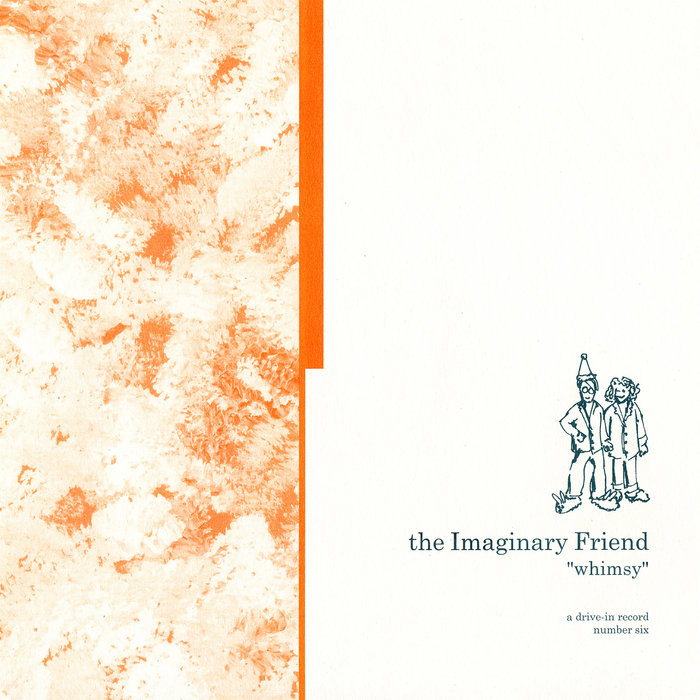
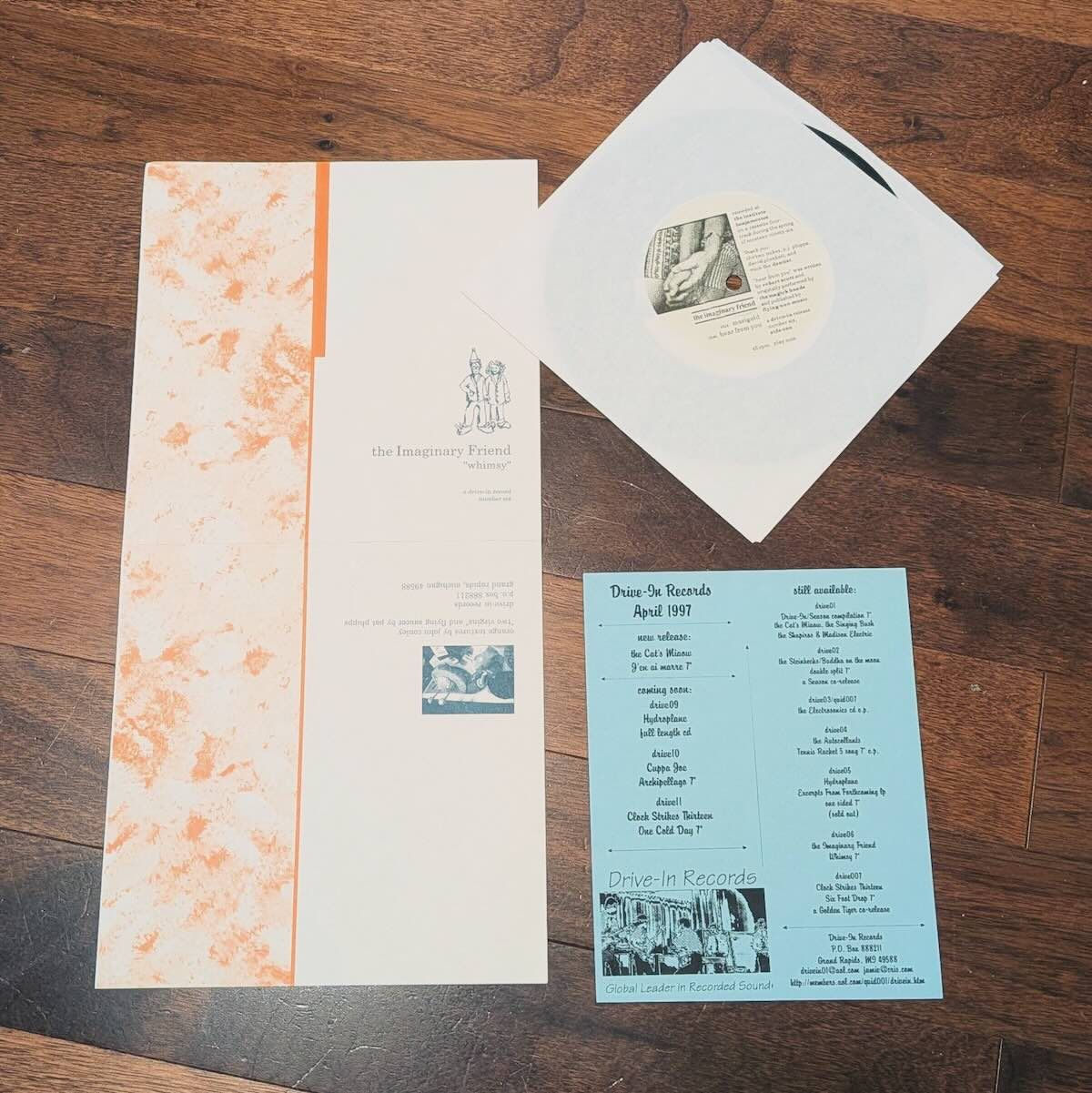
The Imaginary Friend, Nancy and my musical project, has had three 7" singles and a couple of compilation appearances in the three decades of its existence. Two of those singles have been made available here on Bandcamp; the first 7" for whatever reason evaded such conservation. Until a month or so ago when Nancy found a copy in our basement. Typically one would prefer a more pristine source than one unit out of 750 pressed in the work order queue of Nashville's United Record Pressing plant. But you get what you got.
Sure, you inadvertently got "colored" vinyl with your order, because the records were translucently brown when held up to a light, but you couldn't beat the price or the turnaround time, so complaining about "quality" seems churlish. And at the same time, having a "compromised artifact" kinda keeps you honest. You're not going to transform a rumbling, sibilant piece of fragile pop into a brickwalled, streaming-competitive product. I mean, I suppose you could if you had the means, and as much as the gear has improved here, it's still nowhere up to that level of Midas-like magic. As I said, it keeps you honest, or at least less dishonest.
We... or I initially entertained the idea of a straight rip from that 7" on our modest home stereo onto a hard drive then right up onto Bandcamp. "The 29th Anniversary Upload." No remastering, definitely not from the original tapes, no re-pressing (I think we have more copies from 1997 stashed away somewhere).
And then I gave the record a listen. A proper listen.
Nancy put the 7" on when she first uncovered that copy, and my first reactions were a mild twitch from the boomy, low frequency rumble of the vinyl, then a slight cringe when the Kevin Shields-inspired tremolo dive bomb happened on "Hear from You." Not at all a graceful way to receive a friend from three decades ago. Then Nancy went on tour, and I went along as the "road hubby" schlepping her bass. As the dust and fatigue of that short, strange trip settled, I digitized the two songs onto the laptop. Brown United vinyl on a middling turntable through a low-end Sony amplifier into the cheapest USB audio interface in Tascam's catalog and onto the most modestly priced M4 MacBook Air.
For decades I'd been playing around with iZotope's Ozone and RX mastering and repair tools, but lately I'd been on a simpler diet of Logic Pro-native plug-ins: the channel EQ, adaptive limiter, loudness monitor. That's it. Going from a rack full of Penzey's Spices to salt, pepper, and maybe some crystalized garlic. Not because I don't trust the suite of iZotope gadgets, but because I wanted to deliberately limit what I can do to a recording and to be content with the results.
So what we have here isn't that transformative re-rendering of two songs fed to an overworked cassette four-track in a tiny Houston apartment by a couple of folks who weren't aware of the limitations of the tools before them but went on making music with them anyway. You scrape away some of that low-mid and low-end cruft, and not unlike what I imagine archeologists do with a brush, details emerge. A bass part in "Marigold" that I didn't recall recording, for example. But what we have is still a fragile, brittle statement that won't stand up well against anything produced in 2026. Which is kinda the point.
I keep thinking of Rocketship's Los Angeles show – a sold out night at the Teragram Ballroom, 750 people, a goodly portion of which who weren't born when 'A Certain Smile' was released, and enough voices singing along with every single song loudly enough that I could hear from the side of the stage. That was a moment when band, songs, performance, audience, environment, and audio all converged.
In a way, that's what this single was for us. Patrick Phipps and John Conley (whom I finally got to meet in person during the Rocketship tour) contributed art for the record sleeve. Mike Babb and his Drive-In Records put in the time, energy, money, and love to get these copies printed. The mail order catalog insert puts us in fantastic company of kindred spirits who were making music for the joy of doing it. Nancy had written "Marigold" and played it for a guy who'd do his darnedest to impress her with his modest home studio. That song and its accompanying B-side got recorded, pressed, released, stashed away, dug out, digitized, and lightly decluttered. Not for perfection, posterity, or canonizing. But for listening with care.
The perfect sound isn't in your ears, nor in your memory. It's in your heart.
 dodomonster