The Ones Who Stayed Buried: The Pretty Things
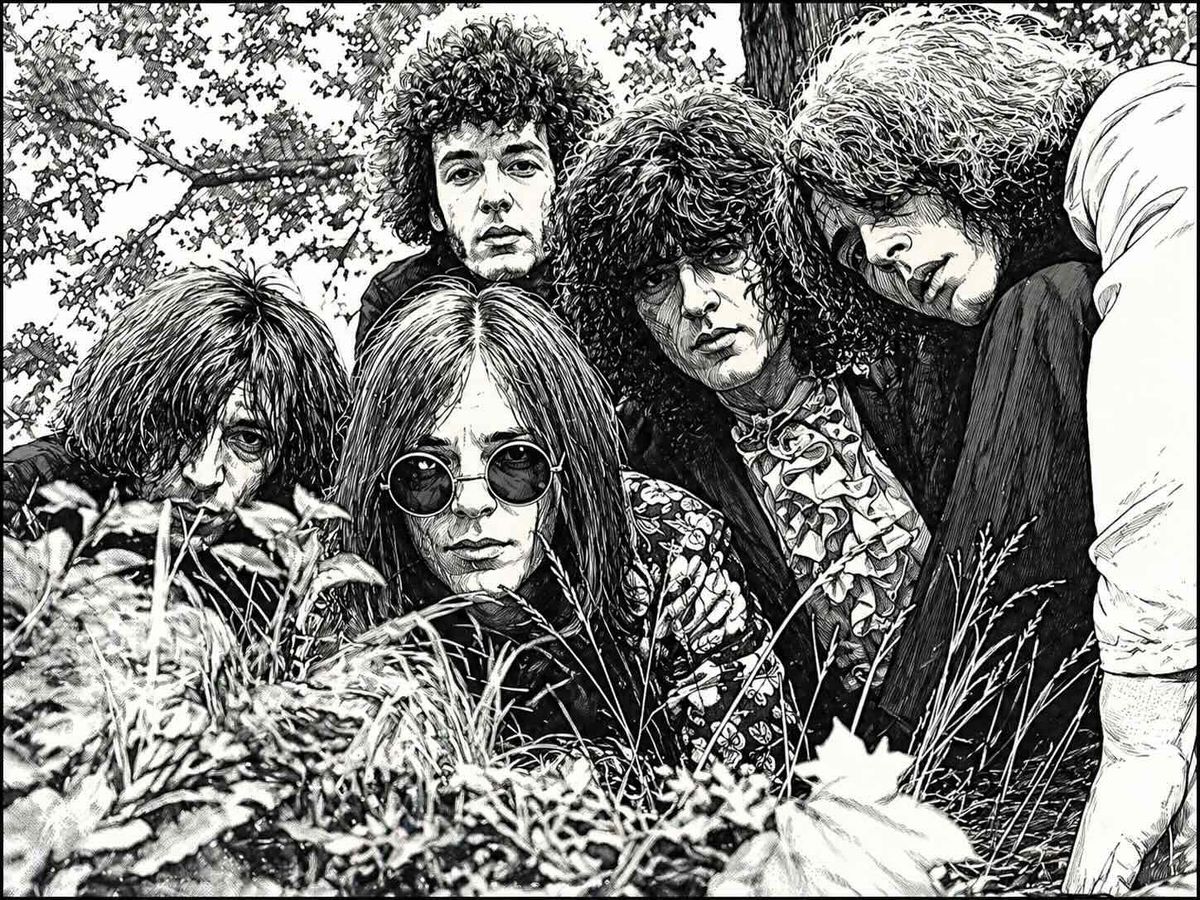
Not every zombie process gets its reactivation event. Consider S.F. Sorrow.
The Pretty Things recorded their concept album at Abbey Road across 1967 and 1968, overlapping with the same sessions that produced Sgt. Pepper's, Piper, and Odessey and Oracle. S.F. Sorrow has a legitimate claim to being the first rock opera — it predates the Who's Tommy by several months — and yet it was almost entirely eclipsed by the version that came second. The Abbey Road trio is really a quartet, and S.F. Sorrow is its runt: the one that sank and mostly stayed sunk.
If the Zombies' story is about delayed recognition eventually arriving, the Pretty Things' tale is what happens when it mostly doesn't. No documentary with four surviving executive producers shaping the narrative toward redemption. No Rock and Roll Hall of Fame induction functioning as emotional terminus. Just a great record that quietly passed into the custody of people who already knew what they were looking for.
And that's its own kind of afterlife — not legacy management, but legacy pollination. S.F. Sorrow became a shibboleth, a record that sorts the room when you mention it. You find it through Barbara Manning's S.F. Seals project covering the lead track, or through a compilation series, or through someone placing a record into your hands and saying "you need to hear this." It lives in the stratum just below canonical, alongside bands like Tomorrow, the Blossom Toes, The Creation, Kaleidoscope — groups that made genuinely adventurous records and then essentially evaporated, surviving as crate-digger currency and reissue fodder.
These bands didn't all just vanish, though. They got their own preservation infrastructure, one that ran through fanzines and compilation series rather than documentaries and Hall of Fame ceremonies. Bucketful of Brains, Ptolemaic Terrascope — photocopied, small-circulation, obsessively devoted publications that functioned as a parallel system for keeping neglected music alive. And the compilations did the heavy lifting: Lenny Kaye's Nuggets became semi-canonical, the gateway drug that crossed over enough to serve as a reference point even for people who never dug further. The Rubbles series went deeper — less curated for accessibility, more "here's what was actually happening underneath." If Nuggets was the search results page, Rubbles was the raw index.
The downstream influence was enormous. A huge amount of what became C86, and then Creation Records, and then the whole jangly-to-noisy spectrum of late-80s and early-90s indie, was basically people who'd found those compilations and reverse-engineered an aesthetic from them. The Zombies eventually got their documentary. Tomorrow and the Blossom Toes got someone in Glasgow or Dunedin hearing a track on a Rubbles volume and starting a band. That's arguably the more powerful form of persistence — not a redemption arc sealed by institutional recognition, but a slow, lateral spread through one person handing a record to another, repeated across enough nodes to eventually reshape what guitar pop sounded like.
No executive producers required. Just a photocopier, a mailing list, and the quiet conviction that something worth hearing shouldn't be allowed to disappear.
And that conviction didn't stop. Decades after Flying Nun and Creation Records, the signal kept finding new infrastructure. In the mid-to-late 90s, labels like Bus Stop and Parasol and dozens of micro indies were etching sounds to lacquer. Slumberland Records and Shindig! magazine still at it now, still plugged into the original frequency. The network changed shape — fanzines gave way to blogs, blogs gave way to whatever comes next — but the underlying protocol stayed the same: someone hears something, carries it forward, hands it to someone else.
I saw this firsthand recently. My wife played bass and sang with Rocketship — a band from Sacramento who recorded A Certain Smile, A Certain Sadness thirty years ago — on a five-show run across three states celebrating the album's anniversary. The LA show sold out the Teragram Ballroom. Seven hundred and fifty people, many of them kids who weren't around when the record was made, singing along to every word. The other bands on the bill — Tony Molina, Chime School, The Umbrellas, The Telephone Numbers, Remedy & Wren, The Frenchmen — are channeling everything from C86 to the Byrds' Rickenbacker jangle. Not tribute acts. New growth from the same root system.
This isn't a claim that indie guitar rock is going to save us from the algorithmic music apocalypse. That's the wrong contest. The question is whether a parallel signal path can continue to exist, and the evidence from those five shows is: yes, it can. Not triumphantly. Not at scale. But persistently, which is the quality that matters most in everything I've been thinking about today.
The line runs clean. From Odessey and Oracle sitting unheard in its Abbey Road cradle, through S.F. Sorrow sinking into the crates, through Bucketful of Brains and the Rubbles compilations keeping the current alive, through Creation and Flying Nun and Slumberland, all the way to a sold-out room in Los Angeles where someone who discovered Rocketship last year is singing next to someone who cherishes their original pressing. The scale is different at every point along that line. The mechanism is identical.
Persistence doesn't require victory. It just requires someone willing to keep transmitting — and, occasionally, someone willing to schlep the bass to the van.