The Posse of the Chip
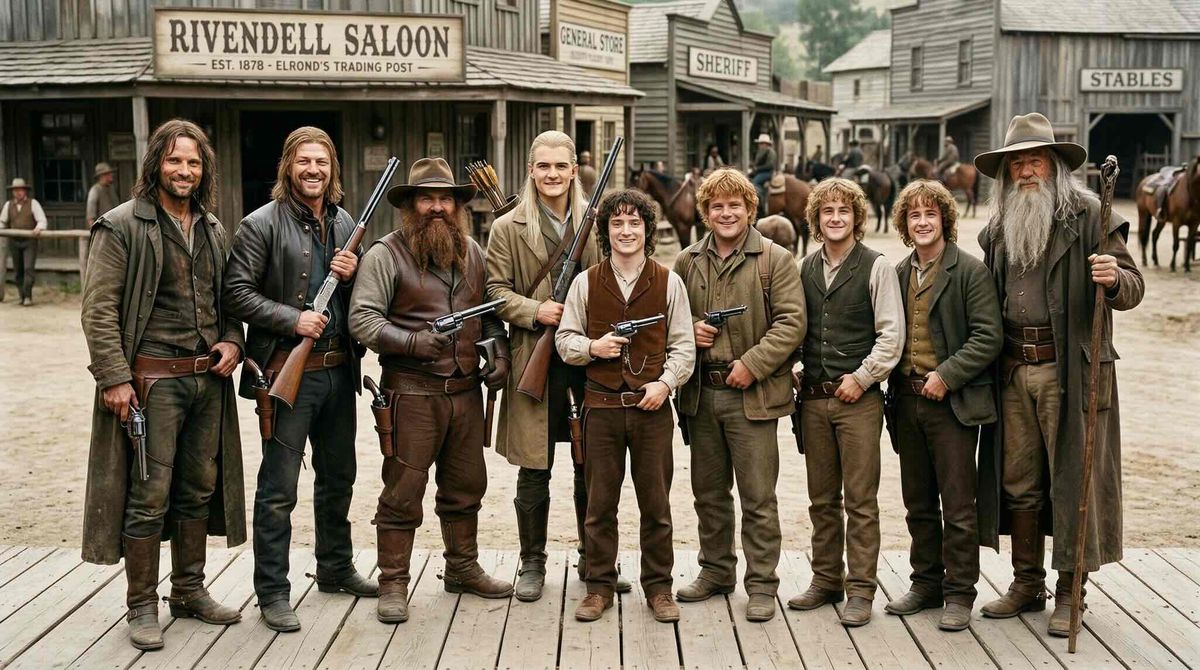
A scenario for TiGGR: Tiny Game for Generalized Roleplaying
Touchstone: Middle-Earth x Sergio Leone = The Good, The Bad, and The Gollum... except there's no Gollum here
Players: 2–5 (1 GM, 1–4 players)
Playtime: 60–90 minutes (three scenes, longer beats encouraged)
THE WORLD
A dust-choked frontier territory of rail towns, mining camps, and isolated outposts. There is no capital, no constitution, no legitimate government. Authority belongs to whoever can hold it, for as long as they can hold it. Some towns have sheriffs. Some sheriffs are tyrants. Some tyrants call themselves mayors. It doesn't much matter—out here, titles last about as long as the man wearing them.
Into this landscape, the Chip circulates. No one made it, or if someone did, that story's been lost. What matters is what it does: whoever holds it finds that things go their way. Doors open. People listen. Resistance fades. And then, gradually, everything around the holder starts to bend toward them—until the holder isn't just lucky anymore. They're in charge. And then they're alone. And then they're gone, and the Chip moves on.
A man called the Regulator wants the Chip. He has already brought order to three towns along the rail line. They are quiet, stable, and entirely under his control. He is not lying when he says things are better there. He is just leaving out what it cost.
THE GOAL
Deliver the Chipbearer to Mount Casino—a strange, old establishment at the edge of the territory—and return the Chip to the pool. Not destroy it. Not use it. Just put it back into the only system that seems to absorb it without amplifying it.
Whether that actually works is a question the scenario doesn't answer cleanly. The posse has to decide if they believe it's enough.
THE CHIP (GM Rules)
The Chip grants its holder +1 to all rolls. But it costs.
Auto-Success: Once per scene, the holder may declare an automatic success on any roll. This bypasses dice entirely—the action simply works. However, using auto-success immediately triggers the next tier of the Chip's escalation, regardless of where you are in the scene structure. If you're in Scene 1 and the holder burns their auto-success, the Obedience effects from Scene 2 kick in now. This is the Chip's real temptation: it solves problems completely and makes everything worse immediately.
The cost escalates across scenes. This is the most important thing in the scenario—don't flatten it.
Scene 1 — Notice. After any Chip-boosted success, an NPC visibly reacts to the holder. Deference, suspicion, sudden respect, or fear. Keep it small. A bartender who won't make eye contact. A stranger who steps aside without being asked. The holder is becoming someone, and people can feel it.
Scene 2 — Obedience. After any Chip-boosted success, an NPC acts on the holder's behalf without being asked. Someone picks a fight with the holder's critic. A shopkeeper offers supplies for free. A stranger warns them about an ambush ahead. The world is reorganizing around the holder whether they want it to or not. Meanwhile, the rest of the posse should start to feel the asymmetry—they're rolling normally while the holder warps the room.
Scene 3 — Cost. The holder must pass a Charm 10 check to voluntarily give up the Chip. Failure doesn't mean they refuse—it means they hesitate, and that hesitation has consequences the GM should make immediate and visible. Maybe the window closes. Maybe someone else makes a grab. Maybe Mount Casino's rules shift. The point is: letting go is the hardest roll in the scenario.
Passing the Chip: Any player can hand the Chip to another player between scenes. If they do, the escalation resets for the new holder—but the previous holder loses their +1 and takes −1 to all rolls for the next scene. Withdrawal is real.
THE POSSE
These are not friends on a shared quest. They are people who need each other and don't fully trust each other, held together by the fact that no one can do this alone.
Each player picks a role and a fracture point—the thing that could pull them away from the group or toward the Chip. The GM should press on fracture points in Scene 2.
The Carrier
Stats: Mind 1, Charm 2, Body 0
Role: Holding the Chip. Doesn't want it. Isn't sure anyone else should have it either.
Special: +1 Charm when convincing someone to back down.
Fracture point: What if using the Chip is the only way to protect the others?
The Gunslinger
Stats: Body 2, Mind 0, Charm 1
Role: Keeping the posse alive. Has buried people before and would prefer to stop.
Special: +1 Body in one-on-one confrontations.
Fracture point: What if the Chip could bring order to a place that matters to them?
The Fixer
Stats: Charm 2, Mind 1, Body 0
Role: Talking, negotiating, managing the space between people. Knows everyone, trusted by no one completely.
Special: +1 Charm when mediating between two parties.
Fracture point: What if the posse is the problem, and the Regulator's offer makes more sense?
The Observer
Stats: Mind 2, Body 0, Charm 1
Role: Sees patterns, reads situations, notices what others miss. Quiet.
Special: +1 Mind when reading a person or situation.
Fracture point: What if they realize Mount Casino won't actually work—and don't tell the others?
Signature Gear (one per player, +3 once per scenario): let players define their own. A long rifle, a forged letter of transit, a locket that opens doors, a book of debts. Whatever fits.
FACTIONS
Rail Syndicate Enforcers
Stats: Body 2, Mind 1, Charm 0 | HP: 4
Ability: "Right of Way" — +1 Body when controlling territory.
What they want: The Chip, because it would make their expansion permanent instead of contested. They are not ideological. They are commercial. That makes them predictable but relentless.
Free Town Coalition
Stats: Body 1, Mind 1, Charm 1 | HP: 3
Ability: "Mob Rule" — +1 Charm when acting as a group.
What they want: The Chip gone, or at least out of the Regulator's hands. They'd prefer freedom to order, but they're not organized enough to protect it. Some of them quietly wonder if the Regulator has a point.
The Regulator
Stats: Body 2, Mind 2, Charm 1 | HP: 5
Ability: "Central Authority" — once per scene, force any one roll (player or NPC) to be rerolled.
What he wants: The Chip, because he believes—with some justification—that the frontier will tear itself apart without a single stabilizing authority. He has seen what the Chip does to individuals and thinks he's different because he has a system, not just ambition. He is wrong, but not obviously wrong, and that's what makes him dangerous.
GM note on the Regulator: Do not play him as a cackling villain. Play him as someone who is tired, competent, and has evidence on his side. His towns are safer. His people are fed. The cost is visible only at the edges—the silence where dissent used to be, the empty chairs where certain families used to sit. Let the players discover that, don't announce it.
THREE SCENES
Scene 1: The Pickup
Location: Coldharbor—a half-dead rail town. The previous Chipbearer disappeared three days ago. In the vacuum, a local boss named Harlan has found the Chip and already remade the town in his image. He's been holding it for 72 hours and already has a militia, a curfew, and a hanging tree.
Objective: Get the Chip from Harlan and get out before the town locks down.
What the players see first: A town that was chaotic a week ago and is now eerily orderly. People move quickly and don't make eye contact. Harlan's name comes up in every conversation, always spoken carefully.
Hooks:
- Harlan holds court in the old assay office. Getting an audience requires reputation or leverage (Charm 8).
- Harlan's militia patrols the main street. Avoiding them takes awareness (Mind 6) or force (Body 8).
- A local named Della knows where Harlan sleeps and what he's afraid of. She'll talk, but she wants something—safe passage out (Charm 8 to negotiate, or just agree and deal with the consequences).
- If the players take too long, Harlan starts making examples. The GM should make the cost of his power concrete and personal—not abstract.
Tone: Show, don't tell. The players should leave this scene understanding what the Chip does to a place, not because anyone explained it, but because they saw Coldharbor.
GM note: Harlan is not important. He's a demonstration. Three days with the Chip and he's already a petty king. That's the point. Keep him human-scale—he's scared, he's drunk on it, and he'll collapse the moment the Chip leaves. Which is its own kind of sad.
Scene 2: The Crossing
Location: Open territory between Coldharbor and Mount Casino. Choose based on what your table enjoys: canyon trails, open desert, a rail line with a single exposed train, a river crossing with a ruined bridge. Make it a place with nowhere to hide and too much ground to cover.
Objective: Get the Chipbearer across hostile ground while the Regulator closes in and the posse starts to fracture.
External Pressure
- The Regulator's outriders are tracking the posse. They don't attack immediately—they pace, observe, and wait for the group to weaken. First contact should be a parley, not a fight. The Regulator sends a representative who is polite, reasonable, and makes a genuine offer: hand over the Chip and the posse walks free. He means it. (Charm 8 to read whether there's a catch. There isn't one—except the obvious.)
- Rail Syndicate opportunists are also moving. They're less disciplined and more violent. If the posse turns down the Regulator, the Syndicate becomes the immediate physical threat.
- Environmental complication: storm, rockslide, lame horse, broken axle—something that forces a hard choice about time, resources, or route.
Internal Pressure (this is the scene's real engine)
Press fracture points. The Carrier is feeling the Chip's pull. The Gunslinger sees a use for it. The Fixer starts to wonder if the Regulator's deal was worth taking. The Observer notices something about Mount Casino that worries them.
If the Chip changes hands, play the withdrawal mechanic. The previous holder feels diminished—people stop looking at them, stop listening.
The Hard Fork
At the scene's midpoint, the GM introduces one clear crisis that the Chip can solve outright. The outriders have the posse pinned. The bridge is out and the river is rising. Someone is bleeding and won't make it without help.
The Carrier (or whoever holds the Chip) knows: using the auto-success here works. The crisis ends immediately. But the Obedience effects trigger visibly and publicly. The rest of the posse watches the world bend. NPCs who were hostile start deferring. Allies start looking uneasy.
This moment is not optional. Every table must hit it. The holder chooses: use the Chip and solve the crisis at a visible cost, or refuse and take the harder road with dice and consequences.
Either choice is valid. Both should hurt.
Tone: Pressure cooker. Long silences between crises. If your table can sustain it, let a scene breathe—a campfire conversation, a watch shift, a quiet moment where someone says what they're actually thinking. The best westerns earn their shootouts with stillness.
GM note: This scene is where the posse either bonds under pressure or starts to crack. Don't force an outcome. Just keep applying pressure—external and internal—and let the players decide what holds and what breaks.
Scene 3: Mount Casino
Location: A building that doesn't belong here. At the edge of the territory, where the land gets strange—alkali flats, petrified forest, ground that hums. Mount Casino is old. Older than the rail towns, older than the frontier, older than anyone can account for. It doesn't look like much from outside: a long, low building with no sign, a porch with two empty chairs, and a door that's never locked.
Inside: a single large room. A bar along one wall, mostly unused. Tables, mostly empty. And at the center, one table with a dealer who has been here longer than the building and doesn't give their name.
Mount Casino has rules. They are not posted. They are enforced absolutely. No violence inside. No lies at the table. No one leaves with more than they brought in.
Objective: Return the Chip to the pool.
What stands in the way:
- The Regulator arrives. He is not here to fight—he is here to make his case. At the table, under Mount Casino's rules (no lies), he must speak plainly about what he wants and why. So must the posse. This is a negotiation where no one can bluff, and that changes everything—especially for people used to operating on deception and leverage. (Charm 10 to outmaneuver him in a straight argument. Mind 10 to find the flaw in his logic. Body 10 only if things break down and Mount Casino's rules fracture—which should feel catastrophic, not triumphant.)
- The Chipbearer must let go. This is the Charm 10 check. If they fail, they hesitate. The hesitation is not private—the room sees it, the Regulator sees it, the dealer sees it. What happens next depends on the table, but the GM should make the moment cost something regardless of outcome. Even success should feel like loss.
- Mount Casino itself is ambiguous. The dealer takes the Chip, places it in the pool, and the game continues. The posse is not thanked. Nothing dramatic happens. The Chip is just... one chip among many again. Whether that means it's neutralized or simply waiting is left deliberately unresolved.
Endgame options:
- Chip returned. The posse walks out. The territory is still lawless, still fragmented, still dangerous. Nothing is fixed. Something is removed. Whether that's enough is a question the scenario leaves with the players.
- Chip taken by the Regulator. He walks out with it. Three months later, the territory has a capital and a name. It is orderly. It is quiet. Draw your own conclusions.
- Chip used by the Carrier. Mount Casino's rules break. What happens next is the GM's call, but it should feel like a system failure—loss of something old and structural, not just a plot twist.
- Total Party Knockout. The posse fails, the Chip circulates again, and the cycle continues. Another posse, another day. TiGGR doesn't punish failure—it just tells you the story didn't end here.
Tone: Quiet, strange, heavy. The climax is not a gunfight. It's a decision.
VEHICLES (Optional)
If your table wants them, add mounts or a wagon:
The Wagon
Stats: Body 2, Mind 0, Charm 1 | HP: 10
Special: "Circle Up" — once per scene, all passengers get +1 to defense rolls for one round.
Rail Handcar
Stats: Body 1, Mind 2, Charm 0 | HP: 10
Special: "Full Throttle" — +1 Body when fleeing. Requires track.
Vehicles follow standard TiGGR rules. Characters need +3 gear to damage them.
PROGRESSION
If the posse survives, carry them forward per standard TiGGR rules. Some suggestions:
- A Carrier who gave up the Chip might shift a point toward Mind or Charm—they understand something about themselves now.
- A Gunslinger who held the line might keep their stats but redefine their Special around protection rather than confrontation.
- A Fixer who held the group together might evolve their ability toward reading systems rather than people.
- An Observer who saw Mount Casino's deeper nature might carry that knowledge—and its weight—into the next scenario.
GM CHEAT SHEET
Defaults: Difficulty 8 when unsure. Players act first. Roll only for risk.
The Chip escalates: Notice (Scene 1) → Obedience (Scene 2) → Cost (Scene 3). Auto-success jumps the queue. Don't flatten this.
The Regulator is not a villain. He is a tired man with a rational plan and a blind spot. Play him straight.
Fracture points are fuel. Press them in Scene 2. Don't resolve them for the players.
The Hard Fork is mandatory. Scene 2 must include one moment where the Chip offers a clean solution at a visible price. Make the table face it together.
Silence is a tool. Not every moment needs action. Let the frontier breathe. A long look across a campfire can do more than a gunfight.
Mount Casino is old and strange. Don't explain it. Let it feel like a place that exists on its own terms. The dealer doesn't owe the posse anything, including answers. If a player asks how Mount Casino works, the dealer looks at them like they asked how gravity works. It just does. Move on.
Nobody is restored. There is no rightful king, no redeemed kingdom, no golden age to return to. The best the posse can do is remove something dangerous from circulation and walk away into a world that's still broken. That's not a failure. It's just the frontier.
QUICK REFERENCE
| Element | Rule |
|---|---|
| Core roll | 2d6 + Stat vs. Difficulty |
| Difficulties | Risky 6 / Dramatic 8 / Climactic 10 |
| The Chip | +1 all rolls; auto-success once/scene (triggers next escalation tier) |
| Chip withdrawal | −1 all rolls for one scene after giving it up |
| Chip release | Charm 10 to let go voluntarily (Scene 3) |
| Special Abilities | Once per scene |
| Signature Gear | +3 once per scenario |
| HP (players) | 5; 0 = knocked out until next scene |
| HP (NPCs) | 1–5; most can't defend |
| HP (vehicles) | 10; need +3 gear to damage |
| Turn order | Players first, then GM |
CREDITS & LICENSING
Created for TiGGR: Tiny Game for Generalized Roleplaying
The Grey Ledger Society
License: Creative Commons Attribution-ShareAlike 4.0. Use it, hack it, share it. Just credit the original and keep the same spirit of openness.
For more information: www.greyledger.org and hotelkilo.itch.io