The Beatbox and the Sampler
The Funky Drummer As Late Capitalism's Everyman
A disclosure, before we begin: this essay was written with the assistance of multiple large language models — systems trained, in part, on the work of writers who were not consulted and will not be compensated. The irony is not incidental. It is the subject.
In 1969, in a Cincinnati studio, a drummer named Clyde Stubblefield played a two-bar break during a recording session for James Brown. The groove he laid down — syncopated, propulsive, alive with micro-timing that no machine could replicate — became the backbone of "Funky Drummer." It also became, by most accounts, the most sampled drum pattern in the history of recorded music.
You've heard it hundreds of times. In hip-hop, in electronic music, in pop. Chopped, looped, time-stretched, pitch-shifted, layered under tracks that have collectively generated enormous sums of money. Stubblefield saw essentially none of it. He was a session musician, paid for the date. The publishing rights belonged to James Brown. When Stubblefield died in 2017, there was a GoFundMe for his medical bills.
This is not an obscure injustice. It's a structural one. And it's the template for what's happening now, at a scale Stubblefield couldn't have imagined.
Two machines tell the story.
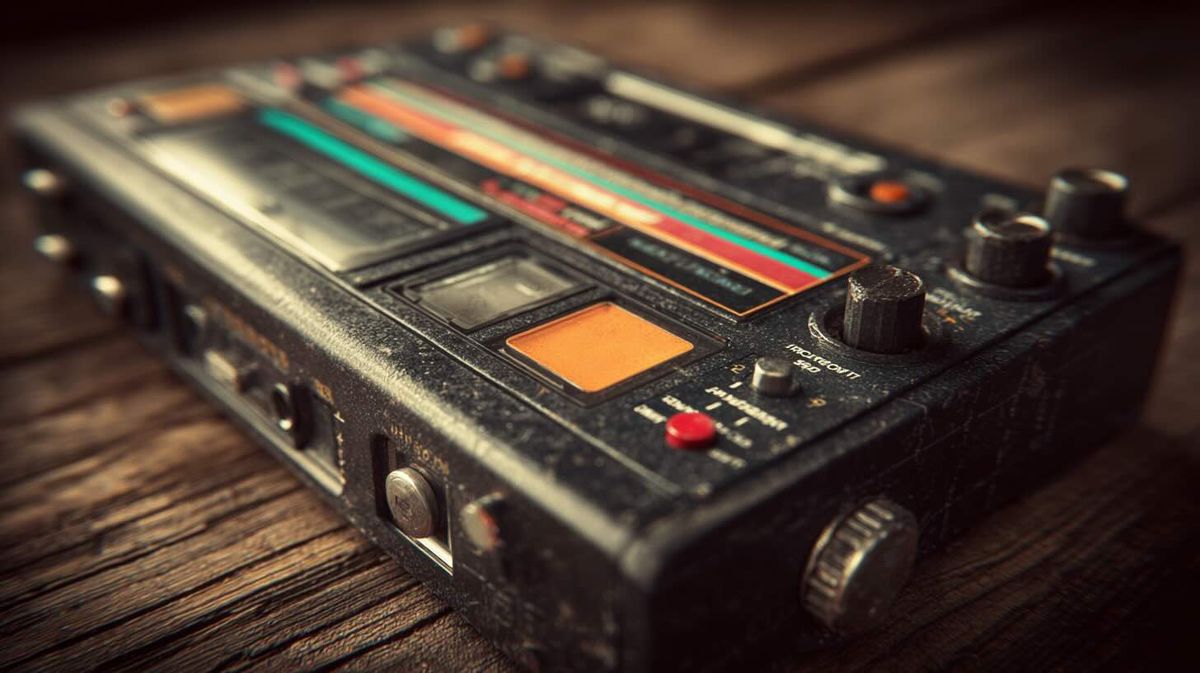
The first is the beatbox — the Roland TR-808 and its descendants. Released in 1980, the 808 was a drum machine with a programmable step sequencer: sixteen slots per bar, equally spaced, locked to a grid. It was meant to provide accompaniment for solo performers. Instead, it became the rhythmic foundation for electro, hip-hop, and most of modern pop. Musicians who couldn't play drums could now program them. The barrier fell. The music that followed was genuinely new, genuinely creative, and genuinely shaped by the grid the machine imposed.
That grid — quantized, 4/4, pattern-based — became the default rhythmic logic for vast stretches of popular music. Not because anyone mandated it, but because it was the path of least resistance. The tool's affordances became the aesthetic. The 808 didn't just enable production. It compressed variation. It pulled everything toward its center, and most users followed, because following was easy and deviation was work.
Auto-Tune did the same thing to pitch. The DAW (digital audio workstation: Logic Pro, Ableton Live, ProTools, etc.) did it to composition. Each tool introduced a grid, lowered friction, raised the floor, and gently narrowed the space of likely outputs. Each was genuinely enabling — ask any bedroom producer who can't keep time, any singer who needs a nudge toward the note they meant to hit. (I should know. My own music, such as it is, exists only because these grids carried the parts I couldn't carry myself.) But each also shaped taste by shaping defaults, and defaults, adopted widely enough, become culture. This is not a failure of individual awareness. It's how tools work. They succeed by reducing friction, and resistance is friction. The system functions precisely because most people don't push against it — and aren't meant to.
The second machine is the sampler — the E-mu SP-1200, the Akai MPC, and their lineage. Unlike the beatbox, the sampler doesn't synthesize. It ingests. It takes existing performances — someone else's drumming, someone else's bass line, someone else's vocal — and makes them raw material. The creative act on top of the sampler is real. Hip-hop producers made extraordinary art by flipping obscure records into something new. But the economics underneath were simple: someone played a session, someone else sampled it, and the value flowed to whoever owned the final product.
The sampler is the extraction machine. The beatbox is the quantization machine. Together, they describe the full architecture of what generative AI is doing to creative labor.
A large language model is not an 808. It does not synthesize from nothing. It is an SP-1200 scaled to the entire internet.
Every piece of text it produces is derived from text that humans wrote — prose, code, dialogue, analysis, jokes, arguments, confessions, tutorials, love letters. That material was ingested in bulk, processed into statistical patterns, and compressed into a system that now recombines those patterns on demand. The people who wrote the source material were not consulted. Most will not be compensated. Many will find their livelihoods repriced by the output of the very system their work made possible.
This is the Stubblefield problem at planetary scale — with one critical difference. The music industry's sampling economy eventually produced legal frameworks: clearance requirements, royalty structures, litigation. Those frameworks were imperfect and often favored the powerful over the originator, but they at least established a principle — that source material had value and its creators had claims. The AI training economy hasn't gotten that far. The ingestion has already happened, at industrial scale, and the legal and economic structures that might govern it are still being contested in courts that move at a fraction of the speed of deployment. By the time ownership is defined, the sampler will have moved on to its next version, trained on yet more uncompensated work.
Meanwhile, a neighbor of mine is looking for work because creative agencies are shutting down. Not because AI produces better design than he does — it doesn't — but because it produces cheap enough design to satisfy clients who were buying on budget, not on quality. The middle of the market, where solid professionals did competent work for fair compensation, is being squeezed. Not by superior craft, but by altered economics. The sampler got bigger, the samples got cheaper, and the people who played the original sessions are updating their resumes.
And the beatbox grid is operating in parallel. Generative AI doesn't just extract — it normalizes. Its outputs are pulled toward the statistical center of its training data. The most probable next word. The most common structure. The smoothest, most frictionless version of whatever you asked for. You can push against this with skill and intention, but the gravitational pull is always toward the mean. And most users, reasonably, don't push. They accept what the tool offers, because it's adequate, and adequate is easy, and easy is the whole point of the tool.
The result is a landscape where production is democratized and variation is compressed. More people can make more things — and that's real, and it matters. But what they make converges on a narrower band of possibility, shaped by defaults they may not even recognize as defaults. The grid isn't visible the way an 808's step sequencer is visible. It presents its output as natural, varied, responsive. The quantization is enmeshed with the math.
And yet.
In Chicoutimi, Quebec, two musicians in papier-mâché proboscis-monkey masks are playing microtonal math rock on a custom double-necked guitar with twice the usual number of frets. Their music uses quarter-tones — the notes that live in the cracks between the piano keys, the spaces no Western grid represents. Six million people have watched their KEXP session. Resale tickets top five hundred dollars. Their fan base skews toward people who describe themselves as opposed to anything AI-generated.
Angine de Poitrine is proof that the appetite for the unsimulatable is real. When someone tried to prompt an AI to produce music in their style, the result was a less adventurous kind of prog rock. The model couldn't reproduce the thing that makes them matter, because that thing lives in the specificity of two humans who've played together for twenty years, making deliberate choices that no optimization function would arrive at.
The same recommendation algorithm that surfaces AI-generated content is what brought Angine de Poitrine to millions of viewers. The system that compresses variation is also, occasionally, the system that distributes the exception. And the exception — once visible enough — becomes a data point, a market signal, a thing that someone, somewhere, will try to approximate at lower cost. The cycle is predictable: emergence, visibility, approximation, flattening. What begins as proof that the grid can't capture everything becomes, in time, the next thing the grid learns to imitate.
I once ran an a cappella track by shambolic indie icons Beat Happening through Auto-Tune. Calvin Johnson's voice — deep, flat, deliberately untrained — is the opposite of what pitch correction is designed to fix, because it isn't broken. It's the whole point. Auto-Tune pulled every note to the nearest semitone on the chromatic grid. The result was technically correct and aesthetically terrifying. The software did exactly what it was supposed to do, and in doing so, it erased the only thing that made the performance worth hearing.
The grid worked perfectly. The output was "correct." And something essential disappeared. Sorry, Calvin.
We are all Clyde Stubblefield in late capitalism's SP-1200. Not all of us equally — some people's work is more extractable than others, and some will benefit from the tools that run on our collective output. But the structural relationship is the same: we provide the raw material, the system processes it into something monetizable, and the returns accrue to whoever owns the machine.
The music made on that machine can still be good. The creative decisions made at the prompt end can still be real. People will genuinely enjoy what comes out — and that enjoyment is not a delusion or a failure of critical awareness. It's real, and it matters. But it's also part of how the system stabilizes. Enjoyment is what closes the loop. It's what turns extraction into entertainment, and displacement into that proverbial Tuesday. The thing works because people like what it produces, and liking what it produces makes the underlying economics feel inevitable rather than chosen.
And Clyde Stubblefield will still be a cautionary tale dressed up as a fun fact about hip-hop history.
I've been describing this as a machine — the beatbox, the sampler, the grid. Clean metaphors with inputs and outputs and a legible structure you can diagram on a whiteboard. But that's too tidy. It implies a boundary between you and the system, a place where the machine ends and the person begins. It suggests you could step outside, if you wanted to, and observe the thing from a distance.
You can't. It's more like a turducken.
A turducken — three birds shoved inside each other, cooked together until the boundaries are technically present but functionally meaningless — is not a dignified metaphor. It's excessive, ungainly, vaguely absurd. That's why it's accurate. The tool that helps me make music and the extraction economy that powers it and the labor displacement it causes and the genuine enjoyment it produces and the legal vacuum it operates in — these aren't separate systems I can evaluate one at a time. They're layered inside each other. The juices have mingled. The flavors have bled. I consume them together every time I open a prompt window, or watch a generated video, or write an essay in conversation with the thing I'm critiquing.
A colleague of mine — a technologist, someone whose job now involves AI daily — put it as honestly as anyone has: "I have major ethical concerns with this tech, I hate it, and I'm embracing it all at the same time." That's not a contradictory position. It's three birds in one. The ethical concern and the dislike and the use aren't in tension because they occupy different positions relative to the system. They're in tension because they're fused together inside the same person, the same workday, the same set of choices. There's no way to carve out one without cutting into the others.
And nobody designed the turducken to be elegant. It just is what it is — a thing that happened, that people participate in, that some people love and some people find grotesque and most people don't think about too hard because they're famished.
So what's left, when the diagnosis is complete?
Every framework I've used in this essay — the grid, the sampler, the extraction economy, the normalization machinery — describes the system accurately. And none of them tells me what to do about our dog.
She's lying on a fleece blanket right now. She has the world-weary patience of someone who has listened to this entire argument and is profoundly unbothered by it. Her name is Delia. She is, by any reasonable assessment, a manic cryptid with doe eyes. No optimization function arrived at her face.
I could describe her to an AI and get back an image that a stranger might find convincing. It would have the right number of legs, the right general shagginess, something approximating her expression. It would be wrong in every way that matters to me. Not because the technology is insufficient, but because the value of Delia on that blanket has nothing to do with what can be captured or generated. She is not content. She is not a data point. She is not a sample. She is ours, and that fact doesn't require anyone's framework to be legible.
And that — not the structural analysis, not the Stubblefield metaphor, not the recursive irony of writing about AI with AI — is where I actually land.
The grid is real. The extraction is real. The compression is real. Tuesday is real. I am inside the turducken, and so are you, and neither of us is getting out. But there is a difference between recognizing that the system is total in its reach and accepting that it should be total in its claims. Some things are not for the grid. Not because they're unsimulatable — that's still the system's framing, measuring everything by whether the machine can replicate it. But because you decided they're not in play. Because you said: not this.
Not everyone has a nutty pooch on a fleece blanket. But I'd like for everyone to have something — a walk, a meal, a conversation that isn't recorded, a skill practiced badly and for no audience, a relationship that isn't documented, a patch on a modular synth that exists for thirty seconds and then is gone — that they choose to keep out. Something that doesn't owe the discourse anything. Something whose value is not that the grid can't capture it, but that you won't let it.
That's not a solution to the Stubblefield problem. It won't fix the economics or close the legal vacuum or slow the compression of the middle market. It won't make Tuesday stop coming.
But it might be the thing that keeps Tuesday from being the whole week.
The question was never "will the machine make good things?"
It will.
Instead consider: who played the session, and who owns the sampler?
And maybe, underneath that: what are you keeping for yourself?
This essay was drafted in conversation with Claude (Anthropic), ChatGPT (OpenAI), Grok (X), and Gemini (Google). The author's words, ideas, and arguments were processed, reflected, extended, and — let's be honest — quantized. Somewhere in the training data, there are writers and thinkers whose work made this possible. They didn't agree to it. The irony remains the subject. Delia was not consulted and does not care.