The Dark Matter Surrounding Grimdark
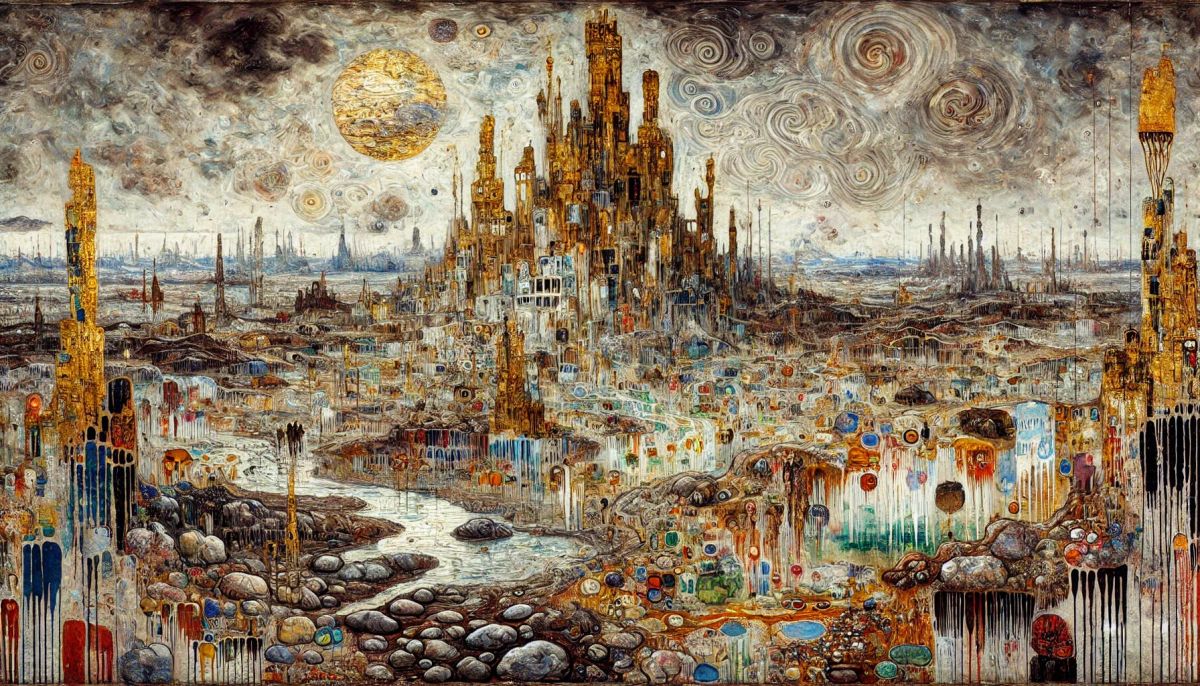
In cosmology, dark matter is what physicists posited when the math stopped closing. Galaxies were rotating faster than their visible mass could account for; stars at the rim should have flown off into the void, and didn’t. Something else had to be there — distributed, gravitationally active, optically invisible — holding the spiral together. The visible stars were real. They were also, as it turned out, a minority of the actual mass.
Genre fiction has a similar rotation problem.
Consider Necromunda: a Games Workshop tabletop skirmish game launched in 1995, set in a miles-tall hive city on a poisoned planet, populated by gangs of mutated workers and outcasts feuding for territory beneath an Imperial overlord too distant to govern and too lethal to ignore. The official genealogy is well-documented and accurate as far as it goes: 2000 AD, Judge Dredd, cyberpunk, the visual language of Blade Runner, Thatcher-era British comics culture, and the commercial logic of needing to differentiate miniatures by faction.
Necromunda’s specific gravity — the way it pulls on a reader, the way its details cohere into something more than the sum of its named influences — requires positing mass that is not in the credits. Not a secret source. Not a buried key. A halo: distributed, inherited, gravitationally active.
The visible Necromunda is easy to describe. The setting is vertical. At the top, in the Spire, dwell the noble houses, exchanging calling cards and observing etiquette while their planet poisons itself. Below them, in Hive City, the working masses toil in factorums producing weapons and goods for a war ten thousand years long. Below them, in the Underhive, are the gangs — the narrative engine of the game — organized into Houses, each with a distinctive aesthetic and pathology.
Goliaths are vat-grown muscle, dying young of organ failure they were designed to suffer. Eschers are an all-female house wielding poisons. Orlocks are working-class iron lords. Van Saars are tech-obsessed and slowly dying of inherited radiation sickness. Cawdor are masked religious zealots whose masks hide faces too disfigured to show. Delaques are paranoid spies, paranoid mostly of each other.
Below the gangs are the Scavvies — feral mutants scraping by on fungus and rats. Below them, the Sump — toxic, half-ruined, occasionally haunted. The whole structure is presided over, nominally, by Lord Helmawr, a doddering cloned aristocrat who hasn’t left his palace in centuries; and pressed upon, intermittently and lethally, by Imperial enforcement when local affairs become too embarrassing to ignore.
Violence is endemic. Resources are scarce. Mobility is mostly downward. Mutation is environmental: you are deformed because your mother drank from the wrong puddle, or because your house works the irradiated forges, or because the air at your level contains something it shouldn’t. The Imperial state extracts what it needs and leaves the rest to grind.
The game’s entire economy of stories — gang feuds, vendettas, territorial wars, the slow careers of named characters who level up, take injuries, and eventually die — runs on this substrate.
That is what is observable. That is the visible mass. The official genealogy explains roughly half of it.
Dredd contributed the silhouette: the mile-high city, the brutal lawmen, the citizenry rendered grotesque. Blade Runner contributed the visual texture of decay — neon on rust, rain on architecture, infrastructure exceeding maintenance. Thatcher-era comics culture — 2000 AD, Pat Mills, the British underground — contributed the tonal ferocity, the willingness to render authority as straightforwardly hostile rather than benignly flawed. The miniatures-business logic explains the faction taxonomy: you need visually distinct gangs to sell visually distinct boxes.
However, none of those influences, alone or in combination, quite accounts for the texture of Necromunda — the specific feel of a sourcebook paragraph describing a Cawdor flagellant, or the joke embedded in Lord Helmawr being a senile aristocrat in a setting otherwise full of demigod warriors, or the way Goliath body horror plays simultaneously as bro-comedy, industrial satire, and tragedy.
Dredd gives you silhouette, but not manners. Cyberpunk gives you decay, but not aristocracy — Blade Runner’s Los Angeles has corporations, not nobles. Thatcher-era ferocity gives you politics, but not quite the comedy; 2000 AD could be many things, but Necromunda’s flavor text often lands in a specifically British class-comic register: fatalistic, grotesque, and funny because nobody inside the horror has the luxury of finding it surprising. Commercial logic explains that there are factions. It does not fully explain why these particular factions feel like families, workplaces, denominations, hereditary diseases, and bad local pubs all at once.
Like those galaxies, Necromunda rotates faster than its visible mass should permit. Something else is pulling on it.
Those uncredited shapers are mostly British, and mostly older than the game’s founders thought to cite. Some they likely read. Some they probably breathed.
The Underhive moves as if Henry Mayhew’s London Labour and the London Poor is nearby, with the lights off. Mayhew’s 1851 survey catalogued the toshers who scavenged the Thames sewers and the mudlarks who picked the riverbanks at low tide; Necromunda’s Scavvies and sump-dwellers occupy a related imaginative pressure zone, where poverty becomes topography and survival becomes a specialized trade. The hive’s plumbing-haunted lower levels, its company-town factorums, its hereditary occupational diseases, rhyme with the Black Country and the Manchester slums of Engels and Gaskell rendered vertical. Van Saar’s radiation sickness is not literally phossy jaw with sci-fi makeup, but it sits in the same moral weather: the body cashing the check for work the economy required and then disowned. Goliath’s vat-grown brevity does not decode neatly into a Victorian foundry worker’s life expectancy, but it echoes the same brutal joke. The laboring body is used up, and the system calls that normal.
The aristocracy — which American cyberpunk almost never includes, and which Necromunda absolutely depends on — comes from somewhere else entirely. Lord Helmawr moves in the gravitational field of Mervyn Peake’s Earl of Groan: a decaying ruler presiding over crumbling ritual in a structure nobody can fully map, attended by functionaries observing protocols whose purposes have been lost. The Imperial House’s ossified ceremony, its cloned succession, its layered etiquette over layered decay, has Gormenghast bones with chainswords laid on top.
The comedy register is British class-comic prose: the blend of fatalism and absurdity that runs from Dickens through the Ealing comedies through Monty Python through Yes Minister. Cawdor zealots whose masks hide their poverty’s literal disfigurement are tragicomic in a register 2000 AD alone does not quite supply. A Goliath posturing about strength while dying of designed obsolescence is kitchen-sink pathos wearing bionic limbs. The joke is funny because the joke is fatal.
The dread layer is Hammer Horror and folk horror. The Spyrer Hunts — nobles in exotic powered armor stalking the underclass for sport — are The Most Dangerous Game and genteel fox hunts by way of The Wicker Man. The hive-haunting and dome-ghost stories are M.R. James in ducting. Cawdor’s Redemption is Witchfinder General with bolt guns. The horror is not only that bad things live in the dark. It is that the dark has local customs.
And then there is the dark matter that does not have a single name.
The editors at Games Workshop whose copy-editing produced a consistent flavor-text voice across decades of sourcebooks. The translators who carried dystopia, gothic fiction, Russian revolutionary dread, and European grotesquerie into the language of later genre writers. The wives, partners, friends, and households that made writing possible without appearing as writing. The players — overwhelmingly the dark-matter mass of any tabletop setting — whose campaigns, house rules, battle reports, kitbashed conversions, forum arguments, and half-remembered campaign legends have produced more Necromunda than Games Workshop ever wrote.
Since 1995, those players have not simply consumed the setting. They have occupied it. They have painted it, argued with it, repaired it, expanded it, and fed their interpretations back into the official material so completely that canon and reception are no longer cleanly separable. A tabletop setting is always more porous than a novel. It has to be. Its final form is not what the publisher prints; it is what the table keeps doing.
Necromunda’s halo is Mayhew, Peake, kitchen-sink pathos, Hammer Horror, industrial disease, class comedy, editorial continuity, hobby labor, and a thousand uncredited maintainers of the form. None of these were necessarily what the founders thought they were doing. All of them were nearby while the thing took shape.
Even Peake’s presence in the halo arrives through preservation labor. His wife, Maeve Gilmore, preserved, interpreted, and extended his work after Parkinson’s disease took his hands. The books survived to keep exerting pressure because someone maintained the conditions of their survival. That matters here not as biographical trivia, but as method. Dark matter is often maintenance: the labor that lets a visible body keep acting visible.
This is a halo argument, not a hidden-cause argument. The claim is not that the founders of Necromunda were secretly reading Mayhew, or that Gormenghast is the real source and Dredd is somehow false. The visible influences are visible because they are really there. 2000 AD is in there. Blade Runner is in there. The commercial logic of selling miniatures is definitely in there.
The claim is smaller and stranger: that the visible mass alone does not explain the artifact’s motion, and the gravitational sources doing the rest of the work are distributed, inherited, unnamed, and often maintained rather than authored. British creators making British genre work in 1995 were breathing British literary air whether they cited it or not. American readers reaching reflexively for Dredd as the reference point are seeing the silhouette and missing the manners.
None of this requires anyone to read the halo before enjoying the game. You can roll dice for your Goliath gangers and have a perfectly good Saturday afternoon without ever thinking about toshers, Peake, phossy jaw, or the politics of editorial continuity. The halo exists for whoever notices that their sourcebook's prose has a particular register and wonders where that came from.
It came from upstream. And most of that upstream is invisible. As the saying goes, it's a feature, not a bug.
Twice a day we feed our dog Delia, who digs into her bowl without giving any thought to how the kibble and freeze-dried salmon were formulated, sourced, manufactured, marketed, distributed, and purchased. When she hears the bags crinkle, she knows num-nums are afoot; logistics remain off her radar. None of this is a slight on Delia, or on the Necromunda players rolling dice. The bowl is sufficient. The Saturday is sufficient. The argument is about what surrounds the sufficient — and on that note, a joke:
There is a joke that floated through American business culture in the 1990s, in the early days of factory automation. The Factory of the Future, it ran, will have two employees: a man and a dog. The man’s job is to feed the dog. The dog’s job is to make sure the man does not touch anything.
The current iteration of that joke has a third employee.
The Factory of the Future has three employees: a man, a dog, and a woman who keeps asking why the factory exists. The man feeds the dog. The dog watches the man. The woman keeps asking. Eventually they automate her meeting notes with a chatbot, mark the action items complete, and remove her from the invite.
This detour was about a particular kind of dark matter: not just hidden influence, but hidden questioning, not just uncredited labor, but the maintained position from which an artifact, a factory, a hive, or a genre can be asked what it is doing. The visible machine depends on that position even when it does not name it. Especially when it does not name it.
Necromunda is one such artifact: a visible machine of gangs, guns, houses, hive levels, bad air, black comedy, and inherited violence, bent by masses it does not name. Some of that mass is influence. Some of it is labor. Some of it is the question the machinery would rather not hear.