Runner-class Data Courier
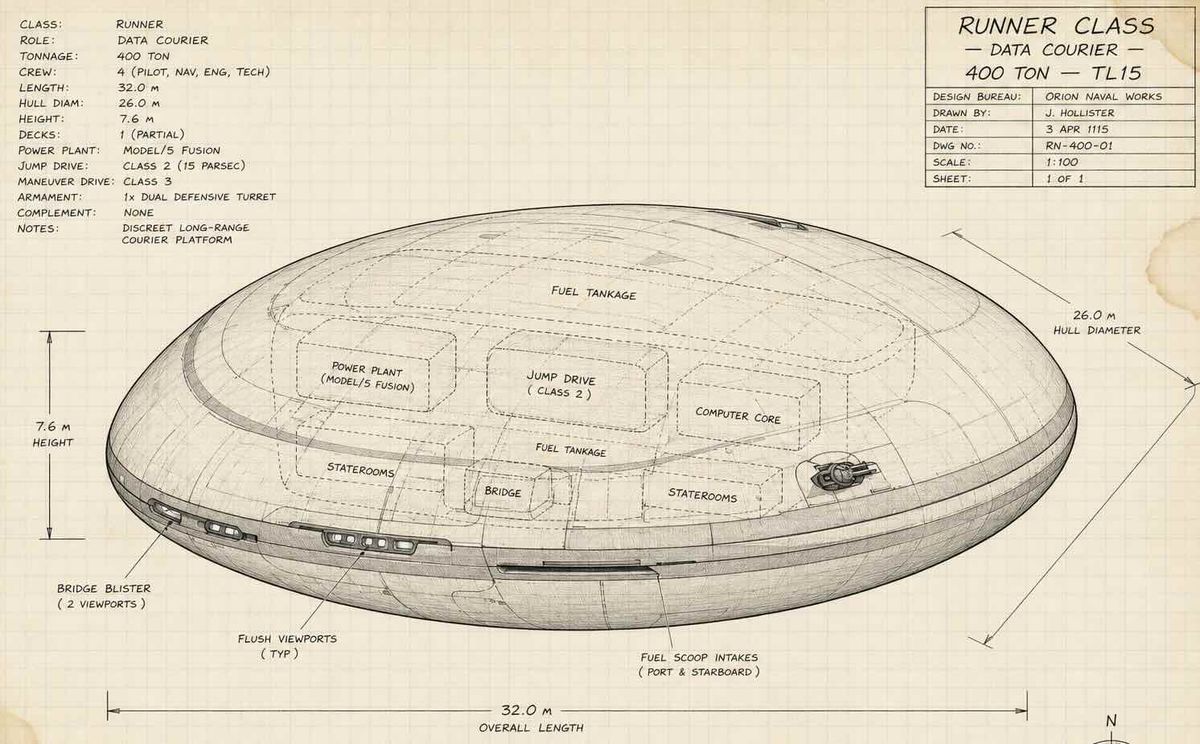
Classic Traveller Book 5 High Guard (1980, second edition), rules as printed. TL15, 400 tons.
Description
The Runner-class data courier is a dedicated jump-6 express vessel built to shuttle high-volume data payloads across a single six-parsec link between two prosperous tech level 15 worlds. Governing tech level is 15. Its 400-ton hull is a fully streamlined flattened sphere (hull cost, including −20% adjustment for flattened sphere configuration: MCr32), capable of atmospheric entry, ocean landing, and gas giant skimming — capabilities held in reserve for misjump self-rescue rather than routine operations, which are conducted entirely between orbital terminus stations.
The ship is jump-6 (28 tons; MCr112), maneuver-1 (8 tons; MCr12), and power plant-6 (24 tons; MCr72). The power plant provides 24 energy points. Fuel tankage comprises 240 tons for jump fuel and 24 tons for power plant fuel, a total of 264 tons — one full six-parsec jump plus four weeks of operations. Fuel scoops are fitted (MCr0.4) and a fuel purification plant sized to full tankage is carried (3.96 tons; MCr0.0396), permitting the ship to skim, refine, and jump home unassisted in the event of a misjump into an off-route system. In routine service the ship burns refined fuel supplied by the terminus stations' in-system scoop fleets.
A bridge (20 tons; MCr2) and a computer Model/9fib are installed (26 tons; MCr200; 12 energy points). The Model/9fib — battleship-grade electronics with fibre-optic backup against radiation — is the ship's reason for existing: the data payload is received by transmission from the terminus station immediately prior to jump, carried through jumpspace, and burst-transmitted onward the moment the ship returns to normal space, after which the Runner docks under its own power (unlike an express boat, which must be recovered by tender).
The ship carries no armor, no spinal mount, and no bay weaponry. A single dual turret (1 ton) mounts one sandcaster (MCr0.25) and one pulse laser (MCr0.5; 1 energy point) as two single-weapon batteries — mixed turrets being permitted on ships of 1,000 tons and under. At tech level 15 the sandcaster rates factor 3 and the pulse laser factor 2. The fit is wholly defensive and requires no expendable stores: the sandcaster obstructs incoming laser and energy fire, and the pulse laser fires in the anti-missile role, covering the vulnerable transmission window after emergence. Route security is otherwise the responsibility of the system defense boat squadrons protecting each terminus.
The crew numbers six (pilot, navigator, two engineers, medic, gunner) and is quartered in six individual staterooms (24 tons; MCr3). A cargo hold of 1 ton is provided, sufficient for priority mail or small high-value freight.
The ship has an agility of 1; it has an emergency agility of 1.
Cost of the first unit is MCr434.19 (add 1%, MCr4.34, for the naval architect's fee if procured privately rather than by a government design bureau). Additional identical units of the class complete at 80% of original cost, MCr347.35, in 80% of the original construction time. Construction time for the class is 36 months or less at any class A starport shipyard.
Statistics
XR-0001 Runner XR-46616J1-030000-20000-0 MCr434.19 400 tons
                                    Crew=6.
                                    TL=15.
Passengers=0. Low=0. Cargo=1. Fuel=264. EP=24. Agility=1. Troops=0.
Note: laser is pulse. All weapon factors are single batteries.
USP breakdown: type XR (express); tonnage code 4 (400 tons); configuration 6 (flattened sphere, streamlined); jump-6; maneuver-1; power plant-6; computer J (Model/9fib); crew code 1 (1–9 aboard); armor 0; sandcasters 3; meson screen 0; nuclear dampers 0; force field 0; repulsors 0; lasers 2 (pulse); energy weapons 0; particle accelerators 0; meson guns 0; missiles 0; fighter squadrons 0.
Component breakdown
| Item | Qty | Factor | Tons | EP | MCr |
|---|---|---|---|---|---|
| Hull, flattened sphere (streamlined, −20%) | 1 | config 6 | (400) | — | 32.00 |
| Jump drive, jump-6 (7% of hull) | 1 | J-6 | 28.00 | — | 112.00 |
| Maneuver drive, 1-G (2% of hull) | 1 | M-1 | 8.00 | — | 12.00 |
| Power plant-6 (TL15: 1% × Pn) | 1 | P-6 | 24.00 | +24 | 72.00 |
| Fuel tankage, jump (10% × 6) | — | — | 240.00 | — | — |
| Fuel tankage, power plant (1% × 6) | — | — | 24.00 | — | — |
| Fuel scoops | 1 | — | — | — | 0.40 |
| Fuel purification plant (264 t capacity) | 1 | — | 3.96 | — | 0.04 |
| Bridge (2%, minimum 20 tons) | 1 | — | 20.00 | — | 2.00 |
| Computer Model/9fib | 1 | J | 26.00 | 12 | 200.00 |
| Dual turret (shared mount, 1 hardpoint) | 1 | — | 1.00 | — | — |
| — Sandcaster (factor 1 +2 at TL10+) | 1 | 3 | — | 0 | 0.25 |
| — Pulse laser (factor 1 +1 at TL13+) | 1 | 2 | — | 1 | 0.50 |
| Staterooms | 6 | — | 24.00 | — | 3.00 |
| Cargo hold | — | — | 1.04 | — | — |
| Total | 400.00 | 13 of 24 | 434.19 |
Energy budget: 24 EP available; 13 committed (computer 12, pulse laser 1); 11 EP surplus → agility floor(11 ÷ 4) = 2, capped at maneuver-1 → agility 1. Combat jump requires 24 EP over one to two turns.
Operational notes
- Fleet sizing. One departure per day from each terminus, with a ~7-day jump and station turnaround, gives a ~15–16 day round-trip cycle: approximately 16 hulls on the line plus 2–4 in maintenance rotation. Fleet acquisition at class pricing: first hull MCr434.19, each subsequent MCr347.35 — roughly MCr6,300–7,000 for an 18–20 ship stable.
- Fuel demand. Each departure consumes 264 tons of refined hydrogen; two departures daily totals ~528 tons/day across both terminus stations, defining the duty of the in-system scoop fleets.
- Misjump doctrine. Scoops + purification + full streamlining give every hull an unassisted recovery path: skim any gas giant or water world, refine, and jump home. The four-week power plant endurance bounds the recovery window.
- Data capacity. The Model/9fib's 40/90 CPU/storage rating governs program handling under the Book 2 software rules; interpreting it as message-payload capacity is a campaign convention layered on the rules, not a rules quantity.
Verification status
All previously flagged values used by this design have been verified against page scans of the printed book (chart sheet p.23 and the Turret Weapons chart):
- Flattened sphere price modifier −20% — confirmed.
- Maneuver-1 drive cost MCr1.5/ton — confirmed.
- Sandcaster TL modifier +2 at TL10+ (factor 3 as built) — confirmed.
One rules-as-printed quirk remains, noted for the record rather than as a doubt: the TL15 fuel purification cost of Cr150,000 per 1,000 tons breaks the table's otherwise declining pattern, but is what the book prints and what its own Kinunir arithmetic uses. Every figure in this design is therefore fully attested.
Save file
Rehydrate or iterate on this design with:
python scripts/hg_calc.py --tonnage 400 --config 6 --tl 15 --jump 6 \
    --maneuver 1 --pplant 6 --computer 9fib --scoops --purification \
    --turrets sand=1/1,pulse=1/1 \
    --misc -1:0:"(sand + pulse laser share one dual turret)" \
    --crew 6 --staterooms 6 --type XR --name Runner