Orks & OGRE
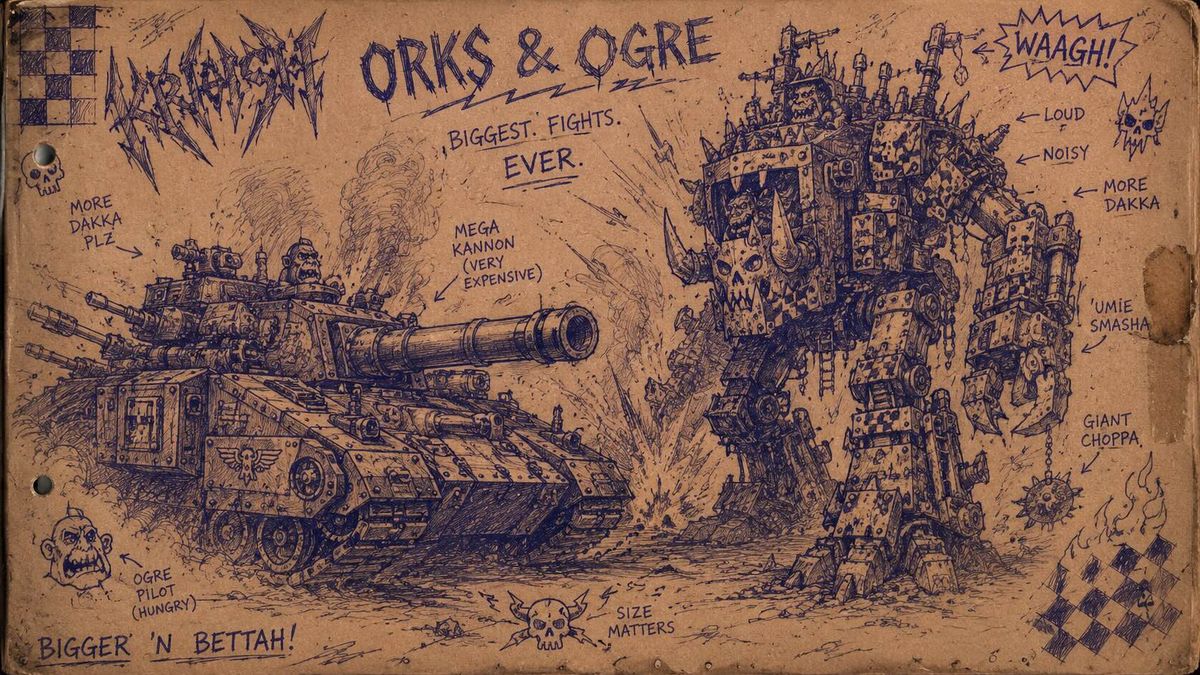
A pocket wargame about Orks trying to stop, loot, ram, board, dismantle, and/or die memorably beneath a cybernetic supertank.
Based on the design chassis of Ogre by Steve Jackson Games. This is an unofficial fan hack. Warhammer 40,000 and all associated names are the property of Games Workshop. Ogre is the property of Steve Jackson Games. No challenge to those trademarks is intended or implied.
What This Is
Ogre is a game about stopping an unstoppable machine. One player controls a cybernetic supertank of vast destructive capability. The other controls a conventional combined-arms force trying to strip it down before it reaches the command post. It fits in a Ziploc bag. It is brilliant.
Orks & Ogre asks what happens when the defending force is Orks.
The answer is: roughly the same thing, but louder, with more theft.
The Ogre player still has an objective. The Ork player also has an objective, but they additionally have Glory — a parallel scoring system that rewards the behavior that makes Orks feel like Orks. Recklessness is a resource path. Catastrophe is content. If the Orks get pasted, it can still be a win.
You will need: The Ogre base game (for the Ogre unit, its record sheet, terrain rules, and combat resolution table). This booklet adds the Ork force, Glory rules, and three scenarios.
The Design Constitution
Everything fits in a bag. Everything occupies one hex. Every unit has one job. The Ogre has an objective. The Orks have Glory. The Mek has a terrible idea.
Definitions
These terms are used throughout the rules. Read this section before the roster.
Ogre-class unit: A Stompa, Squiggoth, or Gargant. These units use subsystem record tracks rather than single hit points, and certain Ork rules apply to them specifically.
Under fire: A unit is under fire if at least one enemy unit with a remaining Attack factor is within Range 2 of it and has line of sight to it. Use standard Ogre line-of-sight rules.
Carrying a marker: A unit that has picked up a Looted Tread marker is carrying it. Carried markers move with the unit. A unit's carry limit is stated in its rules entry. A unit that exceeds its carry limit must immediately drop the excess markers in its current hex.
Last gun in a category: The final undestroyed weapon of a named type on a record card. For example, if a Gargant has lost three of four Grot Bomms, the remaining Grot Bomm is the last gun in that category. The category is defined by the weapon name, not the battery grouping.
Disabled system: A weapon or movement box that has been crossed off a record card. Disabled systems cannot be used unless repaired by a Mek.
Self-inflicted disaster: Any game event caused by an Ork special rule that damages or destroys a friendly unit. Overcharge misfires, Squiggoth Enrage attacks on friendly units, Ram survivors who fail their roll, and Misfire scatter onto friendly units all qualify. Required for Legendary Stupidity.
The Ork Roster
Ork units use the same stat line as standard Ogre units: Move, Attack, Defense, Range. Infantry also have Strength (number of squads). Ogre-class units have subsystem record tracks.
When a rule says roll d6, use a standard six-sided die.
Fast Harassment
Warbikes / Buggies (≈ GEV) Move 3/2 — Attack 2 — Defense 1 — Range 1 — Strength 1
Two-phase movement like GEVs. One hit destroys them.
Their job is not to win fights. Their job is to make the enemy spend good attacks on bad targets, block movement corridors, and exploit units that have already been damaged. A Buggy that dies having absorbed a main battery shot is a Buggy that did its job.
Red paint job: Once per game, one Buggy unit may declare a red paint job before moving. It moves 4/2 instead of 3/2 that turn. It also immediately suffers a Defense 1 attack from its own enthusiasm.
Trukk (≈ light transport) Move 3 — Attack 2 — Defense 2 — Range 1
Can carry one infantry unit. A Trukk without cargo is a bad vehicle. A Trukk with Nobz inside is a decision moving at high speed.
Ram: When a Trukk enters an occupied hex, the controlling player may declare a Ram instead of normal overrun. Resolve an Attack 2 at Range 0 against the target using the standard Ogre combat table. Against an Ogre-class unit's movement track, a Ram automatically removes 2 tread/leg units instead of rolling. The Trukk is destroyed regardless of result.
Nobz carried by a ramming Trukk survive on a roll of 4–6; Boyz survive on a 6. Surviving infantry are placed in the target's hex.
Line Units
Battlewagon (≈ heavy tank) Move 2 — Attack 4 — Defense 4 — Range 2
Standard heavy hitter. No special rules in the base version.
Looted upgrade: If a Mek unit converts Looted Tread markers onto a Battlewagon (see Mek), it becomes a half-track for the rest of the game: Move 3, Defense 5. Mark it with a spare counter or coin. It now counts as a distinct unit type for scenario objectives.
Kannons / Mek Gunz (≈ howitzers) Move 1 — Attack 4 — Defense 2 — Range 3 (indirect) or Range 3 (direct, Attack 5)
Declare direct or indirect fire before attacking. Cannot move and fire in the same turn.
Misfire: On an attack roll of 1, the shot scatters. Resolve the attack against a randomly determined adjacent unit instead (roll d6, use the facing diagram from the standard Ogre rules or agree a direction scheme before play). Friend or foe. The Mek Gunz does not apologize.
Infantry
Boyz mob (≈ infantry) Move 2 — Attack 1 — Defense 1 — Range 1 — Strength 3
Standard overrun infantry. Three squads. No special rules. Cheap, expendable, and prone to being used as ablative material by whoever is nominally in charge.
Nobz wiv spanners (≈ elite infantry / boarding party) Move 2 — Attack 3 — Defense 2 — Range 1 — Strength 2
Against Ogre-class units only:
Tread theft: For every 5 tread/leg units destroyed by Nobz in overrun or adjacent assault, place one Looted Tread marker in the hex where the attack occurred. A Nob unit may carry one marker (Move –1 while carrying). A Trukk may carry two.
Still movin', boss: If the targeted Ogre-class unit still has Move 2 or higher when the Nobz make their tread theft attack, roll d6. On a 1, the Nob unit is dragged one hex in the Ogre-class unit's movement direction and takes a Strength 2 attack. On a 6, they ride the tread assembly and may immediately move one extra hex.
Mek (no Ogre equivalent) Move 2 — Attack 1 — Defense 1 — Range 1 — Strength 1 — Carry limit: 1 marker (Move –1 while carrying)
The Mek does not fight well. The Mek does other things.
Instead of attacking, a Mek unit may take one of the following actions if stacked with or adjacent to at least one Looted Tread marker:
- Repair: Restore one disabled weapon or movement box on a friendly Stompa, Squiggoth, or Battlewagon within Range 1. Costs one Looted Tread marker, which is removed from the map.
- Upgrade: Convert a friendly Battlewagon within Range 1 into its half-track variant (see Battlewagon). Costs two Looted Tread markers, which must both be in the Mek's hex or adjacent hexes; remove both.
- Build objective: Advance the Build Da Bigger Wagon track by one step in scenarios that use it. Costs one Looted Tread marker, which is removed.
Looted Tread markers are physical counters on the map, not abstract points. They sit in the hex where the tread theft occurred. They do not move on their own. The Mek has to go get them, possibly under fire. This is the point.
If the Mek is destroyed, all markers it is carrying are lost. Markers in hexes elsewhere on the map remain until retrieved or until the scenario ends.
The Big Things
Stompas and Squiggoths are Mark I equivalents: dangerous enough to anchor a scenario, not so dominant that the game becomes entirely about them. They are scenario-specific rather than standing roster choices — each scenario specifies which, if either, is present.
The Stompa asks: Can you silence the walking gun tower? The Squiggoth asks: Can you exploit or survive something that may stop listening to its own side?
Stompa (≈ Ogre Mark I) Move 3 — Single hex — Full subsystem record
| System | Attack | Range | Defense | Count |
|---|---|---|---|---|
| Mega-blasta | 4 | 3 | 4 | ×2 |
| Supa-shoota | 2 | 2 | 2 | ×2 |
| AP guns | 1 | 1 | — | ×4 |
| Legz | — | — | — | 24 total |
Legz: Move 3 at 24–17 remaining, Move 2 at 16–9, Move 1 at 8–1, Move 0 at 0.
Overcharged blasta: Before firing a Mega-blasta, the Ork player may declare an overcharge. Attack becomes 6. Resolve the attack normally. Then, on an attack roll of 1, that Mega-blasta is destroyed after the attack resolves — the shot fires, the gun burns out, everyone near the Stompa has a complicated morning. This is a Glory trigger (see Glory).
Squiggoth (≈ Ogre Mark I / heavy monster) Move 3 — Single hex — Full subsystem record
| System | Attack | Range | Defense | Count |
|---|---|---|---|---|
| Howdah guns | 2 | 2 | 2 | ×2 |
| Tusks | 4 | 1 | — | Always active |
| Hides | — | — | — | 20 total |
Hides: Move 3 at 20–13, Move 2 at 12–5, Move 1 at 4–1, Move 0 at 0.
Tusks are never disabled. They function until the Squiggoth is destroyed.
Enrage: If the Squiggoth loses 8 or more Hides in a single turn, the controlling player loses discretion over its movement the following turn. The Squiggoth must move toward the nearest unit on the map — friend or foe — using its full available movement. If two units are equidistant, the Ork player chooses. Combat is resolved normally if the Squiggoth enters an occupied hex. This is a Glory trigger.
The Scenario Centerpiece
Gargant (≈ Ogre Mark III / Mark V) Move 3 — Single hex — Full record card required
The Gargant's scale lives entirely on its record card, not on the map. One oversized counter. One hex. Everything else is on the sheet.
The card has four decision zones, organized by range:
Range 4 — Grot Bomms (one-shot)
| Weapon | Attack | Range | Defense | Count |
|---|---|---|---|---|
| Grot Bomm | 8 | 4 | 2 | ×4 |
Destroy these before they fire, or accept what happens.
Range 3 — Mega-blastas
| Weapon | Attack | Range | Defense | Count |
|---|---|---|---|---|
| Mega-blasta | 5 | 3 | 4 | ×2 |
Same overcharge rule as the Stompa (Attack 7; attack resolves, then destroyed on a roll of 1).
Range 2 — Supa-shoota batteries
| Battery | Attack | Range | Defense | Guns |
|---|---|---|---|---|
| Battery A | 3 each | 2 | 3 | ×2 |
| Battery B | 3 each | 2 | 3 | ×2 |
| Battery C | 3 | 2 | 3 | ×1 |
Combined fire: If both guns in Battery A or Battery B remain intact, they may combine fire as a single Attack 5 against one target at Range 2. Once one gun in a battery is destroyed, that battery loses combined fire permanently. The attacker has a reason to finish a battery rather than chip it.
Range 1 — Big Krushaz Attack 4 — Reusable
Power klaw ram: On entering an occupied hex or ramming an adjacent unit, the Gargant resolves Big Krushaz (Attack 4) in addition to standard ramming resolution. Roll d6 twice to determine two random systems on the target's record card; resolve Attack 4 against each. If the same system is rolled twice, both attacks apply to it. The Ork player does not choose — the Krushaz goes where it goes.
Movement — Boilerz / Legz 50 total. Move 3 at 50–36, Move 2 at 35–16, Move 1 at 15–1, Move 0 at 0.
It still works, boss: The first time the last gun in each category is destroyed, roll d6 before crossing it off. On a 5–6, it fires immediately at Attack –1 (minimum 1) before being disabled. On a 1, it explodes instead: no attack resolves, and the Gargant immediately loses 1 Boilerz/Legz unit from the concussion. On 2–4, it is simply destroyed. The 5–6 result is a Glory trigger.
Dat's ours now: Nobz can steal Gargant Legz using the standard Tread Theft rule. Looted Tread markers taken from a Gargant count as two markers for upgrade and build purposes.
Glory
The Ogre player wins by completing the scenario objective. The Ork player wins by completing the scenario objective and by having a battle worth retelling, regardless of whether the objective was achieved.
Glory is tracked on a separate tally. Score Glory when an Ork unit does something violently memorable:
| Event | Glory |
|---|---|
| A Trukk successfully Rams an Ogre-class unit | 1 |
| Nobz steal treads from a moving Ogre-class unit (Move 2+) | 1 |
| A Mek takes a conversion action while under fire | 1 |
| A weapon overcharges, fires, and then destroys itself on a roll of 1 | 1 |
| A Squiggoth Enrages and its attack destroys any unit (friend or foe) | 2 |
| A Buggy survives an attack from an Ogre-class weapon system | 1 |
| It still works, boss triggers and the last gun fires (roll of 5–6) | 2 |
| Any Ork unit is destroyed while carrying Looted Tread markers | 1 |
| The Mek is destroyed having completed at least one conversion action | 2 |
Glory may be scored multiple times for the same event type in the same game. A Trukk that Rams twice scores 1 Glory each time.
Reading the Final Score
At game end, consult both the scenario outcome and the Glory tally.
| Result | Name |
|---|---|
| Scenario lost, Glory 0–1 | Miserable Loss. Got wiped out and didn't break anything worth talking about. |
| Scenario lost, Glory 2–4 | Good Scrap. Lost badly, but stole parts and made someone nervous. |
| Scenario lost, Glory 5+ | Propa Fight. Lost the mission. The Orks call it a success. |
| Scenario won, Glory 0–3 | Victory, Somehow. The Ogre player is confused and slightly embarrassed. |
| Scenario won, Glory 4+ | WAAAGH. Correct outcome, achieved correctly. |
| Any outcome, Glory 7+ with at least one self-inflicted disaster | Legendary Stupidity. Both players stop and reconstruct what just happened. |
There is no mechanical bonus for Glory. It is simply the record of whether the battle was worth the cardboard.
Scenarios
Scenario 1: Crossing da Scrapyard
Introductory scenario. No Ogre-class Ork units. Learn the chassis.
Setup: Use the standard Ogre Scenario 1 map or any equivalent hex map with a command post objective. Replace the standard defending force with:
- 4 Boyz mobs
- 2 Nobz units
- 2 Trukks
- 3 Buggies
- 2 Battlewagons
- 2 Kannons
- 1 Mek
The Ogre force: One Mark III (standard stats from the Ogre rulebook).
Ork objective: Destroy the Ogre or reduce it to Move 0 before it reaches the command post. Alternatively, complete Build Da Bigger Wagon: the Mek must complete at least 3 conversion actions during the scenario. Track these on a side tally. If the build objective is met, the Ork player scores as though they held the command post regardless of whether the Ogre reached it.
Glory notes: This scenario rewards learning the Looted Tread economy. The Mek under fire trigger is achievable here. The Trukk Ram is almost always worth attempting at least once.
Scenario 2: Loot da Doom Tank
Intermediate scenario. The Gargant is on the table.
Setup: The Ork player sets up first, placing the Gargant anywhere within 4 hexes of the center of the map. The Gargant is not advancing toward an objective — it is already there, having arrived for reasons that made sense at the time. The Ogre force enters from one map edge; the Ork player chooses which after seeing the Gargant placement.
The Ogre force: One Mark V (standard stats from the Ogre rulebook). The Ogre's objective is to destroy the Gargant or reduce it to Move 0.
Ork conventional force:
- 3 Boyz mobs
- 2 Nobz units
- 2 Trukks
- 2 Buggies
- 2 Battlewagons
- 1 Mek
Ork primary objective: The Gargant survives 8 full turns, or the Mark V is reduced to Move 0.
Ork secondary objective: If the Gargant is destroyed before the primary objective is met, the Ork player may still win by accumulating 6 or more Looted Tread value before game end. Looted Tread markers taken from the Gargant count as two each; markers taken from the Mark V count as one each. Markers that have already been spent on conversion actions count toward this total. Track separately.
The Ork player scores Glory normally throughout regardless of which objective path they are pursuing.
Design note: This scenario is deliberately not symmetric. The Mark V has better range discipline; the Gargant has more raw firepower at close range and significantly more one-shot threat in the Grot Bomms. The secondary objective keeps the Ork player engaged and making interesting decisions after the Gargant starts falling apart, which it probably will. The interesting early decision is whether to spend the Grot Bomms immediately (high damage, reveals the timing) or hold them as a deterrent (risky if the Mark V strips movement first).
Scenario 3: Ere We Go, Ere We Go
The Squiggoth scenario. Something is going to stop listening.
Setup: Standard map with command post. The Squiggoth begins in the Ork deployment zone. The Ork player controls it, but should be aware that this may not remain the case.
The Ogre force: One Mark III. Standard objective: reach the command post.
Ork force:
- 2 Boyz mobs
- 2 Nobz units
- 1 Trukk
- 2 Buggies
- 1 Battlewagon
- 1 Kanno
- 1 Mek
- 1 Squiggoth
Ork objective: Standard defense. Destroy the Mark III or reduce it to Move 0 before it reaches the command post.
Special rule — Squiggoth path: Place a marker on the command post hex at setup. If the Squiggoth Enrages and the command post marker is the nearest object on the map (treat it as a unit at Range 1 for proximity purposes only, with no Attack factors), the Squiggoth must move toward it. If the Squiggoth enters the command post hex, the command post is destroyed and the scenario ends as a draw — neither side completed its objective. The Ork player scores full Glory for this outcome regardless of other results. The Ogre player is permitted to feel hard done by.
Design note: This scenario works best when both players understand that the Squiggoth's Enrage is a threat to everyone on the table. The Ork player has to decide how aggressively to use the Squiggoth's speed and Tusks while managing the risk that concentrated fire triggers the Enrage at exactly the wrong moment. The ideal outcome — from a Glory perspective — is a Squiggoth that Enrages, destroys something regrettable, and is then finished off by the Mark III while the Mek watches from a safe hex, having already converted several markers from units that no longer exist.
Designer's Notes
This hack began with a simple question: what happens when you put Orks in the defending position of a standard Ogre scenario? The answer turned out to be: roughly what you'd expect, but the game stops working correctly, and the reason it stops working is the most interesting thing about the design.
Ogre works because both sides are playing the same cognitive game — efficient resource allocation under existential pressure. The defender strips systems off the Ogre to reduce its threat envelope. The Ogre advances to preserve enough firepower to complete the mission. Both players are sweating over the same math.
Orks don't sweat over that math. They sweat about different things: whether the plan is sufficiently ambitious, whether the explosion was big enough, whether the Mek's contraption is going to work or just detonate. The emotional register is wrong for the standard Ogre calculus, and simply reskinning unit names doesn't fix that.
The solution was to give both sides different winning conditions while leaving the underlying game intact. The Ogre player still plays Ogre. The Ork player plays a parallel game that rewards behavior the Ork faction would actually choose: contact, commitment, theft, overcharge, and the occasional dignified catastrophe. Glory doesn't fix the math. It changes what the Ork player is calculating toward, so that the intelligent line and the Orky line point in the same direction often enough to feel like a coherent faction rather than a reskin.
The Mek's Looted Tread economy came from a single observation: in standard Ogre, infantry attacking treads is already brave and slightly desperate. In this version, Nobz attacking treads becomes brave, desperate, and economically rational in the stupidest possible way. They are not merely slowing the doom machine. They are creating future capital improvements. That felt right.
A few deliberate omissions: Gretchin are folded into Boyz/Nobz abstractions. Deff Dreads would split the Stompa design space without adding enough. Flyers would change the game's geometry too much for a first draft. The original Ogre roster was ruthless about abstraction. This one tries to honor that.
The central design paradox is that the Ork fiction is maximalist but the playable Ork rules have to be minimalist. Otherwise the joke eats the game. The fiction is represented through Glory, through the direction rules push players, through the ending classifications — not through a roster that tries to model every available Ork vehicle type. The game earns its Orkiness by making recklessness competitive, not by making it mandatory.
The game is called Orks & Ogre because that name fits on a Ziploc bag, explains the premise immediately, and sounds dumb enough to survive contact with its own subject matter. The subtitle, A Poorhammer Hack, is not a disclaimer. It is a design specification.
Everything fits in a bag.
Orks & Ogre is an unofficial fan hack. Ogre © Steve Jackson Games. Warhammer 40,000 © Games Workshop. This document may be freely printed, copied, and modified for personal use. Do not sell it. Do not claim it is official. Do tell people where you got it.