Flames of Orion: I Went Down to the Crossroads
Premise
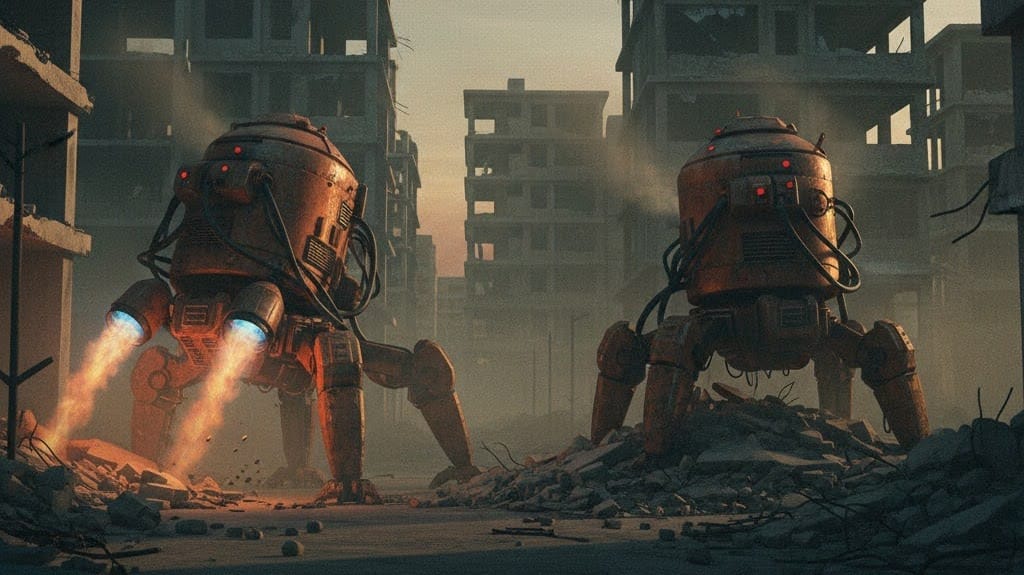
A small detachment holds a central urban intersection after command-and-control collapses. Enemy forces probe from the perimeter. Indirect fire lands unpredictably across the district. No escalation. No countdown. Just pressure.
The objective is simple:
Hold long enough.
Map
Urban terrain recommended.
- Clear map center (intersection / plaza / transit hub).
- Meaningful cover in interior.
- Four distinct edge entry points (North, East, South, West).
If using abstract zones:
- One central zone.
- Four surrounding edge zones.
- Optional interior sub-zones for density.
Player Force
Recommended:
1–3 Medium Frames
(or equivalent small scratch detachment)
UrbanMech-style anchor units shine here, but not required.
Deploy all player units within 3" of map center (or central zone).
Enemy Forces (OpFor)
Spawn Phase (End of Each Turn, after Artillery)
Roll d4:
1 – North
2 – East
3 – South
4 – West
Spawn 1 OpFor unit at that map edge.
Spawn Cap:
Maximum 4 active OpFor units at a time.
If cap reached, skip spawn that turn.
Suggested OpFor Composition
- Light harassment units (mobile)
- Medium generalist units
- Avoid heavy frames unless increasing difficulty
OpFor Behavior (Simple AI)
- Move toward nearest player unit.
- Attack if in range.
- If multiple targets, prioritize:
- Highest Heat OR
- Closest unit
(Choose one rule and keep consistent.)
Keep behavior predictable but relentless.
Artillery Phase (End of Each Turn)
After both sides have acted:
- Roll direction (scatter dice are ideal, but improvise).
- Roll distance: 2d6 − 1 inches from map center.
- Place 2" blast marker.
- Treat the affected area as destroyed Destructible Terrain (see rulebook) and deal damage accordingly.
- Remove blast marker. Lightning can strike twice. 😉
Artillery does not escalate.
Artillery does not scale.
Artillery affects both sides equally.
It is environmental variance.
Victory Conditions
Primary Victory:
At least one player unit remains in the central zone at the end of Turn 5.
Partial Victory:
At least one player unit survives anywhere on the map at the end of Turn 5.
Defeat:
All player units destroyed before Turn 5.
Optional Extraction Variant:
After Turn 5, surviving units may exit via any edge for narrative withdrawal.
Difficulty Dials
Increase Difficulty:
- Raise OpFor cap to 5.
- Spawn 2 units every other turn.
- Increase artillery blast to 2".
Decrease Difficulty:
- Delay first artillery to Turn 2.
- Eliminate artillery Heat penalty.
- Cap OpFor at 3.
Design Intent
This scenario models:
- Encirclement pressure.
- Urban geometry.
- Randomized indirect fire.
- Finite survival horizon.
It does not model collapse.
It does not enforce doom.
It does not escalate artificially.
It presents:
Localized tension under probabilistic danger.
MUNICIPAL DEFENDER
(Urban Security Variant – Medium Frame)
Frame: Medium
Role: Zone Anchor / Area Denial
Silhouette: Boxy, slow, unapologetic
Loadout (3 Slots)
- Medium Weapon: Civic Autocannon
Mid-range, solid damage, moderate Heat generation.
Reliable deterrent, not alpha-strike nonsense. - Light Weapon: Close Defense Laser
Short range, low Heat.
For when someone gets clever. - Heavy Plating: Yes
This unit absorbs more than it sprints.
Core Profile (Orion-style abstraction)
- Armor: Above average for Medium
- Structure: Standard Medium
- Mobility: Low
- Heat Capacity: Moderate
This mech should:
- Win attrition trades if stationary.
- Lose tempo wars.
- Struggle to reposition across multiple zones.
- Fear sustained Heat spikes.
Special Rule: Hold the Block
If the Municipal Defender does not move this turn:
Choose one:
- Reduce Heat by 1
OR - Gain +1 Defense until next turn
This reinforces:
Stand.
Commit.
Punish.
Optional Rule
Reinforced Frame
When within Cover:
Ignore the first point of damage taken each turn (before Armor).
This makes it infuriating in urban terrain without becoming invincible.
Tactical Identity
The Municipal Defender is:
- Not a duelist.
- Not a flanker.
- Not a breacher.
- Not a spectacle.
It is:
A warning.
If the opponent ignores it, they get chipped down.
If they rush it, they risk trading poorly.
If they bypass it, they cede control.
In the Crossroads Scenario
Early Game:
Anchors the center confidently.
Mid Game:
Walking artillery destabilizes its nest.
Late Game:
Forced to choose between cooling and survival.
That’s tension, not doom.
Design Philosophy
This unit exists to answer one question:
What does urban defense look like when stripped of spreadsheet excess?
It looks like:
Medium frame.
Steady gun.
Armor instead of agility.
A choice between cooling or bracing.
Correctly sized.