The Jungle Remains the Jungle
On Downgrade Culture, Cheese Tax, and the Cupertino Conditioning Machine
There's a particular kind of morning clarity that arrives only during a dog walk. No screen, no notification, no algorithm deciding what deserves your attention next. Just a small scruffy terror on a leash, sniffing at things that haven't been relevant to human civilization for ten thousand years, while your brain quietly assembles what the previous evening's conversation actually meant.
What floated to the surface on this particular morning was uncomfortable in the way that true things often are: somewhere between the tech press embargo lifting and the preorder button appearing, I had been carefully conditioned to feel genuine excitement about paying a premium for a downgrade.
The Apple MacBook Neo is, by any honest accounting, a step backward from what I already own. Less RAM than current standards. An A-series chip borrowed from last year's iPhone rather than Apple's current M-series silicon. One fast USB-C port and one that belongs spiritually to 2003. No backlit keyboard. No Force Touch trackpad. Fixed, non-upgradeable everything. The tech press greeted it with breathless enthusiasm, carefully benchmarking it against Intel Core i3 laptops and Chromebooks rather than against the M-series Macs sitting two price tiers up. "Surprisingly capable for the price" did an enormous amount of qualifying work in every review. The audience, myself included, performed the expected excitement.
This is not an accident. It is Cupertino's jungle, and they know every vine in it.
The Reference Point Is the Product
Apple didn't just build a cheap laptop. They built the anticipation of a cheap laptop, which is a different and more sophisticated product entirely. The excitement around the Neo isn't really about what it delivers — it's about what it delivers relative to a carefully constructed expectation. Intel benchmarks. Chromebook comparisons. The $599 price point landed against a market Apple had previously ignored, making the Neo feel like democratization rather than what it more precisely is: competitive repositioning dressed as generosity.
This is the conditioning mechanism in its purest form. The reference point is the product. Shift the comparison class from M-series Macs to budget Windows laptops and a downgrade becomes a revelation. The tech press, operating on page view incentives and product release timelines, dutifully ran the benchmarks Apple suggested against the competitors Apple selected. The audience, conditioned by years of Apple announcement cycles to treat reveal events as cultural moments, responded on cue.
The preorder's been sitting my cart for days. The finger hovers the "complete purchase" button.
The Jungle and Its Vines
This is not unique to Apple. The entire technology industry operates on a cycle that has been compressing with each iteration. WordPress specialists had perhaps five years of viable independent practice before Shopify commoditized their value proposition. Shopify experts had three years before the app ecosystem absorbed them. The current enthusiasm for AI agent orchestration — "help small businesses implement AI that actually works," as one LinkedIn post recently put it, complete with checkmark bullets and equity-instead-of-salary compensation — will likely have a shorter window still. Each cycle generates its own preorder button, its own carefully benchmarked excitement, its own class of eager specialists building practices on vines that are already being cut at the root.
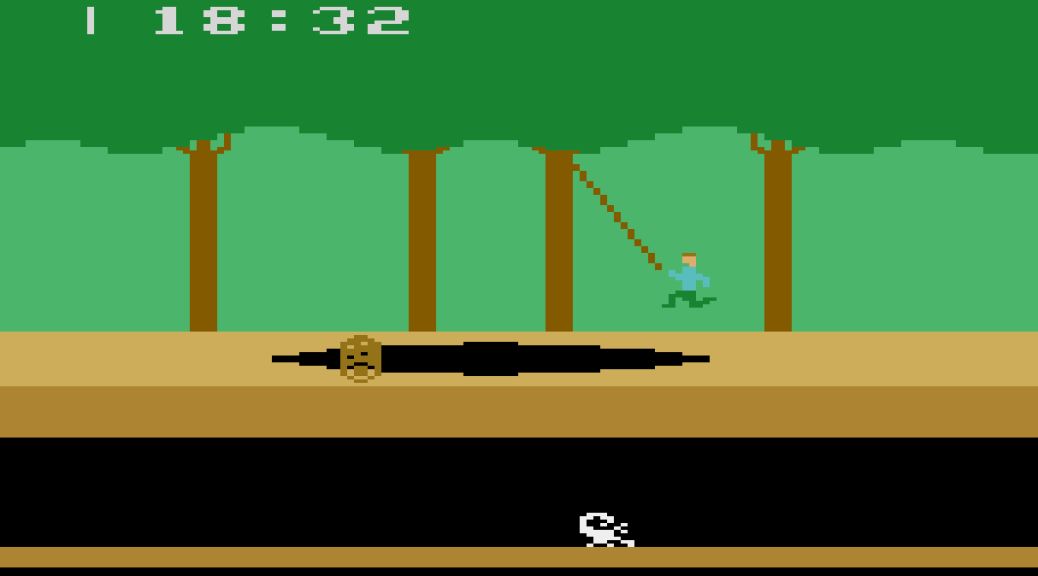
The metaphor that keeps returning is Pitfall Harry. Jump to the vine. Swing at exactly the right moment. Land before the crocodiles snap. Identify the next vine immediately. Never stop moving. The tech career advice industrial complex — itself a vine-dependent enterprise — calls this adaptability and frames it as virtue. What it more honestly resembles is a exhausting, endless, crocodile-adjacent scramble that enriches the people selling maps of a jungle that keeps rearranging itself.
You know what the dog walk clarified? The vines change; the jungle doesn't.
Human communication still requires translation. Complex systems still fail in human ways. Creative vision still needs technical implementation before it can exist in the world. Trust still precedes capability in every meaningful professional engagement. Someone still needs to stand in front of a house sound engineer at The Chapel in San Francisco and explain, calmly and with authority, why a thirty-year-old indiepop band needs exactly two XLR outputs going into the PA and nothing else. The tools that enable that conversation have changed beyond recognition since 1995. The conversation itself has not.
The 2014 Scarlett Solo Principle
There is a first-generation Focusrite Scarlett Solo sitting in a gear bag that has outlasted two MacBook Pros, one brief Ableton phase, and approximately forty-seven pieces of software that were going to change everything. It still works. It has always worked. It is class-compliant on macOS, requires no drivers, and will almost certainly still be functioning when whatever comes after AI agents has been announced, benchmarked against a carefully selected competitor, and preordered by someone sitting on a couch next to a dog.
This is not nostalgia. It is a principle about what actually compounds over time versus what merely cycles. A $200 Logic Pro purchase in 2015 has delivered eleven years of free updates, survived two processor architecture transitions, and currently runs on hardware that didn't exist when the purchase was made. A butterfly keyboard MacBook purchased in 2015 is either in a drawer or contributing to what is probably the largest concentrated deposit of premium e-waste in human history. Same era. Radically different return on investment. The difference was not price. It was whether the thing was built to do one thing well and keep doing it, or built to satisfy a quarterly product cycle and move on.
The hustle culture content economy exposes a Scarlett Solo problem. It is structurally incapable of producing one. The entire apparatus — the LinkedIn thought leadership, the YouTube monetization, the Substack subscription funnel, the personal brand as the product — requires constant new content to maintain the attention that generates the revenue that justifies the content. It cannot build something in 2014 and still be using it in 2026. Longevity is the enemy of the engagement metric. The Goodwill sourcing video that generates $900 in resale income generates rather more in advertising revenue from the audience hoping to replicate the $900. The method doesn't scale. The content about the method scales beautifully. This is not a bug.
The Cheese Tax as Epistemological Corrective
Against all of this — the conditioning cycles, the vine-dependent careers, the performance of expertise for algorithmic reward — there is the cheese tax. The rules are the rules. The facts are the facts. When the cheese drawer opens, the tax is owed. No personal brand required. No benchmark comparison against a carefully selected competitor. No "surprisingly capable for the price." Just a small scruffy dog with strategic eyes and wispy distinguished eyebrows, operating from a framework of complete epistemological clarity about what matters and what does not.

Delia Dogbyshire — named after Delia Derbyshire, the BBC Radiophonic Workshop composer who made genuinely strange and beautiful music from found sounds and tape manipulation, and adopted in the spring of 2025 after a grief that needed interrupting — is not a metaphor. She is a specific small dog who pees on a carpet that a UV light would reveal has been a crime scene since before we moved in, tilts her head at words that don't sound like food or walkies or outside or cheese, and looks at French fries with the full unambiguous commitment of a creature who has never once performed an emotion for an audience.
She is also, not incidentally, correct about most things.
The MacBook Neo may or may not be a sensible purchase. The case for it is genuinely coherent: a dedicated sling bag creative satellite for sketching musical ideas on a Korg minikey through GarageBand, handing off to Logic Pro on a more capable machine, writing in VSCode, blogging through Ghost, running LLM conversations in Chrome with Apple Silicon's memory architecture providing the stability that Intel never could. I'll also be running the mixing board with Presonus's Universal Control app for a band touring the West Coast in April to celebrate a three decade anniversary of an album for which only 25% of the original lineup will be on stage.
The case against it is equally coherent: it is a deliberate downgrade from hardware already owned, generating excitement through carefully managed reference points, preordered in a moment of tech press-induced enthusiasm before the morning walk had delivered its verdict.
My verdict, delivered somewhere between the third lamppost and the turn toward home, is that both things are true simultaneously. The Neo is a reasonable tool for a specific and well-considered workflow. It is also a product of conditioning so refined that a person with a functioning M4 MacBook Air, a working iPad Air, and a 2014 Scarlett Solo that will probably outlive everything else in the ecosystem found themselves excited about buying less than they already have.
The Jungle Remains the Jungle
Cupertino is a jungle. So is the AI agent economy, the content creator apparatus, the hustle culture productivity complex, and the endless Pitfall Harry scramble between vines. They share a common feature: they are all better navigated by people who understand the jungle than by people who have memorized the current vine locations.
My dad's Olympia typewriter, the one on which I learned to type, programmed the muscle memory that makes backlit keyboards irrelevant. The Logic Pro investment kept paying dividends across a decade of free updates. The supposedly obsolete audio interface that keeps pumping like a Kalashnikov unearthed from a dune. These are jungle knowledge. They transfer across tool cycles. They compound rather than depreciate. They are not teachable in a Udemy course because they are not about the tools at all.
The MacBook Neo will either earn its place in the sling bag or it won't. The 30th anniversary shows will happen in April regardless. My wife will be on those stages playing bass aboard a Ship of Theseus. The band's Critter & Guitari video synth will project Marimekko-meets-Peter-Max-via-8-bit-screensaver aesthetic through a venue HDMI cable with complete indifference to whether the trained Mon-keigh in the corner is running Universal Control on an iPad or a Neo or a first-generation Scarlett Solo with googly eyes attached.
The cheese tax will be owed every single day.
The carpet will retain its archaeological record of previous inhabitants and their rabbits and their small beloved animals.
And somewhere between the preorder confirmation and the California shows, the jungle will remain exactly what it has always been — indifferent to the current hype cycle, patient with the people who are learning to read it, and entirely unmoved by benchmarks that compare this year's excitement to last year's disappointment rather than to what actually matters.
Delia knows what matters.
It sounds like cheese.