Condottiere-class Frontier Contingency Transport
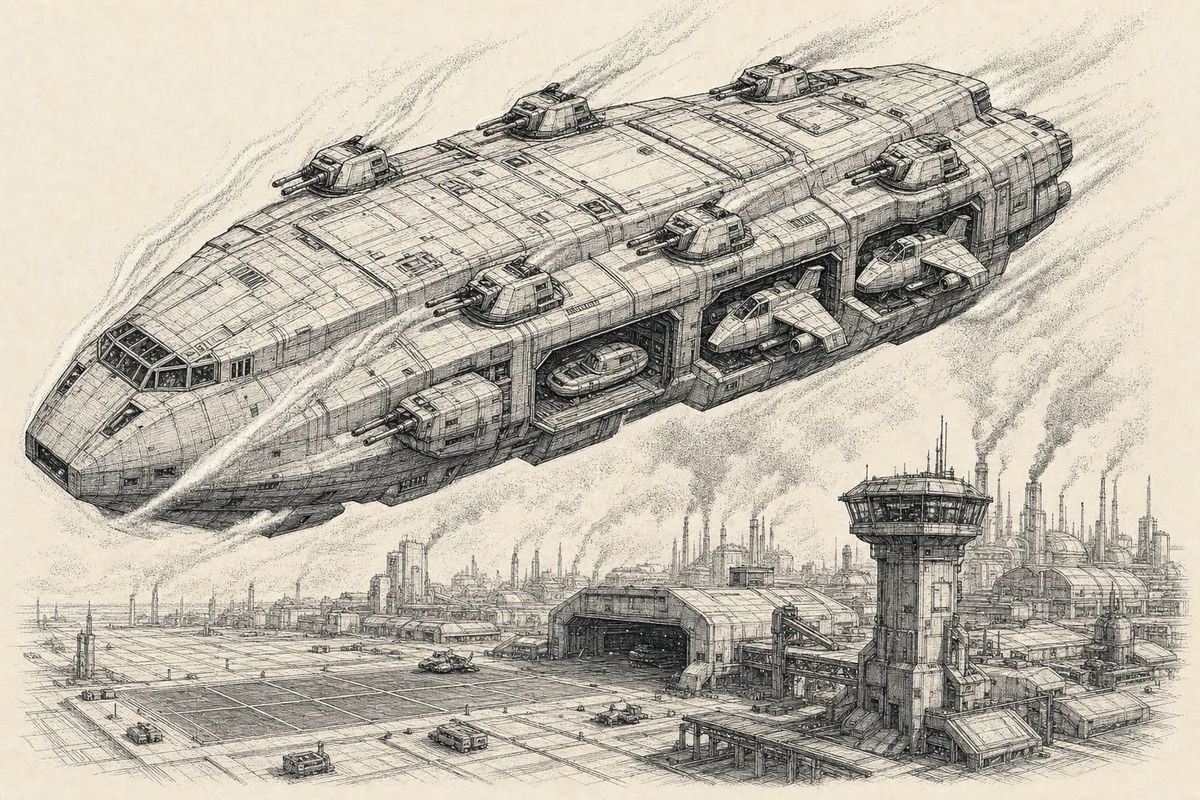
A starship designed under Classic Traveller Book 2 (1981) rules. Book 3 provides the technology-level and planetary-vehicle context. Condottiere is both a mercenary transport and an armed crisis-response platform: it carries a platoon-sized security force, but it can exchange that force’s mission load for medical, evacuation, relief, technical-support, or logistics work.
Description
Using a custom 800-ton hull, the Condottiere-class frontier contingency transport is built to bring a reinforced platoon-sized expeditionary force to a remote problem, sustain it briefly, and remove it again without depending on local infrastructure. It mounts jump drive-H, maneuver drive-M, and power plant-M, giving performance of jump-2 and 3-G acceleration. Fuel tankage of 190 tons supports the power plant for four weeks and permits one jump-2. Adjacent to the bridge is a Model/2 computer. The ship is a TL12 product: its H jump drive is a TL10 component and its Model/2 computer is TL7, but the M maneuver and power drives require TL12 manufacture.
There are thirty staterooms and twenty low berths. In the normal security fit, six crew members receive single occupancy, four staterooms house the eight turret gunners in pairs, and twenty staterooms house forty embarked troops in pairs. The low berths are intended for casualties, prisoners, and cold-sleep replacements. Eight hardpoints mount eight double turrets with fire control; each turret carries a pulse laser and sandcaster. This armament is a credible deterrent against frontier raiders and lightly armed opposition, but is not intended to trade combat turns with purpose-built system-defense warships.
The Condottiere carries three 50-ton cutters and an air/raft. Three tracked ATV modules are supplied; a fourth, open 30-ton module is stored in a 30-ton module bay and can replace the module in any one cutter. Cutter Three is the dedicated armed escort: its 2.5 tons of excess space is allocated exactly as one ton of weapon space, one ton for a Model/1 computer, and 0.5 ton for a third couch. It mounts two pulse lasers and a missile rack; the third couch is normally occupied by a gunner. The open module normally carries a configurable cargo and reload pallet. It may be fitted for evacuation, medical transfer, extra fuel, cabins, couches, or cargo as the mission requires.
The ship has 161 tons of cargo capacity. Its normal doctrine reserves eleven tons as ship’s stores and treats the remaining 150 tons as three nominal 50-ton mission-package positions. These cargo packages are a local shipyard and logistics convention, not a fourth formal Book 2 cutter-module system: they are palletized loads, tank frames, prefabricated rooms, and containerized stores that occupy ordinary cargo capacity. A package must be selected before departure; the Condottiere is versatile because it can be prepared for several kinds of emergency, not because it somehow carries every answer at once.
The minimum ship crew is fourteen: pilot, navigator, three engineers, medic, and eight gunners. Cutter pilots and the gunship’s small-craft gunner are additional assignments, normally drawn from the embarked force or dual-hatted from the ship crew. The core hull costs MCr452.177, including the one-percent naval architect’s fee, and requires 28 months to build. Mission-package contents and special fits are cargo or refit expenses beyond that core price.
Statistics
| Hull | 800 tons, custom; engineering section sized exactly to drives |
| Technology level | TL12 manufacture |
| Performance | Jump-2, 3-G, Power plant-3 |
| Fuel | 190 tons: 160 jump + 30 power-plant fuel |
| Computer | Model/2 (CPU 3 / Storage 6) |
| Staterooms | 30; normal security fit houses 14 crew + 40 troops |
| Low berths | 20 |
| Armament | 8 hardpoints; 8 double turrets, each pulse laser + sandcaster |
| Small craft | 3 × cutters; 3 × tracked ATV modules; 1 × spare open module; air/raft |
| Cargo | 161 tons: 11 ship’s stores + 150 mission cargo by default |
| Streamlined | Yes; includes fuel scoops and water-gathering capability |
| Core cost | MCr452.177, including 1% architect fee |
| Build time | 28 months |
Tonnage and Cost Budget
| Component | Tons | MCr |
|---|---|---|
| Hull, 800 tons (custom) | — | 80.000 |
| Jump drive H (jump-2) | 45 | 80.000 |
| Maneuver drive M (3-G) | 23 | 48.000 |
| Power plant M (Pn-3) | 37 | 96.000 |
| Bridge (2%, minimum 20 tons) | 20 | 4.000 |
| Computer Model/2 | 2 | 9.000 |
| Fuel: 0.1 × 800 × 2 + 10 × 3 | 190 | — |
| Staterooms ×30 | 120 | 15.000 |
| Low berths ×20 | 10 | 1.000 |
| Hardpoints ×8 | — | 0.800 |
| Double turrets ×8 | — | 4.000 |
| Fire control, 1 ton/turret | 8 | — |
| Pulse lasers ×8 | — | 4.000 |
| Sandcasters ×8 | — | 2.000 |
| Cutters ×3 | 150 | 84.000 |
| ATV modules ×3 | included in cutters | 5.400 |
| Spare open-module bay | 30 | — |
| Open module | stored in bay | 2.000 |
| Cutter Three armed-escort fit | within cutter | 3.750 |
| Initial ordnance stock: 30 missiles | cargo/module load | 0.150 |
| Air/raft | 4 | 0.600 |
| Streamlining | — | 8.000 |
| Total installed | 639 | 447.700 |
| Remaining cargo capacity | 161 | |
| Architect’s fee, 1% | 4.477 | |
| Total core cost | 452.177 |
Troop and Small-Craft Doctrine
The embarked forty are best understood as a compact expeditionary task group, not an army formation: several maneuver/security elements plus command, medical, communications, armory, sensor, vehicle, and cutter-qualified specialists. They are well suited to raids, compound or starport security, extractions, rescue, convoy escort, site protection, and reinforcement of local allies. They are not sufficient to occupy a city, defeat a peer military, or maintain a broad counterinsurgency campaign.
Book 3 gives each ATV one driver position and capacity for up to sixteen passengers. It provides complete, though cramped, eating, sleeping, and travel facilities for eight people. A fully packed ATV is therefore an emergency lift rather than a comfortable long-duration patrol vehicle.
A useful standing landing plan is:
| Lift element | Normal role | Personnel |
|---|---|---|
| Cutter One with tracked ATV | First security / route-clearing element | 8-person field party |
| Cutter Two with tracked ATV | Second security / perimeter element | 8-person field party |
| Cutter Three with open module | Command, specialist, evacuation, or resupply lift | 12 personnel in a couch-and-cargo fit |
| Shipboard reserve | QRF, ship security, maintenance, relief, and replacements | 12 personnel |
| Initial ground element | Deliberately restrained first wave | 28 personnel |
This is a doctrine choice, not a hard lift limit. In a maximum-capacity emergency, three fully loaded ATVs can physically move up to 51 persons, including their drivers. A three-cutter sortie also requires six qualified flight crew, plus the armed cutter’s gunner if it is to operate at full effect.
Cutter Module Fits
The cutter’s detachable 30-ton module is a formal Book 2 feature. Only Cutter Three carries the missile rack, so an ordnance load is a reload and supply package unless it is placed aboard that cutter. The open module does not turn every cutter into a gunship.
| Fit | Contents | Use |
|---|---|---|
| ATV module | One tracked 10-ton ATV | Reconnaissance, route clearance, protected ground transport, mobile aid station |
| Ordnance / stores pallet | Missile reloads, sand canisters, tools, consumables | Supports Cutter Three and the ship’s turrets; may be repurposed for cargo |
| Transit module | Example: 12 couches (6 tons) plus 24 tons cargo | Personnel lift, diplomatic extraction, casualty transfer, quick resupply |
| Medical transfer module | Couches, treatment gear, isolation supplies, and selected low-berth equipment | Moving critical patients from a remote site to orbit or a capable starport |
| Fuel module | Standard 30-ton fuel module | Skimming, remote fuel transfer, extended small-craft support |
| Cabin / stateroom module | Configured within the open module’s 30 tons | Long surface hops, technical teams, or protected VIP movement |
A 12-couch transit fit adds MCr0.300 in couch fittings. Medical, cabin, and stateroom modules should be priced when built; their equipment is not included in the core ship price.
Armed Crisis-Response Doctrine
The Condottiere is an armed transport, not a disguised hospital ship. Its public work can be genuine—medical delivery, relief, technical recovery, consulate extraction, evacuation of hospital staff and patients, or removal of a high-value partner population—while its weapons and embarked security force ensure that the mission cannot easily be converted into a hostage situation.
A typical high-value extraction load might retain a 20-person protection and quick-reaction detachment, allocate ordinary stateroom capacity to a bounded evacuee group, use the twenty low berths for critical patients or otherwise untransportable casualties, and configure Cutter Three’s open module as a triage-and-transfer shuttle. The purpose is not mass evacuation. It is the orderly removal of people whose safety, knowledge, relationships, or care obligations are politically and humanly consequential.
The eight pulse lasers make the ship a serious local show of force and a poor prospect for opportunistic piracy or coercion. The M power plant equals, rather than exceeds, the M maneuver drive, so the Book 2 Double Fire program is not available. Sandcasters retain their defined Book 2 role as anti-laser defense. Using them as an atmospheric “oversized shotgun” is a referee-facing campaign ruling, not a standard rules function; it should be short-ranged, indiscriminate, and inappropriate near civilians.
Mission Hold: 150 Tons of Chosen Commitment
The remaining 161 tons of hold are intentionally not treated as a blank cheque. Eleven tons are normally reserved for water, food, parts, filters, repair materials, medical basics, and ship consumables. The remaining 150 tons are organized as three nominal 50-ton cargo-package positions.
These are not Book 2 detachable modules and do not create new capabilities by being named. They are ordinary cargo capacity made operationally legible: containers, tank frames, prefabricated rooms, workshop racks, pallets, and shelters. A package containing permanent staterooms, low berths, or other paid fittings must be budgeted and purchased separately.
| 50-ton package | Typical contents | What it buys the operation |
|---|---|---|
| Field-support package | Shelter, sensors, barrier material, tools, rations, spare parts | A platoon can remain useful after the first day |
| Fuel and mobility package | 50 tons of extra fuel, transfer gear, cutter/ATV support | Operational endurance; it does not increase jump rating |
| Medical package | Triage, isolation, pharmacy, surgical or diagnostic gear, power and sanitation | A compact field clinic or casualty-processing node |
| Evacuation package | Couches, baggage, water, sanitation, privacy partitions, records | Dignified short-term movement of a high-value civilian group |
| Technical recovery package | Workshop, specialist tools, drones/sensors by campaign convention, replacement assemblies | Remote repair, survey, and infrastructure support |
| Relief package | Water treatment, shelter, food, communications, field power | Crisis assistance for a bounded community or facility |
The operational constraint is selection. A security contract may embark field support, fuel, and technical recovery. A diplomatic evacuation may embark medical, evacuation, and relief. The package not chosen before the jump is not waiting in the hold when the briefing changes.
Crew Manifest and Operating Notes
| Position | # | Basis | Monthly salary at skill-1 |
|---|---|---|---|
| Pilot | 1 | One per ship | Cr6,000 |
| Navigator | 1 | Ship over 200 tons | Cr5,000 |
| Engineer | 3 | 105 tons of drives ÷ 35 | Cr12,000 |
| Medic | 1 | Ship of 200+ tons | Cr2,000 |
| Gunner | 8 | One per turret | Cr8,000 |
| Minimum total | 14 | Cr33,000 |
- Cutter staffing: Three simultaneous cutter sorties require six small-craft crew. Cutter Three’s full armed performance also calls for its third-seat gunner. These are additional jobs, normally drawn from the embarked force or handled as dual roles at the applicable penalty.
- Life support: Double occupancy is appropriate to military, charter, and private operation, but costs twice the ordinary stateroom life-support rate.
- Financing: 20% down is MCr90.435; repayment is MCr1.884 per month for 480 months.
- Annual maintenance: 0.1% of cash price, about MCr0.452, and two weeks at a Class A or B starport.
- Refit headroom: None exists in engineering. The custom hull is sized exactly to the 105-ton drive suite; a jump-3 conversion would require hull and yard work, not merely a new component.
- Support ceiling: The ship can operate into low-infrastructure frontier space, but major drive work requires a TL12 industrial base. It can arrive where a backwater cannot repair it.
Design History
- Began as an 800-ton jump-2, 3-G mercenary transport for a reinforced platoon.
- Added thirty staterooms, twenty low berths, eight double turrets, two cutters with ATV modules, and an air/raft.
- Added the third cutter and retained three tracked ATVs, creating the option to land the full forty-person complement in a single, tightly packed emergency lift.
- Replaced the standard 800-ton hull with a custom hull. The standard hull’s 165-ton engineering section would waste 60 tons around this 105-ton drive suite; the custom section recovers that volume as usable hold.
- Added a spare open cutter module, formalized Cutter Three as an armed escort, and adopted the 150-ton mission-hold doctrine.
- Reframed the class as a frontier contingency vessel: security, extraction, relief, technical assistance, and high-value evacuation are alternative loadouts, not simultaneous promises.
Rules Boundary
The core hull, drives, fuel, accommodations, turrets, carried craft, open cutter module, costs, and build time are Book 2 construction. The TL12 manufacturing designation and the ATV’s capacity and field characteristics come from Book 3. The three 50-ton mission packages, the atmosphere use of a sandcaster, and exact medical or relief equipment manifests are campaign and shipyard conventions layered on top of the Book 2 hull; they must be costed when they become permanent fittings.