An Ode to a Prius Driver
On illegibility, bumper stickers, and the refusal to be sorted
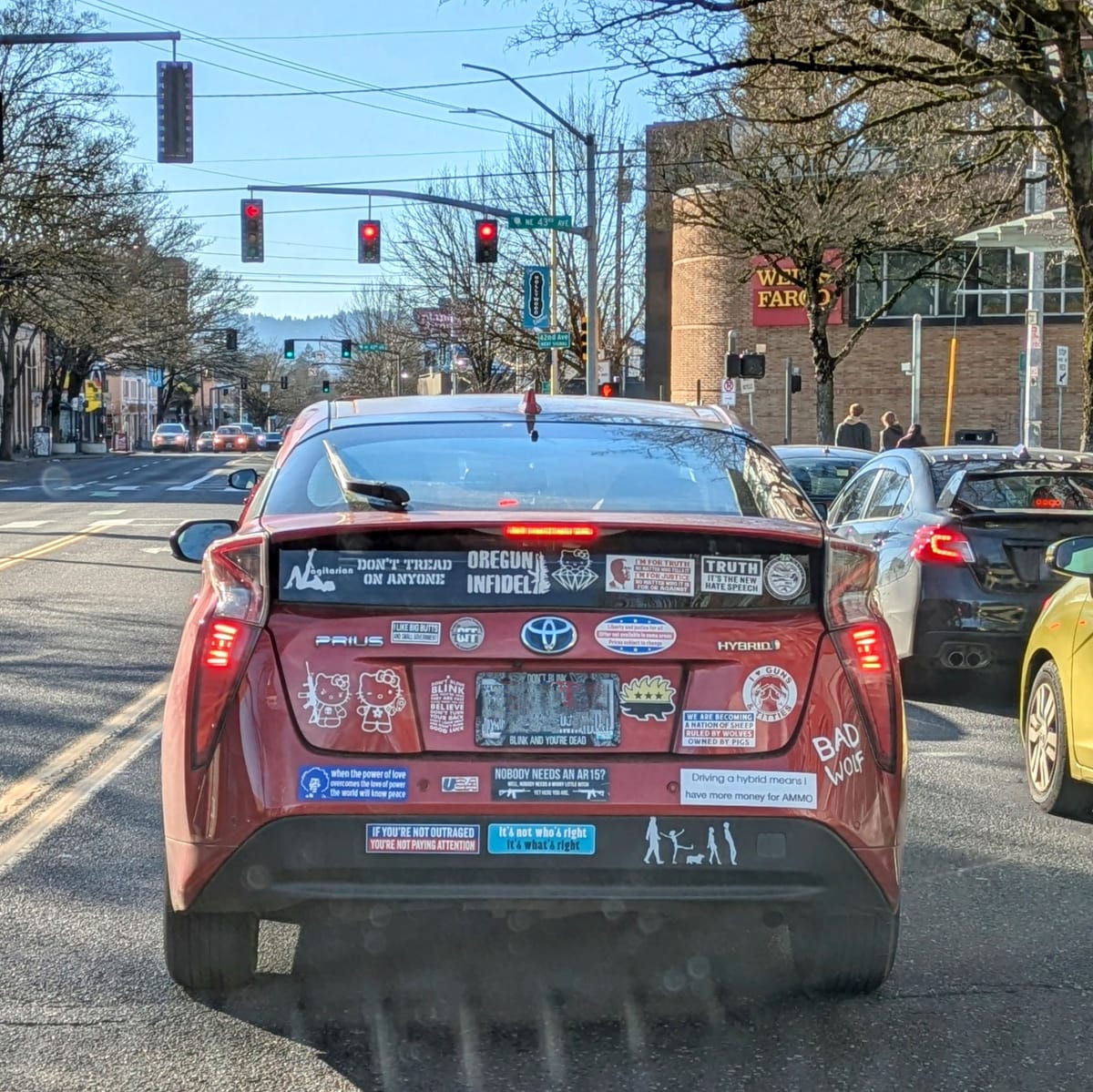
I was behind the Prius for three miles on Northeast Sandy, long enough to inventory the contradictions.
"Don't Tread on Anyone." "Oregun Infidel." "Truth Is the New Hate Speech." These sit alongside "When the power of love overcomes the love of power, the world will know peace"—Jimi Hendrix turning William Gladstone into hippie scripture. There's a sticker about driving a hybrid to save money for ammo. Hello Kitty with an AR-15. A Doctor Who reference. The silhouettes of the Cowboy Bebop crew, which took me a minute.
No coherent politics. No legible tribe. Just a person driving a car whose red paint job wasn't noticeable enough.
We've gotten very good at sorting each other.
The algorithms do it formally—clustering us by engagement patterns, serving us to each other as audiences and adversaries. But we do it too, informally, constantly. A bumper sticker, a hat, a word choice, a car model: we read these as signals and assign each other to categories. Friend, enemy, persuadable, lost cause.
The sorting feels efficient. It is efficient. When you know someone's tribe, you can skip the long work of actually understanding them. You know what they probably believe about twelve other things. You know whether to engage or scroll past.
But efficiency has costs. The sorting flattens almost everything. It takes a person who contains multitudes—as everyone does—and compresses them into a type. What survives the compression is what fits the category. Everything else gets trimmed.
Most people cooperate with this. We self-flatten, performing coherent tribal membership because it's easier, because it's expected, because legibility has rewards. The F-150 with "Molon Labe" stickers is a successful transmission: I am this, categorize me here, expect this from me (and there's a free gun in the glove box). The signal is clear. The slot is satisfied.
The Prius driver has declined.
I don't know anything about this person. I don't know if they've thought through the contradictions or simply accumulated stickers over years without worrying about consistency. I don't know if they're libertarian, leftist, apolitical, or some configuration that doesn't have a name. I don't know if they'd be pleasant to talk to or insufferable.
What I know is that they can't be sorted. The categories don't apply. A survey would choke on them; an algorithm would flag them as noise.
And sitting behind them at the light, I found this—there's no other word—hopeful.
There's a model that circulates in political discourse: one-third of people are authoritarian, one-third are anti-authoritarian, one-third are up for grabs. The numbers vary, but the structure doesn't. We're divided into thirds, or halves, or quintiles—stable segments with predictable dispositions. Politics becomes a matter of mobilizing your third and fighting over the middle.
The model is useful. It's also a lie.
Not a malicious lie. A simplifying one. The kind of lie that makes complex systems legible enough to discuss. But still: a lie. Because people are not coherent. The categories are analyst-imposed, not lived. The "authoritarian third" contains gun owners who want universal healthcare, and church ladies who quietly support their gay nephews, and people who'd score differently on Tuesday than Thursday depending on what they'd just read.
The Prius is evidence. Here is a person who contains Jimi Hendrix and AR-15 jokes, Doctor Who and sheep-wolves-pigs cynicism, Hello Kitty and Second Amendment defiance. They exist. They're out there, stuck at a red light near the Hollywood Theatre, illegible and real.
If they exist, others do too. Which means the model is wrong, or at least incomplete. The thirds are not solid. The slots are leaking.
Illegibility has costs.
You don't get counted in anyone's coalition. You can't be mobilized, which means you can't be leveraged, which means political operators have no reason to care about you. You're noise, not signal. When the rampaging Orkish Waaagh! comes through—left or right, doesn't matter—you won't be part of it, you won't be protected by it, and most likely will show up as a sniveling fence-sitter for both sides to thump.
You also look a little unhinged. The Prius, frankly, looks like a mess. There's no aesthetic unity, no curated brand. It's a collage made by someone who apparently thought each sticker was good enough to add without worrying about what it said next to the last one (that's the story of my Honda Element, for what it's worth). In an environment that rewards coherent self-presentation, this reads as failure—or madness—or, at best, eccentricity.
And illegibility takes energy. Maintaining complexity, refusing to simplify, weathering the friction of not fitting: these require resources not everyone has. The Prius driver can afford to be a rolling contradiction. Someone more precarious might need to self-flatten just to survive. Illegibility is a privilege as much as a choice.
But.
Illegibility also means you can't be drafted.
The culture war needs soldiers who know which side they're on. It needs clear signals, reliable affiliations, predictable responses. It needs people who've pre-sorted themselves, who'll show up when called and fire in the right direction.
The Prius driver is useless for this. Which side would claim them? What banner would they march under? They're AWOL from a war they never enlisted in.
This is not a strategy for winning. The illegible don't win culture wars. But they also don't fight them. They're somewhere else entirely, assembling their own weird collage, one sticker at a time.
I think about the alternatives.
You can self-flatten: trim the contradictions, present a coherent tribal surface, be legible and sortable and therefore real in the way the system recognizes. You'll be counted. You'll belong. You'll also be reduced—a symbol where a person used to be.
You can go gray: say nothing, signal nothing, pass through unnoticed. Security through obscurity. But this has its own costs—invisibility is lonely, and anyway the "gray man" aesthetic has become its own recognizable tribe. Just like the app store, there's a slot for that.
Or you can be the Prius. Accumulate without curating. Contradict without resolving. Let the mess be visible. Arrive at every destination looking like a package that went through the international post and came out tattered but intact.
It's not a strategy. It's barely a choice. It might just be what happens when someone refuses to edit themselves for legibility and has enough resources to survive the refusal.
But it's something. A proof of concept. Evidence that the categories are not airtight.
I don't know what the Prius driver believes about anything that matters. I don't know if we'd agree on policy, or values, or if Ein is the goodest boy (he is). I don't know if they're kind or cruel, thoughtful or reactive, happy or barely holding on.
I know they gave me hope at a red light. Which is much, much more than most drivers in Portland offer.
The light changed. They turned left. I went straight. That's the whole story.
But I'm still thinking about the stickers.
See You, Unsorted Cowboy.