Working As Designed
Soundtracks to Tiny Catastrophes
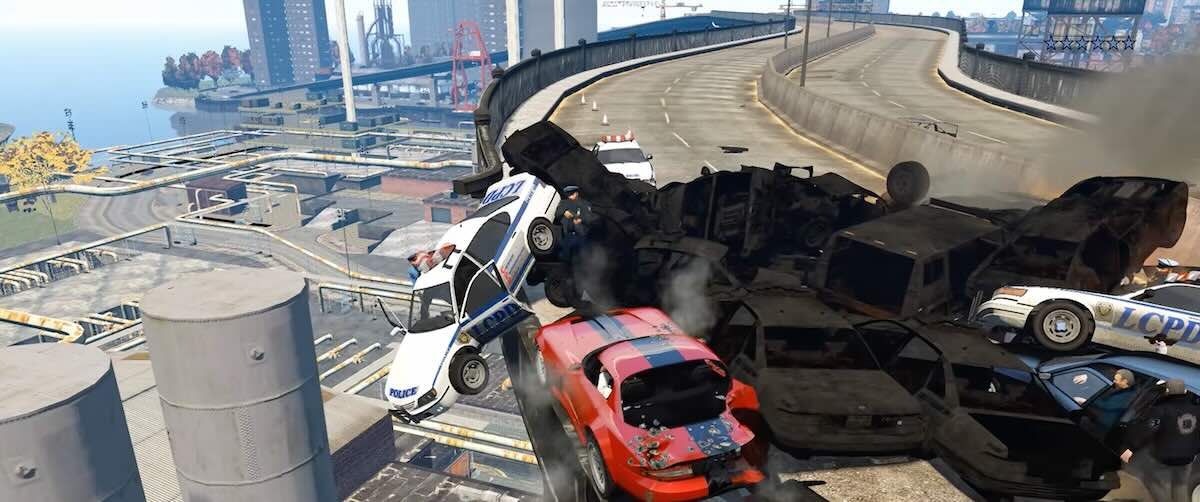
For the past several days, I've been watching police officers fall off an elevated highway in Liberty City. Not actual cops, of course, but the digital representatives of the Liberty City Police Department in Grand Theft Auto IV, a video game released in 2008. Someone on YouTube has discovered a wonderfully idiotic arrangement of cheat codes, geography, and police behavior that produces an apparently inexhaustible sequence of vehicular catastrophes. I've watched several iterations, sometimes with the sound off, sometimes with music playing, and more recently with a growing curiosity about what exactly I'm finding so entertaining.
The setup is simple. Niko Bellic parks a car at the edge of an elevated highway where the guardrail is conveniently absent. Invulnerability cheats prevent him from being killed, arrested, or even pushed over the edge. The police arrive, attempt to apprehend him, and proceed to destroy themselves in increasingly elaborate ways. Officers attempt to approach the driver's door and tumble into space. Cruisers collide, pile up, and occasionally follow one another over the precipice. Reinforcements arrive and compound the disaster. Eventually, gunfire ignites a vehicle, a chain reaction clears the accumulated wreckage, and the whole business starts again.
It's vulgar, grotesque, repetitive, and inexcusably funny.
I've played GTA since its original top-down incarnation on a 486, when mowing down a procession of Hare Krishnas earned the infamous "GOURANGA!" bonus. The franchise has always struck me as a loaded cultural weapon ostensibly firing blanks, occasionally discharging detritus at terminal velocity. By the time I acquired a computer capable of running GTA V, I'd largely abandoned its criminal ambitions. My favorite activity was driving around Los Santos late at night, listening to the radio, going nowhere in particular. Rockstar built an elaborate simulation of American criminality, and I turned it into therapy for insomnia.
The immediate appeal of the police pileups seemed obvious. "Yakety Sax" practically started playing in my head. But while walking the dog one evening, I remembered my first encounter with The Blues Brothers. There was the ancestral spectacle: impossible accumulations of police cars, vehicles behaving like dominoes, authority reduced to slapstick, and the Illinois Nazis sailing off a highway to the accompaniment of Wagner. Jake and Elwood effectively enjoy their own version of god mode. They're on a mission from God, after all.
John Landis needed stunt drivers, elaborate choreography, and a small automotive graveyard to produce those scenes. The GTA experimenter needs a parked automobile, some cheats, and a missing guardrail. Wind up the toys and watch them collide.
The LCPD isn't simply malfunctioning, either. Another YouTube video titled Overanalyzing GTA IV Cops After 10 Hours of Research catalogs an unexpectedly sophisticated simulation. Officers execute pursuit maneuvers, take cover, establish roadblocks, commandeer civilian vehicles, and respond to offenses committed by other NPCs. The GTA Wiki's account of wanted-level behavior describes many of the same capabilities. These are observations of gameplay rather than an audit of Rockstar's code, but the distinction between what individual officers can accomplish and what their collective behavior produces is striking.
In the highway experiment, police repeatedly approach a vehicle from the side facing a fatal drop, apparently incapable of incorporating the results of previous attempts into subsequent decisions. And in our incorrigible tendency to apply a systems theory overlay to everything, we posit the following thesis:
The system exhibits considerable competence within individual behavioral domains, yet possesses no overarching capacity to recognize when those competencies become mutually destructive.
Each subsystem continues doing its job. The pursuit machinery summons reinforcements. Pathfinding directs officers toward the suspect. Arrest routines identify the driver's door. Vehicle physics determines the consequences of collisions. Damage calculations eventually produce explosions. Nothing needs to stop working for the collective result to become catastrophic.
Indeed, the catastrophe is sustained precisely because so much continues working.
This is a particularly tidy demonstration of Stafford Beer's observation that the purpose of a system is what it does, or POSIWID. Under these conditions, the LCPD's apparent purpose is to convert police reinforcements into wreckage, periodically disposing of the accumulated inventory through combustion. The operation is self-replenishing, requires minimal supervision, and produces remarkably consistent results.
There is, however, a blind spot in POSIWID when applied to human institutions. People possess intentions, judgment, and varying degrees of authority. They can recognize destructive patterns, refuse instructions, and occasionally change the rules. Whether their organizations permit them to act upon those realizations is another matter. Treating human beings as merely interchangeable components risks obscuring both their agency and their responsibility.
The virtual officers have no such agency. Their apparent intentions are programmed behaviors. They cannot recognize the absurdity of what they're doing, much less convene an incident review and reconsider their procedures. In this experiment, POSIWID's usual minimization of individual agency becomes a feature rather than a defect.
The music introduced another dimension.
My first attempt at replacing the video's soundtrack used Charles Mingus's "II B.S.", the 1963 reworking of "Haitian Fight Song". The opening bass line immediately establishes a formidable momentum, and the ensemble's surges, collisions, and emphatic accents seemed almost miraculously synchronized with the vehicular destruction. The first police arrival aligned with the musical introduction, and the final crash landed on an explosive passage. I hadn't choreographed any of it. The correspondences were happy accidents.
Mingus brought something unexpected to the proceedings. In the liner notes to The Clown, he explained that he couldn't play "Haitian Fight Song" properly without thinking about prejudice, hatred, persecution, and their injustice. He described sadness and cries, but also determination. The meaning was not merely written into the composition; it was something he brought into the act of playing. Against footage of police officers unloading their weapons on an invulnerable man, that emotional history introduces an uncomfortable resonance. The comedy remains comedy, but the music refuses to become merely comic accompaniment.
There's also a fascinating contrast between the two ensembles. Mingus's musicians operate within demanding structures, but they listen, anticipate, respond, and adjust. Their apparent disorder depends upon extraordinary collective intelligence. The LCPD officers possess elaborate individual competencies but no equivalent collective responsiveness.
Mingus himself makes the comparison sharper. He was notorious for shouting instructions to his musicians, stopping performances, correcting passages, and restarting pieces on the spot. His Jazz Workshop sometimes conducted its rehearsals in front of paying audiences. His methods could be abrasive, even tyrannical, but they demonstrate something missing from the LCPD: someone could hear what the ensemble was doing and possessed the authority to change its course. Awareness could become action, sometimes in the middle of a performance.
Not every ensemble needs a Mingus, and his authority was hardly an uncomplicated virtue. But the musicians could respond to one another, and the bandleader could intervene when the collective result departed from what he wanted. The digital police have neither capacity.
Eric Dolphy's "Far Cry" also worked surprisingly well, its angular phrases seeming to comment upon individual collisions and falls. But it lacked the propulsion of Mingus's arrangement. Raymond Scott's "Powerhouse" offered another possibility, particularly in J.G. Thirlwell's industrially grotesque interpretation under his Steroid Maximus moniker.
Scott's original composition had already enjoyed an unintended second life in Warner Bros. cartoons, where Carl Stalling used its frantic "Powerhouse A" passages for chases and its ominous, repetitive "Powerhouse B" for assembly lines and mechanical contraptions. Thirlwell's rendition takes that mechanical imagination somewhere considerably more monstrous.
Where Mingus introduces human vehemence, Thirlwell supplies the machinery with more machinery: an enormous musical contraption that seems delighted by the possibility of shaking itself apart. I selected another iteration of the police pileup, synchronized one musical impact with an onscreen collision, and watched the remaining correspondences unfold. Toward the end, a sampled voice cries, "They're trying to kill me!"—an especially delicious complaint when the only invulnerable participant is the supposed target of the entire operation.
Scott's composition, Thirlwell's reconstruction, the game's procedural behavior, and my modest editorial intervention form a chain of people repurposing other people's inventions. None needed to anticipate every consequence. We established conditions and observed what happened.
The finished mashups sit on my laptop, assembled from someone else's YouTube footage and commercial recordings living on my NAS. Uploading them back into YouTube would introduce another set of machinery: copyright claims, engagement metrics, recommendations, monetization, and the transformation of an idle experiment into a unit of platform circulation. I'm in no particular hurry to make that happen.
There's pleasure in having no audience to satisfy and no particular outcome to produce. The first Mingus edit was an accident of juxtaposition. The Thirlwell edit involved a little more deliberate intervention. Neither was intended as a statement about policing, jazz, or the political economy of digital culture. I wanted to see whether the music worked with the pictures. It did, and the reasons became more interesting the longer I considered them.
The institutional analogy remains tempting, particularly for anyone who has watched competent teams follow established procedures into a collectively disastrous outcome. Yet the distinction between simulated officers and actual people is essential. In a human organization, someone may understand perfectly well that the operation is failing while lacking the authority to change its course. The missing capacity may not be awareness but the means to translate awareness into action.
Mingus could stop his band. A cloud engineer watching a failing software deployment, a department watching an impossible workload accumulate, or an employee recognizing that established procedures are producing the opposite of their intended results may have considerably less freedom to intervene. Observability is not the same thing as control. And recognizing a problem does not necessarily confer the authority to solve it.
That's considerably more troubling than a broken pathfinding routine.
Meanwhile, back in Liberty City, another cop cruiser arrives. Its occupants have an arrest to make, procedures to follow, and no apparent reason to reconsider their approach. The wreckage of their predecessors is scattered across the highway and the streets below. Somewhere a vehicle catches fire. Another explosion clears the road.
Mingus's bass line drives forward. Or Thirlwell's mechanical orchestra lurches into another furious passage.
The machinery is working as designed. The difference lies in what the participants can hear, what they can recognize, and whether any of them can do something about it.
And yes, I'm still laughing.