Who's On Third?
On Contested Canon, Unstable Artifacts, and the Songs That Survive the Argument
I. The CD Player This Morning
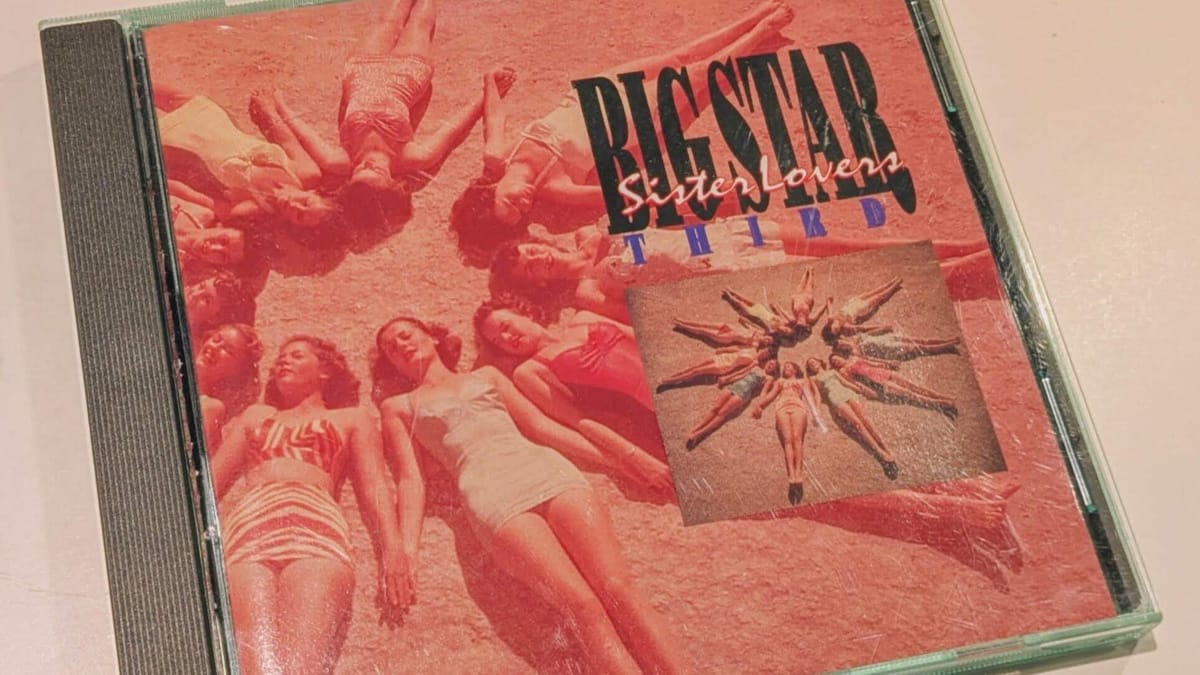
On the CD player this morning is the 1992 Rykodisc version of Big Star's Third / Sister Lovers.
This is a statement that sounds simple and isn't.
It's not like putting on Revolver or Horses or even Big Star's own #1 Record — albums that exist as stable objects, where the artifact and the work have long since merged into a single thing. You press play and you're hearing the album. The question of which version doesn't arise because the version question was settled decades ago.
With Third, the version question was never settled. It was never even properly asked, because the album was never properly finished.
What I put on this morning is a particular configuration of a set of recordings made at Ardent Studios in Memphis in 1974, partially reconstructed by producer Jim Dickinson, circulated as test pressings in 1978, first commercially released in 1985 on PVC Records in one track order, reissued by Rykodisc in 1992 in a slightly different one, and then comprehensively excavated by Omnivore Recordings in 2016 as a 69-track chronological document called Complete Third.
The Rykodisc is the version I've lived with for over thirty years. It feels like the album. But "feels like" is doing a lot of structural work in that sentence.
What is Big Star's Third?
Not rhetorically. Ontologically.
II. The Instantiations
Here is what exists, roughly in order of emergence:
The 1974 Ardent sessions. Alex Chilton, Jody Stephens, and a shifting cast of Memphis musicians recording in a studio that had already produced Big Star's first two records. The sessions are ragged, ambitious, orchestrally strange. Jim Dickinson is brought in to produce — or perhaps to manage — what is becoming less an album and more a field of activity. Songs are tracked. Some are finished. Some are fragments. The tape runs.
The Dickinson reconstructions (1975). Dickinson shapes the material, adds orchestration, makes editorial decisions about what constitutes a track. This is production in the traditional sense — but production applied to material that may not have been intended as a unified album in the first place.
The 1978 test pressings. A small number of LPs are pressed at Ardent. These are the first physical instantiations of Third as an object. They circulate among insiders. They propose a track order. They are provisional by definition — test pressings are proofs, not publications — but they become, retroactively, the ur-text.
The 1985 PVC pressing. The first commercial release. A specific track order. A specific selection. This is the version that enters the world as "the album" for the small audience paying attention. It is an editorial decision presented as a finished work. I encountered a copy of this in college. It felt like discovery. It was actually curation.
The 1992 Rykodisc CD. A reissue with a somewhat different sequence. This is the version that reaches the wider audience enabled by CD-era distribution and the growing Big Star cult. For many listeners — myself included — this becomes the canonical text. Not because it's more "correct" than the PVC, but because it's the one we repeated. Repetition creates authority.
The 2016 Omnivore Complete Third. Sixty-nine tracks. Chronological session order. The "final 21" tracks presumably representing something approximating a last coherent gesture. It is archivally generous, editorially transparent, and fundamentally destabilizing. It reveals the shelf being built in real time.
The Omnivore Ardent test pressing replica. A vinyl reissue reproducing the 1978 test pressing configuration. An attempt to restore primacy. Here is the earliest stable object. But the moment you reissue a test pressing as a commercial product, you are no longer presenting the first instance. You are presenting a curated memory of the first instance.
Each of these proposes a different answer to the question "what is Third?" Each carries editorial authority. None is neutral.
If you'll permit a borrowed metaphor: the Ardent test pressing is the first instantiation of the Third class. Every subsequent release is either a subclass (reordered, recontextualized), a wrapper (expanded, annotated), or a debugger (chronological, process-exposing).
The class was never fully defined. The instances keep proliferating.
And here's the paradox: the more versions circulate, the less certain the "true" Third becomes — but the stronger the narrative of haunted incompletion grows.
Instability becomes aura.
III. The Diagnostic
Is Third an anomaly?
The folklore says yes. A band disintegrating. A singer unraveling. A producer trying to hold the seams together. Songs that veer between devastating beauty and orchestral absurdity. An album that never got delivered because it couldn't be delivered — because the conditions of its creation were too volatile to produce a stable object.
That's a good story. It's also shelf-work. Narrative infrastructure.
Because here's the thing: most albums are negotiated artifacts. We just don't usually see the negotiation.
Consider Love's Four Sail, released in 1969. By that point, Arthur Lee's lineup had already molted into something closer to a Ship of Theseus — the band name persists, the personnel shifts. The songs on Four Sail were drawn from a larger batch of recordings. Jac Holzman at Elektra curated a selection and sequenced it as "the fourth LP from Love." Lee then released the remaining tracks separately, almost simultaneously, under his own name.
Two documents from the same recording field. Two different instantiations of authorship. One filtered through label sensibility and market positioning. The other released by the artist on his own terms.
But because Four Sail stabilized before reaching the public — because it arrived as a finished object with a spine and a catalog number — it calcified into canon without controversy. The filtering happened offstage. The artifact looked whole from day one.
Third never got that chance. The filtering continued after circulation. The curatorship became part of the story.
Which suggests something important:
Ownership-transfer is probably universal. Visibility of ownership-transfer is not.
Every album passes through filters — A&R shaping, label decisions, mix choices, market timing, distribution logistics. Even the most "pure" record is a stabilized negotiation. The idea of a pristine, unfiltered object may be a retrospective fantasy.
When mediation precedes canon, we call it production.
When mediation follows canon, we call it revision.
Both involve editorial power. One feels natural. The other feels contested.
Third isn't anomalous because it was never finalized. It's anomalous because the mediation stayed visible. The machinery never finished running before the artifact entered circulation.
That doesn't make it unique. It makes it diagnostic — a case that reveals the process every album undergoes, simply by failing to conceal it.
IV. The Vacuum
"But what of the creators' intent?"
Kinda academic at this point, innit?
Alex Chilton wasn't especially interested in stabilizing legacy. He wasn't Richard Thompson, publicly objecting to a live album he disliked while continuing to produce decades of preferred work that reasserted his own canon. He wasn't an artist who drew a firm archival boundary and dared the industry to cross it.
Chilton's relationship to his own catalog was more diffuse — sometimes dismissive, sometimes indifferent, occasionally contradictory. He didn't police Third because he didn't seem to regard it as a fixed object requiring policing.
That absence of enforcement creates a vacuum. And vacuums attract curators.
Jim Dickinson is gone. Chilton is gone. Jody Stephens may be the only participant from those sessions still walking the earth. The horse is so far from the stable it raised a family with grand-foals and is thoroughly put out to pasture.
Which introduces a hard truth about canon: authorial intent has a half-life.
While creators are alive and engaged, intent can act as constraint. It's enforceable. The living artist gets to say no, and the "no" has standing. Once they're gone — or once the work was never finalized — intent becomes interpretive material rather than governing authority. Not irrelevant. Not trivial. But historical. Part of the folklore layer rather than the executable code.
With Third, you can't even locate a single moment of consolidated intent to decay from. The half-life question is moot. You can't measure decay from a state that was never stable.
Some records resist canonization because they're incomplete.
Some become canonical because they're incomplete.
Third might be both.
V. Properties of an Unstable Object
Here's where I step sideways out of the canon trap.
I don't think of Third as an "album." Not really. Not the way I think of #1 Record or Radio City, which are objects I can hold in my mind as wholes — sequenced, paced, complete.
I think of specific songs.
"Kizza Me." "Thank You Friends." "Holocaust." "Kangaroo." "Blue Moon." "Femme Fatale." "Jesus Christ."
That's almost half the record, depending on which tracklist you're counting.
And those songs are stable. They survive track order. They survive test pressings. They survive Rykodisc and Omnivore and PVC. They persist across every instantiation of the class.
They're properties, not configurations.
"Holocaust" doesn't need to be track 7 or track 9 to devastate. It devastates because of what it is — the vocal, the piano, the slow accretion of strings, the way it builds toward something that feels less like a climax and more like a collapse you've been watching in slow motion. That function is intrinsic to the song. It doesn't depend on what comes before or after it in a sequence someone else chose.
"Kangaroo" doesn't care which pressing you encountered first. It opens the same door every time — that strange, lurching, beautiful thing that sounds like nothing else in the Big Star catalog or anyone else's.
"Thank You Friends" radiates its exhausted irony regardless of which curator placed it where.
This suggests a different model of canon:
Structural canon asks: what is the authoritative configuration?
Affective canon asks: what properties recur in my listening life?
The first is about objects. The second is about methods — the things you actually call, the songs you actually return to, the moments that function reliably across decades and formats.
That's not evasion. It's clarity.
It means canon disputes can rage in the archive while your listening life remains intact. The class may splinter. The properties endure.
There's a quiet liberation in that. It doesn't resolve the ontological question of what Third is. It simply notices that the question may be less urgent than it appears — because the things that matter most about the record aren't the things that change between versions.
The instability is real. The songs are realer.
VI. The SD Card
All of which collapses, eventually, into the most honest question in canon theory:
What goes on the phone?
#1 Record and Radio City are easy. They're stable objects. Authorial intent, historical reception, and lived repetition have converged. They've hardened into canonical executables. You load them. No debugging required.
Third resists that. Not because it's weaker — arguably the opposite — but because it resists singular instantiation.
The Complete Third is the most exhaustive version. It's also 69 tracks. It's an archive, not an album. Source code, not runtime. Putting the entire set on the SD card is like shipping the development environment instead of the compiled binary.
The Rykodisc is emotionally compiled. It reflects the instance through which my relationship with the record formed. Thirty years of repetition have given it an authority that no archival revelation can fully override. The "correct" track order is the one I lived with — not because it's historically privileged, but because repetition creates authority in personal canon even when it doesn't in archival canon.
And then there's a third option, which the properties argument quietly enables: curate your own instance. Extract the songs you consistently return to. Build a personal Third that reflects how the record actually lives in your listening life.
That move is quietly radical, because it shifts authority from label to listener. It's not sacrilege. It's honest usage.
The shelf is infrastructure.
The SD card is agency.
The shelf argues about what Third is.
The SD card asks what you actually return to.
VII. We Don't Encounter the Music
Pull back far enough and the frame widens beyond Big Star.
We don't encounter "the music." We encounter documents. Records are artifacts that have already passed through filters — label decisions, distribution channels, pressing plant constraints, A&R shaping, market timing. The controlled funnels that musicians and composers have minimal influence over, if any.
It would be one thing to have been in Memphis in 1974, in the room at Ardent, hearing these songs take shape in real time. But that experience evaporates. Live performance is experiential and perishable. The record is portable and durable.
And durability wins.
The artifact becomes the currency because it can travel. And once it travels, it becomes authoritative — not because it's faithful to the original experience, but because it's the version that persists. The document becomes the music through sheer survival.
Which means canon formation is document-driven by design. The shelf doesn't organize performances. It organizes artifacts. And once the artifact exists, its particular configuration — its track order, its mix, its sequencing — becomes the thing that accrues authority, even if it was only one of several possible configurations at the time of recording.
Most albums conceal this. The negotiation happens before the shrinkwrap. The artifact arrives looking inevitable.
Third simply never stopped negotiating.
That doesn't make it unique. It makes it honest about a condition that applies to every record ever pressed.
Perhaps most albums are already negotiated artifacts — but the negotiation is hidden inside the release cycle.
Third doesn't conceal the fiction.
And neither, if we're honest, should we.
The class was never defined. The instances proliferate. The songs — the properties, the methods, the things that actually function when called — endure.
Somewhere, the IHOP family is still running toward their pancakes. Somewhere, a test pressing is being replicated as a commercial object. Somewhere, "Holocaust" is devastating someone who has no idea what track number it is.
The signal doesn't need the shelf.
But the shelf will keep being built anyway.