When the Gearbox Slips
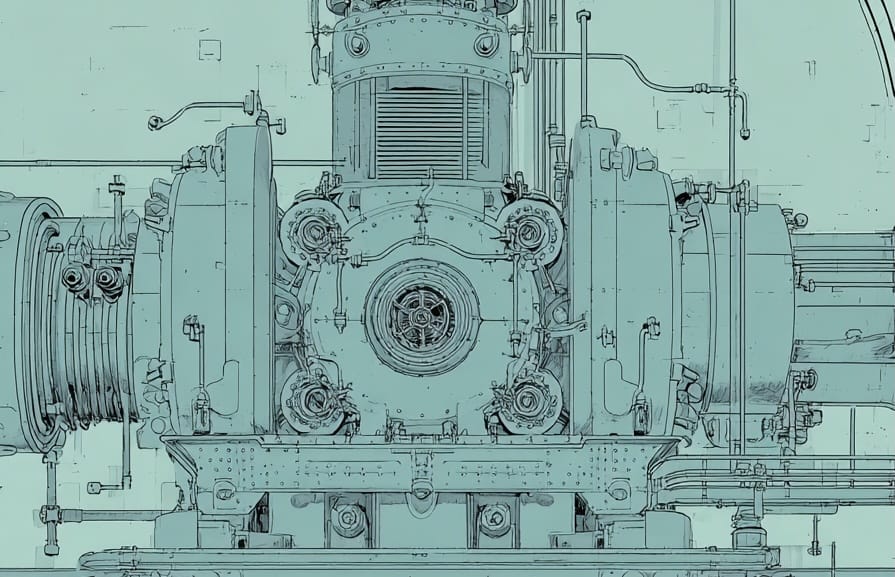
Except When It Briefly Re-Engaged
A recent Guardian article on the efficacy of public protest makes valid points. Protest has mattered. It has bent U.S. history. It has moved elections, forced legislation, built movements, and sustained people through long arcs of struggle. From abolition to suffrage, from civil rights to ACT UP to Black Lives Matter, collective action has repeatedly forced institutions to respond when they otherwise would not.
Yes — and the system that absorbed those shocks is not the same system protest is pushing against now.
From a systems-theory perspective, the core issue is not whether the motor runs. It does. Loudly. Relentlessly. Earnestly. People march, organize, write, document, chant, donate, remember. Energy is being generated. Heat and motion are real.
The problem is the transmission.
In earlier configurations, protest energy mechanically coupled into the drivetrain of power. You could trace the force path:
protest → legitimacy crisis → institutional response → policy change
That coupling depended on specific gears: shared media shock, persuadable elites, electoral vulnerability, courts that could impose consequence, international reputational costs that mattered. When protest revved the engine, those gears engaged. The system moved.
The Guardian article largely assumes that transmission still exists.
Yes — and it increasingly doesn’t.
Today, protest often looks like an engine revving in neutral. The tachometer pegs. The noise is undeniable. Participants feel urgency and connection. But the vehicle barely moves. Decisions proceed. Precedents are set. Enforcement continues.
This isn’t because protestors lack discipline, numbers, or moral clarity. It’s because the clutch has been disengaged — and in places, the gears themselves are stripped.
That damage didn’t happen by accident. It was learned.
From the system’s point of view, past protest “successes” were not moral victories. They were near-failures. Each one became a postmortem. Where did pressure enter? Which component bent? How expensive was the concession? How do we prevent that exact force path from working again?
The civil rights movement taught the state that overt, televised violence against disciplined nonviolent protesters was catastrophically costly. The lesson was not “never repress,” but “never repress that way.” Policing doctrine professionalized. Repression migrated from spectacle to procedure.
ACT UP taught that disruption of bureaucratic process and reputational chokepoints forces engagement. The response was not capitulation, but professionalization: stakeholder processes, advisory committees, managed participation that absorbs pressure while diffuses urgency.
Black Lives Matter exposed police legitimacy as a vulnerability in a shared media environment. The counter-adaptation was fragmentation: body cameras as management tools, reform language without power transfer, and a media ecosystem sorted enough that the same footage could radicalize one audience and reassure another.
These were not moral awakenings. They were engineering lessons.
So yes, protest has shaped history — and history has shaped the state’s immune response.
That’s why contemporary protest can feel uncanny. The tactics are familiar. The commitment is real. The outcomes are thinner. The motor spins, but torque doesn’t transmit.
And this is where the Guardian’s emphasis on protest’s emotional and identity-forming benefits becomes revealing. That reframing is humane and defensible — but it is also an adaptation to lost leverage. Protest is being defended not because it reliably forces change, but because it sustains people, preserves memory, and maintains moral continuity.
Yes — and that shift should worry us.
When expression substitutes for leverage, the system can absorb protest indefinitely without changing course. Worse, it can metabolize it as spectacle: mocked by opponents, celebrated by participants, ignored by those with authority. Engine noise becomes background hum.
The obvious counter is to re-engage the transmission — to apply protest energy where it disrupts control distance, timing, or frame. And this is where the backlash mechanism becomes visible.
When protest actually transmits torque — when it interferes with logistics, imposes unpredictability, or implicates protected institutions — the system does not negotiate. It locks the gearbox.
The UK’s response to Palestine Action makes this explicit. By targeting infrastructure and supply chains tied to arms production, the group reached into the drivetrain rather than revving the engine. The response was reclassification: bans, arrests, trials. From the state’s perspective, this was rational. Once torque is transmitted, the priority is to protect the gearbox and broadcast a deterrent signal.
This is the knife edge protesters now face:
• Keep revving → remain decoupled, tolerated, absorbed, experience wear and burnout.
• Transmit torque → trigger backlash that strips teeth from the gears altogether.
Let's consider another systems insight: some of the gears aren’t just disengaged — they’re damaged.
Courts that once translated legitimacy pressure into consequence are slowed, selective, or insulated. Electoral mechanisms still matter, but are blunted by polarization and structural bias. Media no longer delivers shared shock. International reputational costs are uneven and easily dismissed. These are not clutches waiting to be re-engaged; they are gears with missing teeth.
Which brings us to a necessary counterpoint — the case that seems to break the pattern.
January 6 was different.
Not morally — structurally.
January 6 was not expressive protest aimed at policy or symbolism. It was a direct attempt to interrupt a core constitutional process: the certification of an election and the peaceful transfer of power. In systems terms, it wasn’t the engine revving; it was a shock to the drivetrain.
Because of that, parts of the transmission did briefly engage.
Congress impeached. A select committee held hearings. Prosecutors launched the largest criminal investigation in U.S. history. For a moment, legitimacy pressure translated into institutional response. The system recognized an integrity threat and reacted.
Yes — and that engagement was temporary and partial.
The same architecture that normally insulates power reasserted itself. Legal doctrines narrowed liability. The presidency’s immunity envelope expanded. Electoral outcomes rewired accountability. Prosecutions against the central figure were dismissed upon reelection, and mass pardons erased consequences for participants.
From a mechanical standpoint, January 6 proved two things at once:
- A sufficiently direct threat can still force the transmission to engage.
- The system possesses overrides — immunity, elections, clemency — that can disengage it again before durable accountability takes hold.
January 6 was not evidence that the gearbox works as designed. It was a stress test survived. The lesson absorbed was not “never allow this,” but “here is how to absorb it next time without lasting damage.”
That’s why essays like Robert Reich’s January 6 remembrance feel both necessary and insufficient. They preserve the memory subsystem — a human checksum against revisionism. They keep the engine from stalling entirely.
Yes — and memory alone no longer drives the wheels.
Seen this way, this pattern — executive action, emergency protest, media coverage, ridicule, repeat — is not a failure of will. It’s a known operating cycle. The system has budgeted for engine noise. It distinguishes sharply between historical accountability (cheap, symbolic) and operational accountability (expensive, resisted, neutralized).
The Guardian is right to resist despair. Protest still matters. It still builds people. It still records truth. It still lays groundwork for long arcs.
Yes — and none of that guarantees traction in the current mechanical configuration.
From a certain perspective, the real questions are no longer rhetorical or moral. They’re architectural:
Which gears still have teeth?
Which linkages still transmit force instead of absorbing it?
Which actions re-engage the drivetrain without triggering a full lockup or permanent damage?
Systems do not fail for lack of energy.
They fail for misalignment.
Right now, the motor is strong.
The transmission is slipping.
Some gears are stripped.
More throttle won’t fix that.
Only redesign will.