What Happens If This Ship Exists?
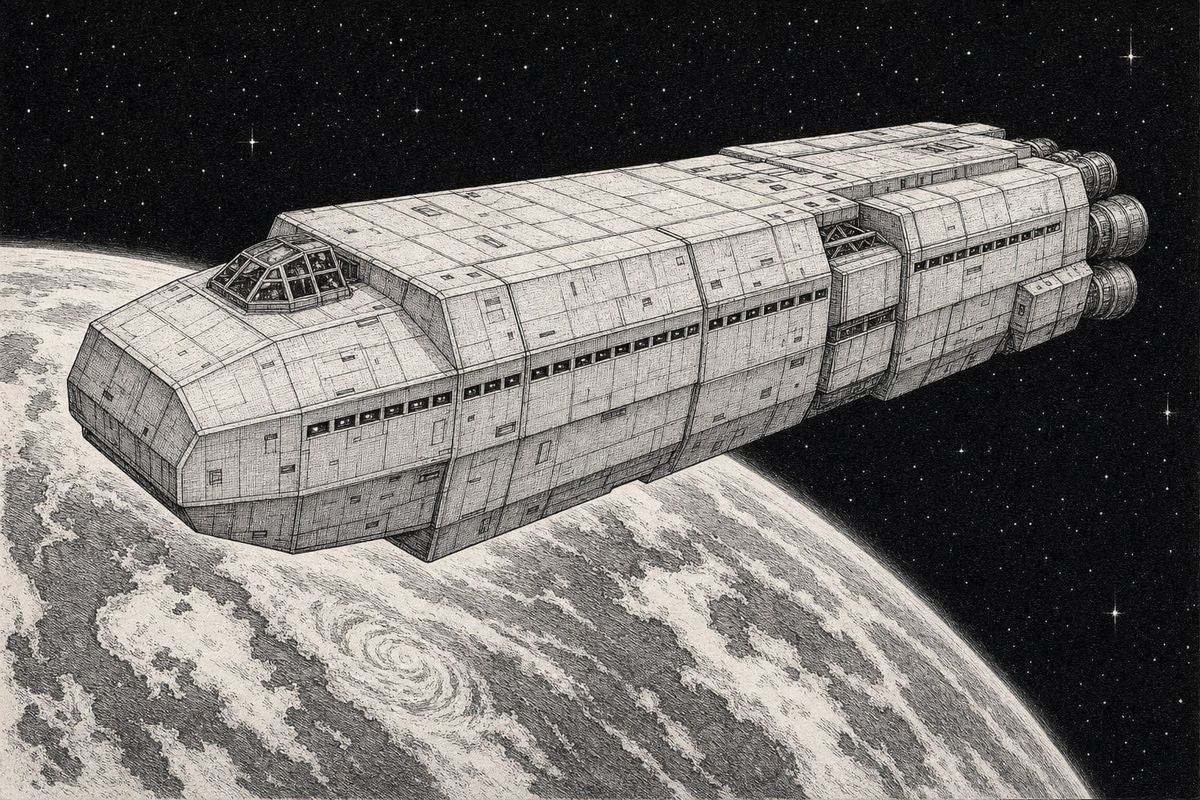
From Traveller tonnage to political consequence
Dungeons & Dragons may have been my first exposure to tabletop role-playing games, but Traveller was the one that truly caught my imagination.
Part of that was surely the presentation: three steadfastly nondescript black booklets in an equally monolithic black box, bearing the now-familiar distress call from a merchant ship under attack. It did not look like it was trying to sell me a fantasy. It looked like it had been issued by an office whose bureaucracy happened to extend into space.
And then there were the rules. Traveller could be played with two ordinary six-sided dice. Its starship design rules were dense enough to feel like engineering without pretending to be engineering. Drives consumed tonnage. Fuel consumed more. A jump rating was not just a cool number; it was a set of tradeoffs. A ship could have more range, more cargo, better acceleration, more weapons, more passenger space—but never all of them. Every choice pushed something else off the page.
The starship design system was also how I got into teaching myself AppleWorks. At some point, recalculating tonnage by hand becomes an invitation to build a spreadsheet. The spreadsheet did not make Traveller less imaginative. It made the imagination more repeatable. You could make a ship, alter one assumption, and see what fell out the other side.
Fast forward more than a handful of years, and that spreadsheet logic has evolved into a Large Language Model “skill”: a specialized procedure that can take the basic parameters and mission of a Traveller vessel, calculate its Book 2 components, check its tonnage and cost, and flag when something does not fit.
That would already be useful. But the more interesting thing is what happens when the skill is surrounded by a conversational interface. A calculator can tell you whether a ship works. A conversation can ask what follows if it does.
That distinction turned out to be the real subject of two recent design sessions: the Condottiere-class Frontier Contingency Transport, and a Tech Level-15 jump-6 long-range courier. In both cases, the ship design began as a fairly bounded technical exercise. In both cases, the numbers became a way to ask questions about institutions, economic power, prestige, security, infrastructure, and the kinds of stories a setting can tell.
The key question transformed from “What job is this ship designed to do?” to “If this ship exists, who benefits, who bears the costs, and what incentives does it create?”
A hundred tons and a mailed fist
The Condottiere began as an 800-ton mercenary transport: a ship intended to deliver, sustain, and extract a reinforced platoon. Its defining decision was comparatively simple. Instead of the stock Mercenary Cruiser’s jump-3 performance, it would accept jump-2.
On an 800-ton Traveller hull, that is not a minor adjustment. Moving from a jump drive M to a jump drive H recovers twenty tons in machinery. More important, the required fuel falls from 240 tons to 160. One lower jump rating returns a full hundred tons of usable space.
That is a lot of narrative waiting to happen.
At first, it becomes practical equipment: extra cutters, tracked all-terrain vehicles, cargo capacity, low berths, armament, staterooms. The Condottiere ended up with three 50-ton cutters, a suite of ATV modules, eight pulse-laser-and-sandcaster double turrets, and enough accommodation to carry forty troops. It is not a ship that should square off against a serious system-defense vessel. But it is also very much not a civilian freighter that hopes nobody notices it.
Then the recovered space starts asking questions back.
What if the cargo space is not merely cargo space? What if it becomes three standardized 50-ton mission packages? A relief clinic. An evacuation module. A field command post. A passenger block. A workshop. Extra fuel. A mobile administrative office. A secure records suite. A field tribunal.
At that point, the ship is no longer merely a mercenary cruiser. It becomes a Frontier Contingency Transport: a bloodless bureaucratic name for something that can arrive at a collapsing colony, troubled world, isolated research station, or politically inconvenient disaster and bring a solution with it.
Or, more exactly, bring several possible solutions—provided someone chose the correct modules before departure.
That is the constraint that keeps it from becoming an 800-ton answer to every problem. The ship is flexible, but it must commit. If it loads a medical unit, evacuation accommodation, and relief stores, it may not have room for the field workshop, heavy equipment, or mobile tribunal. If it brings three ATV modules, it has made a different bet about the mission than if it brings a troop shuttle module and a command center.
Its adaptability is therefore not a lack of drama. It is a source of it.
The ship’s humanitarian role is similarly complicated. It can genuinely serve as an evacuation platform or crisis-response vessel. It has cutters, ground vehicles, low berths, cargo capacity, medical potential, and enough room to lift a consulate, university faculty, hospital staff, or high-value expatriate population out of trouble.
But it definitely ain't Médecins Sans Frontières.
Eight double turrets, a forty-person troop complement, armed cutter options, and tracked ground vehicles mean that its humanitarianism is protective rather than neutral. The ship can bring food, medicine, and evacuees. It can also establish a perimeter, secure a landing zone, escort a convoy, and make itself a poor hostage target.
That makes it a mailed fist in a velvet glove.
And the mobile tribunal possibility is darker still. Three 50-ton modules can plausibly contain offices, records storage, hearing rooms, holding facilities, legal staff accommodation, communications equipment, and security support. The ship does not have to be a “flying court martial” every time it arrives. But the fact that it can be tells us something about the polity, corporation, consortium, or security contractor that owns it.
This is not merely a vessel that can bring force. It can bring administrative legitimacy, or at least the paperwork of legitimacy. It can declare an emergency, process detainees, certify a new local authority, seize records, convene an inquiry, or turn a chaotic situation into something legible to the people paying for the expedition.
The ship’s capabilities imply a doctrine. The doctrine implies institutions. The institutions imply people who will experience its arrival as rescue, occupation, opportunity, threat, or all four at once.
That is worldbuilding emerging from tonnage.
A short route through a long political map
The jump-6 courier began from the opposite direction.
Instead of asking what could be done with recovered capacity, it asked what happens when a capability is scarce.
The current design is a custom 1,000-ton TL-15 vessel with jump-6 performance, 4-G maneuver, a Model/6 computer, ten turrets, and fuel for exactly one jump-6 plus four weeks of power-plant operation. It has only forty-two tons uncommitted. It is expensive—roughly 650 million credits before financing—but for prosperous, billion-population TL-15 endpoint worlds, the cost is not the story.
The story is that only a narrow class of worlds can build, maintain, or properly support it.
The courier can cross six parsecs in roughly one jump week. A jump-1 route threading through actual star systems may take eight, ten, or fifteen jumps, depending on the geography of the subsector and the available fuel-capable worlds. The difference is not merely speed. It is a collapse of practical distance for the two endpoint worlds.
But the ship does not revolutionize freight. Its cargo margin is too poor, and bulk trade will still move through the slower chain. This is not an interstellar container ship. It is closer to Concorde: an expensive, infrastructure-gated, prestige-laden fast lane for time-sensitive people, intelligence, urgent parts, medical materials, key documents, and whoever can secure a place on the manifest.
That means the central question morphs from “Can it make money?” to “Who controls access?”
The endpoints benefit from priority dispatch, first-mover advantage, strategic signaling, and the ability to coordinate faster than their rivals. The consortium backing the ship benefits not mainly from freight revenue but from controlling the allocation of its scarcity. The crew receives a prestigious post on the cutting edge, along with the risk of operating a single-hull asset with thin margins and no easy rescue infrastructure off-route.
The intermediate jump-1 worlds experience something more varied. Some are diversified systems. They will lose must-stop prestige and a measure of traffic, but not their underlying reason to exist. Their response may resemble major Route 66 cities bypassed by interstates: lobbying, rebranding, nostalgia, or a pivot toward whatever the shortcut cannot replace.
Others may be single-function waystations whose economy was built around being unavoidable. For them, the new route is not a slight loss of status. It is a shock. The analogy is not merely that a highway passed somewhere else. It is that a political decision, backed by technology they cannot replicate, has changed the meaning of their location.
And they may be unable to catch up. A TL-15 jump-6 capability is not just something they failed to invest in. It may be structurally outside their industrial reach. That turns a ship design into a durable two-tier order.
The long-jumper is also fragile. There is one hull, one route, a small network of viable maintenance bases, and no fleet redundancy. Lose it in an accident, sabotage it, delay its overhaul, interfere with fuel access, compromise the manifest process, or turn one endpoint politically hostile, and the shortcut disappears. The asset’s cost may be trivial to a world-scale budget. Its scarcity is not.
Again, the rules did not directly produce this politics. The rules supplied the constraints. The conversation made it possible to ask what those constraints meant for everyone who did not own the ship.
Beyond the job to be done
In Agile and Scrum contexts, “job to be done” is often useful shorthand. What outcome is the user trying to achieve? What problem are they hiring this product or service to solve?
That is a good starting question for ship design too. Move troops. Carry cargo. Deliver messages. Conduct survey work. Evacuate civilians. But it can leave the world outside the ship oddly still.
In addition to just asking what the owner intends to do, a more generative question becomes what solutions and complications become possible once the capability exists.
A jump-6 courier can deliver messages much faster. It can also reorganize prestige, create an access monopoly, weaken intermediate systems’ bargaining position, and turn the cargo manifest into a political battlefield.
A modular mercenary transport can move troops and equipment. It can also become an armed humanitarian presence, a corporate crisis-response asset, a diplomatic extraction platform, a mobile administrative annex, or a flying court martial with excellent cargo-handling facilities.
While game statistics have become dissertations (merci, grognards!) , it's worth taking that proverbial step back. Sometimes a jump drive is just a jump drive, and a ship is just the thing that gets the player characters to the next planet.
But Traveller has always been unusually good at rewarding the next question. Its dry tables are covert worldbuilding machinery. Fuel costs imply trade routes. Starport classes imply institutional capacity. Jump ratings imply distance, delay, and isolation. Crew requirements imply labor. Cargo space implies economic purpose. Technology levels imply hierarchy, dependence, and exclusion.
The spreadsheet taught me how to ask whether a ship fit, while the LLM skill makes it easier to ask what kind of universe would make that fit matter.