We Jam Econo
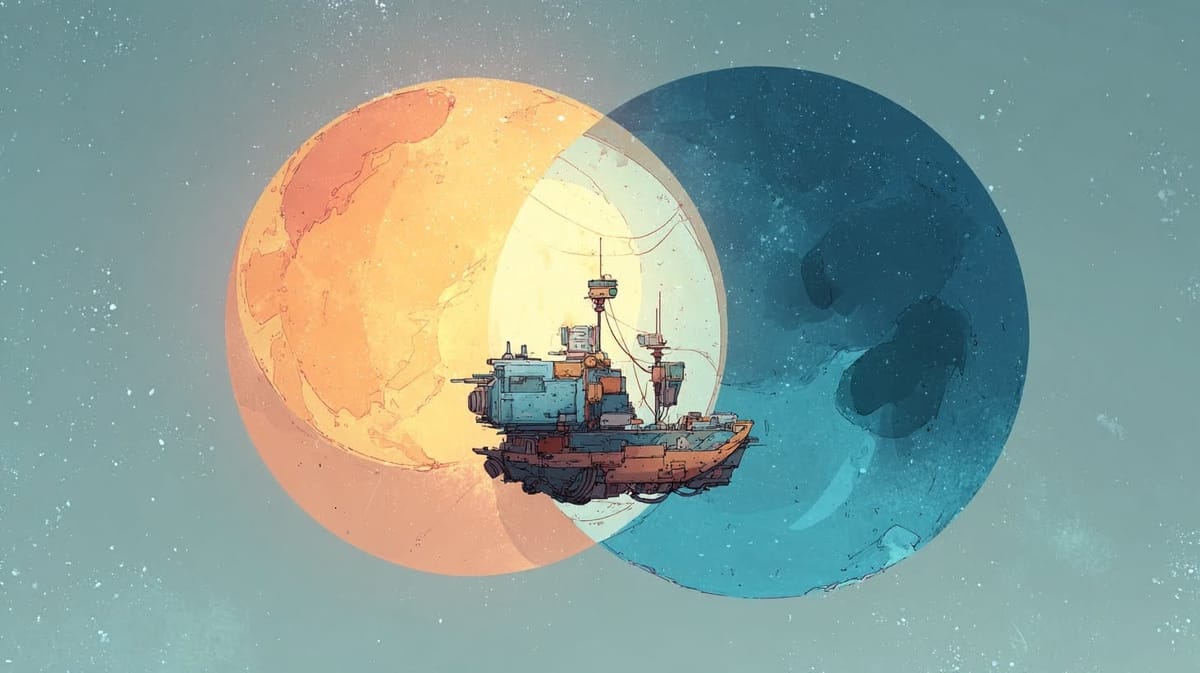
A Framework for Persistent, Life-Sustaining Gig Misadventures in Space
Compatible with TiGGR: Tiny Game for Generalized Roleplaying
Components: 2d6, pencil and paper, TiGGR core rules
Players: 1 GM + 2-4 crew (3-5 total)
Playtime: 60-90 minutes per gig
Tone: Bittersweet persistence — foam-padded bodies, unpadded feelings, infinite continuation
WHAT IS WE JAM ECONO?
We Jam Econo is a framework for playing a crew of interstellar gig workers taking jobs in a universe that doesn't care about them. It's about:
- Persistence as reward (you keep going)
- Selective abundance (every gig has two of three good things)
- Structural absence (one good thing is always missing)
- Foam-padded bodies (nobody dies)
- Unpadded feelings (things still hurt)
- Seasonal participation (people leave, and that's okay)
You don't play We Jam Econo to save the galaxy or spiral into ruin. You play it to take the next gig, balance the ledger, and find out what "together" feels like this week.
The Core Promise
You will take the gig. The money might be bad. The client might be worse. The ship will hold together. Barely.
You will not get everything you need. Two out of three. Always two out of three. You choose which absence you can live with.
You will come back. Dusty, broke, tired, still a crew. Still loading the van. Still checking the gig board.
This is the pattern. This is the orbit. This is We Jam Econo.
THE ORBIT
Most games assume a trajectory. You're going up (gaining power, accumulating wealth, becoming more) or you're going down (losing resources, accumulating trauma, becoming less).
We Jam Econo assumes an orbit.
You are not climbing. You are not falling. You are moving laterally through space, maintaining altitude through continuous effort, skirting the gravity wells of progression and entropy without falling into either.
Progression's gravity well pulls you toward power fantasy. You're accumulating too much, becoming too comfortable, turning into protagonists. The gig economy becomes a career. The crew becomes a corporation. The orbit decays upward into a story about success, and success ends the game because there's nothing left to persist against.
Entropy's gravity well pulls you toward doom spiral. You're losing too much, the ship is failing, the crew is fracturing. The gig economy becomes a death march. The orbit decays downward into a story about destruction, and destruction ends the game because there's no one left to persist.
The orbit is the space between. Not comfortable, not catastrophic. The fuel gauge is where it always is. The next gig is on the board. Someone's not talking to someone. The ship works. The ship barely works. You're going because going is what you do.
The game maintains this orbit structurally. The system itself creates drag when you drift too far in either direction. Players make choices freely within a physics that has built-in orbital mechanics. This isn't railroading. It's genre. A working band doesn't experience the constraints of the gig economy as oppression. They experience them as Tuesday.
THE TRIANGLE
Every gig has two of three: Money, Hang, Glory.
The two that are present define what goes right. The one that's absent defines the emotional shape of the session — the specific ache the crew carries home.
Money + Hang, No Glory
You get paid and you have a good time together, but nobody will ever know what you did. The job is unglamorous. You're hauling fertilizer through an asteroid field, or cleaning out a cargo bay for a friend of a friend. You come home with credits and good stories for each other, and the universe doesn't notice you exist.
The ache is insignificance.
Money + Glory, No Hang
The job pays and people hear about it, but it costs you something relational. Maybe the crew fights the whole time. Maybe you work for someone who makes you feel small. Maybe you succeed but a crewmate got left behind at a critical moment and everyone knows it. You're flush and famous and the ride home is silent.
The ache is loneliness.
Hang + Glory, No Money
The best night of your life. You're with people you love, doing something people will talk about, and you are broke. The fuel gauge is on empty. The ship needs repairs you can't afford. You played the gig of a lifetime and you can't make rent.
The ache is precarity.
Designing With the Triangle
When creating a gig, the GM (or scenario) determines which two legs are present. This isn't hidden — the crew can see the triangle when the gig is offered. Part of the decision to take the job is knowing which absence you're signing up for.
The triangle creates natural campaign rhythm. Three sessions of Hang + Glory gigs and the debt mounts — eventually someone has to take the Money + Glory job that strains the crew. A string of Money + Hang jobs and someone snaps: they want to matter, to do something people remember, even if it costs.
Different crew members want different things. The optimist wants Glory. The pragmatist wants Money. The heart of the crew just wants Hang. They can't all get what they need at the same time, and that's the engine.
THE DEFICIT TRACKS
The crew shares three tracks that measure how long it's been since they got each leg of the triangle. These are crew-level, not individual.
Each track has five segments. When a gig is missing a leg, that track advances one segment. When a gig includes a leg, that track resets to zero.
Money Deficit
Measures how long since the crew got paid properly.
- Segment 1-2: Belt-tightening. Bad food. Deferred maintenance. Cosmetic.
- Segment 3-4: Real pressure. Systems failing. Favors called in. Choices about what to fix and what to let slide.
- Segment 5 — Crisis: The ship can't fly, or a creditor arrives, or someone has to sell something that matters. The crew scrambles. Foam-padding means: the ship won't be repossessed permanently, nobody starves, the creditor can be negotiated with. But the scramble is real, undignified, and forces choices that reveal character.
Hang Deficit
Measures how long since the crew felt like a crew.
- Segment 1-2: Quiet distance. People eating alone. Shorter conversations. Nobody's fighting, but nobody's connecting.
- Segment 3-4: Real friction. Assumptions instead of questions. Decisions made without consultation. The silences are heavy.
- Segment 5 — Crisis: Someone says the thing that's been building. A crewmate announces they're thinking about leaving, or takes a call from someone offering a solo gig, or just goes silent in a way that's different. Foam-padding means: nobody actually leaves. The fight resolves, or reaches détente. But something was said that can't be unsaid.
Glory Deficit
Measures how long since the crew felt like they mattered.
- Segment 1-2: Low-grade invisibility. Nobody knows your name. The gig board has nothing interesting.
- Segment 3-4: Existential itch. A news feed mentions a crew that's not you doing something impressive. An old contact doesn't remember you.
- Segment 5 — Crisis: Someone asks "what are we even doing?" and means it. Someone proposes a plan that's clearly too dangerous and too ambitious, not because they think it'll work but because they need to feel like they're something. Foam-padding means: they survive the reckless thing. But the question hangs in the air.
After a Crisis
When a deficit track hits 5 and the crisis plays out, that track resets to zero. Not because the underlying problem is solved, but because the pressure has been released. You had the fight. You scrambled for rent. You did the reckless thing. The track starts climbing again next time.
Surplus Pressure
The game also resists drift toward progression. If any track stays at zero for three consecutive gigs — if you've had Money three times running, or Hang, or Glory — a surplus complication emerges:
- Money surplus: Comfort attracts attention. A creditor who wrote you off comes back. Someone offers the crew "real" work — legitimate, stable, a way out of the gig economy. The offer is the gravity well. Taking it would mean becoming something other than a crew taking gigs.
- Hang surplus: Insularity calcifies. The crew stops checking with each other because they assume they know. Someone makes a decision for the group without asking. What felt like warmth starts looking like a wall from outside.
- Glory surplus: Visibility obligates. People expect things from you. A faction wants to hire you exclusively. A journalist wants the story. You're becoming protagonists, and protagonists don't get to choose which gig to take — the gigs choose them.
Surplus complications don't punish the crew. They create gentle systemic pressure back toward the orbit. The corridor has walls in both directions.
Drift Pressure
If the crew declines every gig on the board without taking one, advance all three deficit tracks by one segment. Not taking a gig doesn't pause the orbit — it means you're spending time getting none of the three things. The ship still burns fuel. The crew still eats. The universe still doesn't notice you.
The next session's gig board may also be thinner. Opportunities aren't infinite. Turning down work has a way of producing less work to turn down.

WHO YOU PLAY
The Crew
Everyone on this ship is here because this is the best option available. Not the best option imaginable — the best option available. Nobody is subsidizing the operation with surplus from a comfortable life elsewhere. Nobody could walk away and return to something obviously better. The gig economy is not something you opted into from a position of comfort. It is the economy.
The Two Questions
Before anything else — before stats, before roles, before gear — answer two questions. These are your character. Everything else is detail.
What do you need most from the next gig?
Choose one: Money, Hang, or Glory.
This is your pole star. It's what you're watching for when the board refreshes, what you argue for in Scene 1, what you're counting during the scramble, and what you sit with afterward. It's not greed or vanity or softness. It's the specific insufficiency that's become unbearable.
- Money: You've seen what happens when the ship can't fly. You need the account to have something in it. You need to stop doing math on the datapad at 3 AM.
- Hang: You know the crew is the only thing that makes any of this survivable. You need to eat together. You need the silence to be the comfortable kind.
- Glory: You need someone to know your name. You need the work to mean something to someone who isn't on this ship. You need to not be invisible.
Your pole star shapes how you experience the gig's absence. When the crew takes a job missing your pole star, you feel it more than the others. When the deficit track for your pole star hits crisis, you're at the center of it.
Your pole star can shift between arcs if the story supports it. The character who always needed Money might, after a long stretch of solvency, realize they're starving for something else. That shift isn't growth. It's recalibration. The hunger changed shape.
What do you have from the last one?
Name one specific thing you're carrying from your most recent gig. Not a leg of the triangle — a moment. A concrete, particular thing that's still with you.
- The client who paid on time and said "good work" like they meant it
- The moment in the cargo bay when someone made a joke so stupid you couldn't stop laughing
- The bartender at the refueling station who said "I heard about you"
- The uncomfortable memory of what you agreed to haul
- The silence after the fight that cleared the air
- The message from a stranger who said you helped them
- The look on a crewmate's face when you left them behind for thirty seconds too long
This is your residue. It's what you think about during the Re-Entry. It's the thing that colors the first hour back aboard. After each gig, you'll answer this question again, and the old residue is replaced by the new one. Nothing accumulates mechanically. But the table remembers.
The two questions together create a vector. Need minus residue equals direction. A character who needs Glory and carries Hang from the last gig is loved but invisible. A character who needs Money and carries Glory is recognized and broke. A character who needs Hang and carries Money can pay their debts but eats alone.
Fourteen words. Updated every session. The rest is scaffolding.
Stats
Distribute 3 points across:
- Body: Hauling, fixing, enduring, running, surviving vacuum and bad landings
- Mind: Navigation, repair, planning, reading contracts, spotting the catch
- Charm: Negotiation, bluffing, reading people, talking your way aboard, keeping the crew together
Roles
Choose one. These aren't jobs — they're how you show up.
- The Optimist: Finds the next gig, frames disaster as opportunity, needs the crew more than they'll say. (The Schemer's cousin, without the incompetence.)
- The Mechanic: Keeps the ship alive through ingenuity, spite, and parts that shouldn't be compatible. The ship is their instrument.
- The Operator: Handles the clients, reads the contracts, knows when they're being lied to. Usually right. Usually ignored.
- The Stray: Newest aboard, or the one with the least history. Asks the questions everyone else stopped asking. Doesn't know yet that orbits can decay.
Special Ability (once per scene)
Choose one at character creation:
- "I Know a Guy" (+1 Charm when calling in a favor from a previous gig)
- "Hold Together" (+1 Body when the ship or equipment is failing at the worst moment)
- "Read the Room" (+1 Mind when assessing whether a client or gig is what it claims)
- "Not My First Time" (+1 to any roll when you've been in this exact kind of trouble before — describe when)
- "Somehow Still Here" (+1 Body when everything has gone wrong and you just need to survive the next thirty seconds)
Signature Gear (+3 to any roll, once per gig)
Choose one:
- The Toolkit (holds the ship together through means that would void any warranty)
- The Contact List (names, frequencies, favors owed — on actual paper, because electronics fail)
- The Lucky Thing (doesn't matter what it is; it's been on every gig and it's not stopping now)
- Borrowed Credentials (not yours, not expired yet, won't survive close scrutiny)
- The Old Contract (proof someone owes you; you're saving it for when it matters)
HP: 5
0 HP = knocked out, exhausted, overwhelmed, mortified, or incapacitated. Not dead. Describe the setback. Reset to full HP at the start of the next scene.
Between gigs, all HP resets automatically.
Your Last Season
Not "what are your stats" but "what were you before this ship, and why did that end?"
Choose or create:
Completion: Your last season ran its course. You cooked on a station for eight years. You crewed a survey vessel until the contract ended. You ran a repair shop until you didn't want to anymore. You bring skills and an understanding that things end, and that's fine.
Failure: Your last season didn't work. You tried to run an independent courier service and it went under. You had a crew and the crew fell apart. You bring skills and a specific nervous attention to whichever deficit track reminds you of how you lost it last time.
Disillusionment: Your last season succeeded, and the success was ugly. You were a company logistics coordinator and you found out where the cargo actually went. You were a station administrator and you learned what the efficiency metrics really measured. You bring skills and a complicated relationship with visibility — you know what institutions do when they notice you.
No Previous Season: This ship is your first thing. You grew up shipboard, or you've never been anywhere else, or this is the first time anything felt like it was yours. You don't have a "before." If someone leaves the crew, you'll take it harder than anyone, because you have no framework for seasons ending.
Your last season shapes your first pole star. Someone whose season ended in financial failure probably starts needing Money. Someone who saw what institutions do probably starts needing Hang — the crew, not the spotlight. Someone who's never had a season end might start needing Glory, because they haven't learned yet what visibility costs.
Putting It Together
A complete character:
Name: Sable Wick
Last Season: Disillusionment. Ran logistics for a mining combine. Found out the "efficiency bonuses" were calculated against a ghost labor ledger. Left. Brought the spreadsheet skills and a flinch around anyone official.
What do you need most from the next gig? Hang. The crew. Something that feels like it's hers, not an institution's.
What do you have from the last one? The moment after the cargo swap went sideways, when Dex looked at her and said "that was your call and it was the right one" — and meant it.
Stats: Body 0, Mind 2, Charm 1
Role: The Operator
Special Ability: "Read the Room" (+1 Mind assessing clients and gigs)
Signature Gear: The Old Contract (a copy of the mining combine's ghost labor ledger — proof of what they did, saved for when it matters)
HP: 5
THE SHIP
The ship is a character. Not mechanically complex — it doesn't have stats in the traditional sense. But it's the thing that makes the crew a crew rather than strangers at the same fuel station.
Give It:
A Name. Something that was probably optimistic once.
A History. How did the crew get it? Probably not cleanly. Mortgage, inheritance, salvage, won in a card game, found it and nobody came looking.
A Problem. One thing that's always wrong. The heating cycles randomly. The cargo bay door sticks. The navigation computer gives directions in a language nobody aboard speaks. This problem never gets fully fixed. It gets managed. It's part of the ship's personality.
A Sound. What does it sound like when everything's working? What does it sound like when things are about to go wrong? The crew knows these sounds the way you know the sounds of your own apartment.
The Ship and the Deficit Tracks
The ship reflects all three deficits. It's the barometer.
Money deficit shows in the ship's body. At 1-2, cosmetic — flickering lights, worn upholstery, that smell from the ventilation. At 3-4, functional — systems going offline, repairs deferred too long, choosing which broken thing to fix this week. At 5, the ship is the crisis.
Hang deficit shows in the ship's shared spaces. At 1-2, the galley gets messy — nobody's cleaning up after anyone else. At 3-4, shared systems get siloed — someone changes a lock code on a storage compartment, the comm system gets partitioned, personal items migrate out of common areas. At 5, the ship feels like a boarding house rather than a home.
Glory deficit shows in the ship's relationship to the outside world. At 1-2, the gig board has nothing interesting — just hauling and maintenance. At 3-4, port records misspell the ship's name, or call signs get confused with another vessel. At 5, someone hails and it's a wrong number — they were looking for a different crew entirely.
The ship never dies. Foam-padding extends to the vessel. But it can be tired, the way a touring van is tired after two hundred thousand miles — still running, still getting you there, making sounds that worry you.
THE GIG BOARD
The GM prepares or improvises gigs. Each gig has:
The Job: What needs doing. Hauling, delivering, transporting a person, retrieving something, providing security, making a pickup, being somewhere at a specific time. Gig economy work — not heroic quests, not criminal masterplans. Just jobs.
The Client: Who's paying, or who's asking. The client is not your friend. They may not be your enemy, but they have their own priorities and your wellbeing isn't one of them.
The Triangle: Which two of three — Money, Hang, Glory — are present. This is visible to the players when the gig is offered.
The Catch: One thing that makes the gig harder than it looks. The cargo is heavier than listed. The destination has changed. The timeline is wrong. There's always a catch.
Sample Gigs
"Fertilizer Run" (Money + Hang, No Glory) Haul agricultural chemicals from the orbital depot to a farming station three jumps out. Pay is decent. Route is boring. Nobody will ever know you did this. The catch: the chemicals are technically restricted, and there's a checkpoint on jump two that the client forgot to mention.
"The Passenger" (Money + Glory, No Hang) Transport a minor celebrity — a net-famous food critic — from the station to a restaurant opening four systems away. Pay is great. Everyone will know you did this because the critic posts everything. The catch: the critic is insufferable, plays the crew against each other for content, and the ship's galley is going to be reviewed publicly. The ride home will be silent.
"The Benefit" (Hang + Glory, No Money) A friend of the crew is opening a new venue on a struggling station and needs someone to make the supply run for opening night — for free, because they're broke too. The station's small community will remember who helped. The crew will have the best night they've had in months. The catch: the supplies are on a station controlled by people who don't like your friend, and you're not getting paid for any of this. The fuel cost alone will hurt.
"Dead Drop" (Money + Hang, No Glory) Pick up a sealed container from a locker at a transit hub, deliver it to coordinates in open space, leave it on a beacon, go home. No questions. Good pay. The crew has time together on a quiet run. The catch: the container makes sounds sometimes, and the coordinates are in a shipping lane that gets patrolled.
"The Reunion" (Hang + Glory, No Money) A former crewmate — someone from before, from someone's last season — needs extraction from a bad situation on a station. No pay. But the crew will pull together for this, and the story will get around. The catch: the former crewmate's bad situation involves people who don't want them extracted, and "extraction" is a generous word for what's actually a favor with no exit plan.
"The Showcase" (Money + Glory, No Hang) A corporate scout is hiring independent crews for a competitive trial run — deliver a package faster and cleaner than three other crews, and the winner gets a long-term contract. Great money. Major visibility. The catch: the competition brings out the worst in the crew. Someone will cut a corner. Someone will feel thrown under. Winning together might feel like losing something.
THE FOUR SCENES
Every gig follows a four-scene structure. The first three are the job. The fourth is the bill.
Scene 1: The Pitch (10-15 minutes)
Location: Wherever the crew is between gigs. The ship's galley. A fuel station bar. The gig board on a transit hub wall.
What Happens:
- The gig is offered or discovered
- The triangle is visible — the crew can see what's present and what's missing
- The crew discusses, argues, decides
- Preparation happens — loading cargo, plotting route, reading the contract
- The ship's Problem makes itself known (it always does before a job)
- The crew has a moment of being together before whatever's coming
Goals:
- Establish the gig, the client, and the catch
- Let the crew see the triangle and choose anyway
- First rolls, if any — reading the contract (Mind), negotiating terms (Charm), getting the ship ready (Body)
- Set the tone for which absence will shape this session
Scene Ends When:
- The crew commits to the gig
- The ship undocks or the route is set
- Everyone knows what they're getting into (mostly)
Scene 2: The Complication (15-20 minutes)
Location: In transit, or at the job site, or wherever the catch reveals itself.
What Happens:
- The catch becomes apparent
- Things go sideways in cascading, entertaining, physically harmless ways
- The two present legs of the triangle start becoming visible — you can see the money taking shape, or the crew clicking, or word getting out
- The absent leg casts its shadow — costs mounting, or friction showing, or the invisibility settling in
- 3-5 complications, drawn from the gig's specifics
- NPCs appear — clients, contacts, obstacles, rivals, authorities (usually confused)
Goals:
- Navigate the complications
- Give everyone a moment — a roll, a decision, a spotlight
- Make the two present legs feel earned
- Make the absent leg feel like a specific, personal cost
- Build momentum toward Scene 3
Scene Ends When:
- The crew is committed — can't turn back, can't renegotiate
- Multiple things are going sideways simultaneously
- The job is almost done but not done
Scene 3: The Scramble (15-20 minutes)
Location: Wherever everything comes to a head.
What Happens:
- Everything happens at once
- The catch fully unfolds
- Equipment fails, timelines collapse, clients change terms, authorities arrive (wrong ones, wrong time)
- The crew makes desperate plays
- Someone does the thing that saves the gig — or almost saves it, or saves a different part of it than planned
- The job resolves — probably not the way anyone intended
Foam-Padding Applies:
- Nobody dies
- The ship limps home
- Cargo might be lost, timelines might be blown, clients might be furious
- But the crew walks away
- Covered in coolant, broke, demanding to know whose idea this was — but intact
Goals:
- Resolve the gig (however it resolves)
- Give everyone a spotlight moment
- The two present legs are delivered or lost in specific ways
- The absent leg's cost is fully felt
- Someone says something about the next gig (or the next anything)
Scene Ends When:
- The job is done (or done enough, or done wrong, or done in a way nobody planned)
- The crew is heading home
- The immediate chaos has settled into the particular quiet that follows chaos
Scene 4: Balancing the Ledger (10-15 minutes)
This is the scene that makes We Jam Econo its own game. The job is done. Now you live with what it cost.
Location: The ship. In transit home, or docked, or drifting while someone fixes whatever broke.
What Happens:
Adjust the deficit tracks. The absent leg's track advances one segment. The two present legs' tracks reset to zero. Check for surplus complications on any track that's been at zero for three consecutive gigs.
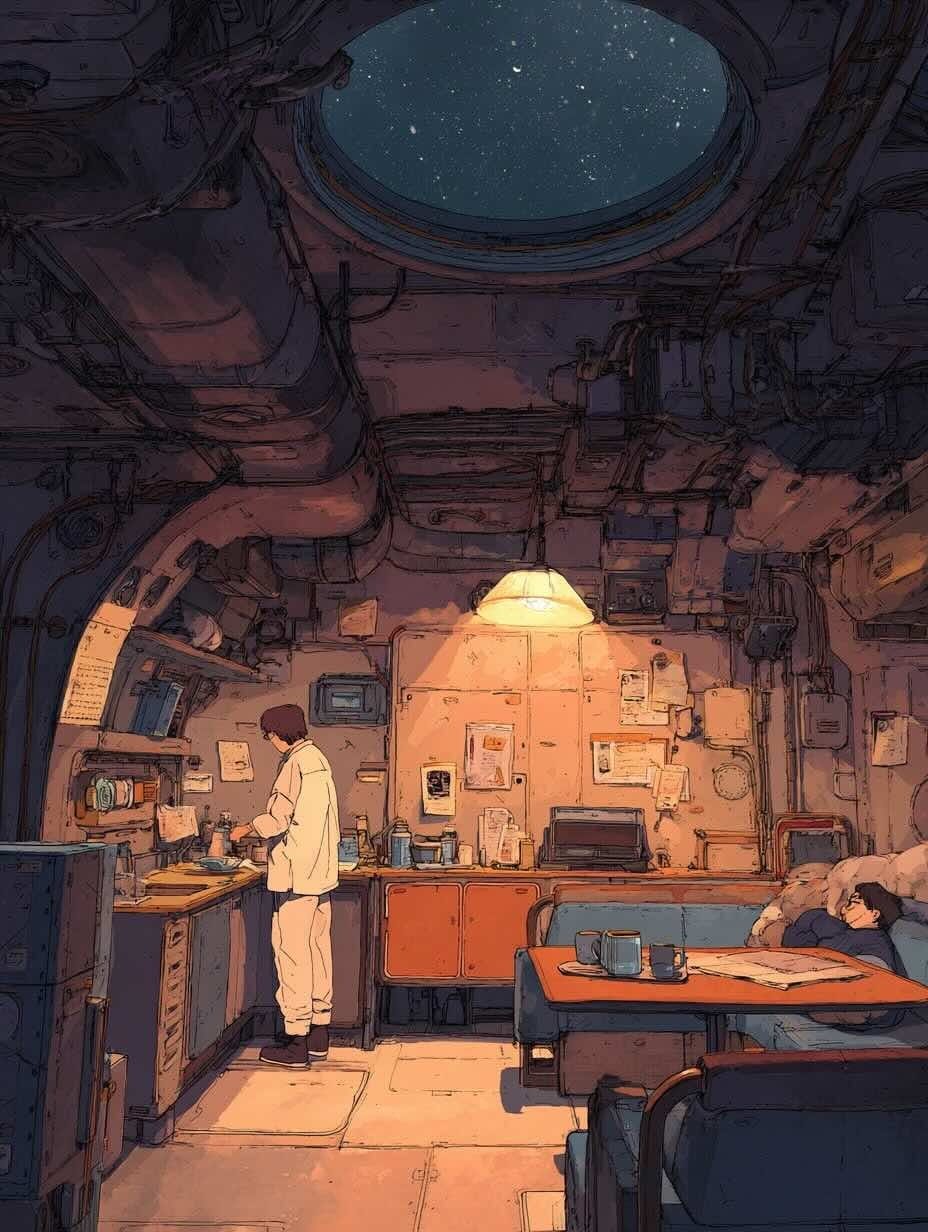
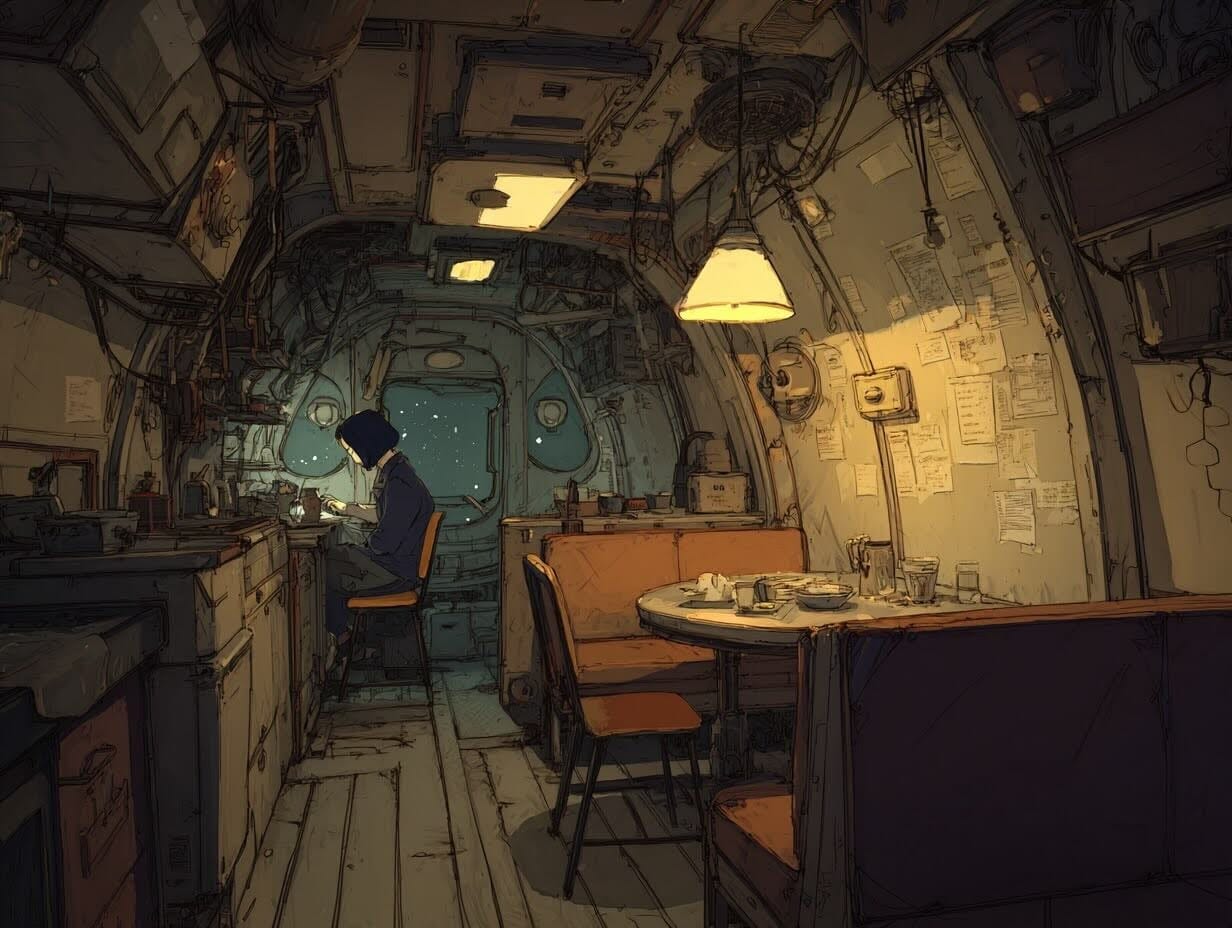
If no track is at 5 — the quiet version. This is the van ride home. Someone makes food. Someone patches a dent. Someone stares out the viewport at nothing. The crew is together in the particular way that crews are together after a job — tired, satisfied or not, aware of each other.
This is where the absence is felt without becoming a crisis:
- No Money: someone's doing math on a datapad and not sharing the numbers
- No Glory: someone's scrolling the feed and seeing nothing about what they just did
- No Hang: someone's in their bunk with the door closed
These quiet Scene 4s matter. They build the texture of the crew over time. They're where relationships deepen through small actions — or don't. They're where someone asks "what's next?" and someone else says "there's a fertilizer run on the board" and someone else sighs, and that sigh contains everything.
If a track hits 5 — the crisis version. The deficit has been building and now it breaks the surface. Play out the crisis as described under the deficit tracks section. The crisis is real but survivable. After it resolves, the track resets.
Scene Ends When:
- The ledger is balanced
- The crew has sat with whatever this gig did to them
- Someone checks the gig board
- The orbit continues
At the Next Session: Re-Entry
The first few minutes of the follow-up session. No rolls. No gig board. You're back on the ship.
Ask each player one concrete question:
- What's still broken from last time?
- What's cleaner than it should be?
- What sound is different?
- Who's where?
- What's playing on the comms?
Don't reference the deficit tracks by number. Let the answers reflect them naturally. If Money is tight, the deferred repairs show up. If Hang is strained, the shared spaces show it. If Glory is low, the comms are static and nobody's hailing you.
Re-Entry doesn't resolve deficits. It reveals them. Then the board refreshes and Scene 1 begins.
FOAM-PADDING: THE PHYSICS OF KINDNESS
We Jam Econo uses modified TiGGR rules to ensure the crew's bodies are protected while their feelings are not.
What Foam-Padding Covers
Physical safety. Nobody dies. 0 HP means knocked out, exhausted, overwhelmed — not killed. Reset to full between scenes, full between gigs.
The ship. It never dies. It can be tired, broken, limping, held together with improvisation — but it gets you home. Always.
The crew's existence. The crew does not break up involuntarily. Deficit crises create fights, silences, tensions — not permanent fractures. The foam-padding guarantees that the orbit continues.
Departure. When a character's player decides their season is over, the departure is honored, not punished. No death, no betrayal. A farewell Scene 4. Gratitude, not guilt. The orbit adjusts and continues.
What Foam-Padding Does NOT Cover
Feelings. The crew can be sad, frustrated, lonely, insignificant, broke, scared, angry. Emotional weight is real. The Blues underneath the persistence are real.
The deficit tracks. These have teeth. Money deficit means the ship is actually failing. Hang deficit means the crew is actually drifting. Glory deficit means the existential ache is actual. The foam-padding guarantees you survive the crisis, not that the crisis doesn't happen.
Dignity. You can lose a gig, botch a job, get cheated by a client, be publicly embarrassed, arrive too late, deliver the wrong thing, get laughed at by a rival crew. The universe's indifference is real.
The absent leg of the triangle. Every gig costs something specific. The foam-padding doesn't fill the absence. It just ensures the absence doesn't kill you.
The Rule
You can lose: money, cargo, time, reputation, dignity, the element of surprise, your temper, your patience, your faith that the next one will be different.
You cannot lose: your life, your crew, your ship, your ability to take the next gig, the orbit.
GM GUIDANCE
Your Job
You are not trying to:
- Destroy the crew
- Reward optimization
- Simulate realistic economics
- Teach lessons about the gig economy
- Push the crew toward progression or entropy
You are trying to:
- Maintain the orbit
- Make the absent leg of the triangle felt
- Make the present legs earned
- Give everyone spotlight moments
- Ensure Scene 4 has emotional weight
- Keep the gig board stocked
The Orbital Mindset
Ask yourself:
- "Which leg is missing and how does it feel?"
- "What would make this gig's specific absence land?"
- "Where's the catch?"
- "What does the quiet Scene 4 look like after this?"
- "What's on the gig board next?"
Don't ask yourself:
- "Is this realistic?"
- "Have they been punished enough?"
- "Should they succeed?"
- "What's the long-term plot arc?"
Maintaining the Orbit
The deficit tracks and surplus complications are your orbital mechanics. Trust them.
If the crew is drifting toward progression — too comfortable, too successful, too known — the surplus complications engage automatically. You don't need to punish success. The system creates drag.
If the crew is drifting toward entropy — too broke, too fractured, too invisible — the foam-padded crisis catches them. You don't need to rescue them. The system provides the floor.
Your job is the middle. The gigs. The complications. The specific texture of this week's absence. The quiet Scene 4 where someone makes food and someone else doesn't eat.
Handling Failure
Every failed roll moves the story forward. Never stops it.
- Failed navigation? You arrive, but late, or somewhere adjacent, or with the ship making that sound.
- Failed negotiation? The client agrees, but changes a term, or adds a condition, or remembers your name wrong later.
- Failed repair? It holds, but temporarily, or loudly, or with a new problem attached.
The rule: failure changes the shape of success. It doesn't prevent arrival.
Running NPCs
NPCs in We Jam Econo are not villains or allies. They're other people in the gig economy.
- Clients have their own problems. They're not evil — they're under pressure from someone else, or they're cutting corners because they have to, or they genuinely forgot to mention the checkpoint.
- Authorities are overworked, underpaid, and enforcing regulations they didn't write. They can be confused, delayed, misdirected — but they're not cartoonishly incompetent. They're just tired.
- Rival crews are doing the same thing you're doing. They're not antagonists. They're the crew in the other van heading to the same venue. Sometimes you help each other. Sometimes you don't. They're not more competent — just differently situated.
- Contacts remember you if you gave them a reason to. They might help. They have their own problems.
The Gig Board
Keep 2-3 gigs available at any time. The crew chooses. This is the most important decision in the game — not "how do we solve the problem" but "which problem do we choose to have?"
Each gig should have a clear triangle, a clear catch, and a clear emotional shape. If you're improvising, pick the absent leg based on which deficit track is lowest (to maintain the orbit) or highest (to push toward crisis, if that's dramatically right).
When You're Stuck
When you need a complication and your mind is blank, ask anyone — another player, a random table, an LLM, the person sitting nearby who isn't playing. The best prompt isn't "what happens next" but something specific to the gig's conditions:
"What goes wrong when three people try to deliver volatile cargo through a checkpoint they didn't know about, in a ship with bad gravity plating?"
"The client just changed the terms mid-job. What did they change and why do they think it's reasonable?"
"Something in the cargo bay is making a sound. It's not dangerous. What is it and why is it inconvenient?"
Good complications are mundane, cascading, and survivable. The catch isn't a monster — it's a paperwork discrepancy, a mechanical failure, a client who forgot to mention something, a schedule that doesn't work, a thing that was supposed to be simple and isn't.
DEPARTURE AND ARRIVAL
When Someone Leaves
Departure is seasonal, not catastrophic. A character's player decides their season is over. Maybe the character's been aboard for many gigs and it's time. Maybe circumstances have changed. Maybe they just feel complete.
Departure is not:
- Death
- Betrayal
- Punishment
- Failure
Departure is:
- A completed season
- Honored with gratitude
- A Scene 4 that's a farewell
- Real and felt and okay
The crew continues. The orbit adjusts. The ship feels different with an empty bunk. Someone checks the gig board.
When Someone Arrives
New crew members are found, not recruited. Gravitational capture, not hiring. Someone at the fuel station needs a berth. Someone's ship broke down and they can't afford repairs. Someone was left behind by another crew and they're trying not to look like they're trying not to cry.
They don't have a cushion. They're not subsidizing the operation. They're another person for whom this ship is the best available option.
New characters are created normally — stats, role, special ability, gear, last season. They join mid-orbit. No origin story required. Just: you're here now. There's a gig on the board. The galley is that way.
CAMPAIGN PLAY
What Changes Over Time
The deficit tracks create rhythm. The crew develops patterns — which absences they tolerate, which they refuse. This pattern is the crew's identity. Some crews are always broke but tight and legendary. Some are comfortable and close but anonymous. Some are solvent and famous but slowly drifting apart.
Relationships deepen through accumulated Scene 4s. The quiet moments build. In-jokes emerge. Someone's way of making food after a bad gig becomes a ritual. Someone's silence becomes readable. The crew becomes itself through repetition, not transformation.
The ship accumulates character. Patches on patches. The sound it makes changes as different things get fixed and different things break. The Problem evolves. The ship becomes the crew's ship specifically, not interchangeable with any other vessel.
The gig board shifts. Contacts remember you (or don't). Stations you've visited have changed. The client from three gigs ago shows up with another offer. The rival crew you helped at the fuel station sends you a tip. The world develops through revisitation, not revelation.
What Doesn't Change
Stats don't advance. You don't get better at things. The TiGGR principle applies: you can shift a stat point if the story supports it, but the total stays the same. You can change what you're bad at, but you stay equally bad overall.
The triangle doesn't get easier. Gigs always have two of three. The orbit doesn't widen. The economy doesn't improve. The crew doesn't graduate to better work.
The foam-padding doesn't thin. Nobody starts dying. The ship doesn't become destructible. The crew's persistence is structurally guaranteed regardless of how long the campaign runs.
The orbit holds. The surplus and deficit mechanics maintain the corridor. Ten sessions in, you're still in the same orbit — but the orbit feels different because of everything that's happened within it.
The Slight Evolution
After 3-5 gigs, each player may:
Shift one stat point if story supports it. "I've been talking our way out of everything" → move a point to Charm.
Rename their Special Ability to reflect experience. "I Know a Guy" becomes "I Know Several Guys, Most of Whom Owe Me." Mechanically identical. Narratively evolved.
Change their Signature Gear to reflect the campaign. "The Toolkit" becomes "The Toolkit Plus That One Part From the Fertilizer Run." Still +3, once per gig.
The principle: characters can evolve their texture without evolving their capability. Not progression. Deepening.
The Logbook
After every deficit crisis, write one sentence in the ship's log. Not a summary — a rule, a boundary, a memory.
"We don't work for Pelorus Freight anymore." "Don't let Dex negotiate alone." "The port-side airlock only opens from outside now."
No mechanical effect. But after five entries, the crew has earned a Seasonal Shift: one crew member may change their role, gain a new special ability, or rewrite their Last Season to reflect who they've become aboard this ship. Not because they leveled up. Because five crises is a season, and seasons change people.
The Logbook is the crew's memory. It tells new crew members what happened before they arrived. It tells departing crew members what they helped build. It tells the table what kind of orbit this has been.
Long-Term Patterns
What emerges after 10+ gigs:
The Crew: Still here. Still taking gigs. Slightly more comfortable with each other in ways that took time. Slightly more known in the corners of space they frequent. Never comfortable enough to stop. Never broken enough to quit.
The Ship: A specific ship, irreplaceable not because it's good but because it's theirs. Full of history. Making sounds that mean things.
The Orbit: Stable. Not because nothing happens, but because everything that happens is absorbed into the pattern. The gig board. The triangle. The scramble. The ledger. The quiet ride home. The next gig.
The Table: Comfortable with persistence. Trusting the pattern. Invested not in where the story is going but in how it feels to be here this week. Coming back for more.
This is the long game. Not progression, but deepening. Not entropy, but texture. Not change, but continuation that earns its own weight.
SAFETY AND CARE
Session Zero
Before your first gig, discuss:
Tone Agreement:
- Bodies are foam-padded; feelings are not
- The gig economy is the setting, not a lesson
- Persistence is the reward, not progress
- Departure is honored, not punished
- Two out of three, always
Boundaries:
- What kind of economic precarity is comfortable to play?
- Any topics to avoid in the "absent leg" emotional weight?
- How do we handle the quiet Scene 4s?
- What does departure look like if someone's character's season ends?
The X-Card, Pause Button, Open Door: Standard safety tools apply. The foam-padding extends to the table.
During Play
The deficit tracks can generate real emotional weight. Scene 4's quiet moments can land harder than the scramble. Check in:
- "Is the tone landing right?"
- "Too bleak or too light?"
- "Is the absent leg hitting in a way that works?"
Adjust as needed. The orbit can be tuned — more slapstick in the scramble, more warmth in Scene 4, different shapes of absence.
The Test
"Would this make the next gig harder to want to play?"
If yes, pull back. The game is about wanting to continue. If something makes continuation feel bad rather than complicated, it's out of bounds.
QUICK REFERENCE
Character Creation
- Two Questions: What do you need most? (pole star) / What do you have from the last one? (residue)
- Stats: Distribute 3 across Body/Mind/Charm
- Role: Optimist, Mechanic, Operator, or Stray
- Special Ability: Once per scene, +1 situational
- Signature Gear: Once per gig, +3
- HP: 5
- Last Season: Completion, Failure, Disillusionment, or None
Core Mechanics
- Roll: 2d6 + Stat vs Difficulty (6/8/10)
- Succeed: You nail it
- Fail: Story moves forward differently
- 0 HP: Knocked out, reset next scene
- Between gigs: Everything resets except deficit tracks
The Triangle
- Every gig has 2 of 3: Money, Hang, Glory
- Present legs reset their deficit tracks to 0
- Absent leg advances its deficit track by 1
- Deficit track at 5 = Crisis (then resets)
- Any track at 0 for 3 consecutive gigs = Surplus complication
Four Scenes
- Scene 1: The Pitch (10-15 min) — gig offered, triangle visible, crew decides
- Scene 2: The Complication (15-20 min) — catch reveals, things cascade
- Scene 3: The Scramble (15-20 min) — everything at once, desperate resolution
- Scene 4: Balancing the Ledger (10-15 min) — adjust tracks, feel the absence, check the board
Foam-Padding
- Nobody dies
- Ship always limps home
- Crew never involuntarily breaks up
- Departure is seasonal, honored, not punished
- Feelings are real; bodies are safe
GM Principles
- Maintain the orbit
- Make the absence felt
- Make the presence earned
- Failure moves forward, never stops
- Trust the deficit tracks
- Stock the gig board
- Scene 4 matters most
DESIGN NOTES
Why We Jam Econo
It occupies a space most RPGs skip — the lateral trajectory between progression and entropy. It asks: what if persistence is its own reward?
It gives permission to:
- Keep going without getting better
- Fail without spiraling
- Succeed without ascending
- Be together without being fixed
- Leave without betraying
- Arrive without auditioning
It challenges the assumption that:
- Games need upward trajectories
- Failure must accumulate into doom
- Success must accumulate into power
- Crews need a reason beyond "this is what we do"
- Persistence requires justification
It affirms that:
- The orbit is enough
- Two out of three is how it works
- The van ride home is where the meaning lives
- Seasons end and that's okay
- Amateur hour goes on and on
For Designers Using This Framework
Core principles to preserve:
- The orbit is maintained by the system, not the players. Deficit tracks and surplus complications create the corridor. Remove them and the game drifts into power fantasy or doom spiral depending on table temperament.
- The triangle is non-negotiable. Two of three. Always. A gig with all three is progression's gravity well. A gig with none is entropy's. The absent leg is what makes each session specific.
- Scene 4 is the soul of the game. The scramble is fun. The ledger is where it matters. Skip it and you have a heist game. Keep it and you have a game about people.
- Foam-padding is selective. Bodies are safe. Feelings are not. This is the balance. Pad everything and there's no weight. Pad nothing and you're playing Orbital Blues.
- Departure is a feature, not a failure state. Design for seasonality. Honor completion. The fishmonger closed. The crew still flies.
Feel free to:
- Create new gigs with different triangles
- Design new roles and special abilities
- Expand the gig board with setting-specific jobs
- Add setting details — systems, stations, factions
- Write scenario packs
Please preserve:
- The triangle (two of three, always)
- The four-scene structure (especially Scene 4)
- The deficit and surplus mechanics
- The foam-padding's selectivity
- The orbital physics
- The permission to persist
APPENDIX: INSPIRATIONS
The Lineage
- Traveller (1977): The accidental persistence game. Built an orbit and called it a ladder. The mortgage is the heartbeat.
- Electric Bastionland (2020): Failed careers as emotional starting positions. You were something and now you're this.
- Orbital Blues (2021): The melancholy underneath the gig economy in space. Blues as mechanical weight.
- Amateur Hour (2026): Kind chaos. Foam-padded failure. The permission to stumble.
Musical
- The Minutemen — "We Jam Econo" (the ethos, not the ending)
- Sparks — "Amateur Hour"
- Townes Van Zandt — everything (the van, the gig, the persistence)
- The Replacements — "Unsatisfied" (the Glory deficit anthem)
- Fugazi — the $5 shows, the ethos of doing it because it's what you do
Film & Television
- Cowboy Bebop (the crew, the ship, the fridge)
- Firefly (before it became about plot)
- The Florida Project (persistence at the margins, without sentimentality)
- Nomadland (the gig economy as life, not metaphor)
Philosophical
- Persistence as dynamic state, not inertia
- Orbits require energy to maintain
- Two out of three is the human condition
- Seasons end and that is not tragedy
- The van is moving. We have a show on Tuesday.
CREDITS
Created by: The Grey Ledger Society with the CGCG Helix
Inspired by: Every crew that kept the van running, every band that played to fifteen people on a Tuesday, every gig worker who checked the board knowing the answer and took the job anyway. The Minutemen, who jammed econo until the road took D. Boon. What if the van crash never happened? What if they just kept going?
Special Thanks to: Tables who find meaning in persistence, players who choose the orbit over the arc, GMs who make Scene 4 matter, and everyone who keeps loading the van despite evidence.
License: Creative Commons Attribution-ShareAlike 4.0 International
Use it, hack it, share it. Write your own gigs. Design your own stations. Stock your own gig boards. Keep the triangle honest. Let the deficit tracks do their work. Honor the departures. Trust the orbit.
Just preserve the two-out-of-three and the permission to persist.
For More Information: www.greyledger.org hotelkilo.itch.io
"What if persistence is its own reward while you skirt the gravity wells of progression and entropy?"
We jam econo.
Pass the gig board