We Can Be Heroes (Just for 15 Minutes)
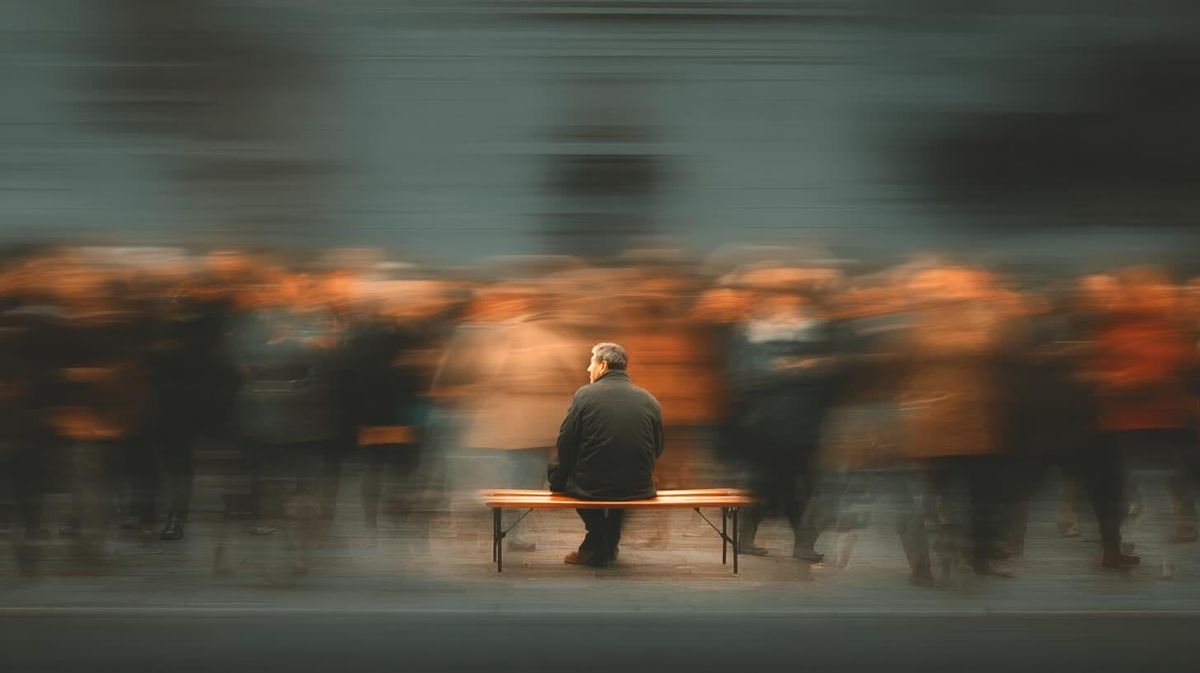
Still, Against Frictionless Flow
The John Connor Problem
Ted Gioia’s viral essay, which cast modern society as an anxiety-ridden digital anthill—a place where algorithms and AI are systematically erasing individual personhood—landed with chilling resonance. He correctly identified the specific, novel terror of our time: the fear that we are voluntarily surrendering our inner lives for the sake of comfort and efficiency. He looked at shows like Severance and the specter of students producing identical, AI-generated essays, and he saw a catastrophic moral surrender. Gioia’s plea for a "New Romanticism," led by artists and thinkers, was a noble call to arms. It was also a fantasy.
We call it "The John Connor Problem": the paralyzing belief that salvation must arrive through a heroic vanguard—a movement, a messiah, or a cultural renaissance that will pull us out of the wilderness, algorithmic or analog. Most of us don’t have the platform, the time, or the cultural capital to launch a new philosophical movement. We have debt, deadlines, and shifts starting in twenty minutes. Telling the debt-ridden student or the over-scheduled barista to "wait for the Romantic poet" is not a survival strategy; it’s a form of privileged resignation. If we are to maintain ourselves—if the self is to survive—the defense cannot be a grand movement; it must be a modest, achievable daily practice.
The Factory vs. The Feed: The Ian Curtis Distinction
To understand why this moment is different—why Gioia's anxiety isn't just timeless hand-wringing about "kids these days"—we need to distinguish between two fundamentally different forms of exploitation.
The pyramid builder, hauling stone under the overseer's whip, was physically enslaved. His body belonged to the Pharaoh, his labor to the empire. But his mind could remain a private bastion. He could curse the gods, compose a prayer, or dream of escape while he worked. His labor was captured, but his consciousness? Possibly not. When a Roman worker carved "Flavius fecit invitus"—Flavius made this unwillingly—into a hidden column of the Colosseum, he was asserting a critical separation: I am not my work. There is a "me" apart from this stone.
This was the contract of industrial capitalism as well. The factory wanted your hands for eight hours; your mind was your own. Ian Curtis of Joy Division worked a dead-end civil service job during the day and wrote some of the most emotionally searing music of the post-punk era in his head while filing papers. The work was likely as alienating and soul-crushing as any office gig—but it didn't occupy his cognition. It left the daydream space intact.
The modern subject faces something categorically different.
When a student uses ChatGPT to write an essay, they aren't just "hauling stone" while thinking free thoughts. They are outsourcing the cognitive process itself—skipping the frustration, the false starts, the boredom, and the uncertainty that generates the self. They feel relief—immediate, dopamine-rich relief—at not having to articulate their own thinking. The algorithm doesn't just organize their external labor; it seeks to organize their attention, their interior monologue, and their emotional metabolism. All the while ticking the check box that the system requires: complete a bullshit assignment.
This is the rupture Gioia identifies, and he's right to be alarmed. Previous systems of control exploited the body and left the mind as a refuge. The new systems want the whole cognitive substrate. They don't just make you work—they offer to do your thinking for you, and make it feel like liberation.
The Geography of Capture: The Soft Cage and the Hard Cage
The panic over cognitive atrophy—the fear that we are too comfortable to think—is, itself, a luxury good.
While the modern anxiety over the loss of personhood feels universal, the mechanism of that loss is dictated by geography, class, and politics. The technologies that enable the frictionless flow are ethically and politically agnostic, operating on a spectrum of control.
For the privileged subject in the West, the walls of the anthill are lined with infinite scroll and optimized delivery; they are seduced into the loss of self (The Soft Cage). For the global precariat or those living under authoritarian rule, the same underlying technologies are used to build a Hard Cage, amplifying old-fashioned methods of tyranny with new, powerful tools of real-time surveillance. The reality, however, is a gradient: the Soft Cage increasingly relies on algorithmic policing and corporate surveillance, while the Hard Cage often uses digital seductions (like state-run social media apps) to manage contentment and distraction alongside coercion.
This geographic asymmetry exposes the fatal flaw in waiting for Gioia's New Romanticism. How can we expect a cultural movement led by artists to save the personhood of those facing immediate digital totalitarianism? Any viable solution—any practice of humanness—must work both in the Soft Cage and the Hard Cage.
Resistance as Friction: The Practice of Being Un-Optimized
If the goal of the algorithmic system is Frictionless Flow—seamless scrolling, predictive text, one-click purchasing, optimized routing—then the definition of being human becomes the practice of deliberate inefficiency.
Friction is what remains available when revolution is not. It requires being slightly worse at being optimized—introducing small, deliberate obstacles into systems designed for total capture.
The Spectrum of Inefficiency
Friction maintains a critical gap between external compliance and internal sovereignty, making it effective across the global spectrum of control:
| Context | Action of Friction | Sovereignty Preserved |
| The Soft Cage (West) | Deliberate Inefficiency: Choosing the longer walking route; being bored for ten minutes without immediately filling the silence. | Agency and Attention. Preserving the right to waste time and choose the non-optimal path. |
| The Hard Cage (Authoritarian) | Internal Distance: Maintaining ironic distance from mandated slogans; preserving private thoughts while public speech is controlled. | Judgment and Awareness. Preserving the distinction between what you say and what you believe. |
The algorithm hates ambiguity—but more than hate, it is engineered to erase it. It cannot process the user who clicks "like" ironically, who scrolls while simultaneously mocking the scroll. Ambiguity is where the self lives.
This is the Ian Curtis Insight operationalized: You may have to work the grey day job, but you can still compose Joy Division in your head. Friction is the practice of maintaining that gap—between what you do and who you are.
While this practice starts as intensely personal, a self defended alone is more fragile than a self defended with others. Friction is the shared, knowing glance between the barista and the customer at the wall-mounted timer feeding KPI to Corporate HQ that says: We both see this is absurd. This shared inefficiency becomes a proto-collective refusal.
The Modest Heroism: Preserving the Self Through Stillness
Gioia waits for his New Romanticism—for artists and thinkers to lead us out. The rest of us don't have that luxury. We have shifts starting in twenty minutes. But we do have fifteen of those minutes to claim for ourselves. The ultimate act of New Stubbornness is to reject the need for a vanguard. Salvation is not a singular, historic event; it is an ongoing, daily act of self-maintenance.
The Bowie Wisdom: 15 Minutes of Ungoverned Thought
Heroism is not about saving the world; it’s about preserving a viable self within it. Borrowing from David Bowie, we can be heroes—just for 15 minutes a day. This is the practice of cognitive friction codified: dedicating a small, defended space of time to non-optimized thought.
| What You Do (The Practice of Friction) | What It Resists (The Algorithmic Demand) |
| Be bored for 10 minutes. | The algorithm's instant cure for boredom. |
| Take the inefficient route. | The imperative of optimization and speed. |
| Sit with unproductive thought. | The pressure for continuous output and problem-solving. |
| Write something badly by hand. | The fear of visible imperfection and the drive for replicable quality. |
The goal is not to produce anything. The goal is to preserve the you who might produce something—someday, when it matters, in your own voice rather than the algorithm's.
This is the meaning of Still. It is resistance not as revolution, but as endurance. The bum note is the signal that the human operator is still present.
We may not be heroes saving civilization. But we can be heroes to ourselves.
Still here.
Still humming off-key.
Still ourselves—just for today, just for fifteen minutes.
Still.