War: What Is It Good For? A Lot of Things.
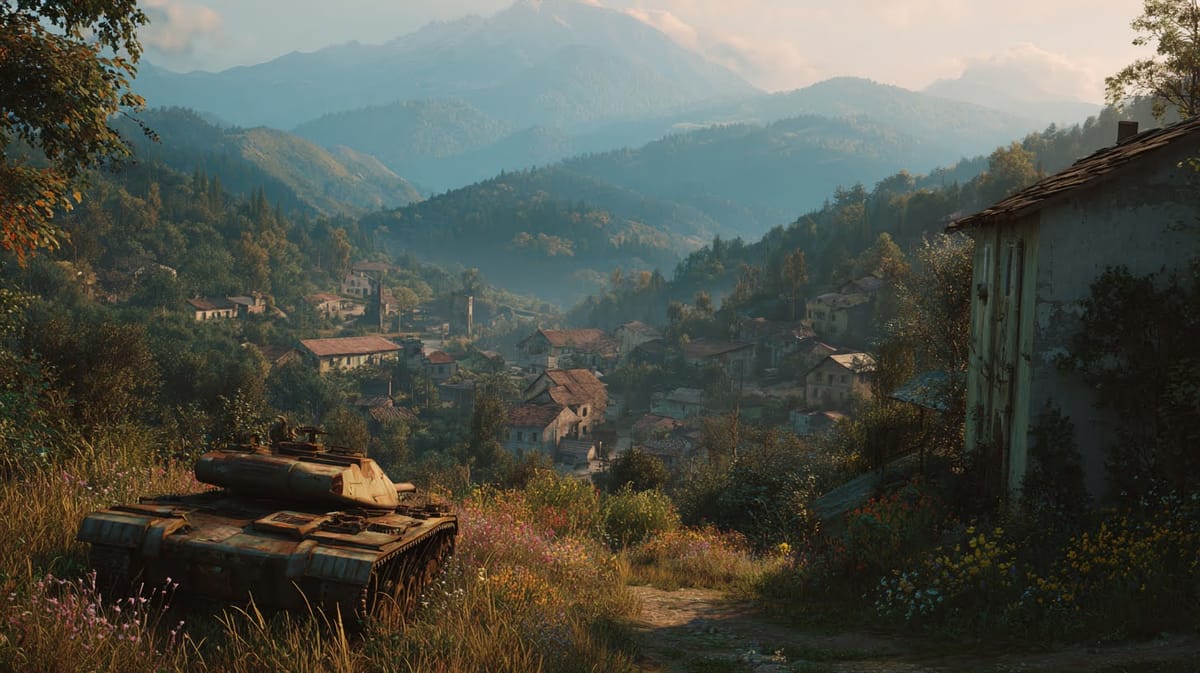
On the distance between those who theorize about conflict and those who live inside it
"The only people for me are the mad ones, the ones who are mad to live, mad to talk, mad to be saved, desirous of everything at the same time..." — Jack Kerouac, On the Road
"The only people for me are the ones who clean up after the mad ones—the steady ones, the ones who are sane enough to bring a fire extinguisher." — Probably Someone's Ex-Girlfriend, Never Cited in a Beat Poem
I. The Headline from Olympus
"How War Stopped Working," declares the Financial Times, and one can almost hear the leather chairs creaking as the insight settles. Ukraine, Iraq, Afghanistan—the story of the century, we are told, is the ineffectiveness of force. War, it seems, has become a poor investment. The returns simply aren't there.
This is the kind of sentence that can only be written from a very specific altitude. High enough to see the pattern above the flak. Too high to hear the screaming and beyond the stench.
Tell the residents of Mariupol that war stopped working. Tell the families of Mosul, the survivors of Fallujah, the orphans of Helmand Province. War worked exactly as designed on their bodies, their homes, their futures. What it may have failed to do is satisfy the strategic ambitions of the states that deployed it. But that is a different sentence entirely, and the distance between the two sentences is where this essay lives.
II. What "Working" Means, and to Whom
Janan Ganesh's argument is not without merit. He observes, correctly, that major states have struggled to convert military force into durable political transformation. Russia has not subdued Ukraine. The United States did not build stable democracies in Iraq or Afghanistan. France abandoned its Sahelian counterinsurgency. The pattern is legible.
And that framing performs a sleight of hand. By defining "working" as large-scale political transformation achieved through land warfare, the thesis selects for its own conclusion. War has always been an unreliable instrument of regime change against resistant populations. What has changed is not war's fundamental nature but the conditions under which it operates: nuclear deterrence, globalized media, the proliferation of cheap precision weapons, and the hardening of national identities that make occupation untenable.
Meanwhile, war continues to work quite well for narrower aims. Russia's annexation of Crimea in 2014 achieved its immediate objective with minimal resistance. Azerbaijan's recapture of Nagorno-Karabakh was decisive. Israeli military operations, however contested morally and politically, have achieved specific operational goals. Turkey's campaigns against Kurdish forces produced tangible territorial effects. These are not WWII-style total victories, but they are not nothing. Force can still produce localized, limited gains.
The more precise claim would be: maximalist land war for regime transformation against populous, nationalized societies with access to modern weapons and global visibility has become structurally unreliable. That's narrower, more defensible, and considerably less suited to a headline.
III. The Last Unconstrained War
World War II was not simply another large conflict. It was an industrial extermination contest conducted with functionally no escalation ceiling. Strategic bombing of cities, firebombing campaigns, atomic weapons, total economic mobilization, unconditional surrender as the only acceptable outcome. Civilian immunity collapsed as doctrine. The result was tens of millions dead and continents in ruin.
It also, paradoxically, "worked." Germany and Japan were not merely defeated but fundamentally transformed. The political objectives of the Allies were achieved comprehensively. If effectiveness is the metric, WWII is the gold standard—purchased at a price that retroactively established the boundary of the tolerable.
Two structural changes followed. Nuclear weapons imposed a hard cap on escalation between major powers. And the post-war institutional order embedded norms—imperfectly enforced but rhetorically powerful—against territorial conquest and the deliberate targeting of civilians. Together, these created what amounts to an escalation ceiling: the memory of what unconstrained warfare looks like, encoded into both weapons systems and international law.
But this ceiling is geographically and politically selective. It holds most firmly between nuclear-armed great powers. It did not hold in Cambodia, Rwanda, the Balkans, Syria, or the Iran-Iraq war. For the populations caught in conflicts where the great powers are not directly facing each other, the experience can be functionally unconstrained. The "civilized restraint" narrative risks being a story told by those who happen to live under the ceiling's protection—about those who do not.
IV. Clausewitz and His Shadow
Carl von Clausewitz wrote that war is the continuation of politics by other means. The formulation assumes a hierarchy: politics governs, and war is its instrument. Violence serves political ends.
The inversion—that politics might be war by other means—is not wordplay. Michel Foucault made essentially this argument: that political order is the sediment of prior struggles, and that law, institutions, and norms encode the outcomes of past conflicts. If so, then politics does not merely contain conflict. It is conflict, conducted through non-kinetic instruments.
This reframing matters because it reveals something about how violence scales. Politics is a coordination system. When functioning well, it channels conflict into elections, courts, and policy disputes. When strained, it can coordinate outrage instead. The same infrastructure that organizes a peaceful march can lower the threshold for a riot. The same media ecosystem that informs citizens can synchronize rage.
When politics adopts war logic—when opponents become enemies, compromise becomes appeasement, and every dispute is existential—certain actors gain leverage. Leaders who convert fear into loyalty. Institutions that expand under emergency conditions. Information ecosystems that monetize intensity. Hardliners within movements who benefit from the marginalization of moderates. Sometimes external competitors who profit from a rival's internal fragmentation.
But this is less likely a conspiracy than a coordination trap. Once one faction frames the moment as survival, opponents face pressure to mirror the framing or risk unilateral disadvantage. Polarization becomes a mutually reinforcing equilibrium. The system escalates not because any single actor wills it, but because de-escalation is individually costly even when collectively rational.
V. The Six-Second Feel-Good
There is a mechanism that operates at every scale of this problem, from geopolitics to a scuffle at Waffle House: the impulsive action that feels like resolution but generates downstream complexity. The military strike that produces the briefing-room satisfaction of "something was done" while creating a decade of insurgency. The political broadside that rallies the base while hardening opposition. The viral post that wins the afternoon while eroding the norms that make tomorrow's negotiation possible.
Call it the six-second feel-good. The time horizon of satisfaction is radically shorter than the time horizon of consequences. And modern systems—algorithmic media, 24-hour news cycles, political incentive structures—are increasingly optimized to produce that mismatch rather than correct for it.
The early scenes of the 2022 film All Quiet on the Western Front capture this with surgical precision. After the initial battlefield scene, we see an industrial workflow: dead soldiers' uniforms stripped, laundered, repaired, and bundled for redistribution. Then a classroom: a teacher's impassioned speech, boys surging with excitement, lining up to enlist—and receiving those patched tunics. The recruitment loop does not require the war to "work" in any strategic sense. It requires only that the mythology of burning, of glory, of the mad ones who never yawn or say a commonplace thing, remains more compelling than the laundry manifest.
Kerouac's famous passage about the "mad ones" who "burn, burn, burn like fabulous yellow roman candles" is the literary distillation of this mechanism. It romanticizes intensity as its own justification. There is no mention of what happens after the candles go out, who cleans up the ash, or what the spiders across the stars actually built. The passage is beautiful. It is also a framework that externalizes all costs onto whoever is standing nearby.
This is not to say that mythology alone fills the ranks. People walk into uniforms because they are invaded, conscripted, economically constrained, or bound by community expectation. Coercion and structure do more heavy lifting than narrative glamour. But myth lubricates the machinery. It makes that coercion feel like calling. It converts structural compulsion into personal meaning. Without the glory narrative, the pipeline doesn't stop—but it grinds harder, and the system must rely more visibly on the force it prefers to disguise.
VI. The Maintenance Deficit
There is a structural asymmetry in how cultures allocate attention and status. Combustion gets the mythology. Maintenance gets forgotten. The dramatic act—the strike, the revolt, the creative destruction, the roman candle—occupies the cultural real estate. The slow, unglamorous work of de-escalation, institution-building, repair, and compromise is attributed to nobody in particular. It does not get framed on orange walls in coffee shops.
This asymmetry is not merely unfair. It is dangerous. It systematically undervalues the work that actually holds things together. It ensures that the people who absorb the costs of others' spectacular decisions—that ex-girlfriend with the fire extinguisher, the civil servant who keeps the water running, the medic who arrives after the roman candle explodes—are structurally invisible in the narratives that shape public understanding.
The American civil rights movement is often cited as proof that dramatic confrontation drives change, and so it did. But the Montgomery Bus Boycott required thirteen months of disciplined logistical coordination—carpools, fundraising, legal strategy—alongside its moral drama. The Freedom Rides were combustion. The NAACP Legal Defense Fund was the fire extinguisher. The movement needed both. But only one gets the poster.
When we undervalue maintenance in favor of combustion, we make war logic more attractive. Burning is narratively superior to building, even when building is what holds things together. And the recruitment pipeline—whether for actual war, political mobilization, or cultural movements—depends on the mythology of the burn remaining more vivid than the reality of the cleanup.
VII. Who Bears the Cost
This is the question that recurs across every domain where systems achieve equilibrium by distributing costs unevenly.
The post-1945 international order has achieved something historically extraordinary: more than seventy years without direct large-scale war between nuclear-armed great powers. That is not trivial. The Korean War could have gone nuclear. The Cuban Missile Crisis nearly did. The Cold War's European theater never ignited. This negative space—the catastrophe that didn't happen—is arguably the most consequential strategic achievement of the modern era.
But it was purchased at a price, and that price was paid disproportionately by populations caught in the fissures. Not pressure-relief valves, for those imply engineering, intentional placement, someone deciding where the steam would vent. Fissures are geological. They form where the structure is weakest: where institutions are thinnest, economies most fragile, political foundations least reinforced. The pressure of great-power rivalry didn't release through designed channels. It found the cracks. Korea, Vietnam, Afghanistan, Angola, Guatemala, Cambodia—these were not sacrificial buffers selected by an architect. They were places where local fractures—occupation, partition, colonial legacy, ideological struggle—already existed, and superpower pressure widened them into catastrophe.
The distinction matters analytically. A valve can be redesigned, relocated, shut off. A fissure can only be monitored, the surrounding ground reinforced, the pressure reduced at its source. That's less satisfying as a prescription. But it is more honest about what these conflicts actually were: not planned releases but emergent ruptures along pre-existing lines of structural vulnerability. The people standing on the crack when it opened did not experience a system functioning. They experienced the ground giving way beneath them.
To frame these conflicts as "failures"—as Ganesh implicitly does—is to adopt the perspective of the states that deployed force and found it unsatisfying. From inside the fissure, the framing is different. The war did not "fail." It succeeded at destruction. What it failed to do was serve the strategic interests of someone far away. That someone is now writing a think piece about it.
In the Warhammer 40,000 universe—a setting whose satirical acuity is routinely underestimated—the Administratum is a bureaucracy so vast it has lost track of entire planets. It issues quarterly reports on corpse starch production, a food product manufactured from the dead. The underhive denizen eating the corpse starch and hearing that output is up experiences a particular kind of dark comedy: the language of productivity applied to one's own suffering.
The Financial Times declaring that war has stopped working is not corpse starch reporting. But the structural relationship is recognizable. A system that converts human suffering into an output metric. An analytical layer that measures success by strategic throughput rather than lived experience. A reporting class so insulated from the input side of the process that the language of investment returns feels natural rather than grotesque.
To be clear: the problem is not strategic analysis itself. The systems view is necessary. Without it, we cannot understand deterrence, escalation dynamics, or the structural forces that shape conflict. The problem is strategic analysis that forgets to acknowledge the asymmetry of cost—that speaks of war's declining returns without noting that the losses were never evenly distributed, and that the people best positioned to declare the investment unsound were never the ones who paid it.
VIII. The Grim Success
If we are honest, the post-WWII order's record is this: it has prevented the worst while tolerating enormous amounts of the merely terrible. Nuclear deterrence has held. Great-power industrial total war has not recurred. And the conflicts that have occurred—however devastating to those inside them—have remained below the threshold of civilizational annihilation.
Whether that constitutes "success" depends entirely on where you are standing.
From the altitude of grand strategy, it is a remarkable achievement. From inside the fissure, it is indistinguishable from catastrophe. Both of these things are true simultaneously, and the refusal to let either frame silence the other may be the only intellectually honest posture available.
So: war. What is it good for?
Territorial consolidation, when the objectives are limited. Deterrence, when credibly maintained. Signaling resolve, when the audience is paying attention. Technological acceleration, as a grim byproduct. The creation of escalation ceilings, through the memory of what happens without them. The establishment of norms, born from the revulsion at their violation. The production of think pieces, for those positioned comfortably enough to write them.
What it may no longer be good for is the thing we most associate with it: the decisive, large-scale transformation of political order through the application of overwhelming force against a resistant society. That era, if it ever reliably existed outside of a few historical exceptions, appears to have closed—constrained by nuclear weapons, nationalist resilience, cheap technology, and the globalized visibility that makes atrocity harder to conduct in silence.
But the machinery persists. The laundered uniforms keep cycling. The recruitment speeches keep landing. The roman candles keep burning. And someone, somewhere, is always holding the fire extinguisher—uncited, unframed, and doing the work that actually holds things together.
The question is not whether war works. It is who gets to define "working," who bears the cost of the definition, and whether the distance between those two populations is itself a kind of violence.
Coda: A Note from the Fire Extinguisher

Look. I don't know what a Clausewitz is, and I don't care. You've been staring at that glowing rectangle for hours. The fissures in the backyard are called "holes I dug," the only maintenance deficit that matters is my food bowl, and the combustion/maintenance binary resolves pretty cleanly when you consider that I need to pee.
You want to know who bears the cost? Me. Right now. On this floor. With these eyes.
The Financial Times never fed me. Kerouac never let me out. And I promise you, whatever the Administratum is producing, it smells worse than what I'm about to produce on this hardwood if you don't get up in the next thirty seconds.
War: what is it good for? I don't know. Walk: what is it good for? Everything.
Get up.
— Delia, Uncited, Unframed, and Holding It