Up in Smoke
Where there’s fire, there’s smoke. And a Facebook post.
Sunday afternoon the algorithm fed me a video geotagged in Glasgow: a multistory building on fire, flames engulfing a domed turret that immediately felt familiar.
From 2010 to 2015 we used to visit Scotland several times a year. We’d befriended fellow musical travelers in the handmade, experimental music world and would take advantage of the direct flights from Houston to Glasgow—or connect through Newark to Edinburgh—hang out, see shows, pretend to be something more than tourists for a few days.
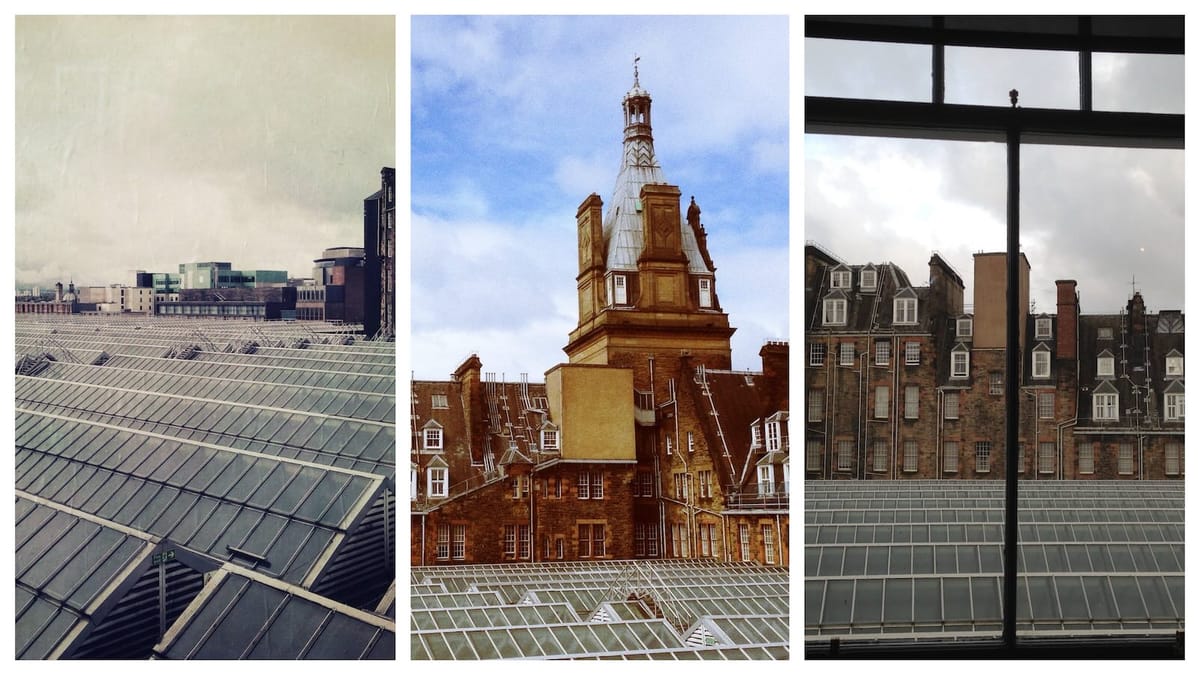
In the spring of 2014 and 2015 we stayed at the Rennie Mackintosh Hotel – Central Station, perched on the top floor of an Edwardian building overlooking Glasgow Central Station. A building with a distinctive domed turret.
A building that was now on fire.
By 2026 I’d completely forgotten the name of the hotel, but the memory of our first stay there—arriving too early to check in, yet still in time for a full Scots breakfast—stuck with me. I’d also organized the photos from my iPhone by year and destination in Google Drive, so finding a few shots from our hotel room overlooking the prism-like skylights of the railway station didn’t take much effort.
Still… what was the name of the place?
voco Grand Central Glasgow is the immediate hit on Google, but comparing the point of view in the photos with satellite imagery ruled that out. The angles didn’t line up. The skylights were right, but the building wasn’t.
Google Maps, however, did show what the growing trickle of Facebook posters were already pointing to as the “smoking gun” of the tragedy: a storefront labeled Prime Vapour.
The vape shop that rapidly became the villain of the story.
Let’s hit pause on that tale for a moment and rewind to 2014, when we arrived jet-lagged and famished—well, me at least.
We were in town for the Tectonics Festival, an arguably more institutionalized celebration of the avant-garde and adventurous musical traditions and practices. Richard Youngs, the naïve shaman of a forever-changing sonic form, was a featured performer that year. For Nancy, who had been following his work for at least a decade by then, hitting Tectonics was a no-brainer.
The Google Drive folder labeled “2014 Scotland” turned up numerous photos from that visit, including what I now vaguely recall as Cindytalk taking the stage. There were also snapshots—filtered through the Hipstamatic app—of Mono, Monorail Music, and Stereo, along with other views of the city, a day trip to the Isle of Arran, and discreet snaps of friends—Brian, Paz, Richard, and Caroline—just out of frame.
Richard in particular—whom Nancy had met on a handful of previous occasions. She still felt slightly awkward around him, the familiar phenomenon of two introverts sharing the same orbit.
And then 2015. No Tectonics that year, but Richard would perform his “pop” album Beyond the Valley of the Ultrahits as a solo acoustic set. He and his son Sorley, along with Paz, would appear as The Flexibles at The 78. There I noticed someone wearing a “Middleage Fanclub” t-shirt, printed in the same stencil font that Teenage Fanclub used for their merch. I still regret not asking him where he got it.
We took the train to Edinburgh to visit Brian and Jill at their new place in Corstorphine, and I schlepped a Teenage Engineering OP‑1 the entire way in hopes of spontaneous artistic inspiration. Instead I ended up sketching something on the MacBook in Ableton Live, capturing a snippet of the railway station outside our hotel room window.
That same week we made an offer on a house in Portland, sight unseen except for the video clips our real estate agent emailed us, the eight-hour time difference adding yet another layer of friction.
Let us return to 2026.
It occurred to me to search for “bed and breakfast in Glasgow Central Station,” which eventually returned the Rennie Mackintosh Hotel – Central Station as a footnote buried in the AI overview. Bingo.
Further searching produced a scatter of contradictory clues: websites for the hotel with dropdown menus and booking buttons, a Google Map that showed no such place of business in the building, and eventually a saved search that read simply: “Rennie Mackintosh Hotel homeless.”
It turns out that not long after our last stay on the top floor, the hotel had been repurposed as emergency accommodation for some of the area’s unhoused residents. And even that chapter didn’t last long. News articles from as recently as 2022 told a grim story of a shelter that had slipped beyond disrepair into something closer to abandonment—rooms infested with mice, structural holes in the floors, the entire place eventually deemed uninhabitable and closed.
A Tripadvisor review from June 2015 read, in hindsight, like a harbinger of doom. The reviewer described sloping floors, filthy bedding, and boarded windows—signs of deterioration that we, for whatever reason, had missed.
It took a bit of digging to find the name of the building where we stayed—now a smoking hulk: Union Corner.
An unapologetically utilitarian moniker for what stood at the intersection of Union and Gordon Streets, just beside Glasgow Central Station. In the wake of the fire, it has become a topic of renewed debate among architects, urban planners, and city administrators who point out the vulnerability of Glasgow’s historic buildings to fire—especially those involving lithium-ion batteries, which power almost every modern device and appliance and are notoriously difficult to extinguish once ignited.
Meanwhile the social media feeds remind me of Marcia Brady, pointing a finger at the epicenter:
Vape shop! Vape shop! Vape shop!
As a tourist, I don’t have much in this race beyond some inconsequential tales of travel and lollygagging. For residents of Glasgow, the demise of Union Corner is another irreplaceable loss in the city’s panorama.
I vaguely recall the aftermath of the fires that gutted the Glasgow School of Art – Mackintosh Building—and yes, what is it with Mackintoshes going up in smoke?—which still remains a burnt-out shell.
For people whose livelihoods depended on the coffee shop, salon, and even the vape store, this fire is a gut punch. And I have no idea what else was lost in the floors above those businesses, even if the former hotel had long since been emptied.
Back in 2014 and 2015, the view from our room looked out over the long prism-like skylights of Glasgow Central Station, rows of glass running the length of the station like the facets of some enormous crystal. Trains slid in and out beneath them all day, and the low Scottish sky reflected off the panes in shifting shades of grey.
It was the sort of view you only notice because you’re traveling—because you’re lingering at the window with nowhere particular to be.
The building behind that window now stands hollowed out, its façade still facing Union Street while the floors behind it have collapsed into ash. Somewhere in that empty shell was the room where we slept, the breakfast we were almost late for, the station sounds drifting up through the glass roofs below.
Cities change. Buildings burn. Stories attach themselves to corners and windows and then drift away again.
All that really remains of Union Corner for me now are a handful of photographs, a few concerts, a ferry ride to Arran, and the memory of looking out across the station roof while Glasgow went about its day.
And a video the algorithm handed me one Sunday afternoon, flames curling around a domed turret I somehow recognized immediately.
Smoke, rising into the same grey sky.