Turning the Mile Coreward
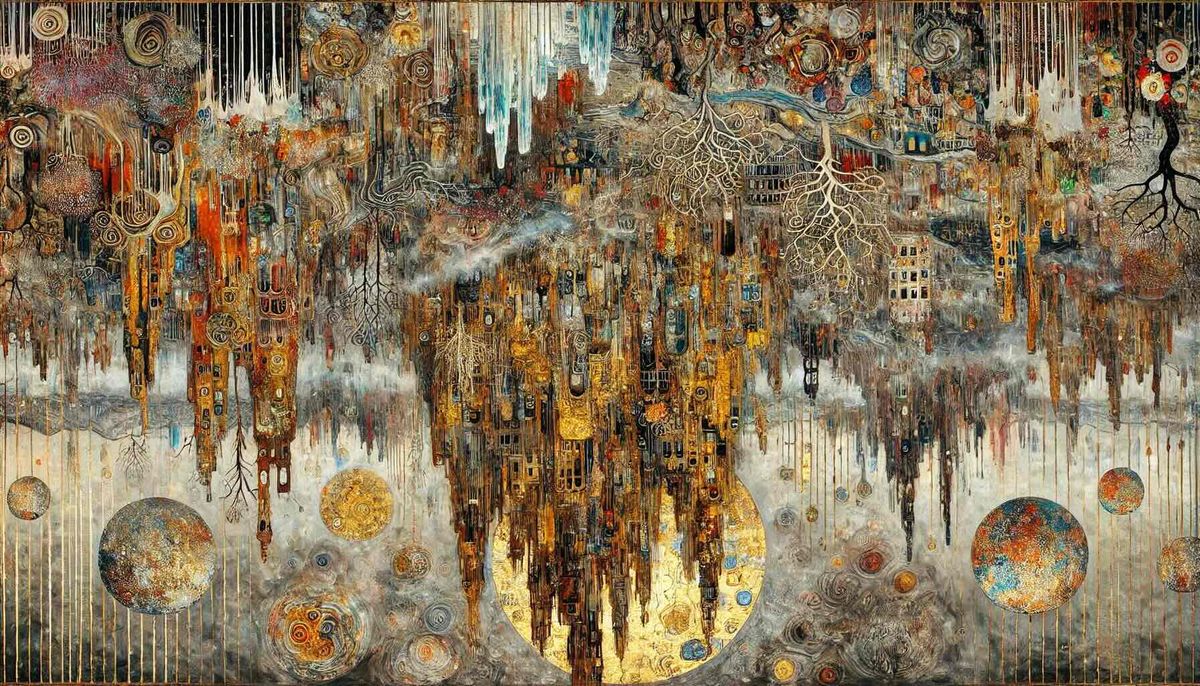
A designer's log on making a gentle setting durable.
This essay was supposed to be about being scooped.
A few weeks after we created The Vertical Mile — a deliberately anti-grimdark zine about a mile-tall building where the heroism is lowercase and Tuesday is allowed to stay Tuesday — Dan Abnett published HIVE, a novel that codifies the Warhammer 40,000 hive city in full grimdark: the mile-tall inhabited tower, the vertical class gradient, the invented argot, the city as a character. For about a day it felt like the thunder had been taken.
It hadn't, for a dull chronological reason. The hive predates both of us by forty years — it has been core to the property since the late 1980s, and Abnett himself has been writing hives for most of his career. You cannot be scooped on a premise that old, and HIVE is a focused consolidation of it rather than a first draft. But the interesting thing was never the defense. The interesting thing was what happened when we stopped defending and started using the hive — when we picked up the exact object that seemed to scoop us and fed it into the Mile to see what would survive contact. What came out the other side we started calling Coreward. And Coreward turned out to be a better record of a method than the Mile's own setting bible would ever have been. This is that record.
The Mile is gentle because its world lets it be
The first thing to admit about The Vertical Mile is that its gentleness is ambient. The building mostly works. Authority is fragmented enough that no one can dominate. The systems run even though nobody fully understands them. The heroism is showing up, knowing the local rules, keeping faith with the people who rely on you. It is a lovely thing to live inside, and it is also, quietly, untested. The Mile is anti-grimdark — it refuses the grim — but it never has to answer the grim. Its peace is inherited, not earned. That is its charm and its hidden brittleness: you cannot actually know whether a kindness would hold under pressure when the world has arranged never to apply any.
So the design question that produced Coreward was simple to ask and hard to answer: what would the Mile's gentleness have to become to survive a world that did not hand it over for free?
The turn: rotate the physics, not the tone
The instinct, when you want to toughen a gentle setting, is to darken the mood — add grit, loss, menace, moral compromise. That is the wrong knob, and reaching for it is how anti-grimdark slides into discount grimdark. We turned a different knob entirely. We left the aspiration exactly where it was and made the physics hostile.
Concretely, we inverted the Mile's axis. The surface of the world is now lethally irradiated, which means safety runs downward; the mile-high tower becomes a mile-deep burrow. And into that inverted substrate we admitted everything the Mile had been permitted to ignore: a genuinely lethal exterior, real scarcity, a hard thermodynamic ceiling, and the inconvenient fact that heat and excavated spoil have to go somewhere. The same heat that threatens you from the surrounding rock is also your only energy source. The waste heat of simply being alive has to be vented somewhere, and the only somewhere is up, toward the killing surface — so your lifeline is a chimney to the place that wants you dead.
This is the move worth naming, because it is reusable. Grimdark as constraint, not as tone. Call the result post-grimdark: not "we read the grim and chose kindness instead," but "the grim has been admitted into the laws of the world, and the kindness now has to survive those laws." The exterior really will kill you. Thermodynamics is not sentimental. Expansion really does generate spoil you cannot wish away. None of that is softened. What is not adopted is cruelty as a first principle. That gap — a hostile world, an un-hostile society — is the entire design space of Coreward.
Hostile physics is a civic-design generator
Here is the practical heart of the method, and the part that surprised us. Once the physics turned hostile, the Mile's free gentleness stopped being free, and every physical threat we admitted generated a civic requirement. You stop inventing institutions for flavor and start deriving them as the necessary answers to physical facts.
The chain ran like this. A sealed deep habitat lives or dies by its ability to reject heat, which makes the heat-rejection path a chokepoint — so you need redundancy and you need to ensure no single hand controls the chimney. More generally, in a sealed hole whoever controls the air, the heat, or the water holds a literal kill switch over everyone, which is the most reliable engine of tyranny ever devised — so power over life support has to be deliberately fragmented and inefficiently divided, the way the Mile's quarrelsome Guilds keep one another honest precisely because they don't cooperate. The thermodynamic ceiling means the society cannot grow its way out of anything, which means population cannot be allowed to float, which means reproduction is regulated — the single sharpest trapdoor into grimdark, since population control is where gentle settings go to die. The only way through that trapdoor and out the gentle side is a culture in which the steady state is wanted and internalized rather than enforced at a checkpoint. And because no closed loop is ever perfectly closed, the slow leak of water and trace elements has to be replenished from the rock itself, so the society is, on a very long clock, eating its own planet to stay alive, and the spoil from digging is not merely waste to store but the mine it lives off.
The discipline is the point: in Coreward the society's kindness is not asserted. It is the shape of the institutions the physics forced into being. Gentleness is downstream of engineering.
The principle: purchased inefficiency
The single line the whole exercise kept circling back to is this: foam-padding is purchased inefficiency. A brittle utopia optimizes everything. A society built to survive its own survival deliberately wastes capacity on slack — redundant systems, divided authority, local repair, institutional memory, cultural homeostasis, and the sacred right of things to break gently. The margin is not overhead. The margin is the civilization.
That principle has a sharper corollary, which became Coreward's deepest civic law:
No failure may become everyone's failure.
It governs engineering, politics, medicine, ecology, economics — and, because this is a setting and not a spec sheet, sin. The same bulkheads that keep heat and radon and pressure from propagating are the model for the institutions that keep ambition, capture, neglect, and resentment from propagating. It is contained rupture applied to the soul of the polity: a tear is permitted, but a tear is never permitted to become contagious.
You can hear the three settings sorting themselves out along exactly this line:
- The Hive says: every tear becomes someone else's suffering, and in time the system calls that suffering order.
- The Vertical Mile says: most tears are small enough to mend, and someone can usually get there in time.
- Coreward says: the world is always trying to tear us open, so we built a civilization around the rule that tears stay local, visible, and mendable.
Maslow becomes a loop
Coreward's answer to Maslow is sharper than "the bottom of the pyramid gets met." Maslow's hierarchy is a leaky heuristic at the best of times — the man never drew the pyramid, and the strict ordering falls apart fastest exactly under siege, where, as Frankl observed, meaning is not the reward you collect after survival but the thing that makes survival endurable. Coreward takes that seriously. Its lower needs are met only because its upper ones are load-bearing. Meaning, belonging, ritual, discipline, and civic trust are not luxuries enjoyed once the air and water are secured; they are what keep the air-and-water systems tended, faithfully, across centuries that will outlast everyone who remembers why. The pyramid becomes a loop.
Which is, in the end, the crucial difference between the two buildings. In the Mile, community makes life better. In Coreward, community is life support.
What it does at the table
The method pays off immediately as session design, and this is where I'd hand it to another GM. A Coreward scenario is never "save the underground city." The city is not in danger; the city is the achievement. A Coreward scenario is a tear is trying to propagate, and the player characters are the people close enough, skilled enough, obligated enough, or unlucky enough to keep one contained problem from becoming a shared rupture.
A few seeds in that idiom:
- A heat-exchange loop is running three degrees hot, and two maintenance clans cannot agree whether to shed the load from a residential ring or from the mushroom nurseries that half the quarter eats from.
- A family petitions for a birth license fourteen months before the registry's window opens, because an elder has entered final decline and they want the lives to overlap, even briefly.
- A spoil vault that three generations have quietly used for sculpture, ritual, and the storage of memory has been scheduled for reclamation as structural backfill.
- A radon scrubber has been overperforming for months because someone has been diverting power to it from a festival hall, off the books — and now the festival's lights are failing and nobody will say why.
- A surface radiator crew has missed a check-in. The problem is almost certainly mundane. Almost certainly.
- A child has started asking why the upper doors are still sealed, if no one alive remembers the surface ever being tested.
None of these is an apocalypse plot. Each is a contained-rupture plot: high in principle, local in play. That is the exact sweet spot the Mile was always circling, and the hostile physics simply gives it teeth.
Honest caveats
Two, in the spirit of not believing our own press.
First, Coreward is so far the durability of an unusually well-poked blueprint, not of a built thing. It feels sturdy because we spent the whole exploration trying to break it, while the Mile and the hive arrived as finished artifacts that never had to survive that. A frame that survives the poking is a good place to start building; it is not yet the building.
Second, and more important: the robust version of Coreward is the one that does not depend on everyone being good. A society whose peace requires saints is brittle, because saints are a single point of failure. The durable version assumes the worse impulse — that someone will reach for the kill switch, defer the maintenance, hoard, or let ambition metastasize — and builds civic bulkheads against vice exactly the way it builds physical bulkheads against heat and pressure. The aspiration lives in the outcome; the design is hard-nosed, nearly cynical, about the people. That is what keeps the grimdark trapdoor visible, and a Coreward that forgets the trapdoor is there has stopped being interesting.
What we actually found
The essay was supposed to be about being scooped. It became about a method, and the method is the thing worth keeping: to make a gentle world durable, do not darken it. Load its physics, hold its aspiration fixed, and let the gap between the two derive the institutions of slack the world now requires. Coreward is just the worked example.
Its kindness turns out to be the strongest kind precisely because it is the least sentimental. Not kinder because the world is kind — kinder because the world is emphatically not, and the society declined to accept that as an excuse. The Mile is gentle because it is allowed to be. Coreward is gentle the way a wound is closed: a little faster than the world can open it.
Abnett didn't take the Mile's thunder. He handed it its shell.
Builds on The Vertical Mile (The Grey Ledger Society + CGCG Helix, CC BY-SA 4.0), and on a critical reading of Dan Abnett's HIVE. Coreward is original work; nothing of Abnett's text is reproduced here.