To All the Guns I’ve Shot Before: Palmetto State Armory Dagger Micro
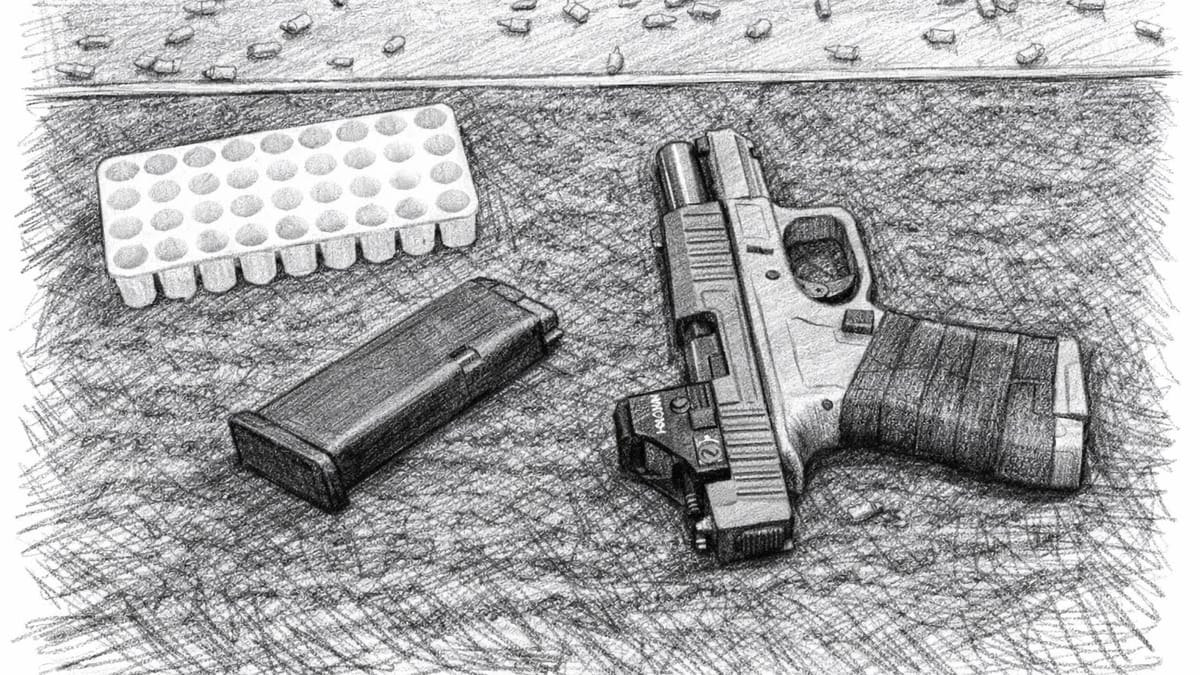
The story of this gun begins, as so many questionable decisions do, with a ballot measure.
Oregon Ballot Measure 114 passed by a sliver, promising a permit-to-purchase regime and a ban on magazines holding more than ten rounds. As of January 11, 2026, it remains unenforced—blocked by a judge out of Harney County and working its way through the courts, likely all the way to the Supreme Court. But a betting man would have assumed it would stick. I did. And since I figured my daily-carry Glock 19 would be legislatively demoted from fifteen rounds to ten, I reasoned that I might as well switch to something designed around ten cartridges as the default. Enter the Glock 48.
Among the many well-worn complaints about Austrian Tactical Tupperware, ergonomics usually top the list (with the plastic “iron” sights and the famously al dente trigger close behind). A Glock is a confluence of right angles. The double-stack frames feel like gripping a 2×4 canted at an angle that gives the 1911 crowd an autoimmune response. I’ve long suspected Gaston Glock had unnaturally long fingers, given how the slide lock and magazine release live just beyond the reach of ordinary muggle digits, but that theory remains untested.
Slim the frame down to a single-stack design—the G43, G43X, and G48 (the .380 G42 would like to have a word)—and the plank becomes a narrower slat. The problem persists. Establishing and maintaining a solid grip remained a challenge, partially addressed with a Hogue rubber overgrip that promptly defeated the point by bulking the frame back up. I eventually compromised with grip tape, which worked but made the gun look like the sort of pearl-clutch-inducing nightmare that local news reserves for the phrase “bad people.”
Let’s detour briefly to South Carolina’s Palmetto State Armory, a company that may have put more AR-15s into American homes than any other manufacturer through sheer force of no-frills ubiquity. A few years ago, PSA turned its attention to Glock—specifically the Gen 3 G19—and produced the Dagger. Patent law wizardry was once explained to me to justify how this was permissible, but that explanation only deepened my confusion, especially when PSA went on to clone the G43X and G48. What mattered, practically, was that PSA made optics-ready slides available at prices Glock seemed to regard as morally offensive.
Fast-forward a couple of years. I did a quick audit of my marksmanship practice and realized the slimline Glock ergonomics—and a still-unexplained occasional clunk during trigger reset—had earned the G48 and G43X a spot in the credit column of a trade-in toward a Sig P238 (again: the G42 would really like to have a word).
But I still had a pile of PSA parts. Slides. Optics. Barrels. Odds and ends.
PSA being PSA, a Dagger Micro frame went on holiday sale. The tinkerer devil on my shoulder did what he does best, and a few weeks later I came home from the not-so-local gun shop (post background check, naturally) with the core of what can only be described as the Gun of Theseus: a Frankenglock assembled from PSA components accumulated over two years, capped with a rainbow-finish Faxon “match grade” barrel.
The 1×4 problem? Mostly solved. The Dagger Micro grip actually has curves, and with more Goon Tape, it’s now a non-issue. The hinged trigger is a departure from Glock’s tabbed design, but it’s flat, wide, and encourages a more consistent finger placement. I made one mistake early on: an ETS clear plastic magazine. The tolerance stacking between PSA and ETS turned the trigger reset into something gluey and hesitant—completely unacceptable in a defensive gun. An OEM Glock magazine fixed the problem instantly, though after about 350 rounds across six range visits, it’s starting to feel a bit draggy in the magwell.
Six boxes of Speer Lawman and one of Winchester JHP later, the Frankenglock has been largely well-behaved. A couple of failures to feed, nothing exotic. The Holosun optic is zeroed to play nicely with my astigmatism, and I can hold three-inch groups at fifteen yards. It is an adequate tool for an unimaginably undesirable scenario.
But it looks like a collage. Multiple manufacturing runs. Mixed finishes. Layers of grip tape. The tan-and-gray palette reads less court retainer from Caladan and more scruffy Fremen from Arrakis. Optics—not the red-dot kind—matter in defensive gun use once things leave the ballistic stage and enter the legal one. A hobbyist’s melange is a gift to a motivated district attorney. That said, for many people, a ballistic pastiche is what affordability looks like, and that reality deserves acknowledgment rather than sneering.
For me, the Frankenglock remains what it always was: a willful regression to a platform I traded away, a demonstration of industrial fungibility, and a range gun that lives in the back of the safe. It exists not because it solved a problem, but because it proved one.