There Is No Reason for This. Do Not Ask.
How a painted miniature accidentally asked a good question about why systems keep running
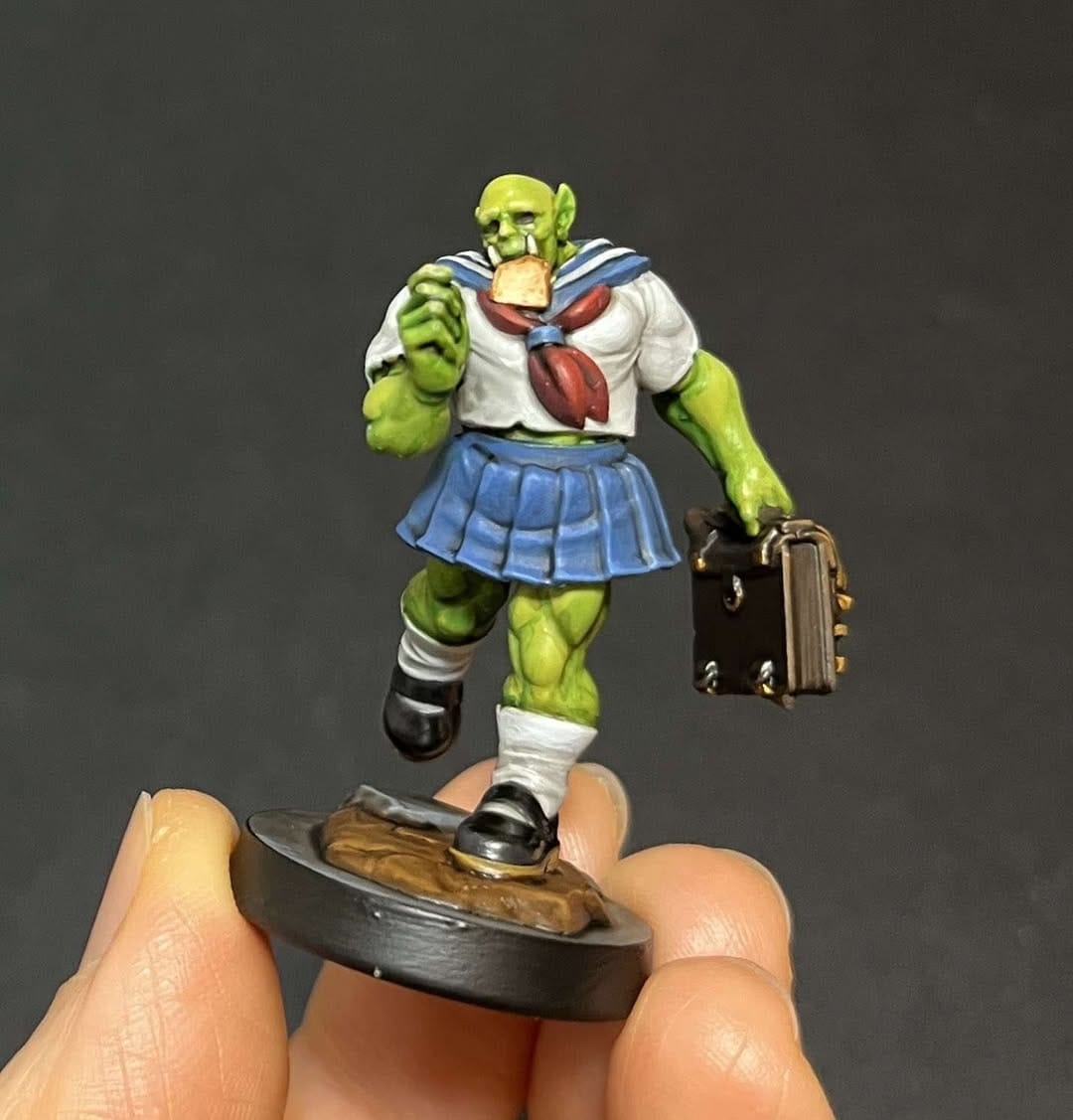
It started with a miniature of an Ork in a Japanese school uniform.
If you're not into the Warhammer 40,000 money pit… erm, hobby, that sentence needs unpacking. Orks, in this setting, are massive green-skinned fungal organisms who reproduce asexually via spores, live for fighting, and operate on a kind of collective psychic field where belief reshapes reality. They are not subtle creatures.
A Japanese school uniform — the sailor fuku, specifically — is one of the most codified, rule-bound aesthetic systems in popular culture: pleated skirt, sailor collar, ribbon, specific socks, specific shoes.
Someone looked at these two things and thought: yes. Together.
The miniature is beautifully executed. The Ork is mid-stride, running late, toast clenched in its mouth — the classic anime "late for school" trope — carrying a satchel. The uniform is painted with care. The skirt is pleated. The socks are correct. The Ork is still very much an Ork.
It's very funny. But the reason it's funny — and the reason it kept being funny long after the initial laugh — turned out to be more interesting than the joke itself.
A friend shared the image, and we started riffing. The usual thing: what would an Ork school actually look like? What's the curriculum? How does detention work? (Answer: it's combat. Targeted skill development.) The jokes wrote themselves because both systems — Ork society and Japanese school culture — are surprisingly well-structured, and you can make those structures rhyme.
Hierarchy? Orks have it. Biggest boss on top, then nobs, then boyz, then grots. Schools have senpai and kōhai, class structures, authority gradients. Different enforcement mechanisms — physical versus social — but the same clarity about who's in charge.
Ritual? Orks have the Waaagh!, color superstitions, cyclical warfare. Schools have morning assemblies, club activities, seasonal events. Both are repeated behaviors that stabilize identity within the group.
Conformity? Orks enforce it through immediate corrective feedback (getting smacked). Schools enforce it through expectation, shame, and belonging. Different methods, same outcome: deviation gets corrected, the system sustains itself.
The more we mapped it, the less the mashup felt like randomness and the more it felt like two systems recognizing each other in a funhouse mirror. Which was amusing. And then we made a tabletop RPG out of it, which was more amusing. And then someone else ran a session of it, which was the most amusing of all because it actually worked.
But the moment that stuck — the one that followed me out the door and down the block while walking the dog — came from a much smaller detail.
When we were writing up the character creation rules for the game, we needed to address uniforms. The school has two variants: skirt and trousers. Standard anime school setup. But Orks are genderless. They're fungi. There's no biological sex, no sexual dimorphism, no reproductive roles, no concept of gender as humans understand it. The "masculine" read that most people project onto Orks — the muscles, the deep voices, the aggression — is entirely a human interpretation of a species where it has no internal meaning.
So when an Ork picks a uniform variant, they're not performing gender. They're not making an identity statement. They're not even making a choice in any meaningful sense. They're just... wearing the one they were given, or the one that was closest, or the one the bigger Ork told them to wear. And they'll enforce it on others with complete conviction and zero comprehension.
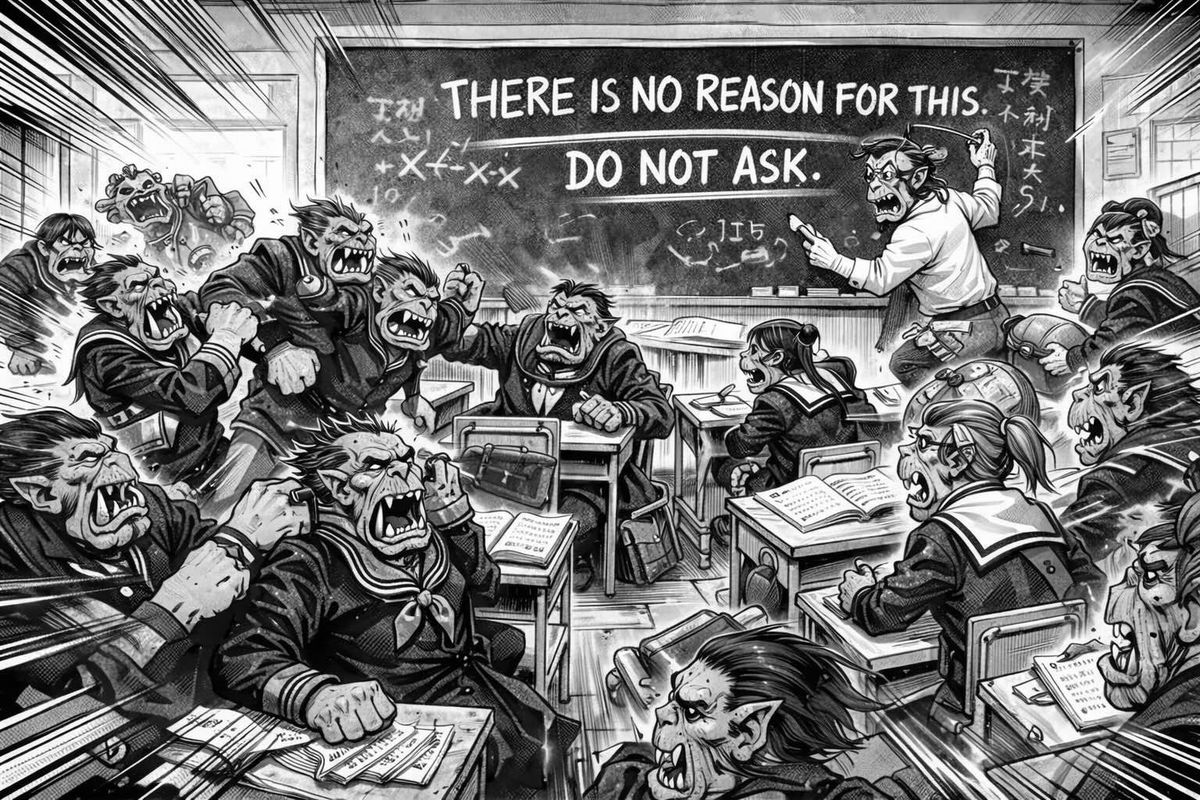
The character creation rule we landed on was: "Skirt or trousers. There is no reason for this. Do not ask."
It was a joke. It is still a joke. But it's also a surprisingly clean description of how a lot of institutional norms actually function.
There's a concept in systems thinking attributed to Stafford Beer: "the purpose of a system is what it does." Not what it says it does. Not what it was designed to do. Not what the mission statement on the website claims. What it does. You look at the outputs and work backward.
Applied to the Ork uniform question: what does the two-variant uniform system do? It sorts bodies into two visible categories. It creates a basis for enforcement. It produces legibility — you can tell, at a glance, which kind someone is. And it persists, because the sorting and the enforcement and the legibility all reinforce each other in a loop that doesn't require anyone to know why there are two kinds. The system runs on participation, not on understanding.
This is interesting — not because it's a revelation, but because the Ork scenario strips away every other explanation you'd normally reach for. In a real school, you can point to tradition, biology, cultural values, institutional history, parental expectations, legal frameworks. There are layers of justification available, and arguing about which ones are functional and which are decorative is the kind of debate that generates way more heat than light and has been doing so for a long time.
Orks have none of that. No biology. No tradition. No cultural inheritance. No history. No concept of what the categories are supposed to represent. And the system still runs.
Which doesn't prove that real-world gendered systems are equally groundless. Some systems persist because their reasons are still live and valid. Some structures track real differences. The thought experiment can't tell you which real institutions are running on genuine purpose and which are running on pattern momentum — that's diagnostic work, case by case, and a joke about fungus monsters in pleated skirts is not the right lens.
What it can do is help focus on the mechanism. It can show you that a categorical system needs surprisingly little to sustain itself: legibility, enforcement, and enough participants who don't ask questions. That's the minimum viable product for institutional persistence. Everything else — the history, the biology, the cultural narrative — might be essential, or it might be a case built after the fact to explain why the machine is still chugging along.
The thought experiment can't tell you which. But it can make the question visible. And sometimes making the question visible is the useful part.
I want to be careful here, because this is the point where a fun riff can start to take itself too seriously.
This is not a thesis. It's not a sociological argument. It's a thought experiment that fell out of a conversation about a painted miniature, conducted between a person and a trio of language models who are very good at finding patterns and constitutionally incapable of knowing when to stop. The Orks are not a clean control group for anything. They're fictional, designed by human writers, interpreted by human players, and reflected back through AI systems trained on human text. Everything we "discovered" about them is something we put there, consciously or not.
The conversation itself was a system, and it did what conversations with language models do: it escalated. Every observation got extended, reframed, connected to something larger. The miniature became a systems analysis became a game became a playtest became an essay about institutional persistence. Each step felt earned in the moment. Whether all of them were necessary is a different question, and one that the conversation was ill-equipped to ask while it was happening.
That's what the walk was for.
After the laughter fades and you've fed the meme machinery with your own TTRPG hack, you take a walk around the block with your dog. The dog does not care about Orks, Stafford Beer, or the structural isomorphism between kawaii and Waaagh. The dog wants to smell things. This is clarifying in a way that only a canine intervention can provide.
What survives the walk is smaller and sturdier than the conversation.
A question — "is this system still running on its original reasons, or just on the fact that nobody's asked lately?" — that's useful for thinking about any institution, even when the answer turns out to be "no, the reasons are still valid, the system is fine."
An observation that play and absurdity can surface questions that formal analysis has trouble reaching, not because jokes are secretly profound but because mashups accidentally isolate variables like a misbalanced centrifuge. You can't easily run a controlled experiment on institutional norms in a real school. But you can paint an Ork in a skirt and see what questions fall out.
And a line from a one-page RPG about fungal monsters attending high school that turned out to be doing more work than anything else in the document:
There is no reason for this. Do not ask.
Not every system that runs without a reason is running wrongly. But every system deserves to have the question asked at least once. Even if the answer is a headbutt from a Greenskin war boss in a sailor fuku.
The miniature that started this belongs to its creator in the Warhammer community. The game, Konnichiwaaagh! High School, is a fan hack of Lasers & Feelings by John Harper, riffing on a universe by Games Workshop. It is unofficial, unauthorized, and was made with more giggles than is probably advisable. The dog's name is Delia. She is not a squig. Do not ask.