The Worlds within Galaxies
A Jazz-Casual's Re-encounter with Alice Coltrane
You reach a certain age and there are artists you are simply supposed to have absorbed by osmosis. Alice Coltrane, for instance. Revered, influential, cosmic, harp, Indian devotional period—absolutely, yes, of course. Titan in her own right. Also John Coltrane’s widow. If you had asked me a week ago what any of her albums actually sounded like, I could have told you: harp. And Pharaoh Sanders. Beyond that, nothing terribly concrete. My wife, meanwhile, actually knows the records.
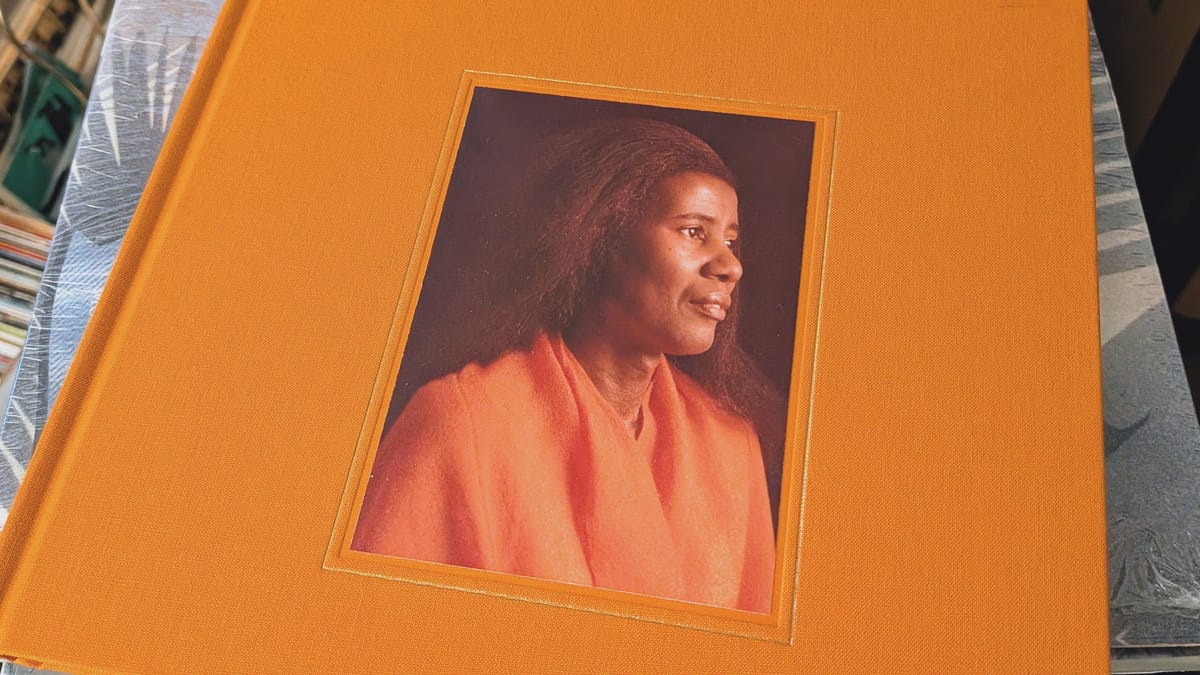
A few days ago I started Andy Beta’s biography Cosmic Music, ordered last year's Hammer Museum exhibition catalog because Amazon briefly had it at a no-brainer discount, and decided to look at what Alice Coltrane we actually had on our network storage device. That was when I realized I had never ripped Journey in Satchidananda in lossless. This is the kind of oversight that can bother a certain type of person.
The last time I visited London was in 2018, and more for old time's sake we stopped by Fopp, the music, movie, and book retail chain specializing in "mid price" and discounted media. Nancy picked up Huntington Ashram Monastery and World Galaxy as a "two albums on one CD" reissue for five pounds. I gave it a listen when we returned home, ripped both albums to FLAC, saved them as separate RAR archives on our Synology NAS appliance, and forgot about it.
I started the work week with Huntington Ashram Monastery playing through the Mackie studio monitors that happen to cohabit my home office. At first it registered less as an event than as an atmosphere. The bass did not so much anchor the music as move beneath it, a slow current rather than a groove. The piano and harp seemed to travel along that current rather than push against it. Nothing announced itself in the way a jazz record sometimes does — no dramatic opening flourish, no invitation to admire the virtuosity in progress. The music simply began and continued, gliding forward with a patience that made the usual vocabulary of tension and release feel slightly beside the point.
That glide was the thing that caught my attention. Jazz — at least the varieties I tend to understand — grooves. The rhythm section locks into something gravitational and the other instruments push and pull against it. Monastery felt different. The bass repeated, but it did not pull the music inward; it carried it forward. The drums were present but rarely insistent. The harp floated in and out of the field like weather. The effect was less like watching musicians negotiate a structure and more like watching a landscape move past the window of a train.
By the time Journey in Satchidananda came on, that sensation had deepened. Cecil McBee’s bass line felt almost tidal, rising and falling in long, patient arcs while the rest of the ensemble drifted above it. Rashied Ali’s percussion flickered rather than drove. Alice’s harp lines traced delicate geometries through the air. What had initially sounded sparse began to feel expansive — a kind of suspended motion in which nothing needed to hurry because nothing needed to arrive.
This is the point where someone more fluent in jazz history might begin explaining modal structures or the lineage from John Coltrane’s late-period ensembles. My own reaction was simpler: the music glided more than it grooved.
Then World Galaxy arrived and the scale of the whole enterprise shifted.
The opening tracks did not so much continue the previous albums as widen them. The string arrangements moved like swirls of gas and dust around a gravity well — not decorative, not lush in the easy-listening sense, but unstable, roiling, pulled in multiple directions at once. Strings and harp carry a certain cultural baggage; they are supposed to soothe, sentimentalize, decorate the foreground. Here they generated friction instead. The sound was psychedelic, though not in the usual flower-child register. Something about it felt darker, almost menacing, as if the orchestra became dark matter - unaccounted for yet present and gravitic.
But the turbulence did not remain turbulence. By the time the album reached “Galaxy Around Olodumare,” the agitation had opened outward into something enormous. The music no longer felt like a group of players negotiating a form so much as a system of bodies exerting gravitational force on one another — strings pulling one direction, organ another, the harp maintaining its quiet orbit. The result was not serenity exactly, but scale. The sort of breathtaking vista you associate with astronomical photographs, where cosmic beauty and thermonuclear violence are part of the same process.
I know just enough about jazz to note that World Galaxy is bookended by "My Favorite Things" and "A Love Supreme" - two (and I roll my eyes slightly here) canonical works of John Coltrane. They're not "covers" in any traditional sense. The former retains the melodic motif just long enough to announce an arrival before initiating a radiant metamorphosis. The latter begins and ends with Swami Satchidananda's invocation and benediction, with a decidedly groovy middle stretch. The Wikipedia entry for this album showed a 2-1/2 out of 5 star rating from Down Beat magazine in 1972, and I wondered what that would have seemed to critics and listeners. A misformed tribute? An act of conservatorship? Outright heresy?
What struck me most was not that the album had suddenly revealed itself as a neglected masterpiece. It was that I had technically owned this music for eight years without ever quite hearing it. Nancy bought the CD for five quid in 2018, because she truly knows and appreciates the numinous and cosmic. I ripped the files, archived them on the NAS, and moved on. The records were present in the most literal sense — perfectly preserved, lossless, catalogued — but they had never actually entered my listening life.
Until, apparently, a Tuesday morning in March.