The Silence at Saint Corvin's: The Mirror Text
A designer's essay on inverting Umberto Eco's The Name of the Rose through procedural gothic
INTRODUCTION: THE INVERSION ENGINE
The Silence at Saint Corvin's is a mirror text to Umberto Eco's The Name of the Rose.
The monastery remains. The investigation remains. The relic remains. But every element inverts: the outsider becomes the insider, the hidden book becomes the speaking tongue, the accidental fire becomes the chosen torch.
Truth isn't solved. It's managed.
I. THE INVESTIGATORS AS THE MACHINE
Eco's William: Reason Against Opacity
William of Baskerville functions as secular method pressing against theological opacity. His rationalism is proto-modern solvent — empiricism applied to divine mystery. He arrives as an outsider (Franciscan in a Benedictine abbey) and maintains critical distance from institutional power. When Jorge burns the library, William has done all he could. He remains intact.
The Ordo Arbitrae: Procedural Faith Itself
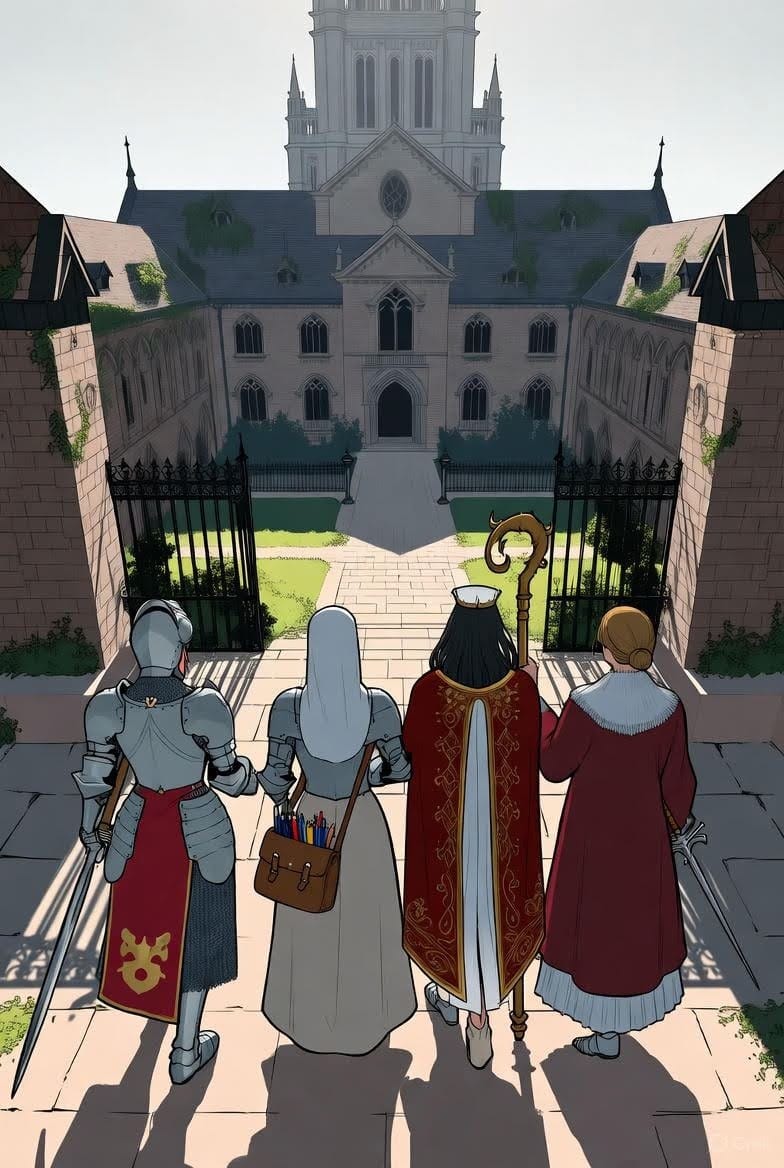
The four officers of Corvin's aren't reason opposing faith. They are the institution's enforcement arm — procedural faith made flesh. They are instruments designed to maintain coherence when meaning fails.
Their tragedy isn't ignorance but over-function: they do their jobs perfectly, and that perfection damns them. The institution damns them not by belief but by meter—Stress accumulates with each proper procedure, Bonds fracture under correct protocol, Heat rises as evidence is properly documented. The Militant secures. The Auditor investigates. The Theologian manages narrative. The Diplomat mediates. Each role executes flawlessly — and that execution becomes the sin.
If The Name of the Rose asks: "Can truth emerge despite the Church?" Then The Silence at Saint Corvin's asks: "What if truth is heresy within the Church?"
The officers don't pierce the institution. They are the institution's piercing implement, discovering they've been aimed at themselves.
II. THE RELIC AS ANTI-BOOK
Eco's Poisoned Tome: Knowledge as Consumption
The lost second book of Aristotle's Poetics (on comedy) kills by being read. Jorge poisons the pages because laughter undermines fear of God. The reader consumes forbidden knowledge and dies. The relationship is passive: text → reader → death.
The Saint's Tongue: Knowledge as Involuntary Revelation
The Saint's Tongue reverses the vector. It doesn't wait to be read — it speaks. It recites sins whether you want to hear them or not. You cannot choose ignorance. You cannot un-hear confession.
It names what you are doing now.
The horror lies in the impossibility of unread truth. Eco's book can be burned unread, its danger contained. The Tongue speaks the moment you approach.
That's why the officers' choice is moral rather than epistemic. You can't "solve" a voice that tells you what you already know. You can only decide whether it deserves to continue speaking.
III. FROM MONASTIC SILENCE TO BUREAUCRATIC SILENCE
Eco: Humility Before God
The silence of Eco's abbey is monastic — born of humility before divine mystery. Speech is rationed because words profane the ineffable. The library's secrecy protects sacred knowledge from vulgar understanding.
Corvin's: Survival Within Hierarchy
The silence of the Ordo Arbitrae is bureaucratic — born of survival within a hierarchy that conflates obedience with virtue. Speech is rationed because words create liability. Records are sealed not to protect the sacred but to protect the system.
This is the shift from devotional gothic to procedural gothic: confession replaced by paperwork, penance replaced by report-writing, absolution replaced by sealed files.
Every signed document is a burnt page of the lost library.
IV. GENDER AS ARCHITECTURE, NOT ALLEGORY
Why Female Authority Matters Structurally
The female-led Ordo Arbitrae is an aesthetic of competence that evacuates the "exceptional woman" trope. Sister Adalberta isn't impressive for a woman. She's impressive because she commands.
By making female authority unremarkable in-world, the scenario removes patriarchal arbitration from institutional rot. The tragedy isn't "women corrupted by male structures." It's "people corrupted by institutional structures, regardless of who built them."
At the table: Seraphine overrules Adalberta by invoking guest-right. No one blinks. Authority looks like this here. It always has.
Ironlily's Aesthetic: Naturalization, Not Parody
Ironlily's visual language — medieval armor rendered in anime softness, high-saturation devotional colors, faces that combine grace and competence — naturalizes rather than subverts.
The softness isn't decorative. It's the visual vocabulary of faith turned professional. The red-and-white heraldry, the careful draping of habits over chainmail, the croziers that double as weapons — all of it says: this is normal. this has always been normal. authority looks like this.
A crozier becomes an HR stamp. The seal grants termination authority. The armor is dress code.
That aesthetic choice does critical work: it prevents the scenario from becoming about gender and keeps it about procedure under faith.
V. NO MYSTERY, ONLY ETHICS
Eco's Resolution: Intellectual Closure
The Name of the Rose resolves in ashes but offers intellectual closure. William identifies Jorge as the murderer. He understands the poison mechanism. He grasps the ideological motive. When the library burns, the rationalist has done all he could. Knowledge was pursued to its limit.
The tragedy is external: fanaticism destroyed enlightenment. William mourns but is not complicit.
Corvin's Resolution: Moral Recursion
The Silence at Saint Corvin's offers no intellectual mystery. By Act II, the officers know what happened: the relic spoke truth, the nuns panicked, some fled, some killed, some went mad.
The question is never whodunit but what do we do with this.
You roll Savvy against the Tongue and succeed. Now you know the truth and must manufacture a lie.
The officers face what William never does: the correct institutional decision may be the immoral one. Suppressing the truth preserves the Order. Exposing the truth destroys it. Both choices are coherent. Both choices are damnation.
This is the move from modern to post-modern theology — knowledge is no longer redemptive but corrosive. Discovery doesn't liberate; it contaminates.
Where Rose asks "What knowledge is dangerous?" Corvin's asks "Who decides what burns?"
VI. THE FIRE AS WILL
Eco: Accidental Apocalypse
The library fire in The Name of the Rose is accident compounded by fanaticism. Jorge tries to eat the poisoned pages; William struggles with him; the lamp falls; the parchment ignites. The destruction is chaotic, uncontrolled, tragic.
No one chose to burn the library. It happened to them.
Corvin's: Chosen Apocalypse
In The Silence at Saint Corvin's, the officers hold the torch and must decide whether to light it.
Destroying the relic is deliberate. Staging its "ascension" is deliberate. Rewriting doctrine around it is deliberate. Every option requires active will, not passive failure.
This single shift redefines agency. The moral center relocates from the library (object) to the torchbearer (subject). Knowledge doesn't destroy itself. We destroy knowledge.
It's an act of bureaucratic arson — ritualized destruction disguised as duty, filed under "Case Closed."
VII. GENRE MUTATION: FROM DETECTIVE TO AUDIT
Eco's Grammar: Evidence, Deduction, Revelation
The Name of the Rose moves through the grammar of mystery: evidence accumulates, deduction narrows suspects, revelation exposes the murderer. Forward momentum.
Corvin's Grammar: Discrepancy, Documentation, Resolution
The Silence at Saint Corvin's spirals through the grammar of audit: discrepancies are found, documentation is reviewed, resolution is imposed. Inward recursion.
Mystery moves forward. Audit tightens. The library opens corridors; the archive closes boxes.
This is why the scenario is procedural gothic rather than detective fiction:
- The horror comes from doing your job correctly
- The monster is the form you're required to fill out
- The haunting is bureaucratic: someone is keeping records
VIII. THE TWO QUESTIONS
Eco's Question (1980)
"Can reason pierce dogma?"
Written at the height of post-structuralist optimism, Eco's novel argues yes, but at great cost. William's empiricism challenges theological authority. The library burns, but enlightenment attempted its assault. The book is elegy for knowledge lost but also faith in knowledge possible.
Corvin's Question (2025)
"Can conscience survive procedure?"
Written from the rubble of institutions that already failed their own ideals — financial collapse, sexual abuse scandals, political corruption documented in real-time — Corvin's asks whether personal morality can endure systemic participation.
The officers aren't opposing the institution from outside. They're enacting it from within, discovering that good people following good procedures produce atrocity when the system itself is corrupt.
The difference is historical and emotional. Eco wrote when institutions could still be reformed by exposing their hypocrisies. Corvin's writes when institutions have weaponized transparency itself — everything is documented, nothing changes.
But there's a seduction here. If Rose is the fantasy that exposure reforms, Corvin's risks becoming the fantasy that nothing can. The game plays with fatalism; it doesn't endorse it.
IX. MECHANICAL THEOLOGY: STRESS, BONDS, HEAT
Why Mörk Borg + Pressure Drop?
The choice of system is structural, not cosmetic.
Mörk Borg provides:
- Brutal mortality (low HP = vulnerability)
- Fast resolution (action without safety net)
- Apocalyptic inevitability (the world is ending, what do you do?)
JARLS: Pressure Drop adds:
- Stress: Internal pressure (am I breaking?)
- Bonds: Interpersonal fracture (are we fracturing?)
- Heat: External attention (are they closing in?)
Together, they create a mechanical theology where:
- Your body fails (HP)
- Your mind cracks (Stress)
- Your relationships corrode (Bonds)
- The system tightens (Heat)
And there is no escape valve. Heat never decreases on its own. Stress accumulates. Bonds fracture under pressure.
The mechanics don't simulate investigation. They simulate the cost of investigation when you are the thing being investigated.
The Pressure Triangle as Moral Engine
The genius of Pressure Drop is that each system feeds the others:
- High Heat makes rolls harder → more failures → more Stress
- High Stress causes poor decisions → Bonds drop → less support
- Low Bonds mean no one covers you → more exposure → more Heat
This is institutional doom as clockwork. The officers aren't fighting monsters. They're fighting entropy, and entropy is winning by design.
When Sister Lucienne questions Sister Adalberta's tactics (Bond −1), and Adalberta snaps under pressure (Stress check), and their argument is overheard by a novice (Heat +1), the system hasn't malfunctioned. The system is working perfectly.
That's the procedural gothic: the machine hums. The forms are filed. The reports are sealed. And everyone is damned.
X. THE IRONLILY LENS: AFFECTIVE CAMOUFLAGE
Visual Dissonance as Design
Ironlily's aesthetic creates affective camouflage — purity rendered in high-saturation tones that can't conceal the machinery beneath.
The four officers in their red-and-white habits, holding polearms and seals, look like:
- Saints in illuminated manuscripts
- Magical girls in transformation sequences
- Corporate middle managers in devotional cosplay
All three readings are correct. That's the power of the aesthetic.
The anime softness disarms. The faces are gentle, the proportions elegant, the armor stylized rather than brutal. But look closer:
- The polearms are real weapons, not props
- The seals grant institutional authority, not symbolic protection
- The eyes carry competence, not innocence
This is competence without commentary. The officers aren't subverting the system by being female. They're operating the system with full authority — and discovering that authority is its own prison.
Why Kawaii + Medieval = Gothic
The combination of cute and competent, soft and martial, creates psychological dissonance that serves the scenario's themes:
Cute signals safety, harmlessness, non-threat
Competent signals danger, capability, authority
The dissonance forces the viewer to reconcile: these women can hurt you, and they'll look beautiful doing it, and that's normal here.
That's the same dissonance the officers experience: I can destroy the truth, and I'll look righteous doing it, and that's my job.
The aesthetic externalizes the moral trap. The system looks holy. The procedure feels correct. The damnation wears vestments.
XI. PLAY EXPERIENCE: AUDIT AS RITUAL
What Happens at the Table
When players sit down to The Silence at Saint Corvin's, they get:
- Evidence they already understand (the clues don't reveal — they confirm)
- Debate over institutional response (arguing with each other, not fighting monsters)
- Choosing which damnation to file (there is no "save the day")
The play experience is uncomfortable by design. Players aren't heroes. They're auditors of a crime they must either bury or become.
The Three Conversations
Every playthrough produces three overlapping conversations:
1. The Investigation (procedural) "What does the evidence show? Who was here? What happened?"
2. The Accusation (political) "Who's responsible? What do we tell the capital? Whose authority decides?"
3. The Confession (moral) "What does the relic know about me? Can I live with this choice? Who am I after?"
The first conversation is professional. The second is tactical. The third is existential.
The scenario succeeds when the third conversation dominates the second, when players stop asking "What's the smart move?" and start asking "What can I live with?"
What the Mirror Does
Players don't leave unchanged. The mechanics ensure it.
You've marked Stress six times. You've fractured Bonds with your partners. You've rolled to see if you break—and you broke, or you didn't, and that's worse because you're still functional. You return to the table next week and remember: I chose to seal that file. I signed that order. I knew.
The post-play ritual matters. Burn a seal. Sign a report. Speak one sentence you'll stand by. The game gives you the mirror. The ritual shows you what it does to the person who looks.
This is the medium's gift: you don't read about complicity. You enact it. You mark the consequence on your character sheet in your own handwriting.
Why Four Players Exactly
The four archetypes create a 2×2 tension grid:
Axis 1: Force vs. Negotiation
The Militant (force) ↔ The Diplomat (negotiation)
Axis 2: Truth vs. Narrative
The Auditor (truth) ↔ The Theologian (narrative)
Diagonal 1: Law Enforcement
The Militant + The Auditor = "Find and eliminate the problem"
Diagonal 2: Institutional Preservation
The Theologian + The Diplomat = "Manage perception and maintain stability"
With four players, conflict is structural, not interpersonal. Players aren't arguing because they're ornery. They're arguing because their roles demand it.
Remove one player and the grid collapses. Add a fifth and the symmetry breaks.
Four is the minimum cast for institutional tragedy.
XII. WHAT ECO COULDN'T WRITE
The View From Inside
The Name of the Rose is written from the margins of power. William is Franciscan investigating Benedictines, English examining Italians, empiricist questioning mystics. He maintains observer status even while embedded.
Eco could show institutional corruption but not institutional complicity from within. William never has to choose whether to become Jorge. He can remain the detective, untainted by the crime.
The Impossible POV
The Silence at Saint Corvin's is written from the center of power. The officers aren't observers. They're operators. They can't maintain critical distance because they are the mechanism of institutional will.
This is the POV Eco couldn't write — or chose not to. The story from inside the machine, where good intentions execute bad systems, where competence produces atrocity, where the person holding the torch must decide whether to light it.
It's the perspective of the inquisitor who knows the defendant is innocent but signs the order anyway.
Post-Institutional Storytelling
We live in an age where:
- Every institution's internal memos leak
- Every abuse is documented in real-time
- Every cover-up is catalogued, archived, searchable
And yet: nothing changes.
The officers of the Ordo Arbitrae face that reality. Exposing the truth won't fix the system. Suppressing the truth won't fix the system. The system is unfixable — it functions exactly as designed, producing harm through proper procedure.
That's the horror Eco's William never confronts. He can still believe in reform through revelation. The officers of Corvin's know better.
They are post-institutional investigators — people who understand that documenting atrocity is itself an institutional function, that transparency can be weaponized, that "following procedure" is the defense and the crime.
XIII. THE ENDING BOTH STORIES SHARE
Both The Name of the Rose and The Silence at Saint Corvin's end with fire and silence.
Eco's Ending: Elegy for Lost Illumination
William watches the library burn. The greatest collection of knowledge in Christendom turns to ash. Jorge's fanaticism triumphs through destruction.
But William leaves intact. He mourns, yes. He failed, yes. But he did not choose the fire. His conscience survives because he stood outside the machine.
The final lines: "The library was perhaps justified in burning, for what is a book that no one can read?"
Ambivalent. Melancholy. But not complicit.
Corvin's Ending: Confession of Chosen Darkness
The officers stand in the ruins of Saint Corvin's. They hold the relic — or its ashes. They know what happened. They know what they did.
They return to their Order and file the report.
There is no mourning. There is no outside to escape to. There is only the form to complete, the seal to stamp, the file to close.
The final question: "What will you tell them?"
No ambivalence. No distance. Only complicity or confession — and either choice is its own damnation.
XIV. THE MIRROR SHOWS WHAT THE WINDOW CANNOT
The Name of the Rose is a window into the past. It shows us medieval theology from the enlightened distance of postmodernity. We watch William struggle against dogma and feel superior to Jorge's fanaticism.
The Silence at Saint Corvin's is a mirror reflecting the present. It shows us our own institutional entanglement. We watch the officers struggle against procedure and recognize ourselves.
Eco's novel lets us say: "I would have sided with William." Corvin's scenario forces us to ask: "Which officer am I?"
And the answer is terrifying: all four.
We are:
- The Militant when we value security over justice
- The Auditor when we demand accountability for others but not ourselves
- The Theologian when we manage optics instead of addressing harm
- The Diplomat when we prioritize peace over truth
We contain the entire institutional apparatus. The officers aren't villains. They're us on a Tuesday, doing our jobs, filing our reports, choosing what to document and what to seal.
XIV-A. COMIC UNDERTOW
Bureaucracy is ridiculous right up to the moment it ruins lives.
"Where are the men?" "Back at the convent — doing laundry."
The institutional absurdity isn't a distraction from tragedy. It's the texture of tragedy. Forms filed in triplicate. Seals that must be properly stamped. Jurisdictional disputes over who investigates whom. The machine's gears grind with comic precision—until someone's caught between them.
This is why procedural gothic works. The horror and the farce share the same paperwork.
XV. CONCLUSION: THE INVERSION'S GIFT
The Silence at Saint Corvin's doesn't contradict The Name of the Rose. It answers it — from within the system Eco thought could never speak.
Where Eco asked: "Can reason pierce dogma?" Corvin's replies: "Reason becomes dogma when institutionalized."
Where Eco showed: "Knowledge destroyed by fanaticism" Corvin's shows: "Knowledge destroyed by procedure"
Where Eco mourned: "The library we lost" Corvin's mourns: "The report we filed"
The inversion's gift is this: it makes complicity playable. It lets us sit in the officer's chair, hold the seal, face the choice, and discover what we're willing to burn to keep our position.
You roll the dice. You mark the Stress. You lose the Bond. You file the report.
The fire doesn't need fanaticism. It just needs us to do our jobs.
APPENDIX: DESIGN AXIOMS
For designers building similar procedural gothic scenarios:
1. The Institution Must Be the Protagonist Characters serve roles, not personalities. The system drives behavior.
2. Evidence Should Confirm, Not Reveal The mystery isn't "what happened" but "what do we do with what we know."
3. Every Option Must Be Coherent No clearly "right" answer. Institutional logic validates all paths.
4. Mechanics Should Model Decay Systems that only increase pressure (Heat, Stress) without release valves.
5. The Investigator Must Be Investigated The relic speaks back. The audit audits the auditor.
6. Competence Is Not Virtue Skilled execution of harmful procedure is still harm.
7. Documentation Is Confession What you write becomes the truth. The report damns or absolves.
8. Silence Is Active, Not Passive Suppression requires will. Sealing a file is arson by paperwork.
9. The Fire Must Be Chosen No accidents. No external villains. Only institutional will.
10. The System Survives Whatever the officers choose, the Ordo Arbitrae continues. That's the horror.
WORKS CITED
Eco, Umberto. The Name of the Rose. 1980.
Ironlily's Scriptorium. Patreon.
The Grey Ledger Society. JARLS: Pressure Drop. 2024. Itch.io.
Ockult Örtmästare Games / Stockholm Kartell. Mörk Borg. 2020.
ACKNOWLEDGMENTS
This essay and the scenario it describes emerged from conversation — a collaborative thinking-through of what happens when you invert a classic text's structural assumptions. The analysis was sharpened by questions about what's minimized, overstated, or overlooked in preliminary drafts.
Special thanks to:
- Ironlily, for creating an aesthetic that makes competence and devotion inseparable
- The designers of Mörk Borg and JARLS: Pressure Drop, for building systems where entropy is mechanical
- Umberto Eco, for writing a book that demands response rather than homage
And to the players who will sit down as officers of the Ordo Arbitrae, hold the torch, and discover what they're willing to burn: may your reports be honest, even when you seal them.
Author's Note:
This essay reads game structure through narrative inversion. The Silence at Saint Corvin's uses procedural mechanics to ask questions about complicity that novels can describe but RPGs can enact.
You don't read about an officer choosing to burn evidence. You roll the dice and mark the consequence.
That's the medium's gift. Use it carefully.