The River, the Shore, and the Tide Pool: A FiiO Snowsky Disc DAP "Review"
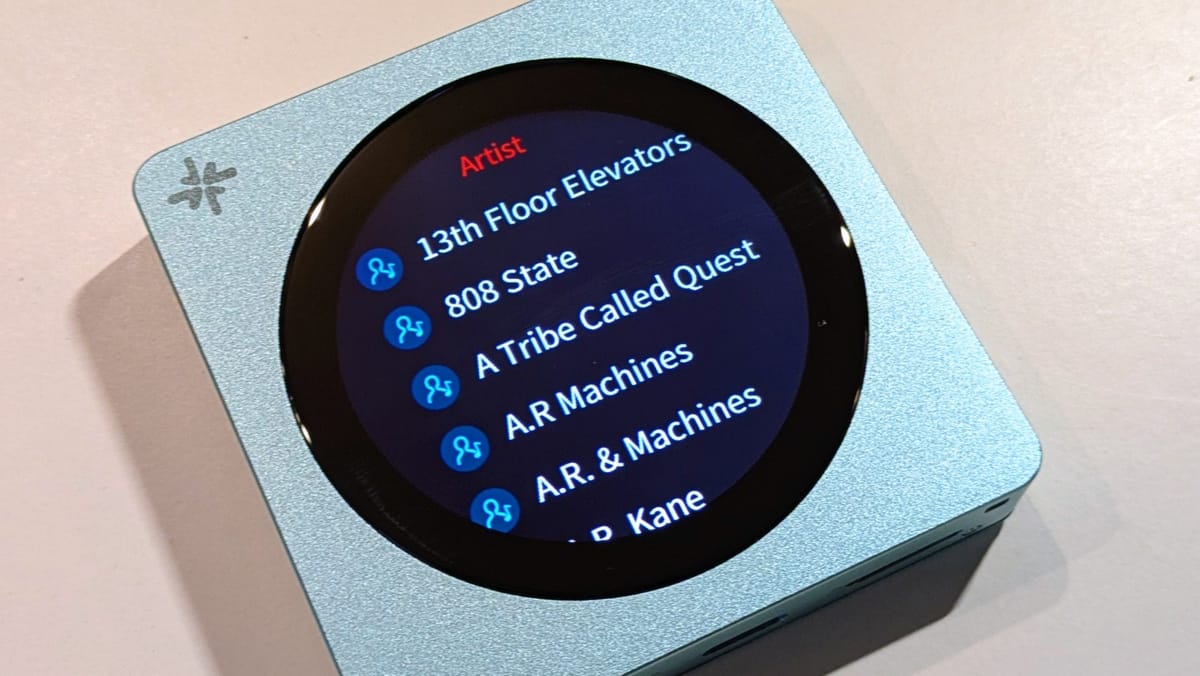
It is possible to review a device by listing its specifications.
The Snowsky Disc DAP is roughly the size of two stacked MiniDiscs. It accepts a 1TB microSD card (and, ominously, up to 2TB). Mine currently handles 11,544 FLAC files without complaint, occupying 318 GB and leaving 637 GB as negative space. The touchscreen is just laggy enough to be noticeable, comparable to a lower-end Samsung A16. It is, however, more stable than VLC running on that handset. It has Bluetooth and Wi-Fi. It runs for hours. It costs about $90.
All of this is true.
None of it explains why the device matters.
There was once a river.
In the 1980s, music flowed downstream through FM radio. You didn't summon songs. You encountered them. The river carried classic rock into pop into hair metal into a late-night specialty show on a community or college station that played something stranger. The flow was shared. You could be sure that someone else, somewhere nearby, was hearing the same chorus at the same moment.
The river implied depth without revealing its source.
Through a confluence of events, you stepped into a student radio station and saw a shore. LPs in wall-to-wall stacks. Handwritten record reviews with favorites marked with two checks and a plus. Milk crates of specialty show vinyl, even more oddball than what's on playlist. Older DJs explaining how things used to be different... three semesters ago. You noticed that the river was not infinite. It was curated. Physical. Finite enough to map, vast enough to overwhelm.
The scale suggested an ocean.
Streaming arrived and delivered an ocean directly to the handset. Infinite scroll. Instant search. Every wave available on demand.
That ocean seems impressive. It is also quite frictionless. When apparently every song is accessible, silence becomes an oversight rather than a choice. When the perfect track for every micro-mood exists, the temptation is to optimize atmosphere rather than inhabit it.
However, it is one body of water, less of an ocean, more like an artificial inland sea, bound by label and distribution agreements, but effectively abundant.
Even this abundance shifts from aspirational to consumable.
You can listen this way indefinitely. Many do. There is nothing inherently wrong with it.
But something subtle changes when scale loses boundary.
Enter the tide pool.
A tide pool is not the ocean. It is a bounded sample of it, carried forward by the tide and left behind when the water recedes. It contains life. It contains motion. It contains evidence of vastness without attempting to replicate it.
The Snowsky Disc functions as that milk crate of LPs.
It is not the full archive. There are terabytes elsewhere; we measure the pool in gigabytes. It is not the complete discographies of every artist. There are omissions. Deliberate ones. It does not attempt to mirror streaming’s seemingly infinite adjacency. It contains what was chosen.
What was chosen reveals more than any recommendation engine could.
A cluster of rhythmic records that still move a room regardless of era. A fragile Memphis album that resists canonical stability. A Brazilian clearance-bin find that expanded into gigabytes. A Cajun Mardi Gras song that exists only as an MP3 but outweighs more prestigious artifacts. A pair of art-rock albums upgraded long ago, their provenance encoded in road trips rather than mastering notes.
These files do not merely occupy storage. They carry sediment.
The device’s capacity approximates that of a respectable low-power college radio station from the late 1980s. It is light enough to fit in a shirt pocket. It is deep enough that you can cue up “Israelites” in seconds. It is not so deep as to become un-navigable.
It's a sweet spot. One of potentially many, hand-picked and held in reserve.
A milk crate multiplied by a hundred, but still a crate.
The touchscreen lag becomes almost appropriate. It prevents the device from feeling like a feed. It behaves like a tool rather than a portal. There is no algorithmic gravity. There is Artist → Album → Play.
The Bluetooth stack exists not for convenience, but for low-probability scenarios in which a room needs two hours of Desmond Dekker and you gotta be ready.
This is preparedness without compulsion.
The question that emerges is not about bitrate or DAC topology.
It is this:
What matters enough to carry?
Not to access.
To carry.
A finite container forces articulation. Not every historically important album survives selection. Not every former favorite retains urgency. Rhythmic propulsion endures. Shared discoveries endure. Records tied to geography endure. Some albums represent rupture; others represent continuity. Some exist simply because they were found at the right moment.
Silence is allowed.
Not every occasion requires a soundtrack. The crate need not solve every mood. If The Jam is absent and The Style Council remains, you adapt or just enjoy the silence.
Constraint restores proportion.
The Snowsky Disc will fail eventually. The battery will degrade. So will the microSD card. Firmware will age. The casing will scratch. It is a mass-produced object and will weigh no less on any tariff manifest for having hosted meaning.
But the tide pool logic will persist.
A bounded, chosen ecosystem in proximity to the body alters listening. It shifts music from infinite utility back toward companionable presence. It does not reject the ocean. It simply refuses to carry it all.
In this sense, our review is complete.
The device works.
More importantly, it asks its user the right question.