The Queen's Right Hand
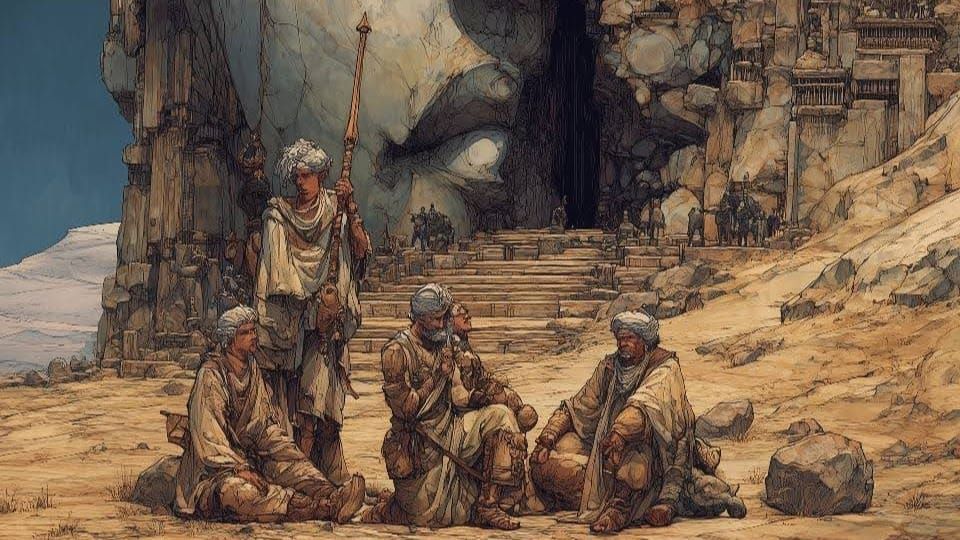
A setting for use with The Black Hack (v1.2)
The Brief
A kingdom keeps a small royal institution — the Queen's Right Hand — mandated to keep monsters and other dangers away from ordinary subjects. It is a decent employer with a real hierarchy: work is assigned by rank, gear and healing are requisitioned, and promotion brings better access. It is also stretched thinner than anyone outside it knows.
Rules used: The Black Hack, first edition (v1.2) — Armor Points, four classes, Conjurer.
House conventions: A level is an arc, not a session. Early arcs are short; later ones run for weeks as the stakes grow. The GM names each arc's end condition when it begins. At level 10 a character leaves play and becomes an NPC in the next cohort's world.
The Setting
Where play begins. A provincial station of the Hand: a stone hall, a requisition clerk, a duty roster, and a map of the district with pins in it. Within a day: farm hamlets, quarries, old barrows, the road to the capital. Beyond that: the frontier the Hand no longer patrols in strength.
What is dangerous, what is scarce. The dangers are ordinary for the profession — vermin, raiders, hungry things in old places — and they are dangerous now because everything else is scarce: good weapons, torches, healing, and above all senior operatives. Almost every experienced member of the Hand has been assigned elsewhere.
Why anyone adventures. Because they are told to. The Hand assigns work by rank, and the players' cohort gets what is left over.
Magic. As the rules have it: two traditions, arcane and divine. Conjurers are trained at the Hand's own expense and owe it their training; the divine tradition comes through the crown's temples, which supply the Hand by arrangement. Both are rare enough that a station may have one of each, or neither.
Who the characters are. Junior members of the Hand, of any of the four classes, posted together as a cohort. Rank and level are the same thing.
What ordinary people can do, and have. Subjects farm, quarry, trade, and fight badly. They own tools, not weapons. Anyone who can read, cast, pick a lock, or stand in a line with a shield is already unusual, which is why the Hand recruits them.
How lethal it is. As written. The Out of Action table stands, armor is a pool that runs out, and nothing scales down to meet the characters.
How grim and weird it is on screen. It ramps. Early arcs are a dungeon delve with a commissary attached: the institution is background, and mostly comic — forms, refusals, a clerk with opinions. As rank brings worse postings and the opponents' HD rise, the machinery moves into frame: who is unavailable, what a refused requisition means, what the benefits actually cost. Nothing in the rules scales on its own, so the escalation follows promotion rather than a dial. The pitch of the grimness is still the table's to set; only its timing is fixed.
Deeper Truths
Death. Recoverable, at a price the Hand pays for its own. Raise Dead works within seven days, which makes body recovery a real objective and the journey home a clock. Members lost where no one can reach them are simply lost.
What "evil" means. Not a cosmology. Things that prey on the Queen's subjects, and the powers behind them. Detect Evil finds intent to harm, which is why it is taught early and trusted only so far.
Threats. Ordinary for the setting: vermin, raiders, the old dead, things that come up out of places that should have stayed shut. The monster list stands as written.
Who has power. The crown, through the Hand. The Hand's own seniors, through the roster and the requisition book. Locally, whoever the Hand is not currently able to reach.
How ordinary people treat the characters. As professionals of a slightly unlucky trade: useful, mildly feared, worth feeding. Rank shows on the badge, and everyone can read it.
Leaving. Anyone may resign. Almost nobody does. The benefits are real, the work matters, and there is nowhere else that does it. Former members are out there, retired or gone quiet, and they know things the station's files do not.
What is changing. Every senior operative has been assigned to a single standing operation elsewhere. Junior cohorts now handle work that used to be supervised. [DEFERRED — depends on: how much the Hand knows about what it is facing] Whether the seniors' assignment reflects accurate knowledge, honest triage, or a guess determines whether the station's cheerfulness is decency or denial. Both read identically from a junior's desk.
The Situation
The station is short-handed, the roster is thin, and the district's routine work is now being done by people who have not done it before. That is the pressure; it is not yet a plot.
When you want one, take the thing the seniors were pulled away for and let it show up at the edges of ordinary jobs — a job that is worse than the file said, a hamlet that has stopped sending word, a requisition that is refused without explanation. Do not name it in the first arc. Let the cohort notice the shape of the gap before anyone tells them what fills it.
Characters
The four classes are unchanged mechanically. They are the Hand's four trades, and each carries a duty and a standing.
Warrior — Sworn Blade. The trade that stands in the doorway. Constraint: may not refuse a posting, however bad the file looks. Standing: the one strangers speak to first.
Thief — Surveyor. Locks, traps, heights, quiet movement, and the reading of old writing. Officially the Hand does not employ thieves; officially these are surveyors. Constraint: everything they take is the crown's, and the clerk counts it. Standing: useful and watched.
Cleric — Chaplain. Seconded from the crown's temples, which supply the Hand by arrangement and recall their people at will. Constraint: answers to two masters, and the temple's word wins. Standing: trusted by ordinary subjects more than the badge is.
Conjurer — Adept. Trained at the Hand's expense, which is stated on the indenture in years. Constraint: may not cast where subjects can see, except on a posting. Standing: rare, valuable, and quietly unnerving.
Rank is level. Each level is a promotion, and promotion is what unlocks the requisition tiers below. At level 10 a character is offered a place on the standing operation, and the player answers for them — take it, refuse it, break it, or go. Either way, that character leaves play and becomes part of the next cohort's world.
No new class yet. The four cover the work as written. If the campaign turns toward negotiation between hamlets, guilds, and the crown, that is the gap to fill.
Equipment and Requisition
Prices and usage dice are unchanged. What changes is that juniors rarely buy anything: they draw it from the station, and the clerk decides.
Starting gear. Instead of 3d6 × 10 coins, a new member draws the kit for their trade from stores. Roll the starting coins anyway and treat it as personal money — what they had before they signed.
Third-hand. Issued weapons and armor are used. At the GM's discretion, issued armor starts with half its Armor Points until the cohort earns a fresh set.
Requisition by rank. One line each:
- Levels 1–2. Torches, rope, rations, a serviceable weapon, gambeson. Ask twice for anything more.
- Levels 3–4. Leather, shields, oil, thieves' tools, a lantern that works. Holy water on request.
- Levels 5–6. Chain mail, quality weapons, healing potions by the flask, horses.
- Levels 7–8. Plate, a standing line of credit at the station, a chaplain's attendance on postings.
- Levels 9–10. Whatever exists. Including resurrection, which the Hand pays for as a benefit of service — within the seven days.
The clerk. Refusals are normal and not always explained. A refused requisition is information.
Magic
Both spell lists stand as written, at every level. Nothing is cut. What the setting adds is who controls access.
- Spellbooks are the Hand's property, copied at the station and signed for. A lost spellbook is a report, not just a loss.
- The high-level spells are the seniors' spells. Cure Serious Wounds, Raise Dead, Commune, Word of Recall and the rest exist, and the cohort will meet them as services rendered by someone senior rather than as things they can cast. This is the setting's explanation for why the top of the spell tables is rare without cutting a single entry.
- Banishing Undead works as written and is the chaplain's most-used skill in this district.
- Detect Evil and Protection from Evil key to intent to harm (see Deeper Truths). Useful on a posting; useless for telling whether a decision upstairs was a good one.
Threats
The monster list stands. These are the district's standing entries — same statistics, local names and habits.
Creature | HD | Actions and Specials |
|---|---|---|
Bug-hole vermin (Giant Ant Warrior) | 2 | As the list. The Hand's most common posting, and the most common way a junior dies. |
Barrow dead (Ghoul) | 2 | As the list. Banishable. Rarely alone. |
Hill raiders (Human Berserker) | 1 | As the list. Subjects of the Queen, which complicates the report. |
Goblin warren | 1 | As the list. Nipped in the bud for a generation; nobody has checked recently. |
Old thing below (Wight) | 3 | As the list. Level drain. Requires silver or magic — neither of which a junior cohort can requisition. |
Absent senior | 6+ | Not present. Their absence sets the difficulty of everything above. |
Scaling. Nothing scales to meet the cohort. The jobs get worse because rank brings worse postings, and because Powerful Opponents already makes anything above the characters' level bite.
Change Log
- Advancement: level = arc, not session. Arcs lengthen as rank rises. House convention; keeps ten levels from passing in ten evenings.
- Level 10 = exit. The character is offered the standing operation and leaves play whatever they answer. Gives the cap a destination.
- Starting coins become personal money; kit is issued. Puts the requisition book between the players and the equipment list without changing a price.
- Issued armor may start at half Armor Points. Optional. Makes scarcity mechanical at the levels where it matters.
- No new subsystem. The allowance is unspent. Requisition is fiction and GM ruling, not a rule.
- Nothing cut. All spells, all monsters, all equipment as written.
Open Questions
Deferred — needs your answer before it matters at the table
- How much does the Hand know about what it is facing? Options: (a) it knows and has been changed by fighting it — the benefits package reads as complicity, and level 10 becomes a question the player may refuse; (b) it knows and is triaging honestly — level 10 is a burden offered to someone who has earned it; (c) it does not know — the seniors are gone on a guess, and the cohort may be the ones who find out. Changes the briefing voice, not a single statistic.
Kept open by you
- How grim the district gets on screen.
- The live situation and any antagonist.
Assumed — overrule freely
- The Hand answers to the crown directly, not to a ministry.
- Chaplains are seconded from temples rather than trained in-house.
- Adepts are indentured for their training.
- One station, one district, one cohort as the starting frame.
Discover in play
- Where the seniors actually went, and whether any have come back.
- Who the retired members are and what they would say.
- What the district was like before the roster thinned.