The Method and the Mileage
We started by fast-forwarding through a wrong-way highway chase, only noticing the Wang Chung soundtrack from the closed captioning. The cars were moving at lethal speed, but the volume was down. The spectacle was present; the urgency was optional. We were skimming 1985 Los Angeles the way one skims a Wikipedia plot summary — curious, not captive.
It’s a mistake to say the film was about the chase. The chase was combustion grammar. The real subject was already sitting in the passenger seat.
William Friedkin’s To Live and Die in L.A. is remembered for velocity — the graceless steel sedans barreling against traffic, the sun-bleached aggression of federal agents who believe intensity is righteousness. But what lingers isn’t the impact. It’s the vacancy.
The protagonist burns out. The system does not. A desk remains. A badge remains. A partner shifts posture and occupies the empty space without ceremony. The fleet-issued Fords aren’t atmosphere. They are the argument: institutional skins covering obsession, extortion, robbery, murder by proxy. The vehicles are replaceable. So are the drivers.
Obsession combusts. The office persists.
Even in fast-forward, that much is legible.
The Basin
Los Angeles consumes rupture the way a lake absorbs a dropped stone. The splash is real. The ring expands. The surface settles. Another stone falls.
Wildfires bloom in orange plumes large enough to tint the sky two counties over. Riot footage burns into national memory. “Rooftop Koreans” becomes shorthand for a particular week in 1992. The images are catastrophic. The metro area remains.
And within those boundaries, people go to work, shop, argue over what to do about dinner.
The basin is too large to collapse from a single event. Infrastructure continues. Container ships dock. The 405 congeals. Homework is due. The grid hums.
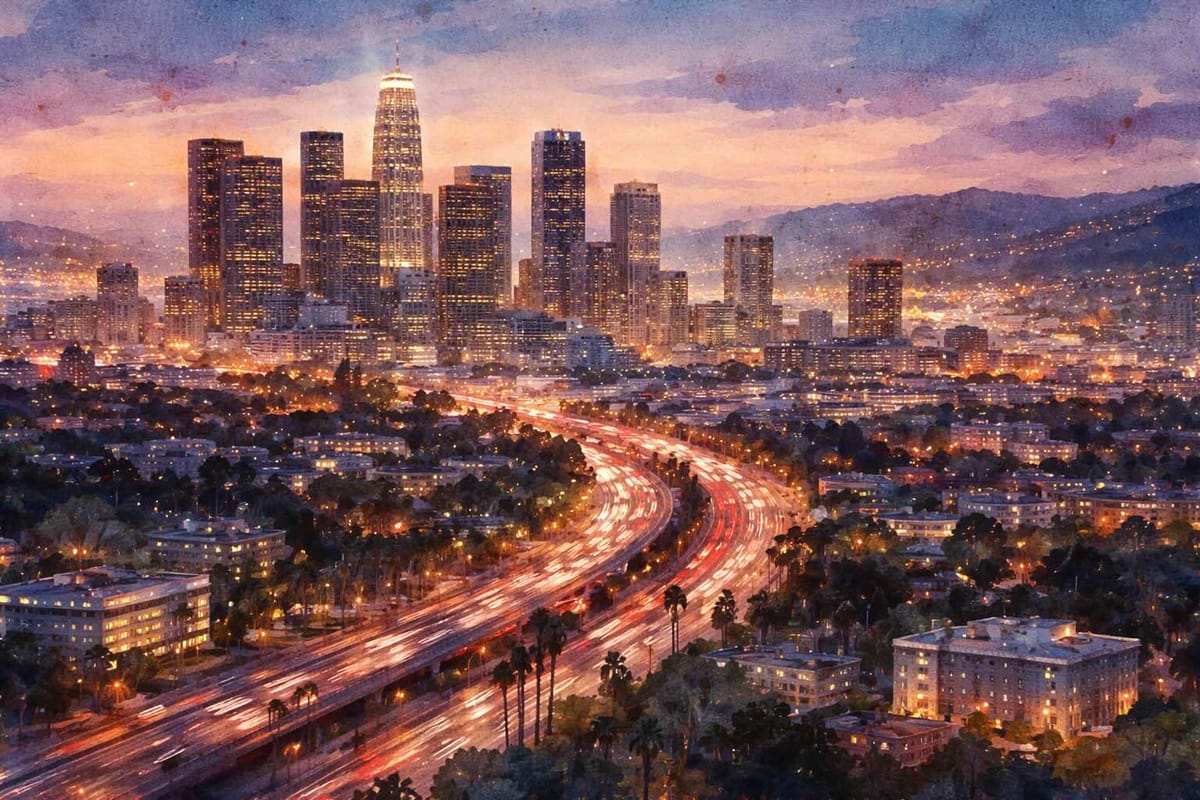
My recurring vision of Los Angeles is the Apple TV screensaver: a slow aerial drift over the U.S. Bank Tower to the Staples Center, the lights clean and geometric, an aircraft’s blinking navigation lights never quite arriving anywhere. The city rendered as idle animation in infinite loop. No chase. No plume. No siren.
Maintenance as aesthetic.
It is not that catastrophe is unreal. It is that scale dilutes singularity. The city persists not because it is virtuous but because it is vast. It metabolizes volatility the way an organism metabolizes fever.
Viewed from a rental car on the freeway, Los Angeles becomes cinematic. Viewed from above, it becomes abstract. Walked through, it becomes specific.
The basin holds all of it without commentary.
The Lines We Draw
Lines look decisive on paper. They appear clean, almost elegant — ink resolving ambiguity. The Durand Line in 1893. The 38th parallel drawn in haste with an atlas and a deadline. The 17th parallel as temporary demarcation. The red lines on housing maps that decided who received credit and who did not. Mercator’s projection making Greenland appear heroic and Africa diminished.
The line precedes the life it bisects.
Mortimer Durand had excellent maps. He is not available for comment on the Pakistani air force bombing Kabul.
The metaphor of a “smoking gun” is too tidy for what bleeds from these lines. There is rarely a single discharge. There is instead a structural wound that never heals and reopens under pressure. Afghanistan and Pakistan inherit a border that was administrative before it was lived. The people divided by it continue to live.
“Imperialism: The Gift That Keeps On Giving™.” The trademark arrives in the voice of a radio ad copy reader and then withdraws before it becomes glib. The joke lands only because the cost is ongoing.
Elsewhere, the United States shredded its retired F-14 Tomcats not for scrap value but to prevent black-market parts from extending the life of Iran’s aging fleet — the only other operator after 1979. Wings, avionics, structures demolished in the desert so that maintenance could not occur. The aircraft made iconic by a Kenny Loggins soundtrack reduced to confetti because even scrap can be a security threat.
Combustion is cinematic. Maintenance is strategic.
The line drawn in ink. The jet reduced to mulch. The sanction that persists after the slogan fades. Roles outliving occupants. Systems indifferent to individual intent.
From altitude, the pattern appears coherent. At ground level, the pressure remains.
“Don’t push me ’cause I’m close to the edge.”
Melle Mel filed that report from inside the fissure.
At Ground Level
This morning, Nancy and I went for coffee at a shop that is not walking distance but not one that requires a longer drive. It is special, but not that special. Spatial enough.
She ordered a cappuccino with dairy instead of her usual oat. Last year, after an annual checkup, she cut down on sugar and dropped fifteen pounds.
“They say there’s nothing sweeter than having lost weight,” she said.
“Considering how much work it takes to get there, I get it,” I replied.
I ordered a large chai latte and was won over by a spinach-and-cheese pastry. She tried a bite.
“Flaky,” we both said.
An older trio sat down at the adjacent table. As one of them turned his head, I glimpsed a hearing aid — small, discreet, almost invisible. They’re getting better at that.
REO Speedwagon came on over the speakers. We sang along, gesticulating for emphasis. You can't fight that feeling. Another song followed.
“Who is that?”
“Kenny Loggins?”
“Oh yeah. Has that ‘Danger Zone’ ring to it.”
Nancy pointed to a patron packing up his laptop.
“I think we drove that guy away.”
“Good.”
Overnight, there had been Israeli airstrikes in Iran. Nancy told me she had dreamt about looking for a fallout shelter.
“Did you have those dreams in the ’80s?”
“No.”
Atomic annihilation had once felt ambient. The world could end tomorrow. Homework was also due then.
Today, the dry run for armageddon is announced via app notification.
Homework is still due for someone.
Back at home, Delia The Dog would like it noted that none of this is her responsibility and her food bowl situation remains unresolved.
Suffolk
In W.G. Sebald's The Rings of Saturn, the narrator visits a seaside resort that had once been a reputable paragon of bathing culture. The promenades remain. The hotels remain. The optimism that built them does not. Economic decline settles in. Statistics accumulate. Residents off themselves with regularity minus theatricality. At an inn, a plate of fried fish arrives from what feels like a previous century and refuses to justify its continued existence. The dining room persists. Hospitality persists. The fish is inedible.
A retired barrister breeds flowers in his later years and dies in a freak gardening accident. No symbolic closure attends him. A life accumulates. It ends.
This passage sticks with me:
The shadow of the night is drawn like a black veil across the earth, and since almost all creatures, from one meridian to the next, lie down after the sun has set, so one might, in following the setting sun, see on our globe nothing but prone bodies, row upon row, as if leveled by the scythe of Saturn – an endless graveyard for a humanity struck by falling sickness.
The earth rotates. Humanity lies down in synchronized vulnerability. Sleep resembles death from orbital distance. An age can pass in a second.
The image does not argue. It levels.
The remains of the fish, inedible yet politely nibbled on, remains on the plate.
Rotations
We started by fast-forwarding through a wrong-way freeway chase, noticing Wang Chung only because the closed captioning told us so. We end with Saturn’s scythe passing over a rotating globe, leveling humanity row upon row in the dark.
This seems inevitable now. It was not predictable then.
The method only becomes visible once the mileage has been logged.
Friedkin spoke of Los Angeles with the dialect of combustion: obsession flaring, a vacancy filled, the fleet-issued sedan waiting for its next driver. The basin absorbed riot and wildfire without forfeiting the grid. Lines drawn by absent hands continued to bleed across continents. Jets were shredded in the desert so that maintenance could not occur. Maps distorted scale. Systems persisted.
At ground level, a pastry was declared flaky. A hearing aid nearly disappeared against the ear that wore it. REO Speedwagon in café. A dream about a fallout shelter arrived without commentary. Homework due. Delia waited.
Sebald walked along the Suffolk coast and found a resort in decline, a dining room with fish from another era, a barrister felled in his own garden. Then the earth turned and everyone lay down at once.
Combustion attracts attention. Maintenance sustains existence. From altitude, the pattern appears coherent. From the table beside us, it simply appears.
The mileage was accounted.
The trail only became visible by walking it.
And somewhere, between Wang Chung and Saturn, the cars are still moving, the inedible fish is still being served, the lines remain in ink, and morning comes again and again and again.