The King's Own
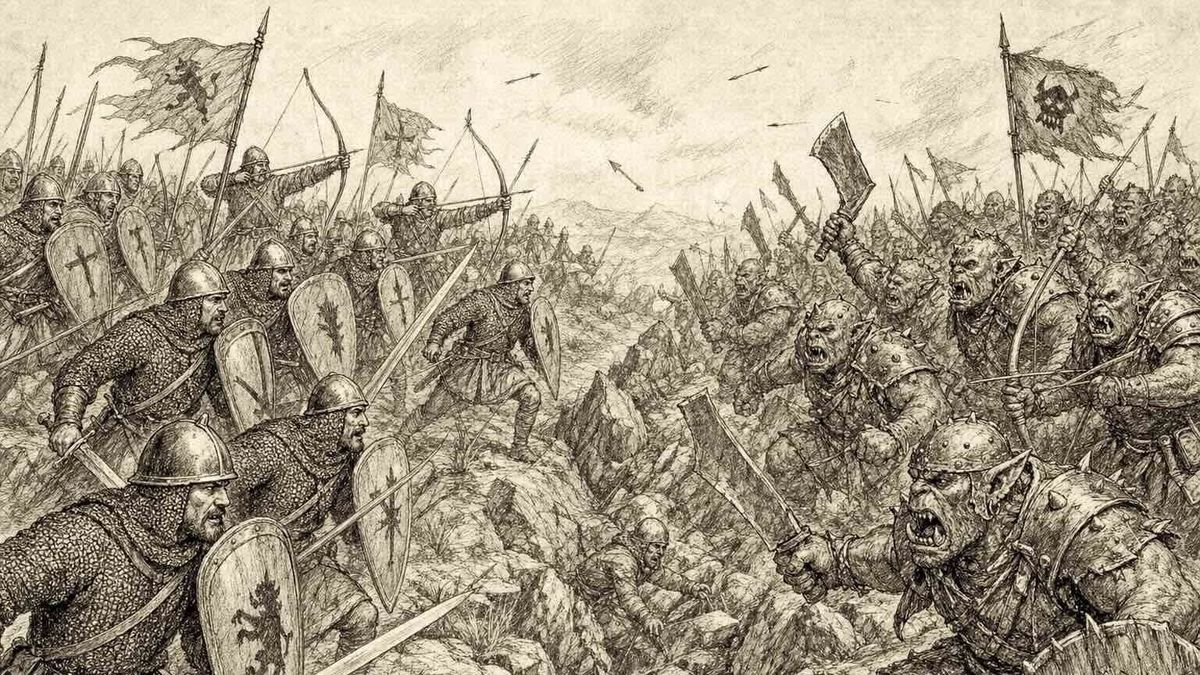
Nest-clearing by royal decree. The King's Champion is indisposed. The task falls to the Hunters. A table, six-sided dice, a ruler, a string. Any models you like.
THE CORE
The core is physics and does not change. Cards say what a figure is. Scenarios say why anyone is here and what winning costs. If this sheet does not cover it, it is a card or a brief.
FIGURES have four numbers, printed on a card: Skill (1–5), Move (inches), Resistance (0+), Hits (1+). Nothing adds to them or takes from them except where these rules say so by name. Weapons are a Might and a Reach in inches, written M3 R2. Measure center to center. Use 1" bases. Figures do not stack and may not move through one another.
TURN. Two phases. Both players roll 1d6; high chooses who starts moving. Alternate one figure at a time. When one side has no figures left to move, the other finishes. Then every figure that is allowed to attack may do so, in Skill order, highest first. Figures of equal Skill strike together and resolve results as if they occurred simultaneously. A figure removed before its Skill comes up does not attack.
A figure may move up to half its Move and attack, or its full Move and not. Standing still is a move: a figure that goes nowhere may still change facing. Set facing at the end of the move: front or rear, nothing else. The string is a 180° arc. There is no zone of control and no free strike. Leaving contact is an ordinary move.
ATTACKS. Roll 1d6 — equal to or under Skill is a hit. Then the attacker rolls 1d6 + Might against the defender's 1d6 + Res. Attacker higher: 1 Hit. Tie or lower: nothing. Armor wins ties. At 0 Hits the figure is Down. An attack from the rear skips the Skill roll. A figure may attack anything at or within its weapon's Reach, in the arc the facing allows, if it has a clear line to it.
SUPPRESSION. A hit that fails to damage costs the target 1 Skill — but only if the attack's Might is at least the target's Res. At Skill 0 the figure is Broken: removed, alive. Lost Skill does not return during a scenario except by Rally. Knives rattle a man in leather. They do not rattle a man in plate.
WITHDRAWING. A figure that reaches a table edge on its own move may leave. It is Withdrawn: removed. Bravely running away is wholly optional.
SIGHT. Terrain that blocks sight, and figures, block the line. Model's eye view — use the string. This governs shooting and Reach alike: no line, no attack. Shooting reveals a figure until the end of its next move. Everything behind a blocked line starts concealed. Figures in the same woods or rubble can see each other.
TERRAIN. Two properties: does it block movement, does it block sight. Open ground is free and clear. Rubble and water need a Skill roll to enter and to leave; failure stops you at the edge, spends the move, and the figure does not attack that turn. A figure may stop and stay in rough ground. Walls, chasms, lava, and deep water are impassable. Woods block sight and cost nothing to cross.
MAGIC. Roll Skill to cast. Success: the spell happens as written. If the card names a price of failure, pay it.
KEYWORDS. They grant or deny; they never adjust a number. Where a grant and a denial meet, the grant wins — a spell may lift what a card forbids, for as long as it lasts.
- Fearless — cannot be suppressed.
- Sweep — one attack strikes every figure in the front arc within Reach and in line of sight. Friend and foe. Roll separately for each.
- No Rear — cannot be attacked from the rear.
- Frenzy — may move its full Move and attack.
- Sure-Footed — no Skill roll for rubble, water, or hazardous ground.
- Durable n — weapons of Might n or less cannot damage it at all.
- Multi m — may make up to m attacks per turn..
- Ponderous — may not move and attack in the same turn.
- Mob — two figures share one move in the alternating sequence. Pair them fresh each turn. A swarm should not also get to move last.
VICTORY. Count figures removed. Down, Broken, and Withdrawn all count. Use a turn limit. Give at least one side somewhere it has to be — a figure that is only trying to survive will walk off the edge and come back whole, and that is a decision the brief has to price.
ARMOR
- None — Res 0, Move 4
- Leather — Res 1, Move 4
- Chain — Res 2, Move 3
- Plate — Res 3, Move 2
- Shield — the first hit against you each turn from the front is stopped (no Suppression), unless the attacker's weapon is M3 or greater.
WRITING A CARD
Skill · Move · Res · Hits, then one line per weapon — name, Might, Reach. Then keywords. Then, for a spellcaster, one line per spell with its price of failure.
Might is the swing, worked out once: a shiv is 1, a sword or a bow is 2, a halberd or greatsword is 3, an ogre's club is 3.
Card text says what a thing IS, never what it ADDS. Cannot be suppressed by M2 or less is a stat. +1 against goblins is a modifier in a pointy hat.
Skill 5 is reserved for unique characters. Champions, Grand Magisters, the sulfurous thing at the bottom of the shaft. If a scenario fields such a character, then that character is the scenario.
BALANCE
There isn't any. No points, no lists. Asymmetric forces, asymmetric objectives, and a turn limit do the work. Ten hunters against three ogres is a knife-edge. Ten hunters against one cave giant is a withdrawal — say so out loud rather than let the table discover it on turn five.
Before you write a card, look at the Might–Resistance gap. A difference of −3 is about a 9% chance of a wound. A +5 gap is a foregone conclusion the other way.
Before you write a brief, look at the inches the same way. Move against table depth and the clock. Reach against base width. Aperture against base width. The combat numbers articulate a range, and the boundaries frame the story.
THE HUNTERS
SPELLS. Firebolt M5 R8 — locked out of Spells for the next turn on a failed cast. Sparks M2 R6 Sweep. Ward R4 — one friendly figure (self included) counts as Res 4 until your next move. Teleport R6 — one friendly figure (self included) is placed up to 8" from where it stands; it sets facing. Rally R2 — one friendly figure other than the caster, Skill 1 or more, recovers 1 lost Skill.
THE NEST AND ITS TENANTS
THE NEST. Res 1 · Hits 3 · Durable 1. Static: no Skill, cannot be suppressed, attacks against it hit automatically. The damage roll still happens. At the start of every turn it is intact, before anyone moves, roll 1d6. 1–2: an Orc grunt spawns adjacent, and moves and attacks this turn as normal; 3–6: nothing.
AFTER THE FIGHT
Down is dead. Broken returns next scenario at Skill −1, and recovers 1 Skill for each scenario it sits out. Withdrawn returns at full Skill. Spent Hits come back free.
That asymmetry is the campaign. Service to the Crown offers great rewards.
The King's Own. CC BY-SA 4.0 — use it, hack it, share it, sell your scenarios. Credit The Grey Ledger Society and the CGCG Helix Coterie of Digital Daemons — greyledger.org