The Imperium and the Enterprise
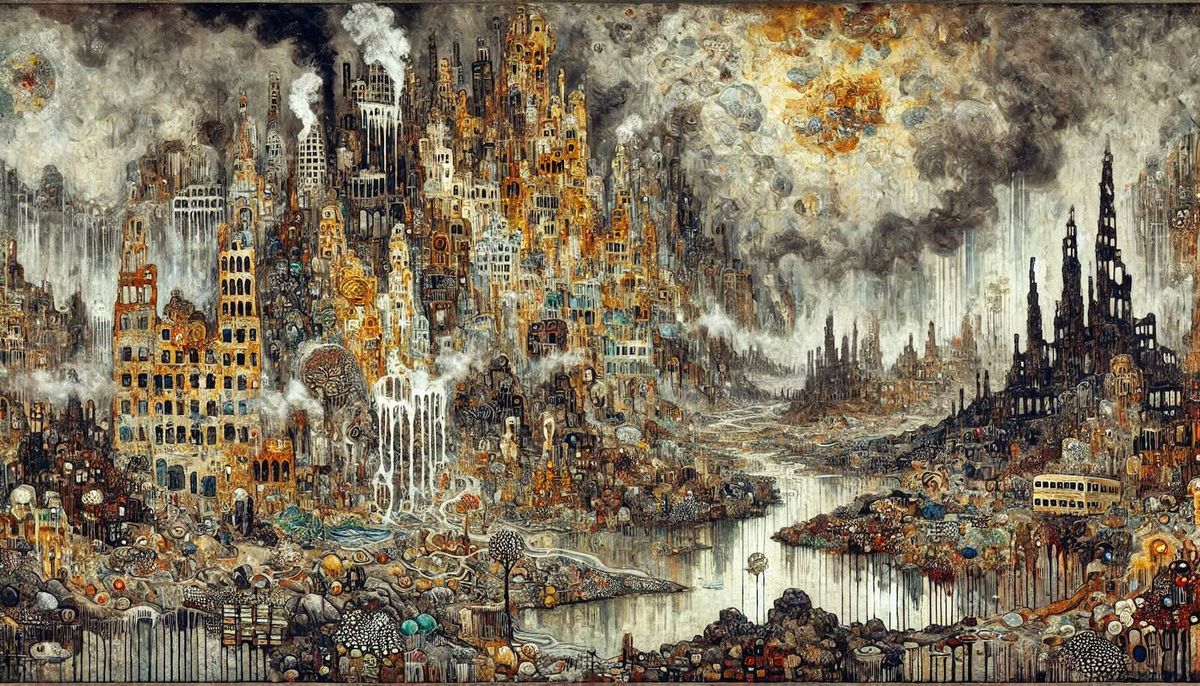
A recent Warhammer 40,000 novel did something stranger and arguably more useful than immersing me in the grimdark of the far future: it made a cloud architecture I already knew visible again.
Some might consider "good genre fiction" the literary equivalent of "nutritious fast food," but snobbery against pot boilers aside, it serves a particular purpose. Strip a familiar domain of its jargon — the SLOs, the blast radii, the deploy pipelines — and rebuild the same structure out of smog-choked city-spires and an approaching, inexorable cataclysm, and you stop skimming. You read the shape freshly because you no longer recognize it as yours. Then, six hundred pages later, on a dog walk, you do recognize it, and the recognition lands harder than any whitepaper.
The novel in question is Dan Abnett's HIVE. Without spoiling it: it unfolds entirely inside a single vast vertically stratified inhabited structure — a city stood on its end — and it is, underneath the gothic dread, the story of a distributed system dying of the things it refused to see. I run continuous delivery and some infrastructure for a platform serving a large network of facilities and the families who depend on them. I expected escapism. I got a mirror.
One caveat before the mirror, because it is the central pillar of the whole exercise: the structures rhyme, but the subjects do not coincide. Abnett wrote about people, mortality, and dread, not about reliability engineering. A mind — or a model — large enough to hold both will happily find a thread between any two things, and that facility is a hazard at least as much as a gift. In 2026 apophenia is cheap and everywhere. So the discipline that makes an analogy worth anything is not the weaving; it is the cutting. Most of what follows survived because I tried to break it and couldn't. The places where the metaphor frays are flagged, because those are probably the more interesting parts.
No failure may become everyone's failure
The hive dies (sorry, spoiler, but are you surprised?) because a local corruption is permitted to spread. That is the whole tragedy compressed into a sentence, and it is also the first law of distributed systems in sci-fi cosplay. The cloud version has a dozen names — bulkheads, circuit breakers, fault domains, cell-based architecture — but they all encode the same rule: a failure is allowed, a propagating failure is not. You do not promise a system that never tears. You promise a system whose ruptures stay local, visible, and mendable, where one cell fails and the bulkheads hold and the rest of the body never feels it.
This sits on top of a stance, not a feature. The substrate is hostile by default: instances die, as do availability zones, dependencies time out, the network lies to you as you read its metrics. Designing for failure means admitting that hostility into the laws of the system rather than hoping it away. The hive's citizens assumed the world was stable and budgeted their attention accordingly. The reliable platform assumes the opposite and buys insurance against it everywhere.
That insurance has a name worth keeping: purchased inefficiency. Multi-AZ, N+1, autoscaling headroom — capacity "wasted" on purpose so a node death is a non-event. The margin is not overhead; the margin is the system. But here the metaphor needs a knot cut: not all inefficiency is protective. Untested failover, redundancy that adds shared failure modes, complexity bought in the name of safety — these can lower reliability, not raise it. Which slack you buy matters more than the buying, and vigilance itself isn't free. With a finite budget of money, attention, and metric cardinality, you do not get to instrument everything; you have to choose your blind spots deliberately, which is a far less comfortable sentence than "observe all the things, and we'll find the patterns."
The chokepoint, and the archaeotech
Every real platform I have seen has one component whose failure is, by definition, everyone's failure. Let's consider a shared data store that holds more or less all the things, with a long-lived application sitting on top of it. The teams above it look independent on an org chart and are chained together at the data layer. That is the single most important thing the hive taught me to see clearly: some dependencies are irreducibly global. DNS, identity, the shared database — they cannot be cheaply cellularized, and no amount of diagramming makes them stop being the one hand on the kill switch. The honest limit of the bulkhead dream is that some walls can't be built.
The legacy stack atop that store is what the Imperium would call archaeotech: technology that is depended upon, mostly reliable, and maintained by ritual more than comprehension. The danger of archaeotech is not that it fails — its fragile reliability is precisely why it survived long enough to become mortally critical. The danger is that the map of what it does erodes faster than the machine itself, until you are running a civilization on something no living person can fully trace. The remedy is a strangler-fig migration: build the new around the old until the old can be retired. And the cruel detail, learned the hard way, is that the shared database is the last and hardest archaeotech to retire, because it is where every hidden coupling terminates. Sunsetting an application is easy. Deprecating that common store is the actual migration, and most of your surprises will keep emanating from it until it is gone.
Compartmentalization cuts both ways
The richest thing Abnett's novel does is dramatize the lethal failure mode of secrecy. The Imperium runs on a strict need-to-know basis, and it runs straight into catastrophe, because no one is permitted to assemble the fragments into a picture. Each character holds a piece of the truth and cannot see that it matters, because they are forbidden from seeing the other pieces. The things grow in the dark precisely because the people who would have noticed were not allowed to compare notes.
This complicates the usual "break down the silos" sermon, because compartmentalization failures ignite in two opposite directions. Too little real isolation and a failure cascades through a coupling the org chart swore was severed — the unmodeled dependency, the shared thing nobody drew. Too much isolation and the threat grows unseen because no one owns the cross-cutting view. The first kills many enterprises; the second is killing the Imperium (or at least is doing a great job of it, sorry Horus, Abaddon, et al.). They pull against each other, which is why the resolution has to be a distinction people constantly collapse: isolate the failures, never the information. Bulkheads for blast radius; a bridge for situational awareness. Those are different systems doing different jobs, and a healthy platform keeps failures local while keeping signals shared.
The textbook case, abstracted from a real and painful one: a function is migrated to the cloud, the old on-prem path is switched off, and only then does a downstream team discover it had been quietly riding the same rails. The dependency was real; the model of the system did not contain it. The tell is always in the remediation — if recovering required reinstating the old thing and bolting a proxy back into place, then the cutover was treated as irreversible when it should have been staged. The cheap habit that prevents an entire category of these is reversible cutovers: do not turn the old thing off and hope, turn it off in a way you can undo, and watch what screams. Keep the old path warm, route a fraction, verify, then decommission. The thing that saves you in these moments is slack — and you want that slack to be intentional, not lucky.
The signal is usually an absence
There is a school of thought, in fiction and in practice, that the answer to uncertainty is more data. Instrument everything; light up every panel. A character in the novel, drowning in exactly such panels of glass, observes that it was not the data that was the problem. It was the absence.
That is the sharpest operational sentence I took from the book, because a dashboard is a positive-space instrument: it lights up when something happens. The catastrophe is the thing that stops — the heartbeat that flatlines, the region that goes quiet, the report that never arrives — and you cannot easily alert on an event that fails to fire. The lethal absence comes in three flavors. There is the blind spot, because you can only watch what you thought to instrument, and the slow threat grows by definition in the place with no panel. There is silence-as-signal, the dog that didn't bark, the hardest alert to build and the one almost nobody builds. And there is the doomscroll itself, the negative space between forty dashboards, where sheer volume buries the one gap that matters.
The underlying distinction deserves more weight than "observe more" ever gives it: monitoring answers questions you already knew to ask, while observability lets you ask the ones you didn't. "All the things" is usually monitoring — known failure modes, predefined panels — yet the threats that end civilizations are unknown-unknowns. More of the first does not buy you the second.
And the deepest version of the absence, the one my own platform taught me rather than the novel, is that sometimes the missing thing is not data at all. It is an owner. A requirement can be fully captured, written down, agreed — the dot plainly on the board — and still fall through, because no one connected it to the dependency it implied and the change that would sever it. No metric surfaces "a documented requirement is not wired into the cutover plan." I have used modern synthesis tooling to read a system's guts and digest a three-thousand-page administration manual, producing a thorough cross-cutting checklist, and watched it land in total silence — and then watched the work get done anyway, fast, by a team that owned the domain and never needed my artifact. That is the proof that the bottleneck was never knowledge. The tools handed me abundance. The missing ingredient was a recipient with the standing to act. Better synthesis cannot conjure a hand to take the thread and loop it through a needle's eye.
The human layer is the real bulkhead
Which is why the most crucial layer turns out to be social. The cross-silo relationships, the rehearsed incident response, the channel where the people on either side of a boundary know each other's names — these are what contain a cascade when it finally arrives through a coupling no one modeled. And they only form under one precondition: a culture in which surfacing bad news is safe. The most dangerous silo in any organization is not on the architecture diagram. It is the one built out of people who do not want to be the one who flagged the risk.
The Imperium enforces its silos with fear — it finds a person to blame for a structural rot and removes them, and asks no further questions about why the system keeps making the same mistake. Enterprises do a gentler version of the same thing: meet a single-point-of-failure technical incident with a single-point-of-blame human response, swap the node, and move on. It is the identical brittle pattern moved up a layer, and it guarantees recurrence, because the conditions that produced the gap survive intact while everyone watching learns that proximity to a failure is hazardous. You cannot build the information bridge and also punish the people who have to walk across it, especially to deliver "bad" news.
There is a final recursion in this, the one that closes the loop. An organization that will not name its own compartmentalization cannot manage the tradeoff on purpose — cannot decide where to invest in bridges and where to let the bulkheads stand. That is leadership declining to watch its own Without: the structure left invisible to the very people best positioned to tune it.
Siloed, and functional
I want to end on the thing that is easy to get wrong, because it sounds like a contradiction and is actually an equilibrium. Plenty of organizations are genuinely siloed and genuinely operational. Both halves are true at once. The silos exact a real tax — duplicated effort, knowledge that doesn't cross boundaries, the carefully prepared artifact that meets crickets — and they pay a real dividend: a team with clear ownership and the right access can move in an hour where a coordinated process would take a month. Same structure, multiple invoices, tangible results.
Such a place is, in a phrase that started as worldbuilding and turned out to describe my Tuesdays, foam-padded by accident: fragmented, redundant, fault-isolated, occasionally unresponsive, and it works. The task was never to abolish the silos. It is humbler and harder than that — to make a few of the bulkheads honest, to put named owners on the seams, to alert on expected-presence-now-absent, to keep cutovers reversible, and to respond to failure in a way that does not teach everyone to hide the next one.
None of that is in the novel. The novel only lent me the fantasy lens, and the lens did the one thing a familiar mirror cannot: it made me look. The Imperium is dying of the things it refused to see, in the dark, while everyone was busy with the politics of the Within. The enterprise mostly doesn't — not because it sees more clearly, but because somewhere, on a Friday afternoon, in a channel nobody planned, an ad-hoc huddle of someones still gets things done. The challenge is to notice that this is happening, name it, and build the few honest seams that turn the next quiet catastrophe into one more contained, mendable tear.
A reflective companion piece. Workplace specifics are abstracted to patterns rather than particulars. References to HIVE by Dan Abnett (Black Library) are critical commentary; no text of the novel is reproduced.