The Easy Part and the Hard Part
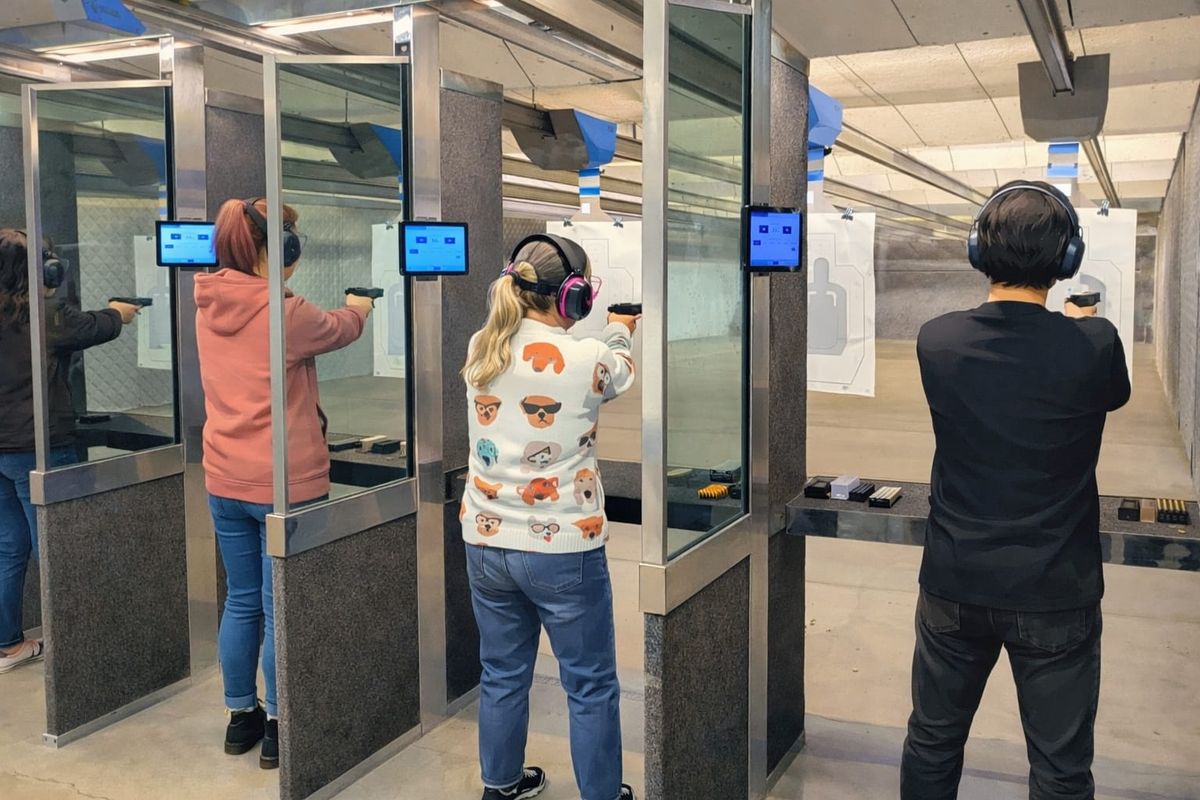
The Clackamas County Sheriff's Office operates a well-furnished public gun range just outside Portland, Oregon. Given the city's reputation as a liberal bastion, its existence feels, at first glance, slightly implausible. And yet it's there, within easy driving distance, offering a four-class defensive handgun curriculum that is described—without much hedging—as equivalent to what state police cadets receive at the academy.
I didn't find the Public Safety Training Center because I was looking for it. In 2019 I needed fingerprints for a background check required by the U.S. Senate for a work project, and a colleague suggested the PSTC as a convenient option. I made an appointment, walked in, and immediately noticed three things: they had a gun range; they offered defensive handgun classes; and for the introductory course, they would loan you a firearm. That last detail mattered more than I realized at the time.
Eighteen months and an uncomfortable number of ammunition cases later, I had completed the full handgun sequence—101, 101A, 102, 103—and an off-catalog class reserved for prospective range coaches. Before that first 101 course, my only formal firearms training dated back to Boy Scout summer camp and a bolt-action .22. I tell people I've never harbored John Wick fantasies; the PSTC didn't teach me any of that, and I've still never sat through an entire John Wick movie. What they did teach—thoroughly and repeatedly—were the four firearm safety rules, until they were etched deep enough to feel reflexive. If nothing else, they taught me how not to become the next cautionary headline.
I've now been coaching intermittently for about three years. That role required clearing a background check more stringent than a standard firearm purchase, though not as exhaustive as what sworn law enforcement officers undergo. Due diligence is still due diligence. More importantly, coaching placed me in an unexpected position: helping people take their first steps into a skill that is simultaneously easy to misuse and difficult to wield responsibly.
There's a scene in one of the Mission: Impossible films where Tom Cruise hands a Beretta 92 to someone who has never fired a gun and says, "It's point and shoot." I reflexively roll my eyes every time I see that clip—and yet, uncomfortably, he isn't wrong.
It is ludicrously easy to shoot someone. Including yourself. The statistics on negligent discharges and firearm suicides make that plain enough without embellishment. Align muzzle, press trigger. The mechanics are trivial. So trivial, in fact, that Jeff Cooper devoted fully half of his four safety rules not to marksmanship or tactics, but to keeping the muzzle pointed somewhere sane and the trigger finger somewhere else.
What is not trivial—what requires sustained effort, repetition, and restraint—is the responsible and accountable handling of a firearm, and the lawful application of deadly force that may follow from it. That gap between mechanical ease and moral legitimacy is where most of the real work lives. It is also where most training either succeeds quietly or fails catastrophically.
The weekend before the COVID lockdowns went into effect in 2020, I stopped by a local gun shop mostly out of curiosity. Every third person who walked out was carrying a branded cardboard box, held tight against the chest as if it were simultaneously precious and terrifying. Cue the hangman meme: First time?
What I couldn't stop thinking about were the people who had just acquired a firearm for whatever reason—fear, uncertainty, rumor, politics—and would go no further than the transaction itself. No safety briefing. No instruction. No slow introduction to what they'd just brought into their homes. To this day, I hesitate to tally the downstream consequences: negligent discharges, self-harm, domestic violence incidents, stolen weapons that later reappear at crime scenes. Not because those outcomes are rare, but because they are depressingly predictable when capability outpaces responsibility.
There's no Holden Caulfield fantasy here—no belief that you can run around saving people, or play John the Baptist shouting that everyone needs more training. That posture doesn't work, and it isn't honest. Most people don't want to be preached at, and institutions don't change because someone yells loudly enough.
But when a local institution makes a genuine effort to provide that training—when the doors are open, the rules are clear, and the intent is plainly about safety rather than spectacle—it becomes harder to justify standing entirely on the sidelines. At that point you shrug a little, remind yourself that the best way to truly know something is to be able to teach it, and you show up. Not to fix people, but to catch small failures before they cascade: a wandering muzzle, a trigger finger that forgot where "home base" is supposed to be.
As I've already suggested, guns are ludicrously easy to fire, but far less obvious to operate well. I remember my first encounter with a Glock 19 during my 101 class, trying to manipulate the slide lock while keeping the muzzle downrange and my trigger finger indexed on the frame. It felt like one of those coordination tests: stand on one foot while tapping your head and rubbing your belly.
Then there was the two-handed grip—nothing like the old "cup and saucer" you might have absorbed from movies—and the stance: nose over toes, wrists and elbows locked, but without resorting to the kind of death grip that reliably sends rounds low. Put it all together and what initially looks simple turns into a small, full-body choreography. Suddenly a Bikram yoga pose doesn't seem so demanding by comparison.
Anyway, as overwhelming as that checklist of "doing it correctly" can be, I've come to think the most important takeaway for a 101 student is much simpler: the ability to load, fire, and unload a firearm without a negligent discharge. The yoga pose can be introduced gently, but only after fundamental safety practices are firmly established. Being able to place shots on paper matters too—but it comes second.
Over the number of classes I've coached, I've watched a consistent pattern emerge. Thanks to a combination of well-designed training methods and modern firearm ergonomics, a person who has never touched a gun before can reliably land twelve rounds into the center-of-mass of a paper target at distances between three and ten yards, without committing a single safety violation. On one hand, this is a genuine marvel of pedagogy and engineering. On the other, it is a quietly terrifying demonstration of how little time it takes to bring someone up to functional speed with a lethal tool.
It's also worth naming the role of privilege in all of this. Not everyone can simply decide to take a class like this. A full-day commitment, a few hundred dollars once ammunition is factored in, reliable transportation, comfort entering a law-enforcement facility, and should you progress beyond 101, the ability to pass background checks without complication all function as quiet prerequisites. None of those are distributed evenly.
That filtering cuts both ways. On one hand, it selects for seriousness and intentionality. On the other, it ensures that access to structured training — and therefore to the habits that make restraint more likely — is itself a form of advantage. The people most able to pursue responsibility are often those already buffered by time, money, and institutional trust. Meanwhile, firearms circulate far more widely than the opportunity to learn how to handle them safely.
Like the adherents in Vonnegut's Cat's Cradle, we all play our parts and do what we can. In that sense, the range coach is hardly alone. The Everytown activist, the Firearm Policy Coalition staffer filing injunctions, the suicide prevention counselor, the gun shop owner who refuses a sale, the local Pink Pistols organizer, even the self-styled militia member convinced collapse is imminent—all are responding to the same device, the same risks, the same asymmetries. They share no cosm, no politics, and often no trust. But like the Bokononists, they perform their small rituals anyway, hoping to keep catastrophe at bay, or at least to feel less complicit in it.
I'd just gotten back from a Sunday spent shoring up the instructor-to-student ratio at the range, and later that evening—while listening to a Movietone album Nancy had cued up—I found myself thinking again about why I keep coaching.
I want to remind folks that racking and locking a slide is not intuitively obvious. That holding a controlled explosion two feet from your face will freak out your lizard brain. That combining the chain of motions—grip, stance, presentation, sights, trigger press, follow-through—is hard. That every bullet you send out into the world has a lawyer attached to it. And that you'll win every gunfight you don't get into. I want to reassure the 101 students that it's all okay.
I'm not writing to claim moral authority, or to suggest that coaching resolves the contradictions baked into firearms culture, training, or access. It doesn't. But within a system that moves people quickly toward capability and far more unevenly toward judgment, being present, attentive, and willing to slow things down still feels like a worthwhile way to spend a few weekends a year.