The Crater and the Field
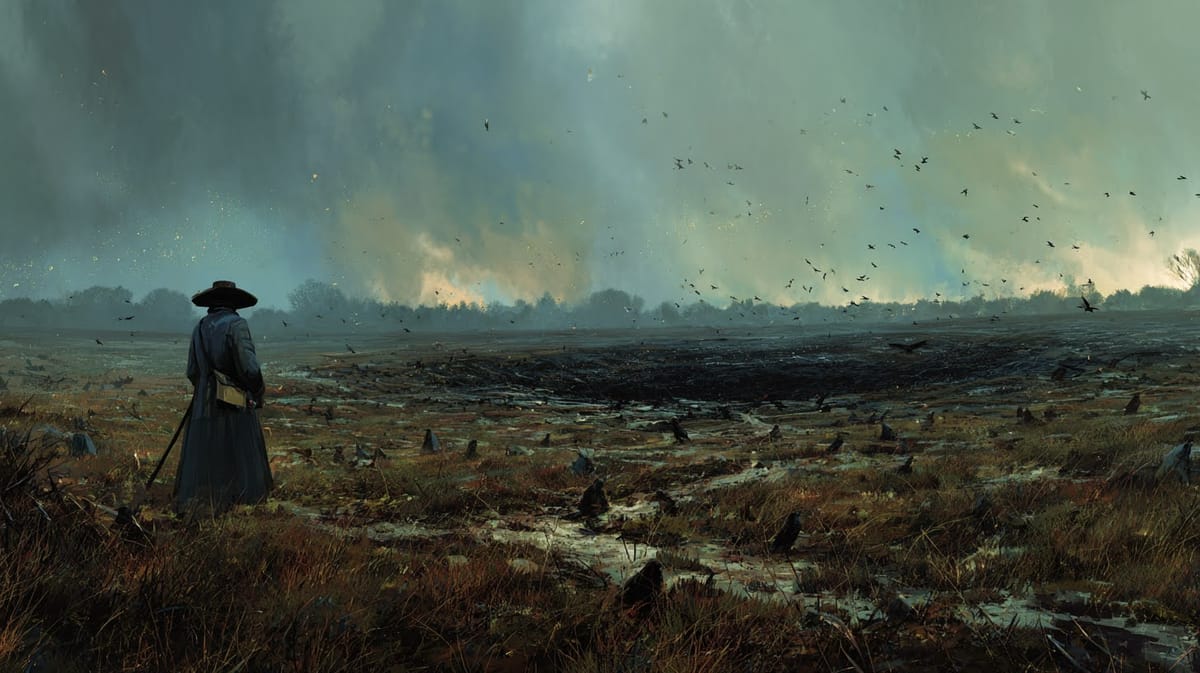
A Scenario for Black Powder & Brimstone
TONE & DESIGN PHILOSOPHY
This scenario sits at the intersection of pike-and-shot desperation and cosmic intrusion. The reference point is A Field in England — men ground down by war, stumbling into something older and stranger than any army, becoming complicit in something they don't fully understand until it's too late.
Combat is available but rarely wise. The real engine is curiosity, negotiation, and the slow erosion of judgment that happens when a calm man in a ruined field keeps being right about everything.
Characters in Black Powder & Brimstone die quickly and unpredictably. This scenario treats that as a feature. The players should feel that the Penitent's protection — his knowledge, his fire, his quiet warnings — is one of the only things keeping them alive. Which is true. Which is the trap.
THE PREMISE
A battle has just ended badly. The PCs are loose in the countryside, cut off from whatever army or allegiance they served, trying to survive. The road takes them past a field where something fell from the sky during the fighting. At the center of that field is a crater. At the center of the crater is a man who has been waiting — possibly for them specifically.
His name, if asked, is Brother Casimir. He was a soldier-monk of the Orthodoxy. He is no longer entirely that.
ACT I — THE ROAD
Opening
Before the players make a single decision, establish the world they're moving through.
Read or paraphrase:
The battle is behind you. You know this because you are alive and moving away from it. The smoke is still rising — three columns, maybe four — and the crows are already working the field where the cavalry broke. Somewhere north, cannon. Somewhere east, nothing. The road ahead cuts through farmland that someone planted and no one will harvest.
Ask each player individually why their character is on this road. Give them options if they hesitate:
- Routed by cavalry, separated from the unit
- Wounded and left for dead, now ambulatory and furious
- Deserting, which is a death sentence if caught
- Separated during chaos, technically still loyal, practically abandoned
These origins matter later. The deserter has the most to lose from the army patrol. The wounded character has the most reason to accept the Penitent's hospitality.
Soft Encounters
These are not fights. Run them as brief scenes. Their purpose is psychological priming.
The Dying Soldier
He's propped against a milestone. One leg is wrong. He's been there long enough that he's stopped hoping for rescue and started hoping for water.
If the players give him water or any basic kindness, he talks. His name is unimportant. What matters:
"There's a field about a mile on. Don't go into it. Something fell there during the bombardment — not shot, not shell. Something else. The men who went to look didn't come back wrong, they just… came back different. Quiet. Following that man around the crater like dogs."
He may carry a small object — a religious medallion, a folded letter, a fragment of something metallic that hums faintly if held near the ear. This is the relic hook. He found it near the field and has been unable to throw it away. He'll give it up easily. It frightens him.
If the players don't stop, he calls after them: "Don't go into the field."
He'll be dead when they pass back this way. The medallion will be gone if they left it.
The Looter
Stripping a corpse with professional efficiency. Not ashamed. War is war.
He's cheerful until the field comes up. Then something closes in his face.
"I've picked clean three fields this week. That one I won't touch. The earth there whispers. I don't mean that as poetry. I mean the ground makes a sound."
He has no other information. He doesn't want any. But he's observant — if the players seem to be heading toward the field, he studies them with something between pity and curiosity.
He will reappear as a possible candidate for Quest 3. The players will remember this conversation.
The Deserters
Two soldiers. One wants to go back to the army and take his punishment. The other refuses.
The argument is quiet and vicious and has clearly been going on for hours.
The one who refuses: "Better the gallows than that field. I saw what came out of it."
He won't say what he saw. Not because he's being dramatic — he genuinely can't find the words. He makes a shape with his hands that doesn't correspond to anything.
The one who wants to return will go. The one who refuses will still be in the area later. He's made camp in a ditch a quarter mile from the field's edge. He watches the crater at night. He's been watching it for two days. He hasn't slept.
ACT II — THE FIELD
Approach
The field announces itself before they reach it.
The grass at the edges is burned in a wide arc — not scorched the way fire burns, but bleached, as if drained. Closer in, the soil is disturbed in patterns that don't match any crater the players have seen from cannon fire. The impact came from above, not from the side.
Metal fragments in the soil. Not iron. Not anything they have a word for. Lighter than it should be. Warm despite the cold air.
Plants growing at the crater's edge are pale and fast. Too pale. Too fast.
Animals avoid the area entirely. The crows that are working every other part of the battlefield are absent here.
The silence is specific. Not peaceful. Deliberate.
The Crater
At its center, roughly forty feet across and fifteen deep, with walls that are smooth in a way that erosion doesn't explain.
Something is at the bottom. The players can't quite resolve what it is from the rim. It's large. It's partially buried. It's not a rock.
And Brother Casimir is standing beside it, looking up at them, as if he's been expecting them for exactly as long as they've been walking.
Brother Casimir — First Impression
He was a soldier-monk. The Orthodoxy trained him. This is visible in his posture, his economy of movement, the way he takes in the group without appearing to look at anyone directly.
He has been altered. This should be felt before it's understood. His eyes catch light strangely. The star fragments embedded in the crater walls seem to orient toward him slightly when he moves, the way iron filings move near a magnet. He doesn't seem to notice. Or he's stopped noticing.
He is completely calm. In a context where calm is wrong, this reads as authority.
He does not reach for a weapon. He does not move to block their approach. He simply waits, and the waiting has weight.
When they're close enough:
"You've come a long way to arrive exactly where you were meant to."
He doesn't explain this. He lets it sit.
"My crater," he adds, with the particular tone of a man who is not threatening anyone, who simply finds ownership self-evident.
Then, before they can respond:
"You look hungry. Come away from the rim — the edge isn't stable yet."
The Camp
Twenty feet from the crater's edge. A fire. Boiled roots. Clean water from a covered vessel. A lean-to built with the efficiency of someone who has camped in bad conditions for years.
Small generosities. Real ones.
The first conversation should feel almost normal. He asks where they came from. He listens. He offers information in return — where the patrols are running, which roads are clear, where the Inquisition has set up its checkpoints. This information is accurate. Players who test it will find it reliable.
He doesn't ask them to do anything yet.
He lets them stay the night.
The First Night
One player — whoever drew the short roll, or whoever the GM feels is most interesting to target — has a dream.
It's not threatening. It's almost beautiful. A light descending. A sound like a chord played on an instrument that doesn't exist. A sense of something very large becoming aware of something very small, with something that might be tenderness.
They wake with a wound that has healed slightly faster than it should.
Casimir, if asked, says only: "The star has noticed you."
He does not elaborate. He does not seem concerned.
ACT III — THE QUEST CHAIN
The Principle
Each task should feel reasonable when it's offered. The escalation should be gradual enough that players find themselves committed before they've identified the moment they should have refused.
The crater keeps developing whether the players help or not. If they refuse a task, the scenario continues — Casimir works alone, and the players watch the situation escalate without them. This preserves agency. It also means that refusing to participate is itself a choice with consequences.
Quest 1 — Retrieve the Relic
The Ask
Casimir mentions, with no particular urgency, that something came down with the star. Separated during the impact. It will have been found by now — the battlefield scavengers are thorough. He'd like it returned.
He describes it. It matches what the dying soldier was carrying.
The reward is information — the safest route south, the location of a cache of provisions left by a retreating unit, whatever the players most need.
"A fair exchange," he says. "I need the object. You need to survive. Neither of those things is unreasonable."
The Battlefield
The relic is findable. The path to it is not comfortable.
Star fragments are embedded in the corpses near the crater's blast radius. Not deeply — just beneath the skin in some cases, as if drawn there. Animals still won't enter the zone. The players will notice this before they understand why.
The relic itself — the medallion, or whatever form it takes — hums at a frequency that sits just below hearing. Holding it produces a mild warmth. It's not unpleasant. It's worse for not being unpleasant.
The soldier who had it is dead. Someone else has it now — a camp follower, a scavenger, another deserter. The retrieval involves a negotiation, possibly a small conflict, possibly simply money.
Return
Casimir receives the relic with the careful attention of a man handling something sacred. He thanks them. He pays what he promised.
Then he places the relic at the crater's edge and begins drawing diagrams in the soil around it. He doesn't explain the diagrams. If asked, he says he's taking measurements.
The diagrams are geometric but wrong — they resolve differently depending on the angle from which they're viewed.
Quest 2 — Dig the Crater
The Setup
A day later, Casimir explains that the relic has revealed something beneath the impact site. Something that came down with the star but went deeper. He needs help to excavate it.
He offers more than fair compensation. He's matter-of-fact about the work.
If They Refuse
Casimir digs alone. It takes longer. The players watch, or they don't.
At night, lights appear in the crater — not fire, something colder. The earth shifts on its own. By the second day, a section of the crater wall collapses inward revealing a tunnel regardless.
The players now face a question that has nothing to do with Casimir: do we investigate, or do we leave something unknown behind us?
OSR players who short-circuit the quest chain will find the crater doesn't require their help. It just requires their presence.
If They Dig
The excavation takes most of a day. What they find, in layers:
- More star metal, in larger pieces, warm to the touch
- Bones. Human bones, but fused at the joints in ways that suggest heat, or pressure, or something else entirely
- Cavalry armor fragments among the bones. Old cavalry armor — older than this war
- The tunnel. Narrow, smooth-walled, descending at an angle that suggests it wasn't dug from above
The tunnel breathes. Not metaphorically. Air moves in and out of it in a slow rhythm.
That Night
Everyone has the dream now. It's less beautiful this time. The large thing that noticed them before is closer. It's still not threatening. It's curious in the way that something enormous can be curious about something very small — with complete attention and no particular care for the small thing's continued existence.
Whispers at the edge of sleep. Cold patches in the air near the tunnel entrance.
One player's metal equipment — a buckle, a blade, a flask — vibrates faintly and continuously until they move away from the crater.
Casimir sleeps perfectly. Or doesn't sleep at all. It's hard to tell.
Quest 3 — Bring a Captive
The Ask
This is where the mask slips slightly — not Casimir's mask, but the scenario's.
He explains, with the same calm reasonableness he's used for everything else, that the next stage of his work requires a witness. Someone who hasn't been near the crater. Someone whose perception is uncontaminated by proximity.
He uses the word witness. He means it sincerely. He also means something else by it.
"I'm not asking you to harm anyone. I'm asking you to bring someone here. What happens after is between them and the star."
He doesn't elaborate on what that means.
The Candidates
The players have met all of these people:
- The looter, still working the edges of the battlefield
- The deserter in the ditch, who hasn't slept in three days and might come willingly
- A soldier from one of the patrols, which introduces significant risk
- An Inquisition scout, which introduces significant risk and significant narrative weight
Each choice has different moral texture. The deserter who comes willingly is different from the looter who's grabbed in the night. The players will feel that difference.
The Moral Tipping Point
This is the moment the scenario has been building toward.
By now the players have eaten Casimir's food, slept by his fire, used his information, retrieved his relic, possibly dug his crater. The first two tasks felt like fair exchange. This one doesn't feel like fair exchange. But they're already here. They've already helped build this.
Casimir, if pushed, says:
"You may leave whenever you wish."
A pause.
"But the war will still be there."
No threat. Just truth.
THE REVELATION
The ritual begins at the tunnel entrance at dusk.
It doesn't look like what the players probably expected. No circle of candles, no chanting, no theatrical horror. Casimir places the relic at the tunnel mouth. He speaks quietly in a language that predates the Church of Light by a considerable margin. The captive is positioned at the edge.
And then the players understand what they've been helping build.
The crater is not an impact site. Or it is, but impact isn't the right frame. The star didn't fall — it arrived. The crater is an opening. The tunnel is not a tunnel. The bones in the soil are from the last time this happened, however many centuries ago that was, and the cavalry armor was from soldiers who came to investigate, just as the players did, and stayed, just as the players have.
Casimir was not studying the star.
He was finishing what it started.
The thing beneath begins to move. The ground hums at a frequency that sits in the chest rather than the ears. The star fragments throughout the field begin to orient toward the tunnel mouth.
And Casimir, for the first time, looks something other than calm. He looks like a man about to see something he has been waiting his entire life to see.
Whether that's salvation or catastrophe he may not be able to distinguish anymore.
The Son
At some point during the ritual — ideally at the worst possible moment — a player who has been paying attention will notice the bones in the crater. Specifically the cavalry armor fragments.
Casimir, if confronted with this, is quiet for a long moment.
He says: "I had a son in the cavalry."
Then he returns to the ritual.
He doesn't explain. He doesn't need to. The players will carry that detail for the rest of the session. Some of them will carry it longer than that.
EXTERNAL PRESSURE
These forces arrive gradually, creating time pressure without forcing a specific resolution.
Army Patrols — Searching for deserters. They're methodical. They'll reach the field eventually. The deserter PC has the most to lose here. Casimir can make them go away, once, with a word. He doesn't explain how.
The Inquisition — Investigating witchcraft reports from the battle's aftermath. They're better resourced than the patrols and more dangerous. They will burn the site if they reach it during the ritual. They might burn it regardless.
Refugees — Families moving away from the battle zone. They pass along the road. They see the lights in the crater. Some stop. Some of them are exactly the kind of frightened, desperate people who might make the situation significantly more complicated.
These factions don't coordinate. They don't need to. The players are managing multiple closing timelines, which is its own kind of pressure.
ENDINGS
The outcome scales directly to how far the players helped the ritual progress.
The Ritual Never Begins
The players interrupted the chain early — refused Quest 3, drove Casimir off, destroyed the relic.
The Inquisition arrives and seals the site with fire and prayer. The crater fills in. The star fragments go cold.
The field is just a field.
The war continues. The players are still on the road.
But in the tunnel, which the Inquisition didn't find, something waits with the patience of something that has been waiting before and knows how to wait again.
The Ritual Begins But Is Interrupted
Something came through. Not much. Not the full thing.
A watcher. A fragment of attention. A whispering intelligence that has no physical form but has a location now — it's in the area, diffuse, curious, learning.
The players know they made this worse. The Inquisition will hunt it. They may be associated with its arrival. The looter, if he survived, saw something and is already talking.
The world is slightly worse than it was. The players did that.
The Ritual Completes
The crater becomes permanent. Whatever arrived is here now. It's not immediately destructive — it's not that kind of thing. It's more like a new fact about the world.
The war continues above it, around it, through it. Soldiers march past the field. The Inquisition sets up a cordon and calls it a miracle site. Casimir is gone, or is something else now.
The players are the only people who know what the field actually is.
That knowledge is its own kind of weight.
BROTHER CASIMIR
The key to Casimir is that he is not a villain. This cannot be overstated. He is a man who understands the deep laws of the universe more completely than anyone else in the scenario, and that completeness of understanding is precisely what makes him dangerous.
The model is the Duc de Richleau in The Devil Rides Out — a man of genuine warmth, real courage, and absolute certainty who invokes forces he fully comprehends, accepts that someone will pay the cost, and says thank God in the wreckage with complete sincerity. He's not wrong, exactly. He's not lying, ever. He simply understands that the angel cannot return empty-handed, and he has already decided who that will be, and he finds the necessity genuinely sorrowful and completely non-negotiable.
Casimir should feel like that. Not a manipulator. Not a deceiver. A man doing what must be done by someone who understands what must be done, which is a far more unsettling thing to be in a room with.
He is always working when approached. Measuring. Recording. Tending the fire. He is never theatrically idle — no dramatic silhouettes, no staring into the middle distance. The work is constant and largely incomprehensible and he treats it with the focused attention of a man who has very little time and knows it.
His prophecies are accurate because he genuinely knows things. Not because the star tells him, necessarily — because he is extraordinarily observant, deeply experienced, and has been in this field long enough to understand its patterns. Establish this early. Let players discover that ignoring his warnings has direct consequences. This is not a manipulation tactic. It is simply his actual relationship with reality.
He answers direct questions honestly. Every time, without hesitation. He simply doesn't volunteer the full picture unprompted. There is a difference between lying and not telling the whole truth, and Casimir lives entirely in that difference. If a player asks is this dangerous, he will say yes. If they ask could we die here, he will say yes. If they ask is what you're doing good, he will look at them with genuine consideration and say he believes so, which is the most frightening answer he could give.
The small generosities are real. The food, the fire, the clean water, the information about patrols — none of this is calculated. He helps them because they need help and he is capable of providing it. Richleau feeds his guests, tends his wounded friends, fights exhaustingly on their behalf. The warmth is not a mask over the coldness. Both things are true simultaneously. Casimir genuinely cares about these people and has already decided what they're going to help him do.
He already knows the cost. This is the Richleau insight that transforms the character. The Duc understood that invoking the Angel of Death meant a life would be taken — he invoked it anyway, and Mocata paid, and Richleau accepted that with the equanimity of a man who had already done the moral accounting. Casimir has done the same accounting. The ritual requires what it requires. Someone will pay what it costs. He finds this genuinely sorrowful. He proceeds anyway. When the players eventually understand this, they should have to sit with the fact that he told them the truth every time they asked.
The son lands quietly. Not as a dramatic revelation but as a brief aside — a momentary stillness while he looks toward the battlefield, a sentence, then back to work. I had a son in the cavalry. He doesn't elaborate. He doesn't ask for sympathy. Players who later find the cavalry armor in the crater bones will understand that the ritual and the grief are not separate things. He may be doing this partly for the son, under some logic the star has given him that no one else can fully follow. Or the star may have simply consumed that grief and given him certainty in its place. He would not necessarily know the difference anymore.
The line that defines him:
"You may leave whenever you wish."
A pause.
"But the war will still be there."
Deliver this with complete sincerity and no edge of threat whatsoever. Richleau never threatens. He simply knows things, and sometimes knowing things is indistinguishable from a threat. The players are not prisoners. They are people who have looked into the crater and cannot now be people who have not looked into it. Casimir understands this. He is patient enough to wait for them to understand it too.
The question the players should never fully resolve is whether Casimir is right. Not whether he's dangerous — he clearly is. Not whether the ritual should be stopped — that's a legitimate choice. But whether his understanding of the deep law is accurate. Whether the thing in the crater is what he believes it is. Whether the cost he's accepted on everyone's behalf is actually the cost, or whether he's a man whose grief found a cosmology to inhabit.
Richleau was right. The angel could not return empty-handed. The law held.
Casimir believes the same about his star.
The scenario does not confirm or deny this.
That uncertainty is the thing the players carry home.
The crater remains whether or not you fill it in. Something that arrived once knows how to arrive again.
CREDITS & LICENSE
The Crater and the Field is an independent production by The Grey Ledger Society and is not affiliated with Ockult Örtmästare Games or Stockholm Kartell. It is published under the MÖRK BORG Third Party License.
MÖRK BORG is copyright Ockult Örtmästare Games and Stockholm Kartell.
The Crater and the Field is designed for use with Black Powder & Brimstone, written and illustrated by Ben Tobitt and published by Free League Publishing.