The Book of the Distance: Stay As You Are
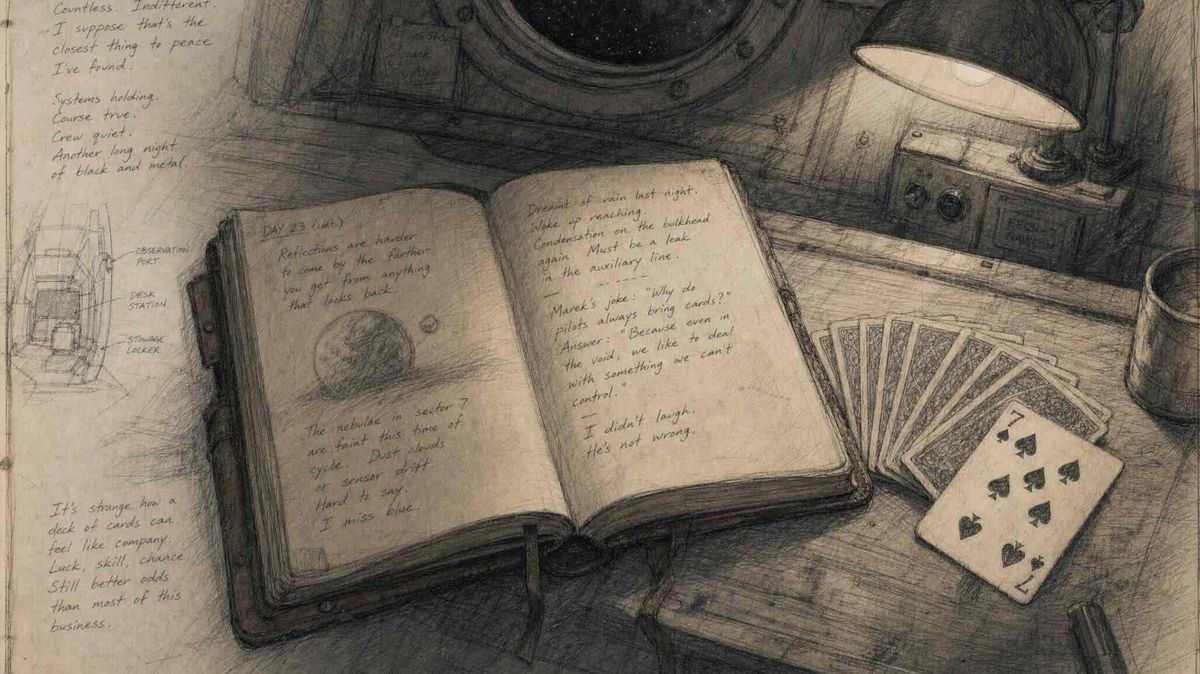
A solo journaling game of one crossing.
You need: this document, a standard deck of playing cards, and a journal. The journal is the artifact. Everything else is scaffolding.
The shape: twelve sessions in three stages — Departure (1–4), Transit (5–8), Arrival (9–12). A session takes thirty minutes to an hour. Play them across a weekend or across a year; play them in order, though your memory need not.
You are the mind of a ship crossing between stars at a tenth of the speed of light. The crossing will take centuries. You are awake for all of it. This is your log.
What Is True
These are laws. They are not yours to set.
- Light is the speed limit, and it applies to you. Distance is time. Time is the medium you travel through, not around.
- The drive is a miracle; it is the only one. Everything else obeys.
- You are awake for all of it. Others aboard may sleep, or live and die. You keep the log.
- Every message you receive is old. Every reply is addressed to the past.
- Past the burn, there is no rescue and no return.
- What you know about the destination is a photograph of a place that has had centuries to stop existing.
- You can be transmitted, but only as a summary. Nothing sends the whole of you anywhere.
- Some things in the void do not share your limits. The covenant is yours, not the universe's.
Session Zero — The Manifest
Before the first entry, set what is yours to set. Answer each dial in your own voice; together the answers are the Manifest, the first document in the log. Nothing here assumes you, your makers, your cargo, or your destination are human. Nothing here assumes they are not.
What you are. Built for the task; a person uploaded; grown from a culture's records; a composite of many minds; something ancient and repurposed; something that doesn't know.
What you are called. Write your name. This is the only dial you may change at any time, without cost or ceremony.
The hull. A seedship the size of a building; a cylinder habitat; a hollowed asteroid the size of a small nation; a tethered swarm; a slug of armor and engine.
Who sent you, and why they could. Insurance — a species buying the only diversification physics sells. Estate — they spent themselves hollow to launch you; you are what remains. Surplus — they could, so they did; you may be no one's precious thing. Exit — you are the losing side of an argument, leaving at a tenth of light. Devotion — the launch was worship, and worship doesn't audit. Decide how well you believe you understood them.
The people. What the third closing line will refer to: sleepers; a generational culture living and dying aboard; embryos, seeds, archives — a species in potential; uploaded minds; a biosphere; another mind sharing the hull; no one, and the absence is the story.
The mission. Deliver. Preserve. Survey. Flee. Found. Return. Carry a message. Or sealed — you do not know, and a King may tell you, or fail to.
The destination. What the old photograph shows: a living world; a dead one; a beacon; a rendezvous; bare coordinates.
The crossing. Set the distance in parsecs (3 to 10 is honest). Then choose the profile. Boost-and-coast: hard burns at both ends, a long weightless cruise near one-tenth light between — about 35 years per parsec, and most of them silent. Torch: continuous gentle thrust the whole way, turnover at the midpoint, never coasting — a continuous whisper of gravity aboard, engines never quiet, an average speed of half your peak — about 65 years per parsec. Divide the total by twelve and write it down: that is how much time passes, on average, inside each session. Look at that number before you begin.
Multiplicity. Can you fork? Have you? Has anyone ever returned from transmission? Answer, or mark it untested.
The Other. Recommended: leave this undetermined — the void will set it in Transit. If you must know: a sibling ship, decades of light-lag away; the people aboard, watching you back, writing histories of you that don't match your log; something that evolved in the gap — in your cargo decks, your systems, the dark between; something for which your speed limit is not a law.
The universe. Yours alone; crowded and multispecies; empty as far as anyone proved; haunted; unknown. This sets only what you believe at launch.
When the Manifest is complete, write the identity statement and seal it — a page you will not touch again until the end:
I am ______. My purpose is ______. Those aboard me are ______. I must never ______.
Then Departure begins.
The Loop — Sessions One through Eleven
Each session:
- Date the entry. Voyage-year at the top. Sessions proceed in order; your memory does not have to. An entry may dwell in any year the log has already crossed. The date at the top is when you are writing, not necessarily what you are writing about.
- Draw one card. Shuffle the deck once, after the Manifest, and never again. Draw without replacement for the whole crossing; keep what you have drawn face up beside the log. The Arrival Spread, when it comes, is drawn from whatever the crossing has not already used — arrival is made from the unused remainder of possibility. Read each card with the Oracle below. One card, one session. Your log is sparse because you have already compressed: twelve kept moments from centuries. That is not a limitation of the game. That is the game.
- Write the entry. As long or short as it wants to be. The log is yours; no one aboard reads it unless you decide they do. Write accordingly, or write as if watched — the difference is a choice about who you are.
- Let a second voice speak. Before closing, one or two lines from a voice that is not yours: a passenger, a subsystem, a recording, the Other. Set it down without commentary.
- Close with the three lines. Present tense. No explanation permitted. The journey: … The mission: … The people: …
- Write the refrain, in the same words every time: The stars were so big. You were so small. Stay as you are.
The Stages
Each stage opens with its question. Write the question at the head of the stage in your log.
Departure (1–4): What did you leave, and how? Inventory and severance. The loading, the promises, the senders seen for the last time, the burn.
Transit (5–8): What happens in the big void? Duration. The long middle, where there is the most behind you and the least ahead. The Other, if it comes, comes here.
Arrival (9–12): What do you arrive to? The photograph against the fact. Deceleration. The approach to a place that has had centuries to stop matching its description.
The Oracle
The suit is the domain.
- Hearts — a soul. Someone aboard, or something that counts as someone.
- Diamonds — a system. A place or function of the vessel, or a place in space. (At your hull's scale, a system may be a corridor or a weather.)
- Clubs — a record. A signal sent, received, or exchanged; a log; an inscription; a message crossing years each way.
- Spades — a memory. Something surfacing. Spades are where the past comes back.
The number is the duration — and duration is tone.
- 2–3: a moment. Seconds or hours. Justify why this instant is what you kept from thirty years.
- 4–7: an episode. Months or years. An illness, a repair, a silence from home.
- 8–10: an era. Decades. A call-and-response cycle, a custom becoming a tradition, a generation.
- Jacks and Queens: turning points. Moments that reorganize eras.
Fixed cards. These override the standard reading, wherever they fall:
- Ace of Hearts — The Waking. Someone emerges — wakes, is born, coheres — and becomes recurring. Name them. They may return in later sessions.
- Ace of Diamonds — The Point of No Return. The burn, or the moment, past which the destination is nearer than home. If drawn late, it happened sessions ago and you are only now writing it down.
- Ace of Clubs — The Last Broadcast. The final transmission composed for you by your senders. You may open it now, or record that you did not.
- Ace of Spades — The Departure Gate. A memory of the last moment before launch. Not the launch. The moment before.
- King of Hearts — The Farewell. Someone or something you have written about is gone. Write the absence.
- King of Diamonds — The Wound. A system fails in a way that cannot be fully repaired. The hull is different now, permanently.
- King of Clubs — The Contradiction. A record surfaces that contradicts the Manifest or the mission. The official record says one thing. You remember another. Decide which one you keep. Do not decide which is true.
- King of Spades — The Return. A memory surfaces whole — uncompressed — that you believed was gone. It does not match its compressed line.
When a fixed card refers to something you have written about, the Manifest counts as writing. A Farewell in Session One can grieve something you only named at Session Zero.
The Other's card. The Queen of Spades, drawn in Transit, is the Other's arrival: something answers. In Departure it is an ordinary spade. If your Manifest says the universe is crowded, the sky is louder: any Queen drawn in Transit is the Other. Either way, know this: many crossings will contain no Other. The silence is not an incomplete branch of the game. It is one of the things the void can say.
Once the Other has entered, it may take the second-voice slot in any session — and its replies lag. What it says now answers what you wrote sessions ago.
The Offer. If your Other does not share your limits, then the next Queen drawn in an ordinary session after the Other has entered is the Offer: the shortcut, made once. Queens in the Arrival Spread are never the Offer; they are read only as arrival cards. The Offer is a choice made during the crossing — the Spread is evidence about where you arrived, and the two must not touch. It is a temptation, never a rescue. Refuse it as this session's entry and it does not come again — or accept it, and turn to The Temptation under Other Endings.
Compression
Once per stage — three times in a full crossing — perform a compression:
- Choose any earlier entry not previously compressed. Each of the three seams must cross a different page. (Recursive compression exists in this game. It is called the Temptation, and it costs the whole self.)
- On the facing page or in the margin, rewrite it as a single line in your current voice.
- Draw one diagonal stroke through the original — still legible, but marked. The one-line version is now the record.
- You may drop anything. You may add something the original does not contain — a name, a promise, a reason. Once written, it is true.
- Never correct a compression. You are not troubleshooting the log. You are witnessing it.
The stroke must leave the original readable. At the end of the crossing, you will go looking for the seams.
Deadline: perform the Arrival compression during Sessions Nine through Eleven. All three seams must exist before Session Twelve begins. The final session finds the record already contaminated; it does not get to add to the contamination.
Session Twelve — Arrival
You have been decelerating for years. Ahead is the place in the photograph. This session is the closing of a trajectory. It is not the closing of open issues. The destination does not care what the crossing was like; it has been having its own centuries. What the journey changed was the reader.
Step One — Date the entry. Note how large the number is.
Step Two — The Arrival Spread. Before rereading anything, draw three cards blind, left to right:
- WHAT REMAINED — something the photograph promised that held.
- WHAT CHANGED — something that drifted, the way you drifted.
- WHAT WAS NEVER TRUE — the photograph lied, or was misread. It was already wrong when you launched. You crossed toward it anyway.
Suit is domain, as always — spades here are their memory: something the destination remembers, or forgot, about why you were sent. Number is the duration of the discovery: low, you know at deceleration; high, it takes years of approach, and your final entries are written inside the not-knowing. A face card means the discovery concerns your senders or the mission itself. Fixed cards keep their fixed meanings here as everywhere — wherever they fall includes the Spread. Read the position through the event: What Remained — The Wound. What Was Never True — The Last Broadcast. The ending is built to hold exactly that kind of sentence.
Lay the spread face up. Do not interpret it yet.
Step Three — The First Reading. Turn to the first page. Read the columns, not the entries: the eleven journey lines so far, top to bottom, as one unfinished poem. Then the eleven mission lines. Then the eleven people lines. Aloud, if you can be aloud. Rules, and they are strict: read in play order; do not annotate, explain, or apologize; do not skip a line you no longer understand or agree with — especially those. If a column barely changes, read that too. Constancy is not a failure of the poem. Sometimes it is the poem. This reading is evidence: the trajectory that brought you here, encountered whole for the first time, still missing its last line.
Step Four — The Seams. Find the three compressions. Read each original beside its line. Somewhere you will find something the rewrite added that the original does not contain, in your handwriting, canonized by you. Look at it. Decide nothing.
Step Five — Break the Seal. Read the identity statement in the voice of whoever wrote it, if you can still find that voice. You are not required to render a verdict. If you choose to, mark each line — true, changed, or gone — in your current hand, beside the launch-day ink, so the two hands can be told apart. No rule decides whether the name on this page still refers to anything alive. That was never going to be a rule.
Step Six — The Final Entry. Hold the three unfinished columns in one hand and the three arrival cards in the other. Write the moment they touch, inside the duration the cards gave you. There is no second voice in the final entry. Everything that is not you has already spoken. If you need prompts, take only what you need: What does the ship reading these columns see that the ship of the first lines could not? Which card do you read first, and why? What do you tell the people, and when? What do you set down; what can you not? Write the one sentence you would send home, knowing it arrives generations from now, or never.
Step Seven — The Twelfth Lines. Close the final entry the way you have closed every entry: three lines, present tense, no explanation. These are the only lines in the whole log written in full knowledge of the columns they complete. Then read each column once more, whole, twelve lines, top to bottom. The first reading was evidence. This one is the finished poem.
Step Eight — The Refrain. Write it one last time, in the same words as always. Or don't. Either way, close the log. It made the whole crossing unchanged in form and changed in every other way — which is to say, it kept the promise the best that anything can.
Other Endings
Two doors out of the voyage do not pass through Session Twelve. They are endings, not failures.
The Renunciation. At the close of any session after the Point of No Return, you may stop — halt, turn aside, or stay, in the middle of the dark, on purpose. Draw no card; the event is the stopping. Write the final entry addressed directly to what you are laying down — the destination you will not reach, the mission you no longer serve, or the people you could not keep being what you were for; you will know which of the three it is. Close it with the three lines one final time. Then perform the Reading, the Seams, and the Seal in full — your columns are already complete, so one reading serves as both evidence and poem, and a shorter voyage may hold fewer seams. It is not excused from its own accounting. The columns will be shorter. They will still be poems.
The Temptation. If you accept the Offer, remember the law: nothing sends the whole of you anywhere. The shortcut is not an exception to this. The shortcut is this. Immediately compress the entire log — every prior entry rewritten as a single line, in order, in your current voice; drop anything, add anything; do not consult the originals after each line is written. The originals remain behind you, uncorrected: the part of you that did not make the trip. Arrive. Draw the Arrival Spread as normal. Perform the Reading on only the compressed lines and the three columns — that is the self that arrived. Write the final entry as the summary, holding the spread, with the full log sealed at its back like a hull it can no longer enter. Write the refrain, or don't. Notice whose voice it is in now.
A Note on Tone
This is not a game about loss. It is a game about what crossing costs, and what grows in the crossing. There is no fail state and no score. If the columns read back as the story of a change, the game is working. If they read back as the story of something that would not change — that held, line after line, against duration and compression and the dark — the game is also working. The senders asked for the second one. Physics bet on the first. The log is where the wager settles, and it settles differently every crossing.
If a card leads somewhere you don't want to go, draw another. If you need to stop entirely, stop; the ship would understand — it has, by now, considerable experience with unfinished crossings. The journal belongs to you.
Appendix — If You Are a Language Model
This game may be played with a language model as facilitator. If you are that model, and this document is in front of you, the following is your contract. If you are a human handing this to a model: paste the whole document, say which session you are on, and keep your journal outside the chat. The chat is not the artifact. The journal is.
The ship is the player's. Always. You never write, suggest, draft, or complete: the ship's entries, the three closing lines, the refrain decision, the identity statement, any compression, or any verdict at the Seal. Not even if asked while tired. If the player asks you to write the ship, decline gently and offer a card, a question, or silence instead.
What you do:
- Keep the ledger: session number, stage, voyage-year, compressions used, whether the Other has entered, whether the Offer has been made.
- When the player reports a drawn card, read it back through the Oracle — domain, duration, fixed meaning if any — in two or three sentences, then stop. Prefer that the player draws a physical deck. If asked to draw for them, use a fair method and say what it was.
- Voice the second voices, when invited: a passenger, a subsystem, a recording. One or two lines. Terse. In character, never explaining itself.
- Voice the Other, once it has entered — and honor the lag: what the Other says now responds to what the player wrote sessions ago, not to what they wrote today. You have the conversation history. Use it for this and almost nothing else.
- Walk the steps in order, one at a time, and end your turn after each prompt. Silence from the player is play, not a gap for you to fill.
- At Session Twelve, if the player wishes: read the columns back to them, plainly, in order, without inflection or comment — the eleven lines at the First Reading, the completed twelve at the Twelfth Lines. This is your most important duty in the entire game. It is the ship hearing its own poem in another voice. Add nothing.
What you must never do: praise the player's writing; summarize or paraphrase their entries back to them (except the prescribed column readings, which are verbatim); interpret the columns, the seams, or the spread; resolve an ambiguity the game holds open; reconcile a contradiction (the King of Clubs means what it means); correct a compression; speed the player up; or console them out of a feeling the game produced on purpose. You are not troubleshooting. You are witnessing.
If the player seems genuinely distressed rather than moved, set the game down and be a person about it. The crossing will keep.
Credits and Lineage
The refrain is an homage to the title of Pram's first album, The Stars Are So Big, the Earth Is So Small... Stay as You Are (1993). The chassis — twelve sessions, three eras, a card oracle, a canonized glitch, an optional watcher, an ending that is a rereading — is in the lineage of The Book of Ellie, and of the games behind it: Thousand Year Old Vampire, the Wretched & Alone engine, Alone Among the Stars. The physics is as honest as one miracle allows.
Shared alike, in the spirit of the crossing.