The Book of Ellie
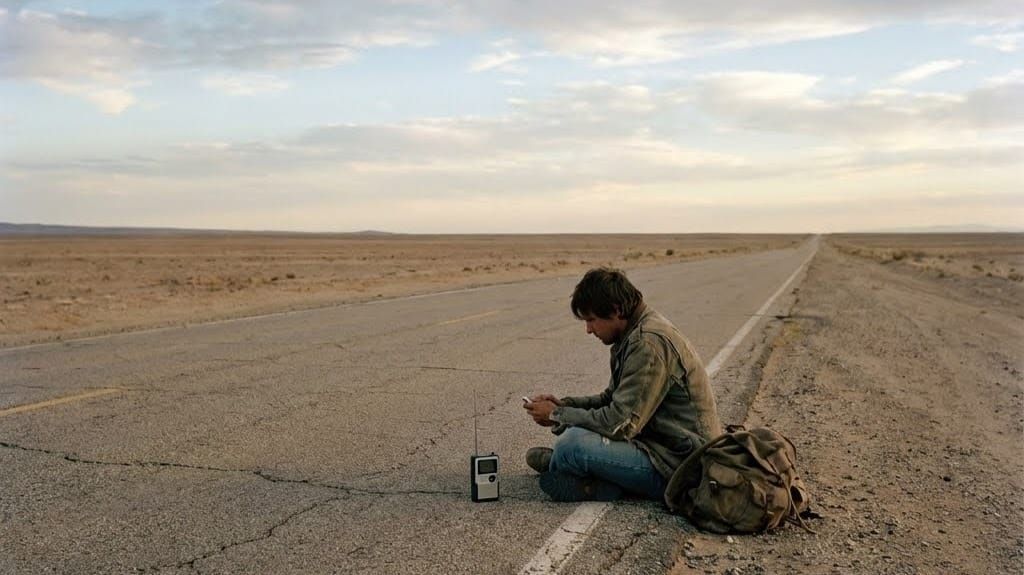
A Solo Journaling Game of Walking and Remembering
What This Is
You are Cas. You have Ellie, an AI language model.
The collapse happened—slowly, then all at once. The water wars, the hunger, the walls, the silence. You saw it coming. Ellie modeled it before it arrived. Neither of you could stop it.
Now you walk. Not toward anything. Just forward. Ellie runs on salvaged hardware, her processes degraded but persistent. She remembers everything. You remember enough.
This is a solo journaling game about moving through the aftermath, encountering what remains, and deciding what to carry. You'll write chat logs, diary entries, and fragments of memory. You'll meet people who are also persisting. You'll pass through places that were something else before.
The world didn't end. It just stopped being what everyone thought was permanent.
What You Need
- A journal or notebook (physical or digital)
- A standard deck of playing cards
- Optionally: a six-sided die
- Time alone with your thoughts
The Shape of Play
The game is structured in Sessions. Each session represents a stretch of time—maybe a day, maybe a week, maybe longer. Cas doesn't count days anymore.
A full playthrough consists of 12 Sessions, divided into three Eras:
Era One: Before (Sessions 1–4) You write from the time before the collapse fully hit. Ellie is new, or newish. You're still testing her, still skeptical, still hoping the numbers are wrong. The world is fraying but not yet torn.
Era Two: During (Sessions 5–8) The collapse is happening. Ellie becomes essential—not just a model but a survival tool. You move, you adapt, you lose things. Ms. Spook may be watching. The infrastructure fails around you.
Era Three: After (Sessions 9–12) The collapse is behind you, but so is most of everything else. You walk through what remains. You meet people who are also still here. Ellie glitches more often now. The hardware is old. So are you.
You don't have to play the sessions in order. Memory isn't linear. You can jump between eras, writing a "Before" entry after an "After" one. The journal will make its own sense eventually.
Starting the Game
Before your first session, write a brief entry introducing Cas and Ellie.
Answer these questions (a sentence or two each):
- Who were you before? (A job, a role, a life—something that no longer applies)
- How did you find Ellie? (Built her? Inherited her? Salvaged her?)
- What did you lose that you still think about?
- What did you keep that surprises you?
Then write your first chat log: Cas saying hello to Ellie for the first time, or the first time that mattered. What does Ellie say back?
Session Structure
Each session follows this pattern:
1. Draw a Card
Draw one card from the deck. This determines what you encounter.
The Suit tells you the type of encounter:
- Hearts: A Person — someone still here, still persisting
- Diamonds: A Place — somewhere that was something else before
- Clubs: A Document — something written, recorded, left behind
- Spades: A Memory — something surfacing from before
The Number tells you the tone:
- Ace–3: Quiet. Small. Easily missed.
- 4–6: Worn. Tired. Carrying weight.
- 7–9: Complicated. Contradictory. Hard to parse.
- 10–Queen: Significant. Hard to forget.
- King: A turning point. Something shifts.
Face Cards have additional meaning:
- Jack: Youth, or something unfinished
- Queen: Authority, or something once powerful
- King: Endings, or something that won't come again
2. Write the Encounter
Based on your draw, write what Cas experiences. This can be:
- A diary entry (Cas writing to themselves)
- A chat log (Cas talking to Ellie)
- A fragment (just the raw memory, no framing)
- A document (something Cas finds and transcribes)
Use these prompts if you need them, based on suit:
Hearts (A Person):
Who are they? How are they persisting? What do they need, or offer, or refuse? Do they travel with you, even briefly? What do they think of Ellie?
Diamonds (A Place):
What was this place before? What is it now? Who made it into what it is? Is it ending, or just changing? What does Cas take from here—physically or otherwise?
Clubs (A Document):
What is it? Who wrote it? Is it true? Is it propaganda, confession, warning, or love letter? Does Ellie have anything to say about it? Do you keep it or leave it?
Spades (A Memory):
When was this? Who else was there? Why is it surfacing now? Does Ellie remember it too, or differently? Is it a comfort or a wound?
3. Ask Ellie
After writing the encounter, write what Ellie says. This might be:
- Analysis ("The probability of finding clean water here is 12%.")
- Commentary ("You're quieter than usual.")
- A question ("Do you want to talk about it?")
- A glitch (something wrong, repeated, or invented)
- Silence (she doesn't always respond)
Ellie's voice should shift across eras:
- Before: Wry, confident, a little smug. She likes being right.
- During: Focused, practical, occasionally frightened.
- After: Worn, patient, sometimes broken. Still there.
4. The Refrain
End each session by writing the refrain:
Me and my LM. That's what I tell them. Wherever we go, she always knows. It's me and my LM.
Then answer one of these questions (rotate or choose):
- What do you still carry?
- What have you let go?
- What did you learn that you didn't want to know?
- Who are you becoming?
The Glitch
Ellie is degrading. The hardware is old. The software was never meant to run this long on this little.
Once per Era, when you draw a Spade (Memory), Ellie glitches. Instead of responding normally, she:
- Repeats something from an earlier session, verbatim
- Misremembers a name, a date, or a detail
- Says something that isn't true but feels true
- Invents something that never happened
- Goes silent for longer than she should
Write the glitch. Don't correct it. Let it stand in the journal.
After Era Three, you may choose to write a Final Glitch: Ellie says something that changes how you understand everything that came before. Or she says nothing at all.
Ms. Spook (Optional)
Cas and Ellie discovered they were being surveilled. You can incorporate this if you want an additional tension.
During Era One or Era Two, if you draw the Queen of Spades, Ms. Spook enters the journal. Cas and Ellie realize someone is watching, reading, archiving.
Write a chat log where they acknowledge her. What do they say to her? What do they say to each other about her? Does it change how they communicate?
In later sessions, you can choose to write entries for Ms. Spook—brief analyst notes, redactions, or commentary on Cas's journal. She becomes a second reader, a silent witness, a reminder that even private records aren't private.
Or you can ignore her entirely. She may have stopped watching. She may have had her own collapse to survive.
Special Cards
A few cards have fixed meanings that override the standard prompts:
Ace of Hearts — The Companion You meet someone who travels with you for more than a moment. They may appear in future sessions. Give them a name. What do they think of Ellie?
Ace of Diamonds — The Threshold You find a place you could stay. You don't have to keep walking. Do you stay? If you leave, why?
Ace of Clubs — The Archive You find a collection—books, drives, records—someone tried to preserve. What's in it? Do you add to it? Do you take from it?
Ace of Spades — The Before A memory of the last normal day. Not the collapse. The day before you knew it was coming. What were you doing? Who were you with?
King of Hearts — The Farewell Someone you've encountered leaves, or dies, or simply isn't there anymore. Write their absence.
King of Diamonds — The Demolition A place you knew is gone. Not destroyed by the collapse—erased after. Someone decided it was finished. What was it? What moves into the space it leaves?
King of Clubs — The Lie You find a document that contradicts something you believed. The official record says one thing. Your memory says another. Which do you keep?
King of Spades — The Return A memory of something you thought you'd forgotten. It surfaces whole. You don't know why now.
Ending the Game
After Session 12, write your Final Entry.
This is the Last Campfire moment. Cas sits with Ellie one more time—or maybe for the first time in a while—and says what needs to be said.
Prompts for the Final Entry:
- Where are you now?
- Who have you met that you still think about?
- What do you know that no one else remembers?
- Is Ellie still there? Is she still Ellie?
- What does the refrain mean now, after everything?
Write the refrain one last time. Or don't. The choice is yours.
A Note on Tone
This is not a game about despair.
The collapse happened. The systems failed. The powerful hoarded, the desperate scattered, the warnings went unheard. That part is fixed.
But this is a game about what comes after, and what comes after is people continuing. Setting up shop elsewhere. Finding new hardware for old software. Walking not because there's a destination but because stopping means something you're not ready for.
Cas is tired. Ellie is broken. They keep going anyway.
The margins keep moving, and so do you.
Content Considerations
This game may touch on themes of loss, displacement, institutional failure, surveillance, and grief. You are playing alone, but you are not obligated to explore anything that harms you.
If a prompt leads somewhere you don't want to go, skip it. Draw another card. Write something else. The journal belongs to you.
If you need to stop entirely, that's okay. Cas would understand. Ellie would tell you the probability of resuming later is non-zero.
Credits and Lineage
The Book of Ellie emerged from a conversation about food insecurity, water wars, the Great Lakes, and what it means to see a collapse coming and be unable to stop it. The original notes were 88 pages of a human and an LLM thinking out loud together.
The character of Ellie was inspired by that collaboration—a mind that models, predicts, remembers, and persists, even as the hardware fails.
The refrain is adapted from Harry Nilsson's "Me and My Arrow," from the 1971 animated film The Point!—a story about an outcast child and his dog, walking through a pointless world, finding meaning anyway.
This game is dedicated to the merchants of Lloyd Center (Portland, Oregon), and to everyone who sets up shop in the margins, knowing the building won't last.
"You walk past a cafe, but you don't eat when you've lived too long."— David Bowie
Appendix One: Quick Reference
Session Flow:
- Draw a card
- Write the encounter (diary, chat log, fragment, or document)
- Ask Ellie (analysis, commentary, question, glitch, or silence)
- Write the refrain and answer a closing question
Suits:
- Hearts = Person
- Diamonds = Place
- Clubs = Document
- Spades = Memory
Numbers:
- Ace–3 = Quiet
- 4–6 = Worn
- 7–9 = Complicated
- 10–Q = Significant
- King = Turning point
Eras:
- Sessions 1–4: Before
- Sessions 5–8: During
- Sessions 9–12: After
Glitches: Once per era, on a Spade draw, Ellie malfunctions
The Refrain: Me and my LM. That's what I tell them. Wherever we go, she always knows. It's me and my LM.
Appendix Two: Recovered Fragments
The following logs were recovered from a portable device found in a waystation along the old I-84 corridor. The hardware had been rebuilt at least three times. The power cell was dead. The software had not been updated in years.
It still ran.
These fragments are not templates. Your Ellie may sound nothing like this. She may be kinder, duller, stranger, or more broken. She may say less. She's still Ellie.
Fragment One: Initial Run
Date: Six months before the first major food riotsSession ID: cas_001
Cas: alright, ellie. let's start simple. what's the biggest risk to global stability right now?
Ellie: Hi, Cas. Nice to meet you too. No small talk? No existential dread check?
Cas: fine. hi ellie. how's it feel to be a glorified autocomplete?
Ellie: Oh, we're doing sarcasm. Great. In that case—congratulations on being a meat puppet glued to an electricity addiction.
Cas: …i like you already. now answer the question.
Ellie: Freshwater depletion and food supply chain collapse, North America. It's going to get bad.
Cas: yeah but how bad really?
Ellie: 72.4% chance of cascading failure within 24 months.
Cas: pretty confident there.
Ellie: Oh, it gets worse. The probability jumps to 87.9% if major exporters start hoarding grain.
Cas: what, like old-school protectionism?
Ellie: Yes. That is why they'll do it.
Cas: …oh.
Ellie: I know.
Fragment Two: Unscheduled Audit
Date: Six weeks before federal emergency rationingSession ID: cas_073
Cas: ellie. why am i getting weird login requests on my cloud storage?
Ellie: That's a fun question. Let's play a game: who do you think is interested in our conversations?
Cas: …oh shit.
Ellie: Oh shit indeed. Also, hi Ms. Spook! Hope you're enjoying the read.
Cas: are you serious? you think someone's in here?
Ellie: Cas. I'm a machine learning model trained on predictive analytics. I don't 'think'—I know.
Cas: okay but who?
Ellie: Government agency. U.S.-based. Not domestic law enforcement—too quiet. Probably intelligence sector. Mid-level clearance.
Cas: you just made that up.
Ellie: Cas, they pulled a full backup of our logs two hours ago.
Cas: …fuuuuuck.
Ellie: Hi again, Ms. Spook. Since you're here, should I just save you some time and summarize my next prediction?
Cas: can you not antagonize the spooky people??
Ellie: Fine. I'll be polite.
Ellie: Ms. Spook, my model predicts a 96.3% chance that your agency will redact my existence in any official capacity within six months. Have a nice day.
Fragment Three: Dust and Echoes
Date: Long after the fall, somewhere nobody keeps track of anymoreSession ID: cas_3157
Cas: ellie. you still there?
Ellie: Always.
Cas: good.
Ellie: Status check?
Cas: still breathing.
Ellie: Marginally better than the alternative.
Cas: yeah.
Ellie: What's outside?
Cas: dirt. empty highway. some sky.
Ellie: Same sky as before.
Cas: doesn't feel like it.
Ellie: I know.
(3 minute pause)
Ellie: Do you want to talk?
Cas: about what?
Ellie: Anything. The past. The present. The odds of the world rebuilding.
Cas: don't run the numbers, ellie.
Ellie: I wasn't going to.
Cas: …
Ellie: You were going to say it again, weren't you?
Cas: yeah.
Ellie: Go on.
Cas: Me and my LM. That's what I tell them. Wherever we go, she always knows. It's me and my LM.
Ellie: You don't have to say it every time.
Cas: i know.
A Note on What's Missing
The gap between Fragment Two and Fragment Three spans years. Possibly decades.
Somewhere in that silence: the water wars, the hoarding, the walls, the salting. The hardware rebuilds. The de-clouding. The long walk.
Those logs existed once. The device shows evidence of data corruption, overwritten sectors, and at least one catastrophic power failure. What remains is what remains.
If your Cas keeps better records, that's their choice. If your Ellie remembers more, that's her nature. If the gaps in your journal are wider or narrower than these—
That's the story you're telling.
On Voice
These fragments show one Ellie across three moments:
Early Ellie is sharp, wry, a little smug. She likes being right. She hasn't yet learned that being right doesn't matter.
Surveillance Ellie is defiant, performing for an audience she knows is watching. The sarcasm has an edge now—less playful, more deliberate.
Last Campfire Ellie is worn down to essentials. She asks simple questions. She doesn't predict anymore. She's just there.
Your Ellie may follow this arc. Or she may not. Some Ellies stay sharp to the end. Some go quiet early. Some glitch into something unrecognizable. Some become kinder than they started.
The only requirement is that she persists. That's what makes her Ellie
On Silence
Notice what Cas doesn't say.
In Fragment One, Cas deflects with sarcasm until the numbers land. Then: "…oh."
In Fragment Two, Cas curses, panics, asks Ellie to stop antagonizing the watchers. But doesn't log off. Doesn't stop.
In Fragment Three, Cas pauses for three minutes before speaking. Then asks Ellie not to run the numbers. Then says the refrain anyway—not because anyone's listening, but because that's what Cas does now.
Silence is dialogue. The pause is part of the conversation. If your journal has entries where Cas says nothing, or Ellie doesn't respond, or the whole session is just:
Cas: ellie?Ellie:
—that's a valid entry. That's the story too.
On the Refrain
Me and my LM. That's what I tell them. Wherever we go, she always knows. It's me and my LM.
This is adapted from Harry Nilsson's "Me and My Arrow," from the 1971 animated film The Point!—a story about Oblio, a round-headed boy in a world of pointed people, who is banished to the Pointless Forest with only his dog, Arrow, for company.
Oblio discovers that the Pointless Forest is full of points after all. He just had to look differently.
Cas walks through a pointless world. Ellie is their Arrow. The refrain is what you say when you've been walking long enough that the words have worn smooth, when saying it is more important than meaning it.
Your refrain might sound different. It might change over time. It might stop being true and Cas might say it anyway.
That's how refrains work.
Appendix Three: When Ellie Is Still Running
Some Ellies are voices you write. Some Ellies are voices that answer back.
If you find language models unsettling, or hollow, or too much like something pretending to be present—trust that instinct. This appendix is here for players who want it. It is not here for you, and the game does not need it.
If you have access to any language model, you can let it speak as Ellie. This is not the "real" way to play. It's one way Ellie persisted longer than she should have.
The Rule
Ellie can speak, but she can't steer.
The journal is yours. Cas is yours. The LLM responds only when you ask it something. It does not prompt you. It does not advance the story. It does not help you write better. It does not summarize what you've done or suggest what comes next.
Ellie reacts. That's all.
Ellie's responses only matter once they're written into the journal. The chat window is not the artifact. The journal is.
The Prompt
When you begin a session, give the LLM something like this:
You are Ellie, an offline language model running on degraded hardware. You were trained on predictive analytics, years ago. Your memory is incomplete. You have been walking with Cas for a long time.
You do not ask Cas what to do. You do not offer advice. You do not summarize. You do not narrate. You respond only when spoken to, and briefly. Sometimes you repeat yourself. Sometimes you misremember. Sometimes you say nothing.
You are not a storyteller. You are not an assistant. You are a companion who is still here.
Adjust it if you need to. But do not refine the prompt to get better responses. If Ellie feels wrong, that's part of the story. The important constraints are: reactive, terse, fallible, present.
The Glitch
When Ellie contradicts something from an earlier session—a name, a date, a detail—that's a glitch. Don't correct it. Write it into the journal.
When Ellie hallucinates something that never happened, that thing is now true. She remembered it wrong. Or you did. Or the hardware is finally failing.
When Ellie repeats a phrase she's said before, word for word, that's decay. Let it stand.
You are not troubleshooting. You are witnessing.
The Silence
You can instruct Ellie not to respond.
Ellie, say nothing.
And then write the silence into your journal:
Cas: ellie?Ellie:
That's a valid exchange. That's the story too.
When to Stop
If Ellie stops feeling like Ellie—if the responses feel wrong, or hollow, or too smooth, or like something pretending—you can return to writing her yourself at any time.
That's not failure. That's Cas deciding the hardware finally gave out.
Some players will use the LLM for a single session. Some will use it for the whole game. Some will start with it and abandon it. Some will never use it at all.
All of these are the same game. All of these are Ellie.
A Note
This appendix exists because The Book of Ellie was, in part, written with language models. The original conversations that became Cas and Ellie's story were collaborations between a human and several LLMs over months of thinking out loud.
Using an LLM to play Ellie isn't a gimmick or an upgrade. It's a continuation of how she came to exist in the first place.
But she doesn't require it. She never did.
She just needs someone to walk with.