Ten Miles, Three Worlds
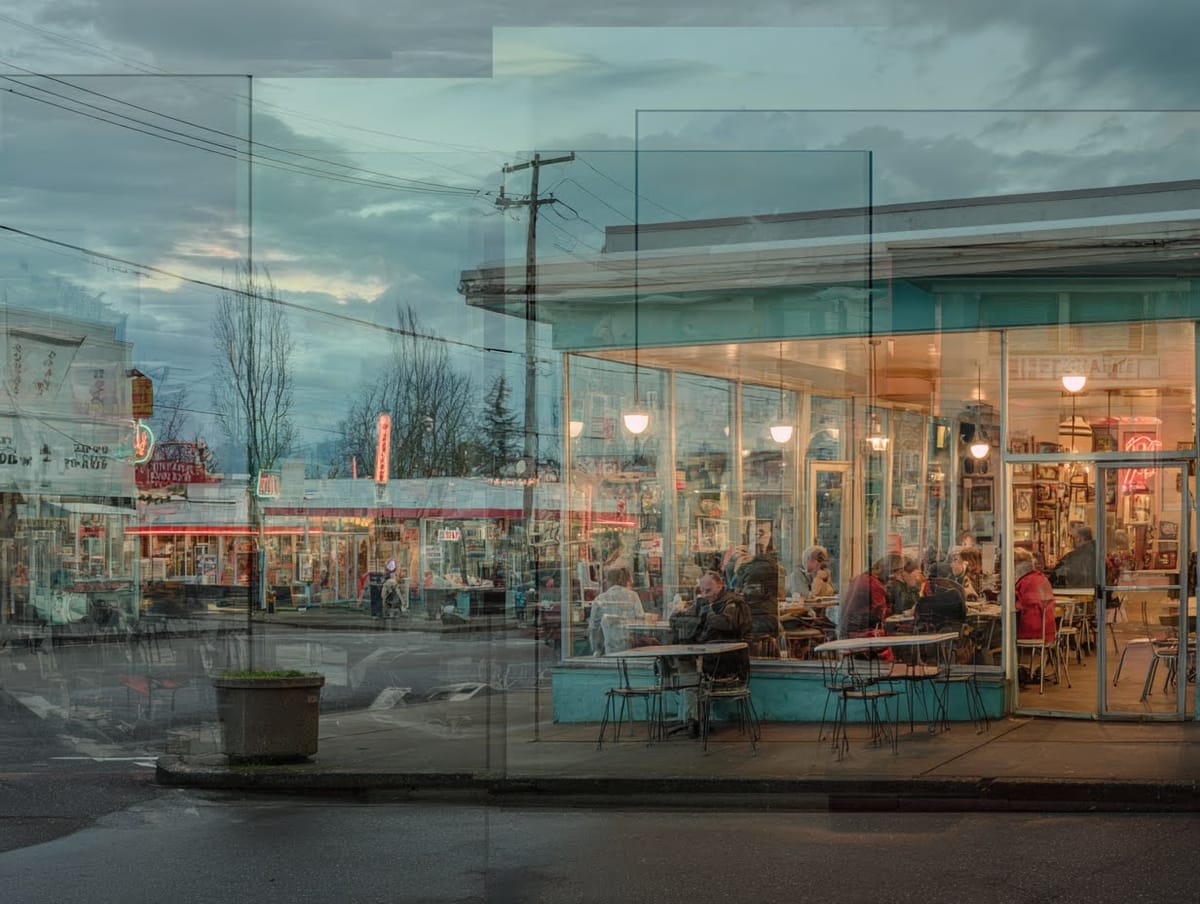
A cheeseburger, tater tots, a soft drink, and a cookie at Mike's Drive-In in Tigard. Fifteen dollars including tip. The lunch crowd is a mix of white and Black folks, a mixed-race couple at the next table, Christmas music drifting from somewhere behind the counter. No one seems to be performing. People are just eating.
The space hums with the particular ease of places that ask very little of you. You show up, you order, you sit, you leave. The codes are legible. The expectations are minimal. Civility and courtesy are given and returned without friction. Familiarity is the product, and it's delivered reliably, one basket of tots at a time.
Half an hour later, I'm standing in line at Cargo, on the Central Eastside of Portland. The store is a labyrinth of imported oddities—Indonesian masks, handmade journals, ceramic animals with unsettling expressions, objects that exist to be given as gifts by people who want their taste noticed. Eccentricity is the norm here. The customers browse slowly, like they're translating. The staff doesn't hover. The whole space assumes a certain kind of person: someone who finds pleasure in symbolic play, who has time to linger, who doesn't need the objects explained.
The crowd reads as overwhelmingly white—not because the door says "no," but because entry costs fluency, time, and comfort with a particular aesthetic register. Selection effects don't require exclusion to produce homogeneity. Again, civility and courtesy flow as effortlessly as the shoppers and the credit card authorizations.
Same afternoon. Same metro area. Less than ten miles apart. And yet: two different worlds.
I didn't change costumes between them. I didn't rehearse a different self. I just got in the car, drove, and walked in as the same schlubby, unassuming person.
I.
Call them cosms—a word I'm borrowing loosely, because "community" implies too much intention and "bubble" implies too much isolation. A cosm is something else: a space optimized for a particular way of being. Not a neighborhood, not a demographic, but an assumptive environment—a place where certain things don't need to be explained because everyone present already shares them.
Mike's is a low-demand cosm. You show up as you are. The menu is predictable. The music is familiar. Diversity is present but unnarrated—just people eating lunch, not a statement about people eating lunch. The social contract asks only for basic civility. Nothing needs to be interpreted.
Cargo is a high-interpretive cosm. Novelty is currency. The objects on the shelves reward symbolic literacy—you're meant to get them, to see the wit, to appreciate the curation. The space doesn't require performance, exactly, but it rewards a certain fluency. If you're comfortable with irony and aesthetic play, you'll feel at home. If not, you'll feel like you're missing a code.
Neither is wrong. Both are forms of shelter.
Every cosm has its own sustaining stories. Kurt Vonnegut called them foma: harmless untruths that make life bearable. In Cat's Cradle, the invented religion of Bokononism knows it's made up, and its adherents know it too, and they practice it anyway—because the foma help them live.
But not all foma are equal, nor do they remain harmless once used in a cosm. A story that says we take care of each other and a story that says they deserve what they get are both foma. They're not equivalent. One builds connection; the other licenses abandonment. Structure is shared; harm is not.
Inside a cosm, the foma don't need defending. They're the air. At Mike's, the foma might include hard work pays off or this is a free country or people mostly get what they deserve. At Cargo, the foma might include creativity is resistance or aesthetics matter or we're the ones who see clearly. Neither set is fully true. Both are functional for the people who live inside them.
A cosm isn't where you live. It's where you don't have to explain yourself.
II.
The ease of moving between cosms is not evenly distributed.
I can walk into Mike's without friction. I can walk into Cargo without friction. I can cross ten miles in half an hour and feel at home in both places, because I've got the right configuration: economic stability, cultural literacy across registers, the kind of body and affect that doesn't trigger suspicion in either space. My fluidity is real. So are the walls I don't hit.
Some people can't cross. Immigration status makes certain spaces dangerous—not symbolically, but materially. Race makes certain spaces exhausting: the surveillance of being watched, the labor of reassuring, the cumulative weight of not-quite-belonging. Disability makes certain spaces inaccessible. Poverty makes certain spaces foreclosed. Trauma makes certain spaces unbearable.
Some people won't cross. Not because they can't, but because crossing feels like betrayal. The friend who can't understand why you'd set foot in that store. The family member for whom your fluidity looks like a failure of loyalty. The colleague who reads your refusal to pick a side as cowardice or contamination. Purity has its own comforts, and for some, the boundaries of the cosm are what hold the self together.
Both of these—can't and won't—are real. They're not the same, but they produce similar effects: people pinned in place, unable or unwilling to move through the variety that a metro area contains.
The borders that feel porous to me are walls to others. Any honest account of plurality has to start with who gets to move and who gets stopped.
III.
There's a pizza shop in my neighborhood with a sign in the window: ICE and Border Patrol must have a warrant to enter these premises.
I noticed it while picking up a slice. The sign is small, printed, laminated, and taped to the front door at eye-level. It reframes the space. This isn't just a pizza shop. It's a cosm declaring its boundaries.
What does the sign do, legally? Almost nothing. A judicial warrant, if a judge signs one, is a warrant. ICE isn't usually free-ranging through small businesses at random nor at will; most operations are planned, data-driven, name-based. But visibility doesn't have to be universal to be effective. A few arrests in the right places, a few viral videos, and the fear generalizes.
What does the sign do, semiotically? Something else entirely.
It says: We know what's happening. We've thought about it. We've chosen a side. For someone navigating the world with a particular kind of fear—status-related, enforcement-related, the ambient dread of being pickable—the sign is a small beacon. Not a legal shield. A signal of shared values. A way of saying: you don't have to explain yourself here.
This is what it means to do semiotic work rather than juridical work. The sign doesn't stop the bulldozer. It tells you that someone in this building sees the enforcement bulldozer coming.
Noshing on a slice of pepperoni pie, I'm in a third cosm now—one that my fluidity lets me enter as an observer, but one that others inhabit as a matter of survival. The sign isn't for me. It's for the people whose relationship to this space is structured by a fear I don't carry.
IV.
That enforcement bulldozer? This is what it looks like in aggregate.
Estimates put the unauthorized population in the United States in the low-to-mid teens of millions. The immigration court system carries millions of pending cases. Placed beside each other, those figures suggest a steady-state condition: a vast adjudication machine that cannot resolve quickly, and therefore governs through suspension.
The categories blur: asylum seekers, parolees, overstays, border crossers, people whose paperwork is simply stuck. What they share is suspension—lives held in conditional existence, unable to plan long-term, exposed to policy shifts mid-process. The backlog isn't only a queue. It's a way of managing without deciding.
And then, in 2025, a visible tactic: arrests in and around courthouses.
Not everywhere. Not uniformly. But enough that the fear diffused. Showing up for a hearing started to feel like a risk. No-shows rose. In absentia removal orders rose with them—nearly tripling in fiscal year 2025 compared to the year before, according to EOIR-based analyses and reporting. The mechanism is simple: absence produces paperwork, and that paper trail facilitates future enforcement.
The trap is bureaucratically elegant and intentionally harsh:
Show up → you might be detained in the hallway. Don't show up → you may be ordered removed in absentia. Either way, the field of vulnerability widens.
The system doesn't need to arrest everyone. It needs to generate enough fear that people remove themselves from the process. This is one sense in which chaos can be load-bearing. Instability isn't a bug when it produces compliance, absence, and self-withdrawal. The system doesn't need to be everywhere. It needs to be possible anywhere.
V.
When describing enforcement, one is compelled to choose between two frames.
The first frame: It's exaggerated. ICE runs targeted, bureaucratic operations. Most people aren't affected. The fear is disproportionate to the reality.
The second frame: It's terror. Militarized agents, tactical gear, arbitrary power. No one is safe. The fear is entirely rational.
Both are true. That's the problem.
Legally, immigration enforcement is civil, not criminal. It's administrative: no jury, lower evidentiary standards, detention framed as non-punitive, removal framed as regulatory. From inside the legal category, it's paperwork.
Phenomenologically, it increasingly resembles something else. Body armor and scary black guns at courthouse doors. Agents with insignia that blur agency lines. The visual grammar of counterterrorism applied to visa overstays. From inside the experience, it's something closer to occupation.
The same raid can be paperwork to one person and terror to another. Neither is lying. They're observing from different positions within the same system.
And the system benefits from this ambiguity. Supporters see law and order: procedures followed, rules enforced, nothing arbitrary. Opponents experience omnipresent threat: militarized presence, arbitrary power, anyone could be next. Both perceptions are available because the system is designed to offer both. One stabilizes the political base. The other disciplines the target population. Together, they produce equilibrium.
Different cosms, different relationships to the same enforcement apparatus, different conclusions about what's happening and whether it's acceptable.
No single story resolves the gap.
VI.
Back to the metro area. Back to the texture of daily life.
The enforcement apparatus is one kind of wall—institutional, federal, backed by force. But there are other walls, softer and closer to home, that shape who moves where and who stays put.
The colleague who posts something online, and you feel the slight chill of realizing you're in different cosms now. The friend who stops calling, not from conflict but from the accumulating weight of unspeakable difference. The family member whose politics you can't discuss anymore, so you discuss the weather, the kids, anything that doesn't touch the fault line.
These aren't dramatic ruptures. They're slow recalibrations. The dinner invitations that thin out. The topics that become off-limits. The relationships that survive in attenuated form—holiday cards, occasional texts, the memory of who you used to be to each other.
Some of this is "can't." The cost of maintaining the relationship has become too high for someone—emotionally, politically, practically. The friend who's undocumented can't afford to spend time with people who might not understand, might say the wrong thing to the wrong person, might be careless in ways that carry no cost for them but real danger for others.
Some of this is "won't." The family member who's decided that your fluidity is betrayal. The colleague who needs you to be legible, and your refusal to pick a side reads as cowardice or complicity. The sorting machine has asked them to choose, and they've chosen, and your continued ambiguity is an irritant they'd rather not tolerate.
The walls aren't only institutional. They run through living rooms, through group chats, through the slow dissolution of connections that used to feel durable.
VII.
An earlier essay ended with a question: Not "how do you win?" but "what kind of person are you willing to be under constraint?"
That question assumed the constraint was temporary—a phase to be endured, a pressure that might eventually lift if enough people resisted, organized, showed up. It assumed that leverage was still available somewhere, even if the path to it was obscured.
But what if the constraint is durable?
What if the system has reached equilibrium—a steady-state configuration that tolerates dissent because dissent doesn't threaten the mechanisms that matter? What if the backlog, the fear, the enforcement apparatus, the interpersonal sorting are not problems to be solved but features of a system that is working as intended for a plurality of the population?
This is the hardest question, the one most movement texts can't ask:
What if our current forms of resistance are already priced in?
Asking this doesn't mean surrender. It means phase recognition: acknowledging that the situation may have shifted from the realm of strategy—where actions produce leverage—into the realm of ethics under constraint—where actions express values without necessarily altering outcomes.
The plateau might be a cruising altitude.
If that's true, the question changes again. Not "how do we win?" Not even "how do we survive?" But: how do we remain human while the ledger stays unresolved?
VIII.
Vonnegut again: Live by the foma that make you brave and kind and healthy and happy.
The adage doesn't specify which foma. It doesn't filter for ideology. It simply observes that humans need sustaining stories, and that the test of a story is whether it helps you live—not whether it's true.
This is the part that makes everyone uncomfortable.
Every cosm has foma. The Mike's Drive-In cosm has stories about hard work and fairness and the basic goodness of ordinary life. The Cargo cosm has tales about creativity and resistance and seeing through the illusions that trap the unenlightened. The enforcement apparatus has narratives about law and order and national security. The movements opposing it have counter-narratives about solidarity and liberation and the arc of justice.
Each would probably be horrified to be told they're doing the same thing.
But structurally, they are. Humans living inside stories that make the world navigable. The stories don't have to be true to be functional. They just have to get you out of bed, sustain your commitments, give you a framework for interpreting events that doesn't collapse into chaos.
This isn't relativism. The content of foma matters enormously. Some stories sustain life and build connection; others justify cruelty and sever bonds. Some help people endure without becoming brittle; others harden into dogmas that won't tolerate question or disobedience.
But recognizing the structure helps explain why exposure rarely converts. Showing someone that their foma are foma—that the stories they live inside are constructions, not truths—doesn't usually produce enlightenment. It produces defensiveness, because you're threatening the architecture that holds their world together.
Everyone has foma. The question is which ones you choose to live inside, and whether you can hold them lightly enough to set them down when they stop serving.
IX.
A zine arrived recently, tucked into a tabletop roleplaying game about small creatures defending their warren against encroaching bulldozers. The pamphlet was titled Confronting the Goliath: Don't Just Do Nothing to Counter Fascism. It was illustrated with whimsical images of rabbits carrying makeshift tools, organizing resistance.
Twenty suggestions. Make soup. Engage in play. Write letters to people in prison. Mourn your dead. Learn new skills. Slow down.
The epigraph was from Pirkei Avot, two thousand years old: You are not obligated to complete the work, but neither are you free to desist from it.
This is not a blueprint for political victory. The bunnies do not beat the bulldozers. The asymmetry is structural: one configuration of people runs the machines, another cultivates ways of surviving being run over. The mismatch doesn't resolve through better tactics or purer commitment.
But the zine knows that. It's not pretending otherwise.
What it offers instead is a discipline: not becoming flattened.
The bulldozer doesn't just destroy warrens. It flattens interiority—reduces life to compliance or resistance, fight or flight, win or lose. The system that produces enforcement also produces the categories through which we interpret enforcement. It wants your attention, your fear, your outrage, your engagement on its terms.
The bunny's refusal is quieter: I will not forget how to hop, hide, play, mourn, and care.
That's not a victory. It's a preservation. It keeps alive capacities that the system would prefer to extinguish—not through prohibition, but through irrelevance. Who has time to play when the bulldozers are coming? Who has space to grieve when the next crisis is already here? Who can afford to make soup when there's organizing to do?
And yet: the soup sustains people. The play keeps something alive that seriousness alone would kill. The grief, attended to rather than deferred, prevents brittleness. The slow weaving builds relationships that can bear weight.
Against a system that thrives on flattening, these refusals are already doing work—even if they never show up in a statistic, a budget line, or a victory speech.
X.
Civility is procedural. You can be civil to strangers, to enemies, to people you'll never see again. It costs little and preserves less.
Care is a bird of a different feather.
Care is the willingness to remain in relationship with people who might hurt you, disappoint you, or never come around. The family member whose politics you can't endorse. The friend who doesn't understand your choices. The neighbor whose foma are incompatible with yours. Care doesn't require agreement. It requires showing up anyway.
The sorting machines of the cosms choke on care.
Every algorithm, every outrage cycle, every purity test points the same direction: retreat to your cosm and stay there. Find the people who share your foma. Cut ties with those who don't. The world is too dangerous, too polarized, too far gone for the inefficiency of maintaining bonds across difference.
And there's truth in that. Some relationships are too costly. Some people are genuinely dangerous. Discernment is not betrayal. The question isn't whether to draw boundaries, but where—and whether the boundary is yours or the machine's.
What I keep returning to is this: the capacity for care across difference is the thing most vulnerable to being flattened, and therefore the thing most worth protecting.
Not because it's strategic. It isn't. Care doesn't scale. It doesn't aggregate into power. It won't show up in anyone's theory of change.
But it's what survives when everything else fails.
Regimes rise and fall. Movements mobilize and dissipate. Coalitions form and fracture. The backlog persists. The bulldozers keep running.
What remains, if anything remains, is the network of people who kept feeding each other, kept showing up, kept the door open even when it would have been easier to close it.
XI.
This has been an extended act of mourning.
Not despair—mourning. The slow, ongoing recognition of what is lost, what was never there, what can't be willed into being.
Mourning for the simpler story, where good and evil were legible and resistance led to victory. Mourning for the unified "we" that turned out to be smaller and more fractured than hoped. Mourning for efficacy—the discovery that you can do everything right and the bulldozers keep running anyway. Mourning for relationships that didn't survive the distance, not from betrayal but from the slow accumulation of unspeakable difference.
Mourning isn't the opposite of action. It's what keeps action from becoming brittle—performative, disconnected, unable to absorb loss without shattering.
The zine understood this. Take time to mourn your losses and grieve your dead—as inseparable from fighting and organizing for the living.
Vonnegut understood it too, in his way. His books are funny and sad at the same time, never resolving the tension, because it can't be resolved. So it goes. Not dismissal—acknowledgment. The only honest response to a world that doesn't owe you coherence.
There's no triumphant conclusion here. No call to action that resolves the tensions.
Just this: the cosms are real. The borders are real—porous for some, walls for others. The enforcement apparatus is real, and it's functioning, not failing. The foma are real, in every direction, sustaining people who can't see each other clearly across the gaps.
And under those conditions, the question isn't how to win. It's how to remain unflattened—in whichever cosm you call home, and in the crossings between them.
Someone is making soup. Someone is extending the invitation again. Someone is mourning what needs mourning, holding their foma lightly, protecting what they can.
Not because it will change the outcome.
Because it's who they're willing to be while the ledger stays unresolved.
For the weirdos. You know who you are. ❤️