Team Bravo: Designer's Notes
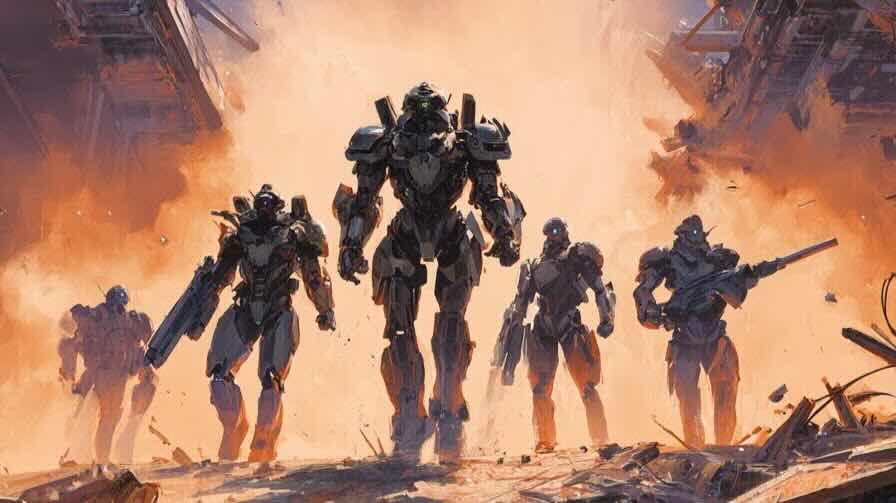
Or: how a question about a 1977 combat results table turned into a tiny game about giant robots.
We wondered how settled the d6 outcomes were in wargames. Strength versus defense, roll a die, look up a table, repeat. Reasonable question. Charles Roberts worked it out in the late fifties, Avalon Hill made it the house style, and by the time Steve Jackson packed Ogre in a sandwich bag in 1977 it was just how you did things. One die, odds ratio, read the column.
Then we started pulling at it, and about a week later there was a game.
Nobody planned that. What happened was that every time we asked why a rule existed, the answer inevitably turned out to be "because the format was cheap" or "because the die only has six faces," and once you know that, you can make different choices. Not better ones necessarily. Different.
Here is the thing nobody tells you about a single six-sided die.
One step of difference on an opposed roll is worth somewhere between eight and seventeen percentage points. The whole usable range is about seven steps. That is your entire vocabulary. Everything you will ever want to say about the difference between a rifle squad and a towering war machine has to fit in seven notches.
So when somebody says "what about cover, add one to defense"? That is a seventh of everything you own, spent on one situational adjustment. Do it three times and a rifle squad and a battlemech start looking like the same unit.
That is why there are no modifiers in this game. Not minimalism. Arithmetic.
A 2d6 game can afford modifiers because the bell curve gives it more room and the tails go flat. There are games out there that stack four or five modifiers while the math holds up. They also contain many more words and pages than Team Bravo: Combined Arms. You pick your die, you pick your consequences.
We wondered whether a modern sabot round from a tank cannon cares about a house being in the way. It does not. It will go through the house and kill what's behind it.
But the crew will not fire a round they cannot aim.
That one observation addressed the whole terrain problem. Cover is not a defensive bonus, it is a sight line, and sight lines are binary — either something is in the way or it is not. No arithmetic, no degrees, no argument about whether that counts as partial. It also means you defeat cover by moving until the line opens, which costs you your shot, which is finally a reason for Movement to matter.
Best rule in the game and it cost nothing, because we deleted something instead of adding it.
Ogre strips treads. Flames of Orion accrues heat. BattleTech fills in dots.
They are all the same mechanic: a number that only goes one way, and the tension is in how fast you let it go. So this one strips Skill — the pilot, not the machine. Get hit and fail to hurt them, and the crew is shaken like a Martini and a little less use than they were. Do it enough and they bail. The machine is still standing there. It is simply not in the battle any more.
Which produced the design's one genuinely surprising result: Skill protects a unit more than armor does. A mech with a good pilot survives twice as long as the same chassis with a newbie. Nobody set out to say that. The numbers said it and we agreed.
Along the way, we got the numbers wrong. At least twice.
First was suppression. We said a rifle squad needed about eight attacks to break a mech. It was five. We had used the raw hit rate as though every hit suppressed, then doubled it for luck. Infantry were nearly twice as dangerous as the document claimed, and the entire "infantry cannot kill armor but can exhaust it" thesis was built on a number that was wrong.
Second was demolition. We said a tank flattened a tenement in about two activations. It was nearly five, and the pioneer squad — whose entire reason for existing was blowing buildings up — could not reliably demolish a building. Their signature capability failed more often than it worked.
Both got fixed. The second one got fixed by removing a die roll: buildings do not dodge. You cannot miss a warehouse. That made every printed number true, gave the pioneers a job, and made the rulebook shorter.
The lesson is not "check your math," which everybody already knows. It is that a game with visible arithmetic invites checking, which is a feature. Nobody audits a points formula. Everybody audits a table.
Somewhere in the middle it became obvious that everything falls into one of three places.
Core rules say how shooting, moving, and dying work. Cards say what a particular thing is. Scenarios say why anyone is here and what winning means.
We did not plan this. It turned up because we kept asking "does this belong in the rules" and the answer kept being no. Facing? Card. Terrain quirks? Card. Whether a tank can drive into a warehouse? Both cards, and they have to agree. Balance? Scenario, every time.
Once you see it, it tells you where to put things you have not written yet, which is most of them.
Other things had to be fixed as we tinkered.
"Buildings admit infantry only" — fine until powered armor turned up. "Only AA can shoot at aircraft" — fine until point defense turned up. "Size means physical scale" — fine until somebody put a fighter wing on the table.
Every one of them named a category instead of stating a criterion. "Infantry only" is a category. "Whatever the card admits" is a criterion. The first is a ruler that measures twelve inches and nothing else. The second measures anything.
If you are going to steal one idea from this document, steal that one.
We ran the thing hundreds of times in abstraction and by hand. It earned its keep — it caught the victory condition rewarding players for shooting the cheapest units, it caught the artillery spotter being exempt from every risk everything else takes, it caught a scenario that mandated the one tactic every real commander works hardest to avoid.
What it never found was the good play.
It never worked out that an AA gun outranged by nothing and outrun by everything should refuse the chase — that being pulled out of position is the loss, not being shot. It never worked out that you could park a tank inside the warehouse and wait for the transport to drive through the door. It fired whenever it had a legal target, because that is what a simulation does.
Real players find those in one evening. They also do things no optimizer would ever do, like charging in blindly, which is most of the fun and none of the math.
A card can quietly exempt a unit from the central trade.
That is how the spotter rule broke. Everything in this game pays for shooting — you fire, you are visible, somebody punishes you. Except artillery, briefly, because the gun was behind a hill and the observer never revealed itself. Free damage, no exposure, and it took three play throughs to notice because nothing about it looked wrong on the page.
Keywords and card text grant or deny. They never adjust. And nothing gets out of paying for the shot.
The one thing we still don't know is whether this game is any good.
The maths is checked. The procedures resolve. Four scenarios have been run and three needed surgery. None of that tells you whether measuring sight lines every activation is satisfying or tedious, whether the blind opening turns are tense or dull, or whether a squad that correctly sits silent for eight turns feels coiled or benched.
That takes two people, a table, and a reason to be reckless. Preferably in a bar, with salt shakers for mechs and pistachio shells for grunts.
Everything above is theory. Go and find out.