Since When Could a Tiger Swim?
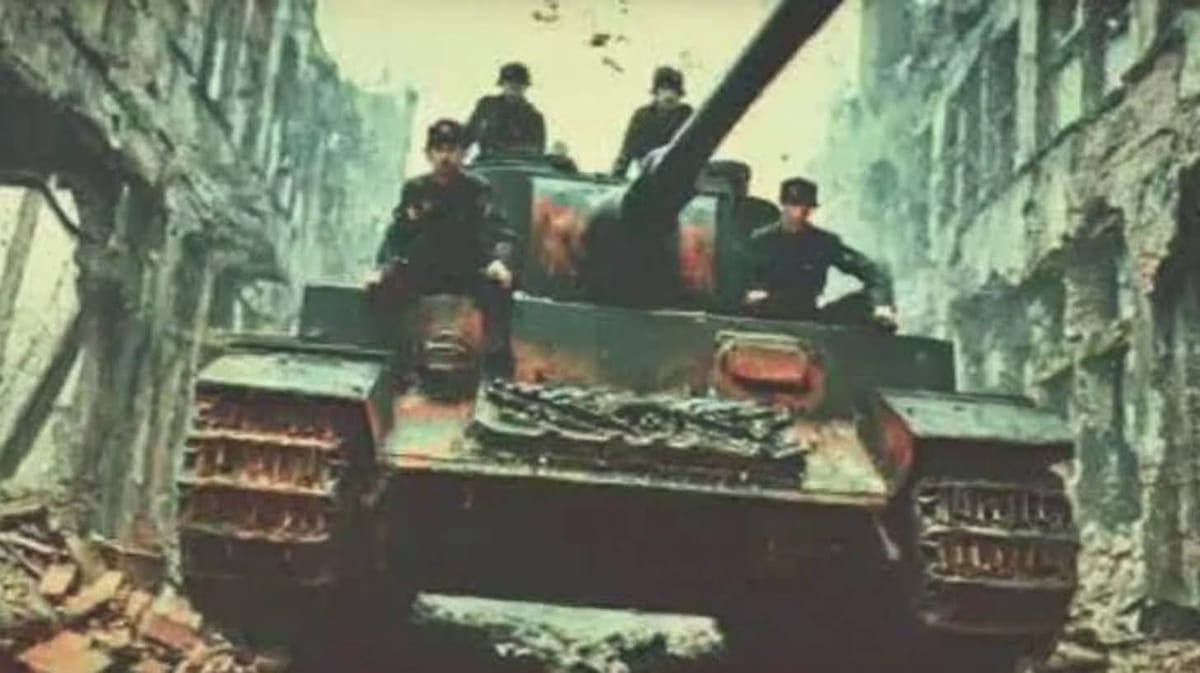
I didn’t start watching Der Tiger expecting it to turn into a meditation on genre mechanics, altered states, and what happens when stories keep running after meaning has quietly exited. I put it on assuming a familiar proposition: a German WWII tank film, competently made, tense, claustrophobic, grim. The kind of movie you already know how to watch. And for most of its runtime, I did exactly that—tracked the crew dynamics, read the tension cues, felt the pressure rise and fall where war films have trained me to feel it. It was only later, after I closed the streaming app and sat with the quiet for a bit (very 2026), that the film began to feel stranger than its surface suggested.
On that surface, Der Tiger is fluent in war-movie language. There’s the paternal commander, the clearly differentiated crew, the familiar talk about orders and obligation, the obligatory land-mine sequence, the sacrificial death that arrives right on schedule. There’s even an underwater tank moment that feels like a knowing nod toward Das Boot, complete with anxious attention to seals, leaks, and whether this battered machine can still hold together under pressure. None of this is played for irony. The film treats these conventions earnestly, almost stubbornly so.
That earnestness turns out to be strategic. These elements act as stabilizers—an interface layer that tells the viewer, “you know how to watch this.” The movie never announces itself as art-house provocation. It lets genre muscle memory do the work. You follow the mission, accept its premises, and read its symbols the way decades of war cinema have taught you to. Which is precisely why it takes a while to notice that something isn’t lining up. The story keeps moving, but the meaning starts to lag.
What began to feel off to me was the structure itself. The supposed mission—pushing deep behind enemy lines to recover a missing officer from a bunker—gradually stops behaving like a literal objective and starts acting more like a narrative solvent, something that dissolves linear time and coherent motivation rather than advancing them. The amphetamines aren’t just period detail here; they’re the mechanism that allows temporal compression, memory flooding, and causal blur. The film’s bookends, centered on a final stand at a bridge about to be destroyed, increasingly feel like the only stable reality. Everything between them starts to read as a speed-fueled rearranging of memory and obligation in the moments before impact.
Certain details quietly support that reading. A crew member killed during a mid-film showdown appears again in the opening and closing scenes, as if death itself hasn’t fully registered in the narrative’s internal accounting. Flashbacks surface without apparent hierarchy... until they do: past atrocities carried out under orders, moments of duty and moments of guilt stacked together without resolution, the telegram from home that topples the Jenga tower. Under chemical acceleration and extreme stress, the mind isn’t integrating experience—it’s shuffling it, one last time, looking for an arrangement that might make the end land cleanly.
Seen this way, the “mission” stops being literal altogether. There is no extraction, no forward arc toward meaning. The crew is simply the last unit holding a bridge, buying time because that’s what they were told to do, even after retreat no longer leads anywhere. The commander’s hesitation—his delay in firing or pulling back—doesn’t need a single motive. It’s doctrine and despair coexisting. Duty and a death wish occupying the same space. The system still issues commands; the body still responds; the future has already vanished.
This is where the genre machinery itself becomes part of the film’s argument. The familiar tropes don’t deliver their usual payoff. The paternal figure doesn’t redeem anything. The sacrificial death doesn’t clarify purpose. Ingenuity doesn’t conquer fate. Even the underwater sequence resists the usual reading of mastery or control. Watching a battle-scarred Tiger somehow remain watertight, the reaction wasn’t triumph so much as disbelief: how is this thing still working? And that question feels intentional. The tank still seals. The engine still runs. Orders still matter. The machinery hasn’t failed—meaning has.
Given the contemporary military filmography it's hard for me to not imagine an American swap. Replace the cast and accents—picture a George Clooney–type commander in place of Brad Pitt—and for a long stretch the film would remain legible as a remix of Fury's claustrophobic tank combat and Three Kings' moral tangle. The break only becomes visible when Der Tiger refuses to complete the transaction those conventions usually promise. There is no reassurance waiting at the end, no moral balancing of the books. The same toolkit is used, but the payoff is withheld.
By the time the film closes, narrative coherence has collapsed into something closer to a memory fog than a resolution. Not a twist so much as an admission. War stories eventually run out before bodies do. When that happens, what’s left isn’t revelation but recognition: this is how it feels when the stories you’ve been using to hold things together finally stop working, while the system itself hasn’t noticed yet.
That was the thought that lingered after I shut the app. Not just about war, or Germany, or tanks, but about structures that persist on momentum alone. About how easily familiar forms can carry us right up to the edge while everything they were meant to support has already slipped away. The discomfort Der Tiger leaves behind isn’t only historical. It’s formal. The machinery of genre, like the machinery of war, keeps running smoothly even after meaning has quietly exited through the back door.