Reflections from the Line
What Coaching a Beginner Handgun Class Teaches You
When you first volunteer as a range coach, it’s tempting to think the job is about shooting. It isn’t.
It’s about watching hands.
Over two recent PST 101 classes, what stayed with me wasn’t tight groups or clean exam runs—though there were plenty of those. It was the small, almost invisible moments where a bad outcome didn’t happen. A trigger finger that drifted a little too early. A muzzle that wandered just enough to merit a quiet correction. A student whose breathing changed right before the press.
Those moments are where the work actually lives.
The First Lesson: Fear Is the Primary Variable
People don’t arrive at a 101 class neutral. They arrive carrying fear—of noise, recoil, legal consequences, embarrassment, loss of control. Some of that fear is rational. Some of it is cultural residue. All of it matters.
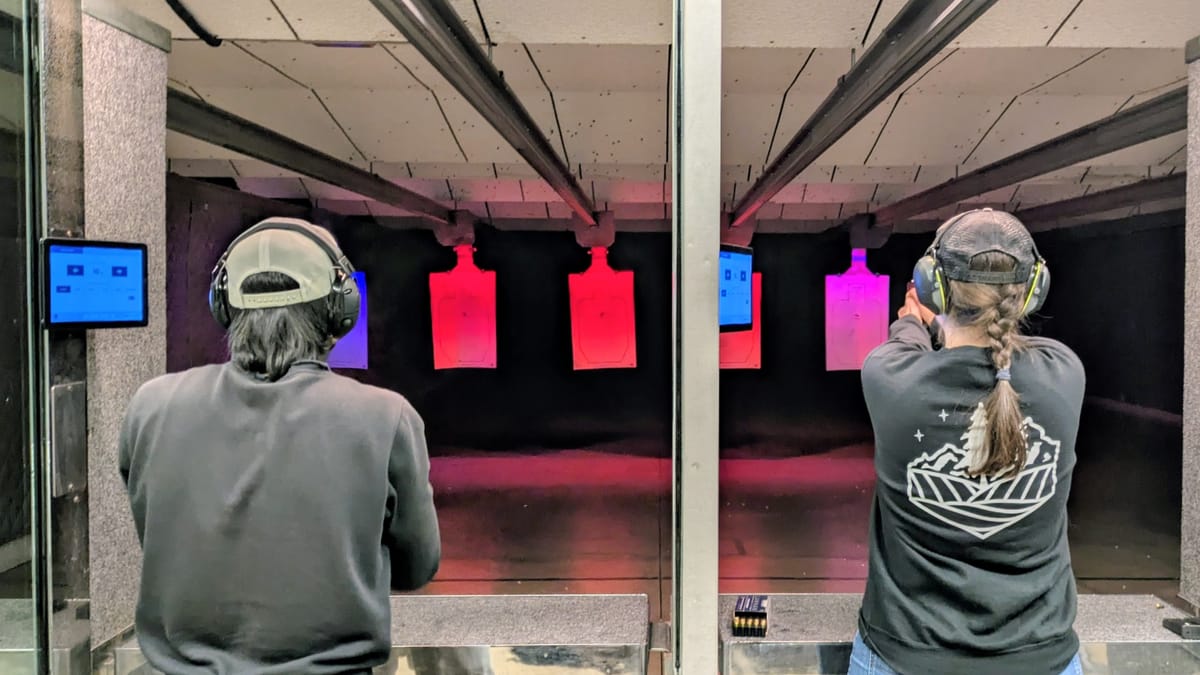
What I saw, twice in a row now, is how effective structured calm can be. Red guns. Slow pacing. Repetition without drama. Clear language. Nothing tactical. Nothing performative.
When fear drops, learning accelerates.
Eight students in the most recent class. Seven achieved “master graduate” performance on the final exam. One of those was a woman who had never touched a firearm before that morning, shooting stock Glock iron sights. That didn’t happen because she became a “shooter.” It happened because the system reduced stress and constrained the problem space until competence could emerge.
That’s pedagogy, not talent.
Negligent Discharge Is the Dominant Failure Mode
In the abstract, people argue endlessly about tactics, calibers, optics, or shot placement theories. In a 101 classroom, none of that matters.
The highest-impact failure mode is a negligent discharge.
Everything else—accuracy, speed, confidence—comes second. Not philosophically, but operationally. An ND ends the class. It injures people. It collapses trust instantly.
Once you internalize that, the curriculum makes perfect sense. Why loading and unloading are drilled so hard. Why muzzle and trigger discipline are corrected instantly and without apology. Why accuracy standards are forgiving compared to safety standards.
Good instruction isn’t about maximizing success. It’s about minimizing catastrophic error.
Modeling Matters More Than Explaining
One of the instructors told us coaches that they have us demonstrate the final exam because we spend the entire day nitpicking everyone else’s fundamentals. Students need to see that the same rules apply to us.
I found that oddly nerve-wracking.
Even after years of training, stepping up cold—no warmup, eyes on you—still triggers adrenaline. But that discomfort is part of the lesson. Students don’t need flawless performance. They need to see careful, boring competence under the same constraints they’re facing.
Authority in this space doesn’t come from swagger. It comes from visible restraint.
Pistols Are Honest to the Point of Cruelty
Watching new shooters reinforces something experienced shooters sometimes forget: handguns magnify everything.
Too much trigger finger. Too little. A wrist that unlocks slightly. Vision issues. Lighting. Fatigue. All of it shows up on paper immediately.
Compare that to a long gun—four points of contact, long sight radius or optic, mass soaking recoil—and you understand why pistols feel unforgiving. The fact that modern ergonomics and training methods can bring a true beginner to consistent center-of-mass hits inside ten yards is both impressive and unsettling.
It’s a reminder of how much engineering and pedagogy are compensating for human inconsistency.
Fatigue Is Telemetry, Not Failure
By the fifth or sixth exam run, you start seeing it: flinches creeping back in, shots pushing low, hesitation on the press. Not because people forgot what to do, but because five hours of noise, recoil, and concentration adds up.
That’s not weakness. That’s system load.
As a coach, you learn to read fatigue the way an engineer reads logs—not judgmentally, but diagnostically. Shooter fatigue reveals limits faster than drills ever will.
Access Is a Form of Privilege
It’s also impossible to ignore who can take a class like this.
A full day. A few hundred dollars once ammo is included. Transportation. Comfort entering a law-enforcement facility. Background checks if you progress beyond 101.
Those filters select for seriousness—but they also select for advantage. Firearms circulate widely. Structured safety training does not.
That tension doesn’t invalidate the work. But it does frame it honestly. The people most able to pursue responsibility are often those already buffered by time, money, and institutional trust.
Why Coaching Feels Worthwhile
What surprised me most is how satisfying prevention is.
The rewarding moments aren’t the targets. They’re the absence of incidents. The quiet corrections that keep something from cascading. The sense that, for a few hours, you helped install a pause—between impulse and action, fear and response.
I’m not interested in being tested in the real world. I don’t want to “use” this skill. I enjoy the focus, the meditative aspects of marksmanship, the discipline of restraint.
And maybe that’s the real lesson I’ve learned as a coach: capability does not require desire.
You can train seriously without craving validation scenarios. You can move competently through this cosm without adopting its loudest identities. You can believe deeply that every bullet has a lawyer attached to it—and that you’ll win every gunfight you don’t get into.
Being present, attentive, and willing to slow things down inside a system that moves people quickly toward capability but unevenly toward judgment still feels like a good way to spend a few weekends a year.
Not heroic. Just careful.