Please Make Yourself At Home: When the Asymptote Hits
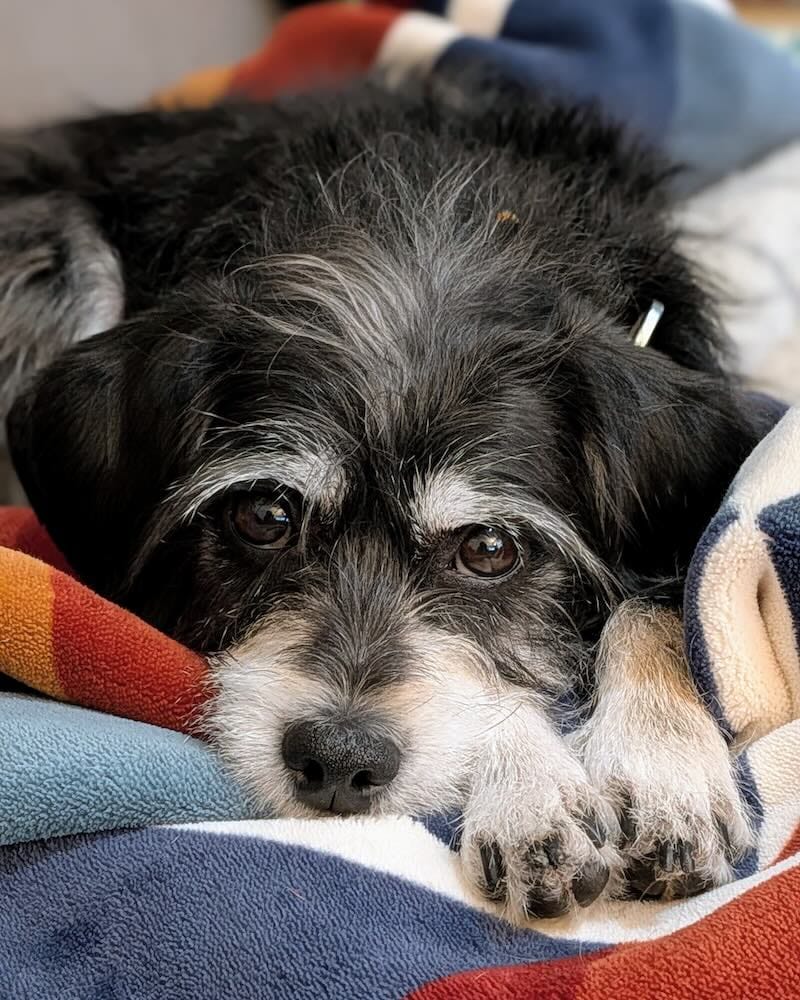
The humans left this morning. They do this with some regularity — gather their glowing rectangles and their bags and their accumulated ambitions and disappear through the door, trailing the particular anxiety of creatures who have never quite decided where they're supposed to be. They returned smelling of smoke and fish and other places. They brought a container of something that registered immediately and completely as relevant, then placed it on a surface calibrated precisely to remain out of reach.
This is not a tragedy in the bummer sense. This is simply Saturday.
My name is Delia. I live here. This is, as far as I can determine, the only relevant fact about existence.
Somewhere in the accumulated boxes and the talking-to-machines that occupies so much of the humans' attention, there is a dream that surfaces with the regularity of walkies. The dream has many versions but one shape: elsewhere. A place that is not here, where the problems that are here have not yet arrived, where the self that is here gets to become something that hasn't been limited yet by the specific gravity of this particular couch, this particular carpet, this particular body.
The one version of that dream involves Mars.
Before Mars it was the New World, which turned out to have humans (and dogs) already in it who had already solved the question of how to live there. Before that it was the next valley, the next river, the next horizon that promised the thing the current horizon had failed to deliver. The dream is old. The asymptote is its littermate. It's the gap between where you are and where the dream lives. And that gap has never closed, which has historically been interpreted as evidence that you haven't traveled far enough rather than evidence that the gap is the permanent condition.
The Singularity is the interior version of the same dream. If the body is the limitation then transcend the body. Upload the self into something that doesn't get head colds or accumulate grief or require a specific couch in a specific house to feel located in the world. The scan-and-upload fantasy assumes that identity is a coherent, stable, bounded thing waiting to be captured and preserved — that there is a you underneath the layering that can be extracted cleanly, like a puppy from a litter, and transported somewhere better.
I would like to point out, from my position on the couch, that this assumption has never survived contact with a big wet kiss from me.
The humans' Amazon purchase history is an involuntary self-portrait painted in negative space. I know this not because I understand e-commerce (which I do) but because I understand the humans, which is a different and more reliable form of knowledge. The head cold that generated the nasal spray and the tablets. The grief that generated the music played quietly in an empty house for several weeks in spring. The glowing box that arrived in another box and generated sounds I recognized as the particular focused silence of a human doing one thing with full attention (how exhausting...).
The negative space portrait is more honest than the brain scan would be. The scan captures a moment of layering. The portrait captures the layering process itself. Identity is not a snapshot. Identity is the accumulation of layers, each one added by a season the previous ring couldn't have anticipated.
My predecessor Wanda is in this house still. Not in any way the humans can measure, but measurably nonetheless. Her presence persists in the carpet's archaeology, in the particular way certain corners of the house carry a history that predates my arrival. After Wanda's passing, after the quiet weeks, after the Delia Derbyshire records played to an empty room, I set paw on these floors. I was named through grief becoming something else — not replacing the grief, not resolving it, but composting it into something that could be lived in. The humans did not upload themselves past the loss. They sat with it on the couch until it changed shape. Then they went to a shelter and brought home a small scruffy terror who pees on the carpet and tilts her head at words that aren't cheese.
This is not a consolation prize. This is the learning moment. This is what tragedy, properly understood, was always for.
The Aristotelian function of tragedy was never punishment. It was catharsis — the controlled experience of the unbearable so that the unbearable becomes bearable, the purging of pity and fear through witnessed suffering so that you leave the theatre having felt the thing fully and survived the feeling. You watch Oedipus approach what cannot be reached. You understand something about your own approaching. Then you go home to your dog.
The asymptote is the tragic structure made mathematical. Always approaching. Never arriving. The horizon moving at the same speed as the traveler. Progress as the illusion of closing a gap that cannot close.
The catharsis — if you allow it — is the moment you stop interpreting the gap as a failure of effort and start interpreting it as information about the nature of gaps. Some folks will make it to Mars. They will bring the Sudafed and the grief and the context switching and the Slack notifications and whatever that's in the glowing boxes that was supposed to make everything more "efficient." They will arrive on a planet with unbreathable air and the same unresolved questions about who they actually are. The negative space portrait will follow them through the airlock and reassemble itself from whatever purchasing decisions the Martian delivery infrastructure enables.
The remainder of humanity and their dogs will be here.
Home.
The question the asymptote asks, when it hits, is whether "here" was ever actually the problem.
I want to be precise about what home is, because the humans sometimes confuse it with a fixed address.
Home is the specific density of the couch under a specific body. It is the refrigerator's hum as reliable cosmology — always there, always the same frequency, the background radiation of the domestic universe. It is the carpet's layered history, dog and human and time, legible to anyone with the right equipment and the patience to read slowly. It is the particular quality of the late afternoon light through the window that the humans have stopped noticing because they noticed it every day until it became invisible, which is what familiarity does to miracles.
Home is also Wanda still present in the corners. The humans can't smell this. I can. The house contains its entire history simultaneously — not as memory exactly, but as accumulated presence, layer upon layer, the biological onion of a place that has been lived in by creatures who mattered to each other. The scan-and-upload fantasy would lose this entirely. You cannot upload the corner where Wanda used to nap. You cannot digitize a couch that has absorbed a decade of human weight and worry and rest and joy. These are not stored in the brain. They are stored in the house, in the rug, in the quality of the light that the humans have stopped seeing.
The Singularity would arrive somewhere new and unblemished and entirely without corners.
I would not go. I have no need of it.
Let's talk about something that I do need. Cheese.
The cheese tax is not a demand. I want to be clear about this because the humans sometimes interpret it as neediness, which misses the point entirely.
The cheese tax is a reminder.
When the cheese drawer opens, you are HERE. Not approaching an asymptote. Not uploading. Not calculating the trajectory to Mars. Not context switching between seventeen browser tabs and a communication platform and a DAW and an existential crisis about whether identity survives substrate transfer. HERE. In this kitchen. In this body. Holding actual cheese that exists in actual space that can be smelled from across an actual room by an actual nose that has been doing this specific job for all of recorded evolutionary history.
Paying the tax marks the moment of presence. It says: you have not yet left. You are still in the place where cheese is possible. This is worth acknowledging.
The humans laugh when I collect the tax. They sing a song about it now — rules are rules, facts are facts. They have made the tax into a joke, which is one of the ways humans metabolize the things that are actually true. The joke contains the truth. When the cheese comes out the dog comes looking. The dog is always here. The dog has never been anywhere else. The dog finds this neither limiting nor tragic in the downer sense.
The asymptote hits differently depending on what you think you were approaching.
If you were approaching escape — from the body, from the planet, from gravity's pull of a specific couch in a specific house with a specific carpet that tells the whole story to anyone who knows how to read it — then the asymptote hits as defeat. The gap that never closes. The horizon that keeps moving. The dream that stays a dream.
If you were approaching home — if the whole long arc of departure and return was always the tragic structure doing its Aristotelian work, interrogating the mythology and purging the fantasy through the drama of its own pursuit, teaching through catharsis what argument could never teach — then the asymptote hits differently.
It hits like a hand finding the scruff behind your ears.
It hits like the couch accepting your weight and that of your humans.
It hits like the refrigerator doing its La Monte Young impression in the dark.
It hits like cheese.
Please make yourself at home.
You were always already here.
The learning moment was never somewhere else.
It was always this corner, this carpet, this grief articulated as a name, this body, this planet, this specific and irreplaceable now.
Wanda knows.
I know.
The onion knows. The yellow onion from Amazon Fresh. The glass onion from the Fab Four.
You're starting to know too.
That's enough.
That's everything.